
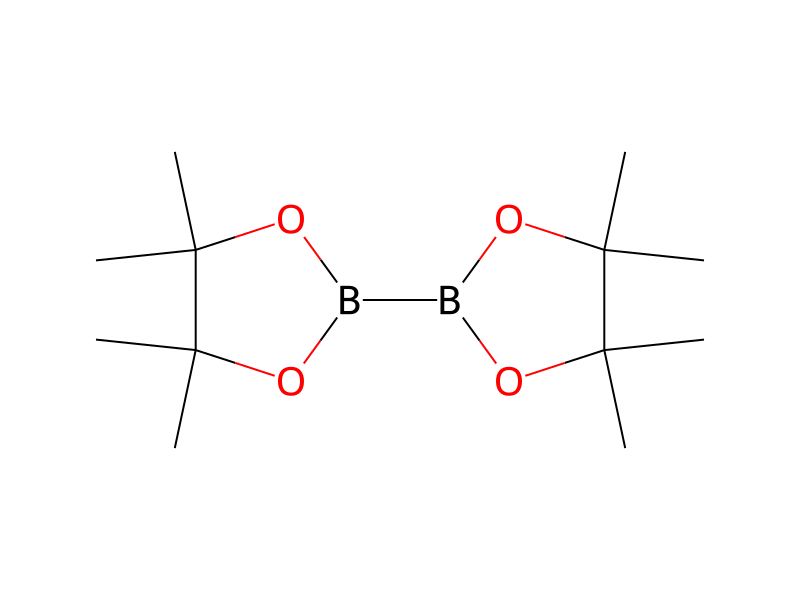
Basic information
- Standard SMILES
CC1(C)OB(B2OC(C)(C)C(C)(C)O2)OC1(C)C- InChIKey
IPWKHHSGDUIRAH-UHFFFAOYSA-N- Molecular formula
- C12H24B2O4
- Average molar mass
- 253.9 g/mol
- Monoisotopic mass
- 254.18607005
Overview
Bis(pinacolato)diboron is a 1,3,2-dioxaborolane that is 4,4,5,5-tetramethyl-1,3,2-dioxaborolane in which the boron hydrogen at position 2 is replaced by a 4,4,5,5-tetramethyl-1,3,2-dioxaborolan-2-yl group. It is a reagent used in organic synthesis to synthesise pinacol boronic esters. It has a role as an EC 3.4.24.24 (gelatinase A) inhibitor.
Names & identifiers
- Preferred name
- Bis(pinacolato)diborane
- IUPAC
- 4,4,5,5-tetramethyl-2-(4,4,5,5-tetramethyl-1,3,2-dioxaborolan-2-yl)-1,3,2-dioxaborolane
- English name
- Bis(pinacolato)diboron
- Molecular formula
- C12H24B2O4
- Molecular weight
- 253.94
Names & synonyms
Bis(pinacolato)diboron73183-34-3bis(pinacolato)diboraneDipinacoldiboronPinacol diboraneB2Pin2Diboron pinacol ester4,4,4',4',5,5,5',5'-Octamethyl-2,2'-bi-1,3,2-dioxaborolaneMiyaura's reagent2,2'-Bi-1,3,2-dioxaborolane, 4,4,4',4',5,5,5',5'-octamethyl-I906W26P4UCHEBI:183312
Show more names
BPINPin2B2(BPin)2B2Pin4,4,5,5-tetramethyl-2-(tetramethyl-1,3,2-dioxaborolan-2-yl)-1,3,2-dioxaborolaneBis(pinacolate)diboron
DTXSID30369935RefChem:569258B(P)DBDTXCID40320971615-925-04,4,4',4',5,5,5',5'-Octamethyl-2,2'-bi(1,3,2-dioxaborolane)4,4,5,5-tetramethyl-2-(4,4,5,5-tetramethyl-1,3,2-dioxaborolan-2-yl)-1,3,2-dioxaborolaneMFCD00799570
Database identifiers
- CAS
73183-34-3- PubChem CID
- 2733548
- DTXSID
DTXSID30369935- ChEBI
CHEBI:183312- UNII
- I906W26P4U
- EC Number
- 615-925-0
- Nikkaji
- J698.829F
Properties
Computed structural properties
- Topological polar surface area
- 36.9 Ų
- Hydrogen bond donors
- 0
- Hydrogen bond acceptors
- 4
- Rotatable bonds
- 1
- Heavy atoms
- 18
- Formal charge
- 0
- Complexity
- 286
Experimental & physicochemical properties
Chemical ClassesMetals -> Metalloid Compounds (Boron)
Physical DescriptionColorless solid; [Merck Index]
Physicochemical properties
- Melting point
- 137 · 137-140 °C(lit.)
- Boiling point
- 222.6 · 222.6±7.0 °C(Predicted)
- Density
- 0.98 · 0.98
- storage temp.
- Keep in dark place,Sealed in dry,Room Temperature
- solubility
- Chloroform (Slightly), Methanol (Slightly)
- form
- Powder or Platelets
- color
- White
- Water Solubility
- Soluble in tetrahydrofuran, dichloromethane, toluene, hexane and heptane. Insoluble in water.
- Sensitive
- moisture sensitive
- Merck
- 14 · 14,1300
- BRN
- 7703552 · 7703552
- InChI
- InChI=1S/C12H24B2O4/c1-9(2)10(3,4)16-13(15-9)14-17-11(5,6)12(7,8)18-14/h1-8H3
- InChIKey
- IPWKHHSGDUIRAH-UHFFFAOYSA-N
- SMILES
- O1C(C)(C)C(C)(C)OB1B1OC(C)(C)C(C)(C)O1
- CAS DataBase Reference
- 73183 · 73183-34-3(CAS DataBase Reference)
- FDA UNII
- 906 W26P4U · I906W26P4U
- UNSPSC Code
- 12352103 · 12352103
- NACRES
- 22 · NA.22
- Symbol(GHS)
- 7 · GHS07
- Signal word
- Warning
- Hazard statements
- 335 · H335-H302+H312+H332-H315-H319
- Precautionary statements
- 280 a-P304+P340-P305+P351+P338-P405-P501a-P261-P264-P270-P271-P280-P301+P312+P330-P302+P352+P312+P362+P364-P304+P340+P312-P305+P351+P338+P337+P313-P501 · P280a-P304+P340-P305+P351+P338-P405-P501a-P261-P264-P270-P271-P280-P301+P312+P330-P302+P352+P312+P362+P364-P304+P340+P312-P305+P351+P338+P337+P313-P501
- PPE
- 95 · Eyeshields, Gloves, type N95 (US)
- Hazard Codes
- Xi,Xn
- Risk Statements
- 36 · 36/37/38-20/21/22
- Safety Statements
- 26 · 26-37/39-36-24/25
- WGK Germany
- 3 · 3
- Hazard Note
- Irritant
- TSCA
- No
- HazardClass
- IRRITANT, IRRITANT-HARMFUL, KEEP COLD
- HS Code
- 29349990 · 29349990
- Storage Class
- 11 · 11 - Combustible Solids
- REACH Registrations
- Active
Safety & regulation
GHS classification
GHS Classification
This chemical does not meet GHS hazard criteria for 67.3% (107 of 159) of all reports.
Danger
H302 (14.5%): Harmful if swallowed [Warning Acute toxicity, oral]
P260, P261, P264, P264+P265, P270, P271, P272, P280, P301+P317, P301+P330+P331, P302+P352, P302+P361+P354, P304+P340, P305+P351+P338, P305+P354+P338, P316, P317, P319, P321, P330, P332+P317, P333+P317, P337+P317, P362+P364, P363, P403+P233, P405, and P501 (click each P-code to see the statement)
Aggregated GHS information provided per 159 reports by companies from 17 notifications to the ECHA C&L Inventory. Each notification may be associated with multiple companies.
Hazard information
Regulatory InformationStatus: Active Update: 20-01-2022 https://echa.europa.eu/registration-dossier/-/registered-dossier/10449
Hazards SummaryA skin and strong eye irritant; [Alfa Aesar MSDS]
Hazard Classes and CategoriesAcute Tox. 4 (14.5%)
Safety data
- PPE
- Eyeshields, Gloves, type N95 (US)
- wgk
- 3
- tsca
- No
- hs_code
- 29349990
- risk_code
- 36/37/38-20/21/22
- Signal word
- Warning
- Symbol(GHS)
- GHS07
- hazard_code
- Xi,Xn
- hazard_note
- Irritant
- safety_code
- 26-37/39-36-24/25
- hazard_class
- IRRITANT, IRRITANT-HARMFUL, KEEP COLD
- Storage Class
- 11 - Combustible Solids
- Hazard statements
- H335-H302+H312+H332-H315-H319
- REACH Registrations
- Active
- Precautionary statements
- P280a-P304+P340-P305+P351+P338-P405-P501a-P261-P264-P270-P271-P280-P301+P312+P330-P302+P352+P312+P362+P364-P304+P340+P312-P305+P351+P338+P337+P313-P501
Chemistry & industry
Uses & manufacturing
UsesUsed as a boron source in organic syntheses; [Merck Index]
Applications
UsesIt is a colourless solid that is soluble in organic solvents. It is a commercially available reagent for making pinacol boronic esters for organic synthesis. Unlike some other diboron compounds, B2pin2 is not moisture-sensitive and can be handled in air.
UsesAs a boron source in Pt-mediated diborations, coupling reactions; in Rh-or Ir-mediated borylations of alkanes and arenes, and in carbenoid chemistry.
Usessuzuki reaction
UsesBis(pinacolato)diboron is used as a condensation agent in the preparation poly(arylene)s. Bis(pinacolato)diboron is an organoboranate with potential use as matrix metallo-proteinase (MMP-2) inhibitor.
General DescriptionBis(pinacolato)diboron or (B2pin2) is the most commonly used diborane reagent in organic synthesis due to its high stability in air and moisture. It can be synthesized by treating tetrakis(dimethylamino)diboron with pinacol in acidic conditions.
Preparation methods
PreparationBis(pinacolato)diboron may be prepared by reacting tetrakis(dimethylamino)diboron with pinacol in acidic conditions. The B-B bond length is 1.711(6) Å. The B-B bond adds across alkenes and alkynes to give the 1,2-diborylated alkanes and alkenes. Using various organorhodium or organoiridium catalysts, it can also be installed onto saturated hydrocarbons: CH3(CH2)6CH3 + [pinB]2 → pinBH + CH3(CH2)7Bpin These reactions proceed via boryl complexes.
Upstream & downstream products
Upstream raw materials
Downstream products
Suppliers50 total
国药集团化学试剂有限公司86-21-63210123 · [email protected]
梯希爱(上海)化成工业发展有限公司021-67121386 · [email protected]
上海阿拉丁生化科技股份有限公司400-6206333 13167063860 · [email protected]
杭州品高化工有限公司0571-87658025 · [email protected]
INTATRADE GmbH+49 3493/605464 · [email protected]
T&W GROUP021-61551611 13296011611 · [email protected]
爱斯特(成都)生物制药股份有限公司+86-28-85122536 85324413 · [email protected]
上海斐珑化学品有限公司021-68735616 · [email protected]
韶远科技(上海)有限公司021-50795510 4000665055 · [email protected]
科瑞迪化学400-821-5857 021-64326257 · [email protected]
上海欧堃化学有限公司(QQ 39130253)021-68712331 39130253 · [email protected]
上海迈瑞尔生化科技有限公司4006356688 18621169109 · [email protected]
宇瑞(上海)化学有限公司02150456736 18602143071 · [email protected]
宁波亿诺化学品有限公司86-574-27787657 · [email protected]
阿法埃莎(中国)化学有限公司400-6106006 · [email protected]
石家庄斯迪亚诺精细化工有限公司0311-89250318 13582355795 · [email protected]
武汉凯威斯科技有限公司86-027-67849912 · [email protected]
上海柏卡化学技术有限公司400-026-1533/(021) 6478-0600 · [email protected]
上海恩诺生物科技有限公司+86 (21) 6435-5022
上海瀚鸿科技股份有限公司021-54306202 13764082696 · [email protected]
常州市淇奥化工有限公司0519-85607258
China Kouting Group Limited+86 (21) 5811-6473 5811-6475 · [email protected]
上海景颜化工科技有限公司13817811078 · [email protected]
嘉兴市艾森化工有限公司0573-85285100 18627885956 · [email protected]
Pure Chemistry Scientific Inc.001-857-928-2050 or 1-888-588-9418 · [email protected]
上海隆盛化工有限公司58099637 13585536065 · [email protected]
上海攀鸿化工科技有限公司021-56491756 13512199871 · [email protected]
武汉丰泰威远科技有限公司027-87465837 19945049750 · [email protected]
杭州东帆化学有限公司86-0571-85151182
孝感深远化工有限公司15527621225; 15527621225 · [email protected]
苏州施亚生物科技有限公司86(512)5235 8471 17715136450 · [email protected]
玛雅试剂+86 (573) 82222445 (0)18006601000 452520369 · [email protected]
四川库利南科技有限公司400-1166-196 18981987031 · [email protected]
天津希恩思生化科技有限公司400 638 7771 · [email protected]
上海楷石化工有限公司021-50273253 13641951838 · [email protected]
湖南汇百侍生物科技有限公司0731-85526065 13308475853 · [email protected]
南京维奥化工有限公司Please Send Email 18652950785 · [email protected]
上海乔木化学科技有限公司021-60451683 15021268886 · [email protected]
百盛HK进出口有限公司+86-18068513926
河南多贝化工有限公司0370-2785118 17550508557 · [email protected]
艾科试剂4008-755-333 18080918076 · [email protected]
深圳法默科技有限公司0755-86648230 · [email protected]
天津科创医药中间体技术生产力促进有限公司022-60116533 13207668525 · [email protected]
上海思域化工科技有限公司86-21-34053660 · [email protected]
苏州思变化学技术有限公司0512-65617459 18915409046 · [email protected]
赛默飞世尔科技(中国)有限公司800-810-5118 · [email protected]
北京伊诺凯科技有限公司400-810-7969 010-59572699 · [email protected]
南京诺利斯医药科技有限公司13901585132 · [email protected]
江苏艾康生物医药研发有限公司025-66113011 13913916777 · [email protected]
上海健超生物科技有限公司150-2103-5486 18017383231 · [email protected]
Additional notes
DefinitionBis(pinacolato)diboron is a covalent compound containing two boron atoms and two pinacolato ligands. It has the formula [(CH3)4C2O2B]2; the pinacol groups are sometimes abbreviated as "pin", so the structure is sometimes represented as B2pin2.
DefinitionChEBI: Bis(pinacolato)diboron is a 1,3,2-dioxaborolane that is 4,4,5,5-tetramethyl-1,3,2-dioxaborolane in which the boron hydrogen at position 2 is replaced by a 4,4,5,5-tetramethyl-1,3,2-dioxaborolan-2-yl group. It is a reagent used in organic synthesis to synthesise pinacol boronic esters. It has a role as an EC 3.4.24.24 (gelatinase A) inhibitor.
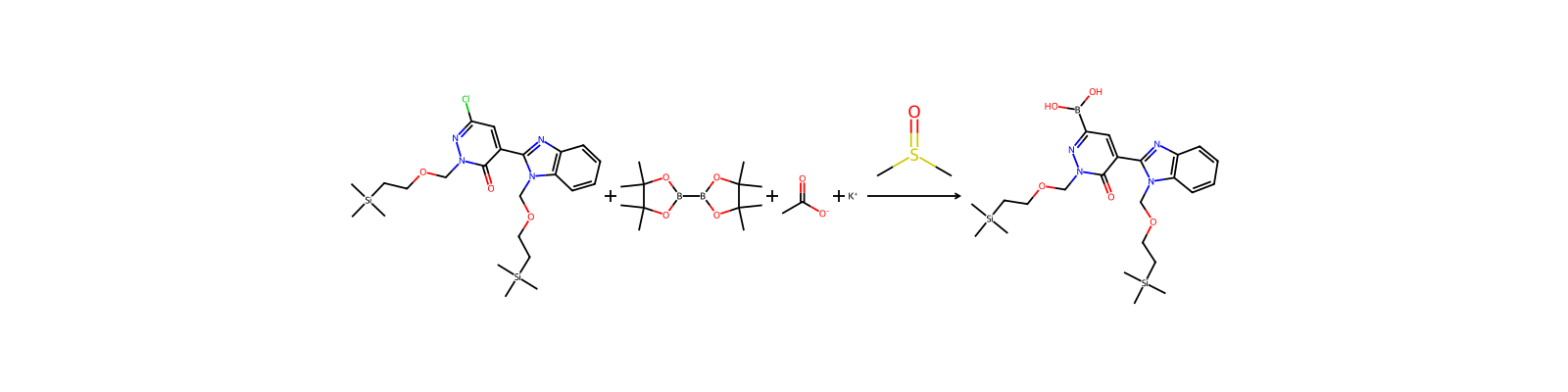
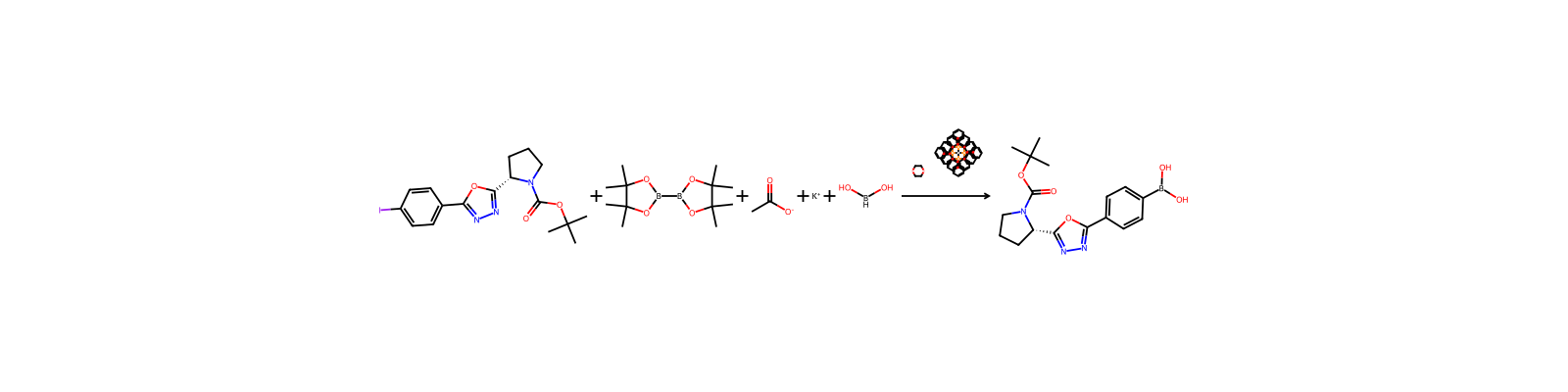
Related reactions
2,619 records





Linked notes
Loading…