HuagongsheHuagongshe Chemistry Print Report · For research reference only
HCID 2736498Generated: October 29, 2026
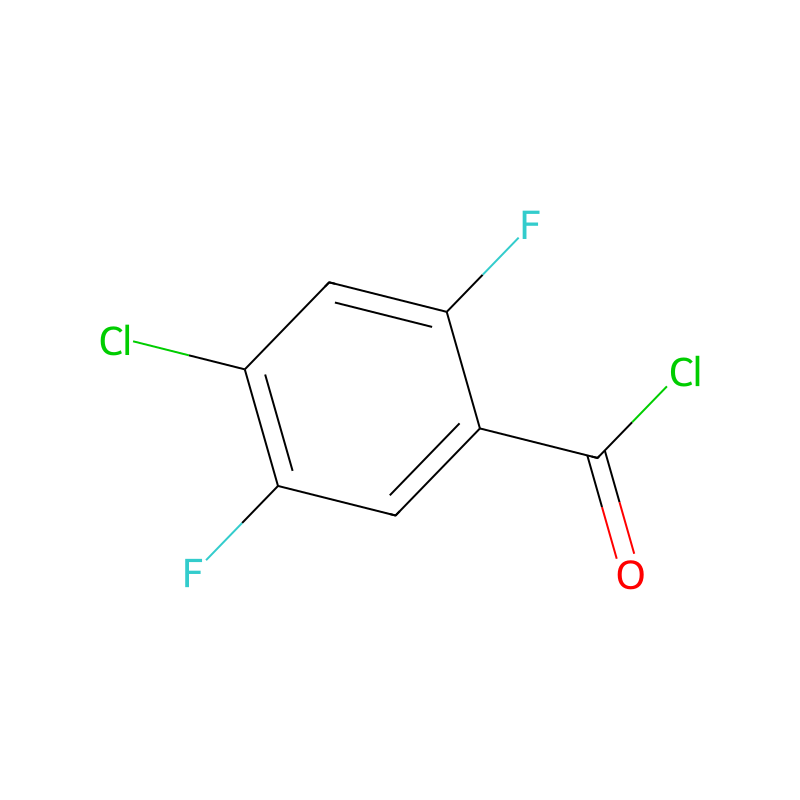
4-Chloro-2,5-difluorobenzoyl chloride
SKL1248 · 4-Chloro-2,5-difluorobenzoyl chloride · 4-Chloro-2,5-difluorobenzoylchloride97% · Benzoyl chloride, 4-chloro-2,5-difluoro- · 4-Chloro-2,5-difluorobenzoyl chloride 97% · Benzoyl chloride, 4-chloro-2,5-difluoro- (9CI)
https://huagongshe.com/en/chemical/2736498
Identifiers & Physical Properties
| CAS No. | 132794-08-2 |
|---|
| Molecular formula | C7H2Cl2F2O |
|---|
| Average molar mass | 210.99 g/mol |
|---|
| Monoisotopic mass | 209.9450764 g/mol |
|---|
| SMILES | O=C(Cl)c1cc(F)c(Cl)cc1F |
|---|
| InChIKey | DFLRZGOHFNFBQS-UHFFFAOYSA-N |
|---|
| PubChem CID | 2736498 |
|---|
| EC No. | 670-555-7 |
|---|
| DTXSID | DTXSID00371404 |
|---|
Chemical & Physical Properties
| XLogP | 3.3 |
|---|
| Topological polar surface area | 17.1 |
|---|
| Hydrogen bond donors | 0 |
|---|
| Hydrogen bond acceptors | 3 |
|---|
| Rotatable bonds | 1 |
|---|
| Heavy atoms | 12 |
|---|
| Formal charge | 0 |
|---|
| Complexity | 188 |
|---|
| Boiling point | 210.5±35.0 °C(Predicted) |
|---|
| Density | 1.548±0.06 g/cm3(Predicted) |
|---|
| Physical state | liquid |
|---|
| Color | Clear, colourless |
|---|
| CAS DataBase Reference | 132794-08-2(CAS DataBase Reference) |
|---|
| GHS pictogram | GHS05,GHS07 |
|---|
| Signal word | Danger |
|---|
| GHS hazard statements | H302+H312+H332-H314 |
|---|
| GHS precautionary statements | P260-P280-P308+P313 |
|---|
| Hazard symbols | C,Xi |
|---|
| Risk statements (R) | 34-36/37/38 |
|---|
| Safety statements (S) | 26-36/37/39-45 |
|---|
| UN transport number | 3265 |
|---|
| Hazard Note | Corrosive |
|---|
| Hazard class | IRRITANT, CORROSIVE |
|---|
| Customs code | 2916399090 |
|---|
Safety & Regulations
| GHS classification | DangerH302 (100%): Harmful if swallowed [Warning Acute toxicity, oral]H312 (100%): Harmful in contact with skin [Warning Acute toxicity, dermal]H314 (100%): Causes severe skin burns and eye damage [Danger Skin corrosion/irritation]H319 (100%): Causes serious eye irritation [Warning Serious eye damage/eye irritation]H332 (100%): Harmful if inhaled [Warning Acute toxicity, inhalation]H335 (100%): May cause respiratory irritation [Warning Specific target organ toxicity, single exposureRespiratory tract irritation]P260, P261, P264, P264+P265, P270, P271, P280, P301+P317, P301+P330+P331, P302+P352, P302+P361+P354, P304+P340, P305+P351+P338, P305+P354+P338, P316, P317, P319, P321, P330, P337+P317, P362+P364, P363, P403+P233, P405, and P501 (click each P-code to see the statement)The GHS information provided by 1 company from 1 notification to the ECHA C&L Inventory. |
|---|
| Hazard Classes and Categories | Acute Tox. 4 (100%)Skin Corr. 1B (100%)Eye Irrit. 2 (100%)STOT SE 3 (100%) |
|---|
| UN transport number | 3265 |
|---|
| Customs code | 2916399090 |
|---|
| Risk statements (R) | 34-36/37/38 |
|---|
| Signal word | Danger |
|---|
| GHS pictogram | GHS05,GHS07 |
|---|
| Hazard symbols | C,Xi |
|---|
| hazard_note | Corrosive |
|---|
| Safety statements (S) | 26-36/37/39-45 |
|---|
| Hazard class | IRRITANT, CORROSIVE |
|---|
| GHS hazard statements | H302+H312+H332-H314 |
|---|
| GHS precautionary statements | P260-P280-P308+P313 |
|---|