
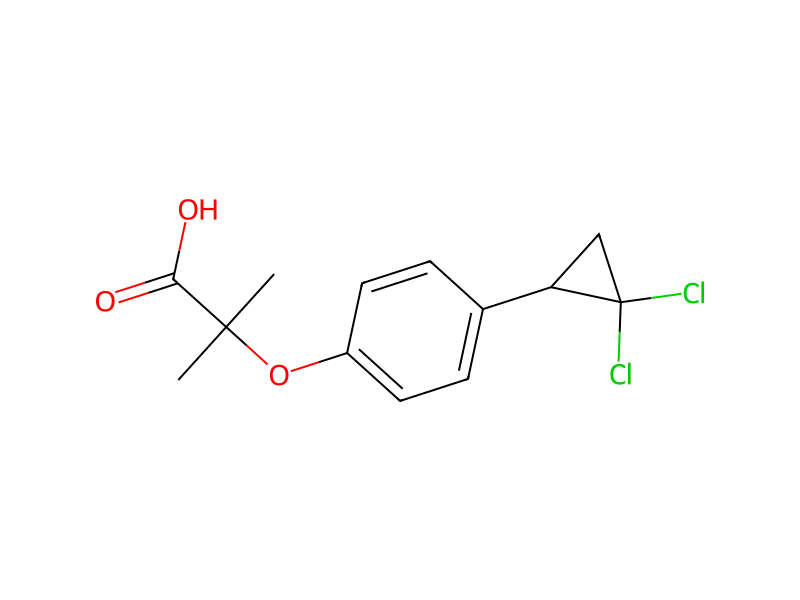
Basic information
- Standard SMILES
CC(C)(Oc1ccc(C2CC2(Cl)Cl)cc1)C(=O)O- InChIKey
KPSRODZRAIWAKH-UHFFFAOYSA-N- Molecular formula
- C13H14Cl2O3
- Average molar mass
- 289.15 g/mol
- Monoisotopic mass
- 288.03199967
Overview
Ciprofibrate is a monocarboxylic acid, an organochlorine compound and a member of cyclopropanes. It has a role as an antilipemic drug.
Names & identifiers
- Preferred name
- Ciprofibrate
- IUPAC
- 2-[4-(2,2-dichlorocyclopropyl)phenoxy]-2-methylpropanoic acid
- English name
- Ciprofibrate
- Molecular formula
- C13H14Cl2O3
- Molecular weight
- 289.15
Names & synonyms
Ciprofibrate52214-84-32-(4-(2,2-dichlorocyclopropyl)phenoxy)-2-methylpropanoic acid2-[4-(2,2-Dichlorocyclopropyl)phenoxy]-2-methylpropanoic acidCiprofibratumCiprofibratoModalimWin-35833WIN 35833DTXSID8020331Propanoic acid, 2-[4-(2,2-dichlorocyclopropyl)phenoxy]-2-methyl-NSC-759617
Show more names
CiprobrateCiprofibric acidCipmlCiprolLipanorCiprofibrate >Ciprofibrate CRS
F8252JGO9S2-(p-(2,2-Dichlorocyclopropyl)phenoxy)-2-methylpropionic acidPropanoic acid, 2-(4-(2,2-dichlorocyclopropyl)phenoxy)-2-methyl-DTXCID20331CHEBI:50867Hyperlipen2-[p-(2,2-dichlorocyclopropyl)phenoxy]-2-methylpropionic acidRefChem:577246
Database identifiers
- CAS
52214-84-3- PubChem CID
- 2763
- DTXSID
DTXSID8020331- ChEMBL
CHEMBL557555- ChEBI
CHEBI:50867- UNII
- F8252JGO9S
- EC Number
- 257-744-6
- Nikkaji
- J10.383G
Properties
Computed structural properties
- XLogP
- 3.4
- Topological polar surface area
- 46.5 Ų
- Hydrogen bond donors
- 1
- Hydrogen bond acceptors
- 3
- Rotatable bonds
- 4
- Heavy atoms
- 18
- Formal charge
- 0
- Complexity
- 333
Experimental & physicochemical properties
Endocrine DisruptorsPotential endocrine disrupting compound
Collision Cross Section171.9 Ų [M-H]- [CCS Type: DT; Buffer gas: N2; Ionization: ESI-; Dataset: TOXCAST; Source Identifier: DTXSID8020331]
Physicochemical properties
- Melting point
- 114 · 114-116°
- Boiling point
- 401.74 °C · 401.74°C (rough estimate)
- Density
- 1.2576 · 1.2576 (rough estimate)
- refractive index
- 1.5209 · 1.5209 (estimate)
- storage temp.
- 2 · 2-8°C
- solubility
- Practically insoluble in water, freely soluble in anhydrous ethanol, soluble in toluene.
- pka
- 3.31 · 3.31±0.10(Predicted)
- form
- Solid
- color
- White to Pale Beige
- Merck
- 14 · 14,2313
- Major Application
- pharmaceuticalpharmaceutical small molecule
- InChI
- InChI=1S/C13H14Cl2O3/c1-12(2,11(16)17)18-9-5-3-8(4-6-9)10-7-13(10,14)15/h3-6,10H,7H2,1-2H3,(H,16,17)
- InChIKey
- KPSRODZRAIWAKH-UHFFFAOYSA-N
- SMILES
- C(O)(=O)C(OC1=CC=C(C2CC2(Cl)Cl)C=C1)(C)C
- CAS DataBase Reference
- 52214 · 52214-84-3(CAS DataBase Reference)
- FDA UNII
- 8252 JGO9S · F8252JGO9S
- ATC code
- 10 AB08 · C10AB08
- EPA Substance Registry System
- 2 · Propanoic acid, 2-[4-(2,2-dichlorocyclopropyl)phenoxy]-2-methyl- (52214-84-3)
- UNSPSC Code
- 41116107 · 41116107
- NACRES
- 77 · NA.77
- Protein binding
- 95 · 95-99%
- Excreted unchanged in urine
- 20 · 20-25%
- Volume of distribution
- 12 Litres · 12 Litres
- Biological half-life
- 38 · 38-86 / 171.9
- Symbol(GHS)
- 8 · GHS08
- Signal word
- Danger
- Hazard statements
- 350 · H350
- Precautionary statements
- 201 · P201-P308+P313
- Hazard Codes
- T
- Risk Statements
- 45 · 45
- Safety Statements
- 53 · 53-22-36/37/39-45
- WGK Germany
- 3 · 3
- RTECS
- 880000 · UF0880000
- HS Code
- 29189900 · 29189900
- Storage Class
- 6.1 C · 6.1C - Combustible acute toxic Cat.3toxic compounds or compounds which causing chronic effects
- Hazard Classifications
- 1 B · Carc. 1B
Safety & regulation
GHS classification
GHS Classification
Danger
H350 (95%): May cause cancer [Danger Carcinogenicity]
P203, P280, P318, P405, and P501 (click each P-code to see the statement)
Aggregated GHS information provided per 40 reports by companies from 3 notifications to the ECHA C&L Inventory.
Hazard information
Hazard Classes and CategoriesCarc. 1B (95%)
Toxicology
Drug Induced Liver Injury
Drug-Induced Liver Injury Severity and Toxicity (DILIst)
ciprofibrate
DILI Positive
DOI:10.1016/j.drudis.2019.09.022
Safety data
- wgk
- 3
- rtecs
- UF0880000
- hs_code
- 29189900
- risk_code
- 45
- Signal word
- Danger
- Symbol(GHS)
- GHS08
- hazard_code
- T
- safety_code
- 53-22-36/37/39-45
- Storage Class
- 6.1C - Combustible acute toxic Cat.3toxic compounds or compounds which causing chronic effects
- Hazard statements
- H350
- Hazard Classifications
- Carc. 1B
- Precautionary statements
- P201-P308+P313
Chemistry & industry
Pharmacology
ATC Code
C10AB08
C - Cardiovascular system
QC - Cardiovascular system
MeSH Pharmacological Classification
Substances that lower the levels of certain LIPIDS in the BLOOD. They are used to treat HYPERLIPIDEMIAS.
A class of nongenotoxic CARCINOGENS that induce the production of hepatic PEROXISOMES and induce hepatic neoplasms after long-term administration.
Applications
DescriptionCiprofibrate is a potent, long-acting hypolipidemic agent related to clofibrate, bezafibrate and fenofibrate. It is effective in types IIa, IIb, IIX and IV hyperlipoproteinemias, and produces a beneficial elevation of the anti-atherogenic HDL.
DescriptionCiprofibrate is an agonist of peroxisome proliferator-activated receptor α (PPARα; EC50 = 0.9 μM in a transactivation assay). It is selective for PPARα over PPARγ and PPARδ at 300 μM. Ciprofibrate (250 μM) induces cell cycle arrest at the G2/M and S phases in Fao rat, but not HepG2 human, hepatocellular carcinoma cells. It decreases fasting plasma levels of triglycerides and increases fasting plasma glucose levels in the apolipoprotein CIII transgenic mouse model of hypertriglyceridemia when administered at a dose of 10 mg/kg. Formulations containing ciprofibrate have been used in the treatment of hypertriglyceridemia.
UsesPeroxisome proliferator-activated receptor α (PPARα) is a ligand-activated transcription factor involved in the regulation of lipid homeostasis. Activation of PPARα results in expression of a variety of genes, particularly those involved in fatty acid β-oxidation, binding, and transport. Ciprofibrate activates PPARα with an EC50 value of 20 μM and only marginally affects PPARγ (EC50 = >300 μM). It has been shown to lower adipose tissue weight and reduce plasma insulin concentrations in obese rats and has been used clinically in the treatment of dyslipidemia. Ciprofibrate reportedly stimulates cholesteryl ester transfer protein expression and improves the flow of cholesterol through the indirect reverse cholesterol transport system, preserving plasma HDL.
Usesantihyperlipidemic
UsesCiprofibrate is a hypolipemic agent, related structurally to Clofibrate (C586910). Ciprofibrate is used as an antilipemic.
Upstream & downstream products
Upstream raw materials
Suppliers50 total
梯希爱(上海)化成工业发展有限公司021-67121386 · [email protected]
衢州润东化工有限公司0570-8789886 18892685668 · [email protected]
上海阿拉丁生化科技股份有限公司400-6206333 13167063860 · [email protected]
广州隽沐生物科技股份有限公司020-36607679; 13502246435 · [email protected]
T&W GROUP021-61551611 13296011611 · [email protected]
Dayang Chem (Hangzhou) Co.,Ltd.+86-0571-88938639 17705817739 · [email protected]
LGM Pharma1-(800)-881-8210 · [email protected]
Syntechem Co.,Ltd[email protected]
Ark Pharm, Inc.847-367-3680 · [email protected]
上海迈瑞尔生化科技有限公司4006356688 18621169109 · [email protected]
大连美仑生物技术有限公司0411-62910999 13889544652 · [email protected]
上海德默医药科技有限公司400-021-7337 2355568890 · [email protected]
安耐吉化学&3A(安徽泽升科技股份有限公司)400-0056266 · [email protected]
杭州科汇生物医药有限公司0571-87359773 18094707759 · [email protected]
上海景颜化工科技有限公司13817811078 · [email protected]
Pure Chemistry Scientific Inc.001-857-928-2050 or 1-888-588-9418 · [email protected]
MedChemexpress LLC021-58955995 · [email protected]
Zhejiang J&C Biological Technology Co.,Limited+1-2135480471 · [email protected]
孝感深远化工有限公司15527621225; 15527621225 · [email protected]
深圳菲斯生物科技有限公司0755-83725681-603
AdooQ BioScience, LLC+1 (866) 930-6790 · [email protected]
TCI AMERICA800-4238616 · [email protected]
TOKYO CHEMICAL INDUSTRY CO., LTD.03-36680489 · [email protected]
TCI Europe320-37350700 · [email protected]
深圳振强药物研发有限公司0755-66853366 13670046396 · [email protected]
上海偕腾生物科技有限公司+86-021-58975553 · [email protected]
Shanghai Witofly Chemical Co.,Ltd[email protected]
泰州天鸿生化科技有限公司0523-86132544 15366717810 · [email protected]
Cato Research Chemicals Inc.020-81960175 · [email protected]
上海喀露蓝科技有限公司18149758185 18149758185 · [email protected]
湖北鑫源顺医药化工有限公司13971561712, 13995564702, 027-50664929 · [email protected]
上海湄水化工科技有限公司021-60549325 18616193163
上海将来实业股份有限公司021-61552785 · [email protected]
上海笛柏生物科技有限公司400-008-9730,021-54359730 400-008-9730 · [email protected]
上海御略医药科技有限公司021-60345187 13671753212 · [email protected]
杭州杰恒化工有限公司0571-87396432 · [email protected]
南京百鑫德诺生物科技有限公司025-58849295 · [email protected]
凯试(上海)科技有限公司021-50135380 · [email protected]
湖北巨胜科技有限公司027-59599241 18871490274 · [email protected]
池州凯隆进出口贸易有限公司[email protected]
Sigma-Aldrich西格玛奥德里奇(上海)贸易有限公司021-61415566 800-8193336 · [email protected]
AN PharmaTech Co Ltd86(21)68097365 · [email protected]
桦特昇生物科技(武汉)有限公司027-59207879 1972026995 18140587686 · [email protected]
TargetMol中国(陶术生物)021-021-33632979 15002134094 · [email protected]
南京励合化学新材料有限公司025-87787262
上海陶术生物科技股份有限公司+1-781-999-5354; +1-00000000000 · [email protected]
上海皓之翔生物科技有限公司(原上海拓青化工有限公司)526763801 13301653310 · [email protected]
诺尔凯立科技有限公司86-(0)21-31261262 373522135 · [email protected]
九鼎化学(上海)科技有限公司4009209199 · [email protected]
BOC Sciences16314854226; +8616314854226 · [email protected]
Additional notes
DefinitionChEBI: Ciprofibrate is a monocarboxylic acid, a member of cyclopropanes and an organochlorine compound. It has a role as an antilipemic drug.
Related reactions
1 records
Linked notes
Loading…