
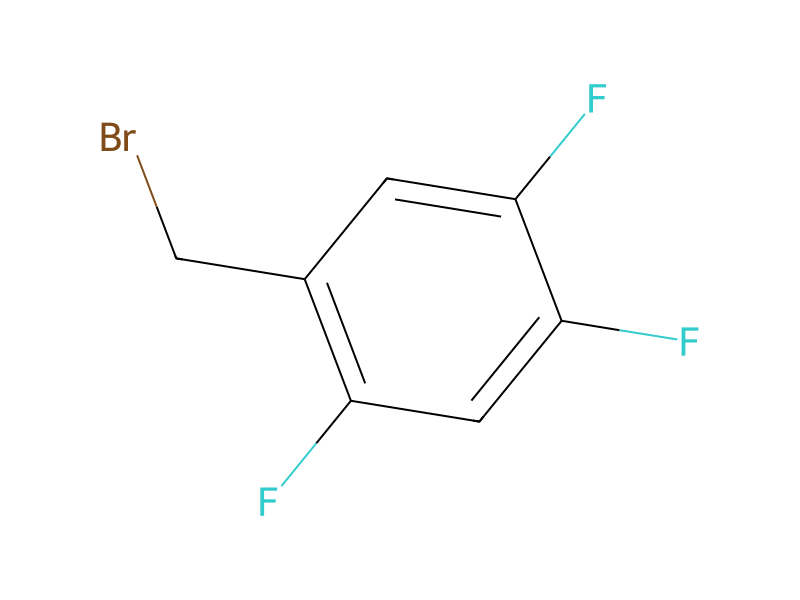
Basic information
- CAS
157911-56-3- Standard SMILES
Fc1cc(F)c(CBr)cc1F- InChIKey
GAUXEYCSWSMMFZ-UHFFFAOYSA-N- Molecular formula
- C7H4BrF3
- Average molar mass
- 225.01 g/mol
- Monoisotopic mass
- 223.94484689
Names & identifiers
- Preferred name
- 2,4,5-Trifluorobenzyl Bromide
- IUPAC
- 1-(bromomethyl)-2,4,5-trifluorobenzene
- English name
- 2,4,5-Trifluorobenzyl bromide
- Molecular formula
- C7H4BrF3
- Molecular weight
- 225.01
Names & synonyms
2,4,5-Trifluorobenzyl bromide157911-56-3DTXSID60380355RefChem:82030DTXCID00331381642-693-8GAUXEYCSWSMMFZ-UHFFFAOYSA-N1-(Bromomethyl)-2,4,5-trifluorobenzeneBENZENE, 1-(BROMOMETHYL)-2,4,5-TRIFLUORO-2,4,5-trifluorobenzylbromideMFCD000612092,4,5-trifluoro-benzylbromide
Show more names
2,4,5-Trifluorobenzy1-(Bromomethyl)-2,4,5-trifluorobenzene, alpha-Bromo-2,4,5-trifluorotolueneCAS:157911-56-35-Trifluorobenzyl broMideà-bromo-2,4,5-trifluorotoluene2,4,5-Trifluorobenzylbromide97%2.4.5-= Fluorobromine vegetables2,4,5-Trifluorobenzylbromide,99%
AKOS0050639071-bromomethyl-2,4,5-trifluoro-benzeneAS-15859EN300-19131712,4,5-trifluoro benzyl bromideA3474A241542,4,5-trifluorbenzylbromide
Database identifiers
- CAS
157911-56-3- PubChem CID
- 2777057
- DTXSID
DTXSID60380355- EC Number
- 642-693-8
Properties
Computed structural properties
- XLogP
- 2.8
- Topological polar surface area
- 0 Ų
- Hydrogen bond donors
- 0
- Hydrogen bond acceptors
- 3
- Rotatable bonds
- 1
- Heavy atoms
- 11
- Formal charge
- 0
- Complexity
- 131
Physicochemical properties
- Boiling point
- 188.8 · 188.8±35.0 °C(Predicted)
- Density
- 1.71 · 1.71
- refractive index
- 1.5015 · 1.5015
- storage temp.
- Inert atmosphere,Room Temperature
- form
- clear liquid
- color
- Colorless to Light yellow
- Specific Gravity
- 1.71 · 1.71
- Sensitive
- Lachrymatory
- BRN
- 8312091 · 8312091
- InChI
- InChI=1S/C7H4BrF3/c8-3-4-1-6(10)7(11)2-5(4)9/h1-2H,3H2
- InChIKey
- GAUXEYCSWSMMFZ-UHFFFAOYSA-N
- SMILES
- C1(CBr)=CC(F)=C(F)C=C1F
- CAS DataBase Reference
- 157911 · 157911-56-3(CAS DataBase Reference)
- Symbol(GHS)
- 5 · GHS05
- Signal word
- Danger
- Hazard statements
- 314 · H314-H318
- Precautionary statements
- 260 h-P301+P330+P331-P303+P361+P353-P305+P351+P338-P405-P501a · P260h-P301+P330+P331-P303+P361+P353-P305+P351+P338-P405-P501a
- Hazard Codes
- C,T
- Risk Statements
- 34 · 34-36-25
- Safety Statements
- 26 · 26-36/37/39-45-23-20
- RIDADR
- 1760 · 1760
- Hazard Note
- Corrosive/Lachrymatory
- TSCA
- T
- HazardClass
- 8 · 8
- PackingGroup
- II
- HS Code
- 29039990 · 29039990
- Limited Quantities
- 5 L · 5.0 L (1.3 gallons) (liquid) or 5.0 kg (11 lbs) (solid)
- Excepted Quantities
- Max Inner Pack (30g or 30ml) and Max Outer Pack (1Kg or 1L)
Safety & regulation
GHS classification
GHS Classification
Danger
H290 (14.3%): May be corrosive to metals [Warning Corrosive to Metals]
P234, P260, P261, P264, P264+P265, P271, P280, P301+P330+P331, P302+P361+P354, P304+P340, P305+P351+P338, P305+P354+P338, P316, P317, P319, P321, P337+P317, P363, P390, P403+P233, P405, P406, and P501 (click each P-code to see the statement)
Aggregated GHS information provided per 7 reports by companies from 4 notifications to the ECHA C&L Inventory. Each notification may be associated with multiple companies.
Hazard information
Hazard Classes and CategoriesMet. Corr. 1 (14.3%)
Safety data
- tsca
- T
- ridadr
- 1760
- hs_code
- 29039990
- risk_code
- 34-36-25
- Signal word
- Danger
- Symbol(GHS)
- GHS05
- hazard_code
- C,T
- hazard_note
- Corrosive/Lachrymatory
- safety_code
- 26-36/37/39-45-23-20
- hazard_class
- 8
- packing_group
- II
- Hazard statements
- H314-H318
- Limited Quantities
- 5.0 L (1.3 gallons) (liquid) or 5.0 kg (11 lbs) (solid)
- Excepted Quantities
- Max Inner Pack (30g or 30ml) and Max Outer Pack (1Kg or 1L)
- Precautionary statements
- P260h-P301+P330+P331-P303+P361+P353-P305+P351+P338-P405-P501a
Chemistry & industry
Applications
Uses2,4,5-trifluorobenzyl bromide is an important intermediate in the synthesis of Ensitrelvir (S-217622). Ensitrelvir is the latest oral drug developed by Japan's Shionogi Pharmaceutical Company to treat COVID-19. It is the first orally active, non-covalent, non-peptide SARS-CoV-23CL protease inhibitor.
Upstream & downstream products
Downstream products
Suppliers100 total
梯希爱(上海)化成工业发展有限公司021-67121386 · [email protected]
上海阿拉丁生化科技股份有限公司400-6206333 13167063860 · [email protected]
上海赫文斯化工有限公司15721252604 17321035817 · [email protected]
科瑞迪化学400-821-5857 021-64326257 · [email protected]
Syntechem Co.,Ltd[email protected]
北京华威锐科化工有限公司0757-86329057 18934348241 · [email protected]
阿法埃莎(中国)化学有限公司400-6106006 · [email protected]
太原市瑞和丰科贸有限公司+86 351 7031519 · [email protected]
安耐吉化学&3A(安徽泽升科技股份有限公司)400-0056266 · [email protected]
武汉凯威斯科技有限公司86-027-67849912 · [email protected]
常州安轩化工有限公司13912302692 · [email protected]
山东煜坤化工有限公司18660690289 · [email protected]
上海瀚鸿科技股份有限公司021-54306202 13764082696 · [email protected]
上海星酶生物科技有限公司18112588827
上海景颜化工科技有限公司13817811078 · [email protected]
嘉兴市艾森化工有限公司0573-85285100 18627885956 · [email protected]
南京哈柏医药科技有限公司13376080562 13376090521 · [email protected]
Pure Chemistry Scientific Inc.001-857-928-2050 or 1-888-588-9418 · [email protected]
上海隆盛化工有限公司58099637 13585536065 · [email protected]
杰达维(上海)医药科技发展有限公司/J & W PharmLab021-64340559 · [email protected]
天津希恩思生化科技有限公司400 638 7771 · [email protected]
天津津御达化工科技有限公司022-58013646 13011382049 · [email protected]
西安瑞联新材料股份有限公司029-68669089-8816
武汉泰凯塞科技有限公司027-86697669 13986148687 · [email protected]
阜新奥瑞凯精细化工有限公司(沈阳同元素)+86-024-83607930 18640359690 · [email protected]
TOKYO CHEMICAL INDUSTRY CO., LTD.03-36680489 · [email protected]
卡迪亚医药科技有限公司0371-86615086 18203638366 0371-86159066 13526786601
越林试剂021-62960152 · [email protected]
湖南复瑞生物医药技术有限责任公司15901640172,19275032510 15901640172 · [email protected]
Clearsynth Labs Limited+91-22-26355700 · [email protected]
山东博洛达生物科技有限公司0531-68659041 · [email protected]
上海湄水化工科技有限公司021-60549325 18616193163
HBCChem, Inc.+1-510-219-6317 · [email protected]
山东轩德医药科技有限公司0531-88803958 19862127196 · [email protected]
重庆星灿医药科技有限公司13594048950 19923294409 · [email protected]
湖南华腾制药有限公司400-8592883 · [email protected]
上海御略医药科技有限公司021-60345187 13671753212 · [email protected]
济南泺合医药技术有限公司86-0531-68658065 15726150375 · [email protected]
天津安浩生物科技有限公司[email protected]
上海纳谦化学科技有限公司13598610367 13598610367 · [email protected]
上海洽凡生化科技有限公司+86-021-61654350 · [email protected]
上海嵩爰化工科技有限公司010-1234567 18521000990 · [email protected]
上海有朋化工有限公司021-69005955 13701776567 · [email protected]
江苏艾康生物医药研发有限公司025-66028182 17714375163 · [email protected]
上海凯赛化工有限公司021-33516722 13701817765 · [email protected]
上海彤源化工有限公司021-021-69182866 13701855675 · [email protected]
上海容立化学科技有限公司021-69992220 13701886816 · [email protected]
上海康拓化工有限公司021-69185552 13701777608 · [email protected]
AN PharmaTech Co Ltd86(21)68097365 · [email protected]
上海皓之翔生物科技有限公司(原上海拓青化工有限公司)526763801 13301653310 · [email protected]
Related reactions
28 records


Compound notes
Loading…