
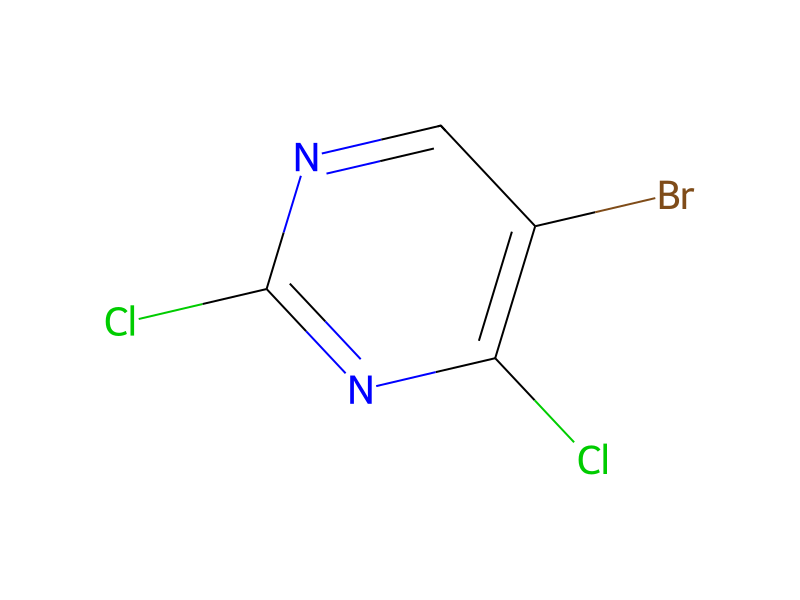
Basic information
- CAS
36082-50-5- Standard SMILES
Clc1ncc(Br)c(Cl)n1- InChIKey
SIKXIUWKPGWBBF-UHFFFAOYSA-N- Molecular formula
- C4HBrCl2N2
- Average molar mass
- 227.87 g/mol
- Monoisotopic mass
- 225.87001549
Names & identifiers
- Preferred name
- 5-Bromo-2,4-dichloropyrimidine
- IUPAC
- 5-bromo-2,4-dichloropyrimidine
- English name
- 5-Bromo-2,4-dichloropyrimidine
- Molecular formula
- C4HBrCl2N2
- Molecular weight
- 227.87
Names & synonyms
5-Bromo-2,4-dichloropyrimidine36082-50-55-Bromo-2,4-dichloro-pyrimidineSIKXIUWKPGWBBF-UHFFFAOYSA-DTXSID40302656RefChem:102099DTXCID40253790629-358-1InChI=1/C4HBrCl2N2/c5-2-1-8-4(7)9-3(2)6/h1HSIKXIUWKPGWBBF-UHFFFAOYSA-N2,4-dichloro-5-bromopyrimidineMFCD00127818
Show more names
NSC 1525175-Bromo-2,4-dichLBUTTPARK 48\06-22TIMTEC-BB SBB003301Xylose Impurity 3-d12,4-Dichloro-5-Bromouracil5-Bromo-2,4-dichloropyrdmidine
PYRIMIDINE, 5-BROMO-2,4-DICHLORO-Palbociclib impurity 992,6-dichloro-5-bromopyrimidine2,4-Dichloro-5-bormopyrimidineNSC-152517NSC152517MPA6TPX8YCSCHEMBL217854
Database identifiers
- CAS
36082-50-5- PubChem CID
- 289973
- DTXSID
DTXSID40302656- UNII
- MPA6TPX8YC
- EC Number
- 629-358-1
- Nikkaji
- J2.324.682A
Properties
Computed structural properties
- XLogP
- 2.8
- Topological polar surface area
- 25.8 Ų
- Hydrogen bond donors
- 0
- Hydrogen bond acceptors
- 2
- Rotatable bonds
- 0
- Heavy atoms
- 9
- Formal charge
- 0
- Complexity
- 103
Physicochemical properties
- Melting point
- 29 · 29-30 °C (lit.)
- Boiling point
- 128 °C/15 · 128 °C/15 mmHg (lit.)
- Density
- 1.781 g/mL · 1.781 g/mL at 25 °C (lit.)
- refractive index
- 20 · n20/D 1.603(lit.)
- Flash point
- 230 °F · >230 °F
- storage temp.
- Inert atmosphere,Room Temperature
- solubility
- Chloroform (Slightly), Ether (Slightly), Ethyl Acetate (Slightly), Toluene (Slightly)
- form
- Liquid or Low Melting Solid
- pka
- -4.26 · -4.26±0.29(Predicted)
- Specific Gravity
- 1.781 · 1.781
- color
- Clear colorless to light yellow
- BRN
- 124441 · 124441
- InChI
- InChI=1S/C4HBrCl2N2/c5-2-1-8-4(7)9-3(2)6/h1H
- InChIKey
- SIKXIUWKPGWBBF-UHFFFAOYSA-N
- SMILES
- C1(Cl)=NC=C(Br)C(Cl)=N1
- CAS DataBase Reference
- 36082 · 36082-50-5(CAS DataBase Reference)
- UNSPSC Code
- 12352100 · 12352100
- NACRES
- 22 · NA.22
- Symbol(GHS)
- 5 · GHS05,GHS06
- Signal word
- Danger
- Hazard statements
- 301 · H301+H311+H331-H314-H317
- Precautionary statements
- 260 · P260-P280-P301+P310+P330-P301+P330+P331-P303+P361+P353-P305+P351+P338
- PPE
- 2 · Eyeshields, Faceshields, Gloves, type P2 (EN 143) respirator cartridges, type P3 (EN 143) respirator cartridges
- Hazard Codes
- T,C
- Risk Statements
- 23 · 23/24/25-34-43
- Safety Statements
- 26 · 26-27-36/37/39-45
- RIDADR
- 3263 · UN 3263 8/PG 2
- WGK Germany
- 3 · 3
- Hazard Note
- Toxic/Corrosive
- HazardClass
- 8 · 8
- PackingGroup
- III
- HS Code
- 29335990 · 29335990
- Storage Class
- 6.1 A · 6.1A - Combustible acute toxic Cat. 1 and 2very toxic hazardous materials
- Hazard Classifications
- 3 DermalAcute · Acute Tox. 3 DermalAcute Tox. 3 InhalationAcute Tox. 3 OralEye Dam. 1Skin Corr. 1BSkin Sens. 1
- REACH Registrations
- Active
- Limited Quantities
- 1 Kg · 1 Kg (2.2 lbs) (solid)
- Excepted Quantities
- Max Inner Pack (30g or 30ml) and Max Outer Pack (500g or 500ml)
Safety & regulation
Safety information is for reference only and does not replace the supplier’s Safety Data Sheet (SDS), applicable regulations, or professional assessment.
GHS classification
GHS Classification
Danger
H301+H311+H331 (74.1%): Toxic if swallowed, in contact with skin or if inhaled [Danger Acute toxicity, oral; acute toxicity, dermal; acute toxicity, inhalation]
P260, P261, P262, P264, P270, P271, P272, P280, P301+P316, P301+P330+P331, P302+P352, P302+P361+P354, P304+P340, P305+P354+P338, P316, P321, P330, P333+P317, P361+P364, P362+P364, P363, P403+P233, P405, and P501 (click each P-code to see the statement)
Aggregated GHS information provided per 58 reports by companies from 12 notifications to the ECHA C&L Inventory. Each notification may be associated with multiple companies.
Hazard information
Regulatory InformationStatus: Active Update: 19-02-2019 https://echa.europa.eu/registration-dossier/-/registered-dossier/25504
Hazard Classes and CategoriesAcute Tox. 3 (93.1%)
Safety data
- PPE
- Eyeshields, Faceshields, Gloves, type P2 (EN 143) respirator cartridges, type P3 (EN 143) respirator cartridges
- wgk
- 3
- ridadr
- UN 3263 8/PG 2
- hs_code
- 29335990
- risk_code
- 23/24/25-34-43
- Signal word
- Danger
- Symbol(GHS)
- GHS05,GHS06
- hazard_code
- T,C
- hazard_note
- Toxic/Corrosive
- safety_code
- 26-27-36/37/39-45
- hazard_class
- 8
- Storage Class
- 6.1A - Combustible acute toxic Cat. 1 and 2very toxic hazardous materials
- packing_group
- III
- Hazard statements
- H301+H311+H331-H314-H317
- Limited Quantities
- 1 Kg (2.2 lbs) (solid)
- Excepted Quantities
- Max Inner Pack (30g or 30ml) and Max Outer Pack (500g or 500ml)
- REACH Registrations
- Active
- Hazard Classifications
- Acute Tox. 3 DermalAcute Tox. 3 InhalationAcute Tox. 3 OralEye Dam. 1Skin Corr. 1BSkin Sens. 1
- Precautionary statements
- P260-P280-P301+P310+P330-P301+P330+P331-P303+P361+P353-P305+P351+P338
Chemistry & industry
Applications
UsesStarting material for the synthesis of trisubstituted pyrimidines via a combination of nucleophilic substitution and palladium-catalyzed aryl cross-coupling.1
Uses5-Bromo-2,4-dichloropyrimidine may be employed as starting reagent for the synthesis of positive allosteric modulators for GABAB receptors (drug-like class of compounds) and pyridinepyrimidine analogs.
General Description5-Bromo-2,4-dichloropyrimidine is a halogenoprimidine. It has been reported as an intermediate during the synthesis of 2,4-di-t-butoxy-5-bromopyrimidine and 2,4-di-t-butoxy-5-pyrimidineboronic acid.
Upstream & downstream products
Upstream raw materials
Downstream products
Suppliers100 total
阜新奥瑞凯精细化工有限公司0418-5113999 18740177324 · [email protected]
梯希爱(上海)化成工业发展有限公司021-67121386 · [email protected]
上海阿拉丁生化科技股份有限公司400-6206333 13167063860 · [email protected]
INTATRADE GmbH+49 3493/605464 · [email protected]
南京科朗科技有限公司025-58748998 18951874644 · [email protected]
杭州布朗生物医药科技有限公司15967138206
韶远科技(上海)有限公司021-50795510 4000665055 · [email protected]
科瑞迪化学400-821-5857 021-64326257 · [email protected]
上海将来实业股份有限公司400-0066400 13621662912 · [email protected]
上海迈瑞尔生化科技有限公司4006356688 18621169109 · [email protected]
北京华威锐科化工有限公司0757-86329057 18934348241 · [email protected]
河北松辰医药科技有限公司0319-5801333-8008 15630992918 · [email protected]
南部县诚信科技有限公司0838-5675166 15883665058 · [email protected]
武汉易泰科技有限公司上海分公司18930552037 · [email protected]
阿法埃莎(中国)化学有限公司400-6106006 · [email protected]
上海德默医药科技有限公司400-021-7337 2355568890 · [email protected]
安耐吉化学&3A(安徽泽升科技股份有限公司)400-0056266 · [email protected]
武汉凯威斯科技有限公司86-027-67849912 · [email protected]
上海恩诺生物科技有限公司+86 (21) 6435-5022
上海瀚鸿科技股份有限公司021-54306202 13764082696 · [email protected]
江西博阳医药化工有限公司15870608400 · [email protected]
上海源鼎化学科技有限公司21-57721279 18121011378 · [email protected]
上海景颜化工科技有限公司13817811078 · [email protected]
嘉兴市艾森化工有限公司0573-85285100 18627885956 · [email protected]
南京哈柏医药科技有限公司13376080562 13376090521 · [email protected]
Pure Chemistry Scientific Inc.001-857-928-2050 or 1-888-588-9418 · [email protected]
上海泰坦科技股份有限公司400-6009262 15618770481 · [email protected]
杭州明苏科技有限公司571-88199336 18957129209 · [email protected]
苏州莱克施德药业有限公司0512-63970158-603 18018108880 · [email protected]
上海隆盛化工有限公司58099637 13585536065 · [email protected]
上海攀鸿化工科技有限公司021-56491756 13512199871 · [email protected]
武汉丰泰威远科技有限公司027-87465837 19945049750 · [email protected]
杭州东帆化学有限公司86-0571-85151182
四川库利南科技有限公司400-1166-196 18981987031 · [email protected]
天津希恩思生化科技有限公司400 638 7771 · [email protected]
武汉爱瑞克科技有限公司027- 51832457 94518350
南京维奥化工有限公司Please Send Email 18652950785 · [email protected]
上海萨科化学有限公司021-53292253 · [email protected]
同创医药(苏州)有限公司0512-63263366 18912765016 · [email protected]
河南多贝化工有限公司0370-2785118 17550508557 · [email protected]
济南邦德化工技术有限公司86-531-88280989 · [email protected]
天津科创医药中间体技术生产力促进有限公司022-60116533 13207668525 · [email protected]
上海思域化工科技有限公司86-21-34053660 · [email protected]
赛默飞世尔科技(中国)有限公司800-810-5118 · [email protected]
张家港保税区凯利特化工有限公司18606289633 15862625988 · [email protected]
江苏艾康生物医药研发有限公司025-66113011 13913916777 · [email protected]
上海健超生物科技有限公司150-2103-5486 18017383231 · [email protected]
阜新奥瑞凯精细化工有限公司(沈阳同元素)+86-024-83607930 18640359690 · [email protected]
TCI AMERICA800-4238616 · [email protected]
TOKYO CHEMICAL INDUSTRY CO., LTD.03-36680489 · [email protected]
Related reactions
399 records
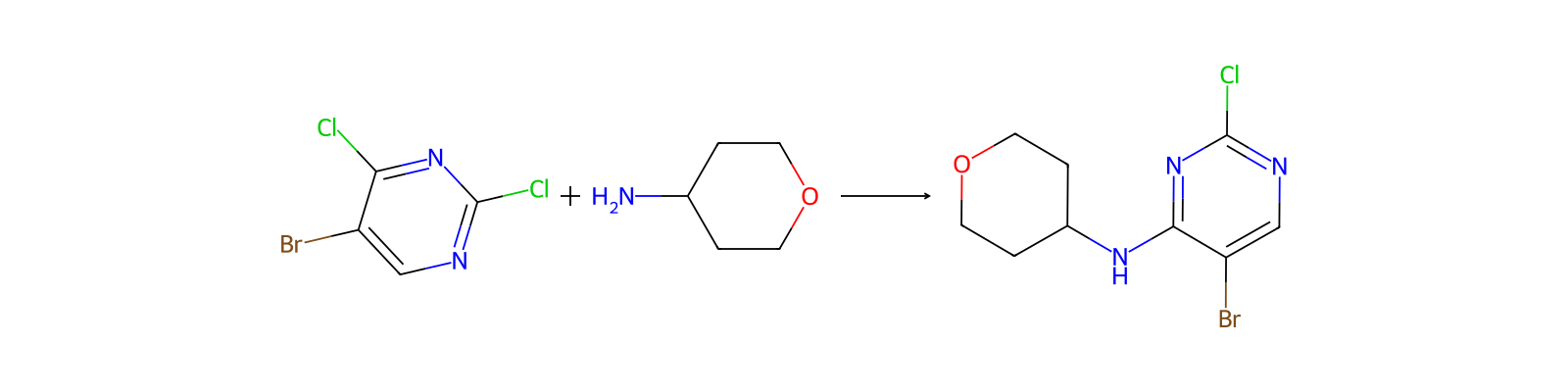


Compound notes
Loading…