HomeMCPWorkbenchSkills
HomeWorkbenchNotificationsMe
llms.txt · MCP GuidePrivacy Policy · Terms of Service · Supportv1.8.0
  1. Home
  2. /Compound

3-Phenylprop-2-En-1-Ol
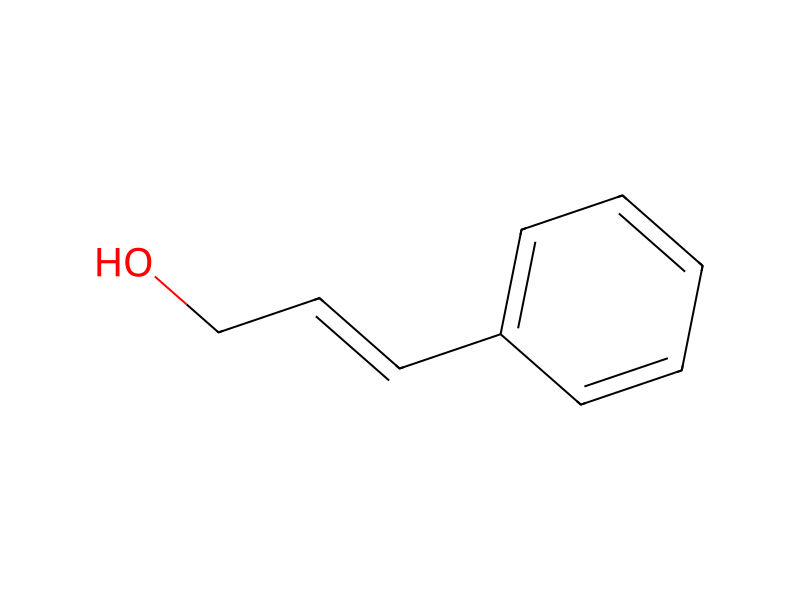
HCID 308
New noteNew reactionRequest quotes
Print preview
Basic informationOverviewNames & identifiersPropertiesSafety & regulationChemistry & industryRelated reactionsCompound notes
Substructure searchFind similar structures

Basic information

CAS
104-54-1
Standard SMILES
OCC=Cc1ccccc1
InChIKey
OOCCDEMITAIZTP-UHFFFAOYSA-N
Molecular formula
C9H10O
Average molar mass
134.17 g/mol
Monoisotopic mass
134.07316494

Overview

3-phenyl-2-propen-1-ol has been reported in Rhodiola sachalinensis, Zanthoxylum ovalifolium, and other organisms with data available.

Names & identifiers

Preferred name
3-Phenylprop-2-En-1-Ol
IUPAC
3-phenylprop-2-en-1-ol
English name
Cinnamyl alcohol
Molecular formula
C9H10O
Molecular weight
134.18

Names & synonyms

RefChem:10684943-Phenylprop-2-En-1-OlPhenylallyl alcohol1-Phenyl-1-propen-3-ol3-Phenyl-2-propenoltrans-cinnamic alcoholPhenyl-2-propen-1-olgamma-Phenylallyl alcoholstyrene-methanolPhenyl-2-propenol(Hydroxymethyl)styreneCinnamyl alcohol, 8CI
Show more names
CINNAMIC ALCOHOL3-PHENYL-2-PROPEN-1-OLTRANS-CINNAMYL ALCOHOLSterone(E)-3-phenyl-2-propen-1-olFEMA 22943-PHENYLALLYL ALCOHOL3-PhenylCinnamylalkohol
(3-phenyl)-allyl alcohol3-phenyl-prop-2-en-1-olSCHEMBL39220SCHEMBL97892SCHEMBL729778orb1222905orb1301286orb3025775

Database identifiers

CAS
104-54-1
PubChem CID
308
DTXSID
DTXSID9041491
ChEMBL
CHEMBL3183153

Properties

Computed structural properties

XLogP
1.9
Topological polar surface area
20.2 Ų
Hydrogen bond donors
1
Hydrogen bond acceptors
1
Rotatable bonds
2
Heavy atoms
10
Formal charge
0
Complexity
101

Experimental & physicochemical properties

SpringerMaterials PropertiesAngular frequency
LogP1.95
Boiling Point250.00 to 258.00 °C. @ 760.00 mm Hg
Melting Point33 °C
Physical DescriptionSolid

Physicochemical properties

Melting point
30 · 30-33 °C (lit.)
Boiling point
250 °C · 250 °C (lit.)
Density
1.044 g/mL · 1.044 g/mL at 25 °C (lit.)
vapor density
4.6 · 4.6 (vs air)
vapor pressure
0.01 mm · <0.01 mm Hg ( 25 °C)
refractive index
1.5819 · 1.5819
FEMA
2294 · 2294 | CINNAMYL ALCOHOL
FLAVIS Number
2.017 · 02.017 | Cinnamyl alcohol

Safety & regulation

Safety information is for reference only and does not replace the supplier’s Safety Data Sheet (SDS), applicable regulations, or professional assessment.

Safety data

F
10-23
PPE
dust mask type N95 (US), Eyeshields, Faceshields, Gloves
wgk
2
tsca
TSCA listed
rtecs
GE2200000
ridadr
2811
hs_code
29062990
Toxicity
LD50 (g/kg): 2.0 orally in rats; >5.0 dermally in rabbits (Letizia)
risk_code
22-36/38-43-36
Signal word
Warning
Symbol(GHS)
GHS07,GHS09
hazard_code
Xn
safety_code
26-36/37-37/39-24-24/25
Storage Class
10 - Combustible liquids
Hazard statements
H302-H317-H411
REACH Registrations
Active
Hazard Classifications
Acute Tox. 4 OralAquatic Chronic 2Skin Sens. 1
Precautionary statements
P261-P264-P273-P280-P301+P312-P302+P352
Hazardous Substances Data
104-54-1(Hazardous Substances Data)

Chemistry & industry

Pharmacology

Cellular LocationsCytoplasm

Uses & manufacturing

Use ClassificationFlavouring Agent -> FLAVOURING_AGENT -> JECFA Functional Classes
Applications · 7 items

DescriptionAs an organic compound, Cinnamyl alcohol has a very distinct sweet, spicy, hyacinth odour that is found in resins, balsams and cinnamon leaves. It is used commonly in the fragrance industry due to its distinctive odour, which can be applied as a deodorant, fragrance and additive in cosmetic products and in the formulation of bath products, body and hand products, such as soaps, toothpaste, deodorants, etc. Besides, it also finds application as a food additive in chewing gum, bakery products, candy and soft drinks. Naturally, Cinnamyl alcohol is occurrent only in small amount, thus its industrial demand is usually fulfilled by chemical synthesis starting from the reduction of cinnamaldehyde. Cinnamyl alcohol has been found to have a sensitising effect on some particular people, thus it is also considered as a Standardized Chemical Allergen. The physiologic effect of cinnamyl alcohol is caused by the Increased Histamine Release and cell-mediated Immunity.

UsesCinnamyl alcohol is valuable in perfumery for its odor and fixative properties. It is a component of many flower compositions (lilac, hyacinth, and lily of the valley) and is a starting material for cinnamyl esters, several of which are valuable fragrance materials. In flavor compositions, the alcohol is used for cinnamon notes and for rounding off fruit aromas.

DescriptionOccupational cases of contact dermatitis were reported in the perfurne industry. Patch tests can also be positive in food handlers. Cinnamic alcohol is contained in the "fragrance mix".

OccurrenceOccurring as an ester or in the free state in hyacinth, Aristolochia clematis, Xanthorrhoea hastilis and in the essence of daffodil flowers. It is also reported found in guava fruit and peel, lemon peel oil, cassia leaf, Bourbon vanilla and cinnamon bark, leaf and root.

Related reactions

147 records
New reaction record
HRID 18903 reaction equation
HRID 18903As reactantuspto-grants-2010_06
HRID 33996 reaction equation
HRID 33996As reactantuspto-grants-2008_09
HRID 48550 reaction equation
HRID 48550As reactantuspto-grants-2004_03
HRID 73280 reaction equation
HRID 73280As reactantuspto-grants-2014_09
HRID 73285 reaction equation
HRID 73285As reactantuspto-grants-2014_09
HRID 98476 reaction equation
HRID 98476As reactantTraining data from https://doi.org/10.1039/C8SC04228D (2/10)
HRID 104788 reaction equation
HRID 104788As reactantTraining data from https://doi.org/10.1039/C8SC04228D (2/10)
HRID 115538 reaction equation
HRID 115538As reactantTraining data from https://doi.org/10.1039/C8SC04228D (2/10)
Page 1 of 19

Compound notes

Loading…

On this pageBasic informationOverviewNames & identifiersPropertiesSafety & regulationChemistry & industryRelated reactionsCompound notes
More actions
New noteNew reactionRequest quotes
Flash point
230 °F · >230 °F
storage temp.
-20 °C · -20°C
solubility
2 O: · H2O: soluble
form
Fused Low Melting Crystalline Solid
pka
0.852 · 0.852[at 20 ℃]
Specific Gravity
1.044 · 1.044
color
White
Odor
100 % · at 100.00 %. sweet balsam hyacinth spicy green powdery cinnamic
Odor Type
balsamic
biological source
synthetic
Water Solubility
1.8 g/L · 1.8 g/L (20 ºC)
Merck
14 · 14,2302
JECFA Number
647 · 647
BRN
1903999 · 1903999
Stability
Stable. Incompatible with strong oxidizing agents.
Cosmetics Ingredients Functions
FLAVOURINGPERFUMING
InChI
1S/C9H10O/c10-8-4-7-9-5-2-1-3-6-9/h1-7,10H,8H2/b7-4+
InChIKey
OOCCDEMITAIZTP-QPJJXVBHSA-N
SMILES
OC\C=C\c1ccccc1
LogP
1.452 at · 1.452 at 25℃
Substances Added to Food (formerly EAFUS)
CINNAMYL ALCOHOL
FDA 21 CFR
172.515 · 172.515
CAS DataBase Reference
104 · 104-54-1(CAS DataBase Reference)
EWG's Food Scores
4 · 4-7
FDA UNII
8 YOP444F · SS8YOP444F
NIST Chemistry Reference
2 · 2-Propen-1-ol, 3-phenyl-(104-54-1)
EPA Substance Registry System
3 · 3-Phenyl-2-propen-1-ol (104-54-1)
UNSPSC Code
85151701 · 85151701
NACRES
24 · NA.24
Symbol(GHS)
7 · GHS07,GHS09
Signal word
Warning
Hazard statements
302 · H302-H317-H411
Precautionary statements
261 · P261-P264-P273-P280-P301+P312-P302+P352
PPE
95 · dust mask type N95 (US), Eyeshields, Faceshields, Gloves
Hazard Codes
Xn
Risk Statements
22 · 22-36/38-43-36
Safety Statements
26 · 26-36/37-37/39-24-24/25
RIDADR
2811 · 2811
WGK Germany
2 · 2
RTECS
2200000 · GE2200000
F
10 · 10-23
TSCA
TSCA listed
HS Code
29062990 · 29062990
Storage Class
10 · 10 - Combustible liquids
Hazard Classifications
4 OralAquatic · Acute Tox. 4 OralAquatic Chronic 2Skin Sens. 1
Hazardous Substances Data
104 · 104-54-1(Hazardous Substances Data)
Toxicity
50 · LD50 (g/kg): 2.0 orally in rats; >5.0 dermally in rabbits (Letizia)
REACH Registrations
Active

UsesCinnamic alcohol is a component in perfumed cosmetic products and deodorants; some perfumery uses (cinnamon; daffodil; hyacinth; jasmine); natural occurrence (cinnamon).

Usescinnamyl alcohol is naturally occurring in cinnamon bark, it can also be synthetically manufactured. It is used in cosmetics as a fragrance or flavoring agent.In perfumery; as deodorant in 12.5% solution in glycerol.

UsesCinnamyl alcohol was used to study the alkylation of 2,4-di-tert-butylphenol by cinnamyl alcohol using aluminum-containing mesoporous ethane-silica catalyst. It was used to study gold nanoparticles supported on titanium dioxide catalysed oxidative coupling of alcohols and amines to form the corresponding imines.

Preparation methods · 2 items

PreparationCinnamyl alcohol is prepared on an industrial scale by reduction of cinnamaldehyde. Three methods are particularly useful: 1) In the Meerwein–Ponndorf reduction, cinnamaldehyde is reduced to cinnamic alcohol (yield about 85%) with isopropyl or benzyl alcohol in the presence of the corresponding aluminum alcoholate. 2) A 95% yield of Cinnamyl alcohol is obtained by selective hydrogenation of the carbonyl group in cinnamaldehydewith, for example, an osmium–carbon catalyst. 3) High yields of Cinnamyl alcohol can be obtained by reduction of cinnamaldehyde with alkali borohydrides. Formation of dihydrocinnamic alcohol is thus avoided.

PreparationBy reduction of cinnamic aldehyde.

Upstream & downstream products

Upstream raw materials

CinnamaldehydePeru balsamCINNAMIC ALCOHOLAluminium isopropoxideCinnamyl cinnamateBenzaldehydetrans-Cinnamic acidHydrogenSodium hydroxidetrans-CinnamaldehydeSTYRAXCinnamon oil

Downstream products

α-Methyl-N-(3-phenyl-2-propenyl)benzneethanamineFlunarizine dihydrochlorideChloramphenicolCinnamyl acetateClofibrateCinnamyl bromide(3-methoxy-1-propenyl)benzeneCyclopropanemethanol, 2,2-dichloro-3-phenyl-CINNAMONITRILEFlunarizineDiphenylcyclopropenonePhenylpropyl aldehyde

Additional notes

DefinitionChEBI: A primary alcohol comprising an allyl core with a hydroxy substituent at the 1-position and a phenyl substituent at the 3-position (geometry of the C2C bond unspecified).