HomeMCPSkillsWorkbenchOpenChem
HomeWorkbenchNotificationsMe
llms.txt · skill.md · MCP GuidePrivacy Policy · Terms of Service · Supportv1.8.5
  1. Home
  2. /Compound

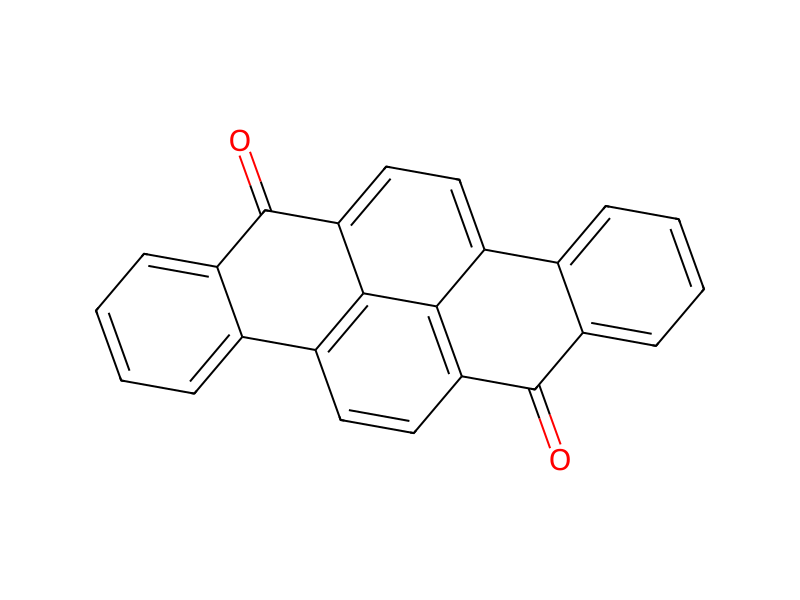
Dibenzo(b,def)chrysene-7,14-dione

HCID 31412
New reaction
Print

Completing data — refresh the page later to see the latest
Basic informationOverviewNames & identifiersPropertiesSafety & regulationChemistry & industryRelated reactionsCompound notes
Substructure searchFind similar structures

Basic information

CAS
128-66-5
Standard SMILES
O=C1c2ccccc2-c2ccc3c4c(ccc1c24)-c1ccccc1C3=O
InChIKey
ZTWQZJLUUZHJGS-UHFFFAOYSA-N
Molecular formula
C24H12O2
Average molar mass
332.3 g/mol
Monoisotopic mass
332.08372962

Overview

C.i. vat yellow 4 is a viscous orange liquid. Used for coloring of cotton, wool and cellulose acetate.

Names & identifiers

Preferred name
Dibenzo(b,def)chrysene-7,14-dione
IUPAC
hexacyclo[10.10.2.02,7.09,23.013,18.020,24]tetracosa-1(23),2,4,6,9,11,13,15,17,20(24),21-undecaene-8,19-dione
English name
Vat Yellow 4
Molecular formula
C24H12O2
Molecular weight
332.35

Names & synonyms

Vat yellow 4C.I. Vat Yellow 4128-66-5YellowTyrion YellowTyrian Yellow I-GOKVat Yellow ZhKhYellow GK baseHelanthrene YellowVat Golden YellowDibenzo[B,def]chrysene-7,14-dioneTinon Golden Yellow GK
Show more names
NSC30987C.I.59100NSC 30987NSC-30987C.I.VATYELLOW4Anthravat golden yellowAmanthrene golden yellowVat yellow 4 (C.I. 59100)Arlanthrene golden yellow
Golden Yellow ZhKhTinon Golden YellowC.I. Vat YellowMayvat Golden YellowCaledon Golden YellowCibanone Golden YellowHostavat Golden YellowLeucosol Golden Yellow

Database identifiers

CAS
128-66-5
PubChem CID
31412
DTXSID
DTXSID6021454
ChEBI
CHEBI:82548

Properties

Computed structural propertiesFilling in

XLogP
5.4
Topological polar surface area
34.1 Ų
Hydrogen bond donors
0
Hydrogen bond acceptors
2
Rotatable bonds
0
Heavy atoms
26
Formal charge
0
Complexity
570

Experimental & physicochemical properties

Chemical ClassesDyes -> Anthraquinone Dyes
SpringerMaterials PropertiesDiamagnetic susceptibility
Solubilitygreater than or equal to 100 mg/mL at 75 °F (NTP, 1992)
Flash Point · 2 items

greater than 200 °F (NTP, 1992)

Flash Point > 93 °C

Physical Description · 2 items

C.i. vat yellow 4 is a viscous orange liquid. Used for coloring of cotton, wool and cellulose acetate.

Orange liquid; [CAMEO]

Physicochemical properties

Melting point
385 °C · 385 °C
Boiling point
429.48 °C · 429.48°C (rough estimate)
Density
1.1459 · 1.1459 (rough estimate)
refractive index
1.4891 · 1.4891 (estimate)

Safety & regulation

Safety information is for reference only and does not replace the supplier’s Safety Data Sheet (SDS), applicable regulations, or professional assessment.

GHS classification

GHS ClassificationNot Classified

Hazard information

Regulatory InformationChemical: Dibenzo[b,def]chrysene-7,14-dione
Fire HazardsThis chemical is probably combustible. (NTP, 1992)
Health HazardsACUTE/CHRONIC HAZARDS: When heated to decomposition this compound emits acrid smoke and irritating fumes. (NTP, 1992)
Hazards SummaryAnthraquinones are toxic by ingestion: vomiting, diarrhea, kidney and liver damage, and coma; Deaths have been reported after children ingested Rhamnus berries; [HSDB]
Reactive GroupHydrocarbons, Aromatic
Special Reports · 2 items

REVIEW OF INHALATION (TOTAL-BODY-EXPOSURE) STUDIES OF COLORED CHEM SMOKES. ACUTE TOXICITIES, TIME TO DEATHS, & GROSS SIGNS COMPARED. TOXICOLOGICAL EVALUATION OF DYES IN SMOKE MIXT INCL. ONE OF THE DYES USED IN CHEM SMOKES IS DIBENZO(B,DEF)CHRYSENE-7,14-DIONE.[OWENS EJ, WARD DM; USNTIS AD/A REP ISS NO 003827/3GA 72 PP (1974)]

DHEW/NCI; Bioassay of C.I. Vat Yellow 4 for Possible Carcinogenicity (1979) Technical Rpt Series No. 134 DHEW Pub No. (NIH) 79-1389

Reactivity ProfileC.I. VAT YELLOW 4 reacts very readily with reducing agents to give a colorless or nearly colorless product. Subsequent oxidation then restores the color.
Air and Water ReactionsWater soluble.

Chemistry & industry

Uses & manufacturing

Uses · 3 items

Used as a dye for cotton, silk, wool, and paper; [HSDB]

Pulp and Paper Processing [Category: Industry]

DYE FOR COTTON, SILK, WOOL & PAPER, FOR PRINTING COTTON

U.S. Imports · 2 items

(1977) 3.88X10+6 G (PRINCPL CUSTMS DISTS)

(1979) 3.50X10+6 G (PRINCPL CUSTMS DISTS)

U.S. Production · 2 items

(1978) PROBABLY GREATER THAN 2.27X10+6 G

(1979) PROBABLY GREATER THAN 2.27X10+6 G

Consumption PatternsESSENTIALLY 100% AS A DYE
Methods of ManufacturingREACTION OF 3-BENZOYLBENZANTHRONE WITH ALUMINUM CHLORIDE & AN OXIDIZING AGENT; REACTION OF 1,5-DIBENZOYLNAPHTHALENE WITH SODIUM AND ALUMINUM CHLORIDES
General Manufacturing InformationDibenzo[b,def]chrysene-7,14-dione: ACTIVE

Applications

UsesVat Yellow 4 is a commercial dye used in textiles. Polyaromatic hydrocarbon with potential carcinogenic activity.Environmental toxin on US EPA Toxic Release Inventory list (TRI) list.

General DescriptionViscous orange liquid. Used for coloring of cotton, wool and cellulose acetate.

Preparation methods

Preparation(a) 3-Benzoylbenzanthroneand Aluminium chloride and antioxidant for the closed-loop response; (b) 1,5-Dibenzoyl-2-naphthaenein Aluminium chloride and sodium chloride were under existing closed-loop response.

Upstream & downstream products

Related reactions

0 records
New reaction record
No related reactions yet

Compound notes

On this pageBasic informationOverviewNames & identifiersPropertiesSafety & regulationChemistry & industryRelated reactionsCompound notes
UNII
8XO6A4G496
EC Number
204-903-2
Nikkaji
J5.411I
Stability
Stable. Combustible. Incompatible with strong oxidizing agents.
Toxicology and Carcinogenesis
4 for · Bioassay of C.I. Vat Yellow 4 for Possible Carcinogenicity (CASRN 128-66-5)
CAS DataBase Reference
128 · 128-66-5
FDA UNII
8 XO6A4G496 · 8XO6A4G496
IARC
3 · 3 (Vol. 48) 1990
EPA Substance Registry System
4 · C.I. Vat Yellow 4 (128-66-5)
TSCA
TSCA listed
Hazardous Substances Data
128 · 128-66-5(Hazardous Substances Data)
Hazard Classes and Categories
Not Classified

Safety & protection

Fire FightingFires involving this material can be controlled with a dry chemical, carbon dioxide or Halon extinguisher. (NTP, 1992)
First Aid · 1 item

EYES: First check the victim for contact lenses and remove if present. Flush victim's eyes with water or normal saline solution for 20 to 30 minutes while simultaneously calling a hospital or poison control center. Do not put any ointments, oils, or medication in the victim's eyes without specific instructions from a physician. IMMEDIATELY transport the victim after flushing eyes to a hospital even if no symptoms (such as redness or irritation) develop.

Nonfire Spill Response · 1 item

SMALL SPILLS AND LEAKAGE: If you should spill this chemical, use absorbent paper to pick up all liquid spill material. Seal the absorbent paper, as well as any of your clothing which may be contaminated, in a vapor-tight plastic bag for eventual disposal. Wash any surfaces you may have contaminated with a soap and water solution. Do not reenter the contaminated area until the Safety Officer (or other responsible person) has verified that the area has been properly cleaned.

Personal Protective Equipment (PPE) · 1 item

RECOMMENDED RESPIRATOR: Where the neat test chemical is weighed and diluted, wear a NIOSH-approved half face respirator equipped with a combination filter cartridge, i.e. organic vapor/acid gas/HEPA (specific for organic vapors, HCl, acid gas, SO2 and a high efficiency particulate filter). (NTP, 1992)

Toxicology

Adverse EffectsOccupational hepatotoxin - Secondary hepatotoxins: the potential for toxic effect in the occupational setting is based on cases of poisoning by human ingestion or animal experimentation.
Ongoing Test Status · 1 item

The following link will take the user to the National Toxicology Program (NTP) Test Agent Search Results page, which tabulates all of the "Standard Toxicology & Carcinogenesis Studies", "Developmental Studies", and "Genetic Toxicity Studies" performed with this chemical. Clicking on the "Testing Status" link will take the user to the status (i.e., in review, in progress, in preparation, on test, completed, etc.) and results of all the studies that the NTP has done on this chemical. [http://ntp-apps.niehs.nih.gov/ntp_tox/index.cfm?fuseaction=ntpsearch.searchresults&searchterm=128-66-5]

Human Toxicity Excerpts · 1 item

Most organic azo dyes are potential skin sensitizers, the most important of which are paraphenylenediamine and its analogs. Water soluble azo dyes are more likely to cause clinical sensitization than insoluble dyes. ... In addition to allergic eczematous contact dermatitis, color developing solutions have caused lichen planus like eruptions. /Organic dyes/

Carcinogen Classification · 6 items

Vat Yellow 4

Group 3: Not classifiable as to its carcinogenicity to humans

Volume 48: (1990) Some Flame Retardants and Textile Chemicals, and Exposures in the Textile Manufacturing Industry

1990

1989

C.I. Vat yellow 4

Non-Human Toxicity Excerpts · 2 items

Vat yellow 4 (C.I. 59100) was tested for mutagenicity in the Salmonella/microsome preincubation assay using a protocol approved by the National Toxicology Program. Vat yellow 4 was tested over a wide range of doses (0, 100, 333, 1000, 3333, and 10,000 ug/plate) in four Salmonella typhimurium strains (TA98, TA100, TA1535, and TA1537) in the presence and absence of Aroclor-induced rat or hamster liver S9. Vat yellow 4 was negative in these tests and the highest ineffective dose level tested in any Salmonella tester strain was 10,000 ug/plate.

Despite their widespread use and potential for significant human exposure, genotoxicity data on anthraquinones and other dyes are limited. In this study, 16 anthraquinones and one azo dye (Solvent Red 1) were selected for testing using the thymidine locus and micronucleus (MN) analysis in L5178Y/TK(+ or -)-3.7.2C mouse lymphoma cells. Six of the dyes were from the same lot used in the NTP rodent bioassay. The dyes used were all production lots and thus varied in their purity. Disperse Blue 7, 2-aminoanthraquinone; 1-amino-2-methylanthraquinone, Disperse Blue 3 and Disperse Red 11 were genotoxic (inducing 1814 mutants/10(6) survivors, 369 MN/1000 cells at 13% survival; 397 mutants/10(6) survivors, 196 MN/1000 cells at 21% survival; 178 mutants/10(6) survivors, 119 MN/1000 cells at 51% survival; 264 mutants/10(6) survivors, 109 MN/1000 cells at 15% survival, respectively). Reactive Blue 19 was weakly mutagenic (inducing 144 mutants/10(6) survivors, but only 8 MN/1000 cells at 13% survival). Vat Yellow 4 and Solvent Red 1, with exogenous activation, were also mutagenic (inducing 300 mutants/10(6) survivors, 18 MN/1000 cells at 57% survival, and 100 mutants/10(6) survivors and 16 MN/1000 cells at 22% survival, respectively). With activation 1-nitro-2-methylanthraquinone was judged to give an equivocal mutagenicity response. The maximum test concentration was limited for some compounds by their solubility. Those chemicals that did not induce mutation or cytotoxicity at the limits of solubility were classified separately. Compounds which were not evaluated without exogenous activation because of insolubility but were evaluated with activation include 1-nitro-2-methylanthraquinone, Solvent Red 1 and Vat Yellow 4.

Evidence for Carcinogenicity · 1 item

Evaluation: There is limited evidence for the carcinogenicity of Vat Yellow 4 in experimental animals. No data were available from studies in humans on the carcinogenicity of Vat Yellow 4. Overall evaluation: Vat Yellow 4 is not classifiable as to its carcinogenicity to humans (Group 3).

Probable Routes of Human ExposureBeauticians exposed to paraphenylenediamine derivatives in hair dyes, workers dyeing texitle resins, and photographic film developers exposed to color developing solutions not infrequently become sensitized to azo dyes. /Organic dyes/
National Toxicology Program Studies · 2 items

FISCHER 344 RATS OF EACH SEX ADMIN FORMULATED PRODUCT CONTAINING CI VAT YELLOW 4 IN DIET FOR 104 WK OR 106 WK @ 3500 OR 7000 PPM. TUMOR INCIDENCE WAS NOT HIGHER THAN THAT OF CONTROLS.

B6C3F1 MICE ADMIN FORMULATED PRODUCT CONTAINING CI VAT YELLOW 4 IN DIET FOR 104 WK OR 106 WK, (25,000 OR 50,000 PPM FOR MALES & 12,500 OR 25,000 PPM FOR FEMALES). IT WAS CARCINOGENIC FOR MALES, BUT NOT FEMALES, INDUCING LYMPHOMAS.

Safety data

tsca
TSCA listed
Hazardous Substances Data
128-66-5(Hazardous Substances Data)

Upstream raw materials

Formyl chlorideNaphthaleneINDUSTRIAL SALTSodium chloratehypochlorous acidAluminium chloride hexahydrate2,4-Dinitrochlorobenzene

Downstream products

Vat brown 39 (C.I. 59270)disodium dibenzo[b,def]chrysene-7,14-diyl bis(sulphate)Vat Orange 1C.I. Vat Yellow 44

Additional notes

DefinitionChEBI: Vat Yellow 4 is an ortho- and peri-fused polycyclic arene.