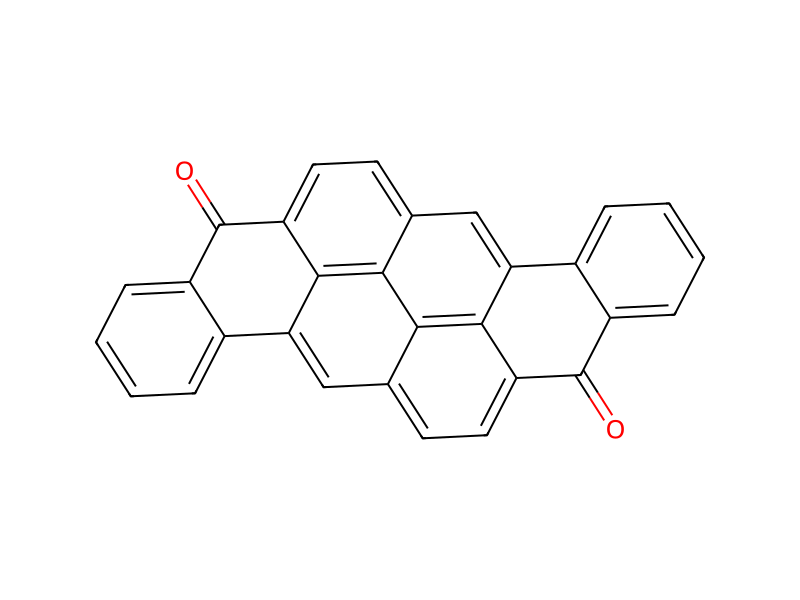
Basic information
- CAS
128-70-1- Standard SMILES
O=c1c2ccccc2c2cc3ccc4c(=O)c5ccccc5c5cc6ccc1c2c6c3c45- InChIKey
LLBIOIRWAYBCKK-UHFFFAOYSA-N- Molecular formula
- C30H14O2
- Average molar mass
- 406.4 g/mol
- Monoisotopic mass
- 406.09937969
Names & identifiers
- Preferred name
- 8,16-Pyranthrenedione
- IUPAC
- pyranthrene-8,16-dione
- English name
- Vat Orange 9
- Molecular formula
- C30H14O2
- Molecular weight
- 406.43
Names & synonyms
Show more names
Database identifiers
- CAS
128-70-1- PubChem CID
- 31414
- DTXSID
DTXSID6059578- UNII
- 4R73B8X40P
- EC Number
- 204-906-9
- Nikkaji
- J5.413E
Properties
Computed structural properties
- XLogP
- 7.3
- Topological polar surface area
- 34.1 Ų
- Hydrogen bond donors
- 0
- Hydrogen bond acceptors
- 2
- Rotatable bonds
- 0
- Heavy atoms
- 32
- Formal charge
- 0
- Complexity
- 763
Experimental & physicochemical properties
Physicochemical properties
- Boiling point
- 703.7 · 703.7±30.0 °C(Predicted)
- Density
- 1.489 · 1.489
- storage temp.
- Sealed in dry,Room Temperature
- FDA UNII
- 4 R73B8X40P · 4R73B8X40P
- NIST Chemistry Reference
- 8 · 8,16-Pyranthenedione(128-70-1)
- EPA Substance Registry System
- 8 · 8,16-Pyranthrenedione (128-70-1)
- Symbol(GHS)
- 7 · GHS07
- Signal word
- Warning
- Hazard statements
- 302 · H302-H315-H319-H335
- Precautionary statements
- 261 · P261-P305+P351+P338
- Safety Statements
- 22 · 22-24/25
- TSCA
- TSCA listed
Safety & regulation
GHS classification
GHS Classification
This chemical does not meet GHS hazard criteria for 22% (11 of 50) of reports.
H413 (78%): May cause long lasting harmful effects to aquatic life [Hazardous to the aquatic environment, long-term hazard]
P273, and P501 (click each P-code to see the statement)
Aggregated GHS information provided per 50 reports by companies from 2 notifications to the ECHA C&L Inventory.
Hazard information
Regulatory Information
Chemical: 8,16-Pyranthrenedione
8,16-Pyranthrenedione: Does not have an individual approval but may be used as a component in a product covered by a group standard. It is not approved for use as a chemical in its own right.
Safety data
- tsca
- TSCA listed
- Signal word
- Warning
- Symbol(GHS)
- GHS07
- safety_code
- 22-24/25
- Hazard statements
- H302-H315-H319-H335
- Precautionary statements
- P261-P305+P351+P338
Chemistry & industry
Uses & manufacturing
Applications
UsesVat Orange 9 is used for dyeing cotton, viscose fiber, silk, and cotton-vinyl alcohol fabrics, as well as printing on cotton fabrics. It has good leveling properties and affinity.
Preparation methods
Preparation8,16-Pyranthrenedione called. (a) 1-(2-Methyl-9,10-dioxoanthracene-1-yl)-2-methylanthracene-9,10-dione in 350 ~ 380 ℃ heat alone, or in low temperature with dehydrant processing, take off 2 Moore water; (b) 1-(2-Methyl-9,10-dioxoanthracene-1-yl)-2-methylanthracene-9,10-dioneaqueous cream content (with or without ammonia or salt all but), in 230 ~ 250 ℃ and under pressure heating 10 to 12 hours; (C) 1-(2-Methyl-9,10-dioxoanthracene-1-yl)-2-methylanthracene-9,10-dioneand Etanol/Potassium hydroxide heating 10 to 12 hours; (d) 1,6-Dibenzoylpyrenewith Aluminium chloride and Sodium chloride melting, and access to oxygen.
Upstream & downstream products
Upstream raw materials
Downstream products
Suppliers37 total
Related reactions
No reaction records under the current filter.
Compound notes
Loading…