
Doxazosin

Basic information
- CAS
74191-85-8- Standard SMILES
COc1cc2nc(N3CCN(C(=O)C4COc5ccccc5O4)CC3)nc(N)c2cc1OC- InChIKey
RUZYUOTYCVRMRZ-UHFFFAOYSA-N- Molecular formula
- C23H25N5O5
- Average molar mass
- 451.5 g/mol
- Monoisotopic mass
- 451.1855689
Overview
Doxazosin is a member of the class of quinazolines that is quinazoline substituted by an amino group at position 4, methoxy groups at positions 6 and 7 and a piperazin-1-yl group at position 2 which in turn is substituted by a 2,3-dihydro-1,4-benzodioxin-2-ylcarbonyl group at position 4. An antihypertensive agent, it is used in the treatment of high blood pressure. It has a role as an antineoplastic agent, a vasodilator agent, an antihypertensive agent, an alpha-adrenergic antagonist and an antihyperplasia drug. It is a monocarboxylic acid amide, an aromatic amine, a member of quinazolines, a N-acylpiperazine, a N-arylpiperazine and a benzodioxine.
Names & identifiers
- Preferred name
- Doxazosin
- IUPAC
- [4-(4-amino-6,7-dimethoxyquinazolin-2-yl)piperazin-1-yl]-(2,3-dihydro-1,4-benzodioxin-3-yl)methanone
- English name
- Doxazosin
- Molecular formula
- C23H25N5O5
- Molecular weight
- 451.48
Names & synonyms
doxazosin74191-85-8DoxazosineDoxazosinumDoxazosinaUK-33274C02CA041-(4-Amino-6,7-Dimethoxy-2-quinazolinyl)-4-(1,4-benzodioxan-2-ylcarbonyl)piperazinCHEBI:4708UK 332741-(4-Amino-6,7-dimethoxy-2-chinazolinyl)-4-(2,3-dihydro-1,4-benzodioxixin-2-ylcarbonyl)piperazinDTXSID7022964
Show more names
UK 33,274Doxazosin baseDOXAZOSINMESYTLDOXAZOSIN(CARDULAR)Doxazosin USP/EP/BPDoxazosin (UK 33274)Doxazosin Mesylate USPDoxazosin, 10 mM in DMSO
NW1291F1W8Piperazine, 1-(4-amino-6,7-dimethoxy-2-quinazolinyl)-4-((2,3-dihydro-1,4-benzodioxin-2-yl)carbonyl)-2-{4-[(2,3-dihydro-1,4-benzodioxin-2-yl)carbonyl]piperazin-1-yl}-6,7-dimethoxyquinazolin-4-amine(4-(4-AMINO-6,7-DIMETHOXY-2-QUINAZOLINYL)-1-PIPERAZINYL)(2,3-DIHYDRO-1,4-BENZODIOXIN-2-YL)METHANONE(4-(4-Amino-6,7-dimethoxyquinazolin-2-yl)piperazin-1-yl)(2,3-dihydro-1,4-benzodioxin-2-yl)methanoneratio Doxazosinratio-DoxazosinDoxaUro
Database identifiers
- CAS
74191-85-8- PubChem CID
- 3157
- DTXSID
DTXSID7022964- ChEMBL
CHEMBL707- ChEBI
CHEBI:4708- UNII
- NW1291F1W8
- EC Number
- 616-059-6
- Nikkaji
- J21.371C
Properties
Computed structural properties
- XLogP
- 2.5
- Topological polar surface area
- 112 Ų
- Hydrogen bond donors
- 1
- Hydrogen bond acceptors
- 9
- Rotatable bonds
- 4
- Heavy atoms
- 33
- Formal charge
- 0
- Complexity
- 678
Experimental & physicochemical properties
Drugs
Pharmaceuticals -> Antihypertensives
Pharmaceuticals
LogP
2.1
3.38
Solubility
0.8%
7.90e-01 g/L
Human DrugsBreast Feeding; Lactation; Milk, Human; Adrenergic alpha-Antagonists; Antihypertensive Agents
Melting Point
275-277
289 - 290 °C
Physical DescriptionSolid
Dissociation Constants6.52
Collision Cross Section
202.9 Ų [M+H]+ [CCS Type: TW; Method: Major Mix IMS/Tof Calibration Kit (Waters)]
196.92 Ų [M+Na]+ [CCS Type: TW; Method: calibrated with polyalanine and drug standards]
Physicochemical properties
- Melting point
- 289 · 289-290°C
- Boiling point
- 718 · 718.0±70.0 °C(Predicted)
- Density
- 1.371 · 1.371±0.06 g/cm3(Predicted)
- storage temp.
- -20 °C · Store at -20°C
- solubility
- Soluble in DMSO
- form
- Powder
- pka
- 6.52 · 6.52±0.50(Predicted)
- color
- White to off-white
- CAS DataBase Reference
- 74191 · 74191-85-8(CAS DataBase Reference)
- FDA UNII
- 1291 F1W8 · NW1291F1W8
- ATC code
- 2 CA04 · C02CA04
- Protein binding
- 98 % · 98%
- Excreted unchanged in urine
- 5 % · <5%
- Volume of distribution
- 1 · 1-1.7(L/kg)
- Biological half-life
- 22 · 22 / Unchanged
- Symbol(GHS)
- 5 · GHS05,GHS07,GHS08,GHS09
- Signal word
- Danger
- Hazard statements
- 302 · H302-H373-H411-H314
- Precautionary statements
- 260 · P260-P264-P270-P273-P280-P301+P330+P331-P303+P361+P353-P304+P340-P305+P351+P338-P310-P363-P391-P405-P501
- REACH Registrations
- Active
Safety & regulation
Safety information is for reference only and does not replace the supplier’s Safety Data Sheet (SDS), applicable regulations, or professional assessment.
GHS classification
GHS Classification
Danger
H302 (20%): Harmful if swallowed [Warning Acute toxicity, oral]
P260, P264, P270, P273, P280, P301+P317, P301+P330+P331, P302+P361+P354, P304+P340, P305+P354+P338, P316, P319, P321, P330, P363, P391, P405, and P501 (click each P-code to see the statement)
Aggregated GHS information provided per 5 reports by companies from 2 notifications to the ECHA C&L Inventory. Each notification may be associated with multiple companies.
Hazard information
Regulatory InformationStatus: Active Update: 01-07-2020 https://echa.europa.eu/registration-dossier/-/registered-dossier/31210
Hazard Classes and CategoriesSkin Corr. 1B (80%)
Toxicology
Hepatotoxicity
Doxazosin has been associated with a low rate of serum aminotransferase elevations that in controlled trials was no higher than with placebo therapy. These elevations were transient and did not require dose modification. No instances of clinically apparent acute liver injury due to doxazosin have been published in the literature, but reports of cholestatic hepatitis have been received by the sponsor. Among the alpha adrenergic receptor antagonists, the most frequently implicated agent in causing liver injury has been alfuzosin with only single, and not well documented cases linked to other alpha blockers. Thus, acute symptomatic liver injury due to doxazosin is quite rare, and severe hepatotoxicity must be exceeding rare, if it occurs at all.
Adverse EffectsDose-related Adverse Effects
Toxicity Summary
Reports with overdosage and toxicity with the alpha-1 antagonists, including doxazosin, remain very limited in the literature. There is a report of one case of acute doxazosin overdose in 2005. The study found that the patient presented to the emergency department (ED) with drowsiness, decreased blood pressure, and reflex tachycardia but did not have orthostatic hypotension or any other abnormalities. This patient was able to fully awaken with supportive therapy in 8 hours and was discharged 48 hours after admission to the ED. Although there are limited works of literature for the toxicity of doxazosin, it appears to have low acute toxicity.
Drug Induced Liver Injury
Drug-Induced Liver Injury Severity and Toxicity (DILIst)
doxazosin
DILI Negative
Oral
DOI:10.1016/j.drudis.2019.09.022
Effects During Pregnancy and Lactation◉ Summary of Use during Lactation
Safety data
- Signal word
- Danger
- Symbol(GHS)
- GHS05,GHS07,GHS08,GHS09
- Hazard statements
- H302-H373-H411-H314
- REACH Registrations
- Active
- Precautionary statements
- P260-P264-P270-P273-P280-P301+P330+P331-P303+P361+P353-P304+P340-P305+P351+P338-P310-P363-P391-P405-P501
Chemistry & industry
Pharmacology
ATC Code
C - Cardiovascular system
QC - Cardiovascular system
Protein BindingThe plasma protein binding of doxazosin is estimated at 98%.. It has also been shown to be bound to the alpha-1 acid glycoprotein.
Pharmacodynamics
Doxazosin decreases standing and supine blood pressure and relieves the symptoms of benign prostatic hypertrophy through the inhibition of alpha-1 receptors. Doxazosin may cause hypotension due to its pharmacological actions. This frequently occurs in the upright position, leading to a feeling of dizziness or lightheadedness. The first dose of doxazosin may lead to such effects, however, subsequent doses may also cause them. The risk of these effects is particularly high when dose adjustments occur or there are long intervals between doxazosin doses. Treatment should be started with the 1 mg dose of doxazosin, followed by slow titration to the appropriate dose. Patients must be advised of this risk and to avoid situations in which syncope and dizziness could be hazardous following the ingestion of doxazosin. Interestingly doxazosin exerts beneficial effects on plasma lipids. It reduces LDL (low-density lipoprotein) cholesterol and triglyceride levels and increases HDL (high-density lipoprotein) cholesterol levels. A note on priapism risk In rare cases, doxazosin and other alpha-1 blockers may cause priapism, a painful occurrence of persistent and unrelievable penile erection that can lead to impotence if medical attention is not sought as soon as possible. Patients must be advised of the priapism risk associated with doxazosin and to seek medical attention immediately if it is suspected.
Mechanism of Action
Doxazosin selectively inhibits the postsynaptic alpha-1 receptors on vascular smooth muscle by nonselectively blocking the alpha-1a, alpha-1b, and alpha-1d subtypes. This action on blood vessels decreases systemic peripheral vascular resistance, reducing blood pressure, exerting minimal effects on the heart rate due to its receptor selectivity. Norepinephrine-activated alpha-1 receptors located on the prostate gland and bladder neck normally cause contraction of regional muscular tissue, obstructing urinary flow and contributing to the symptoms of benign prostatic hypertrophy. Alpha-1 antagonism causes smooth muscle relaxation in the prostate and bladder, effectively relieving urinary frequency, urgency, weak urinary stream, and other unpleasant effects of BPH. Recently, doxazosin was found to cause apoptosis of hERG potassium channels in an in vitro setting, possibly contributing to a risk of heart failure with doxazosin use.
Biological Half-LifeThe terminal elimination half-life of doxazosin has been estimated at 9-12 hours according to some resources. The FDA label indicates the elimination half-life of doxazosin is 22 hours.
Metabolism/Metabolites
Hepatic metabolism of doxazosin produces inactive O-demethylated and C-hydroxylated metabolites. Metabolism occurs via O-demethylation of the quinazoline nucleus of doxazosin or via hydroxylation of its benzodioxan portion. The enzymes involved in the metabolism of doxazosin include CYP2C19, CYP2D6, CYP2C19, and CYP3A4, which is the primary metabolizing enzyme. Doxazosin itself is considered to be mainly responsible for its pharmacological action, however, some active metabolites have been identified whose pharmacokinetics have not been adequately characterized.
FDA Pharmacological Classification
NW1291F1W8
DOXAZOSIN
Mechanisms of Action [MoA] - Adrenergic alpha-Antagonists
Established Pharmacologic Class [EPC] - alpha-Adrenergic Blocker
Doxazosin is an alpha-Adrenergic Blocker. The mechanism of action of doxazosin is as an Adrenergic alpha-Antagonist.
DOXAZOSIN
MeSH Pharmacological Classification
Drugs used in the treatment of acute or chronic vascular HYPERTENSION regardless of pharmacological mechanism. Among the antihypertensive agents are DIURETICS; (especially DIURETICS, THIAZIDE); ADRENERGIC BETA-ANTAGONISTS; ADRENERGIC ALPHA-ANTAGONISTS; ANGIOTENSIN-CONVERTING ENZYME INHIBITORS; CALCIUM CHANNEL BLOCKERS; GANGLIONIC BLOCKERS; and VASODILATOR AGENTS.
Drugs that bind to and block the activation of ADRENERGIC ALPHA-1 RECEPTORS.
Absorption, Distribution and Excretion
Doxazosin is rapidly absorbed in the gastrointestinal tract and peak concentrations are achieved within 2-3 hours after administration. The bioavailability is about 60%-70%. The intake of food with doxazosin is not expected to cause clinically significant effects.
In a pharmacokinetic study using a 1 mg IV radiolabeled dose and a 2 mg oral dose, 63% of the ingested doxazosin was found to be excreted in the feces and about 9% of the dose was found to be excreted in the urine. Traces of radiolabeled unchanged drug were found in the urine and about 5% of the administered drug was found as unchanged drug excreted in the feces.
The volume of distribution of doxazosin is 1.0-1.9 L/kg. In a study of radiolabeled doxazosin administered to pregnant rats, doxazosin was found to cross the placenta.
The clearance of doxazosin is low and ranges from approximately 1-2 ml/min/kg.
Cellular LocationsExtracellular
Uses & manufacturing
UsesUse (kg; approx.) in Germany (2009): >250
Applications
DescriptionDoxazosin mesylate is a selective alpha, blocker indicated for the treatment of hypertension, reportedly of special benefit as a first-line agent in the most hypertonic patient population. Another advantage of doxazosin is its favorable effect on blood lipids; it significantly increases the HDL/total cholesterol ratio and decreases the total cholesterol as well as triglycerides levels.
UsesACIPHEX therapeutic Erosive or Ulcerative Gastroesophageal Reflux Disease
General DescriptionDoxazosin, 1-(4-amino-6,7-dimethoxy-2-quinazolinyl)-4-(1,4-benzodioxan-2-ylcarbonyl)piperazine(Cardura), is a quinazoline compound that selectively inhibitsthe α1-subtype of α-adrenergic receptors. This agentis very useful in the management of hypertension associatedwith pheochromocytoma.
Upstream & downstream products
Upstream raw materials
Additional notes
DefinitionChEBI: A member of the class of quinazolines that is quinazoline substituted by an amino group at position 4, methoxy groups at positions 6 and 7 and a piperazin-1-yl group at position 2 which in turn is substituted by a 2,3-dihydro-1,4-benzodioxin-2-ylcarbonyl roup at position 4. An antihypertensive agent, it is used in the treatment of high blood pressure.
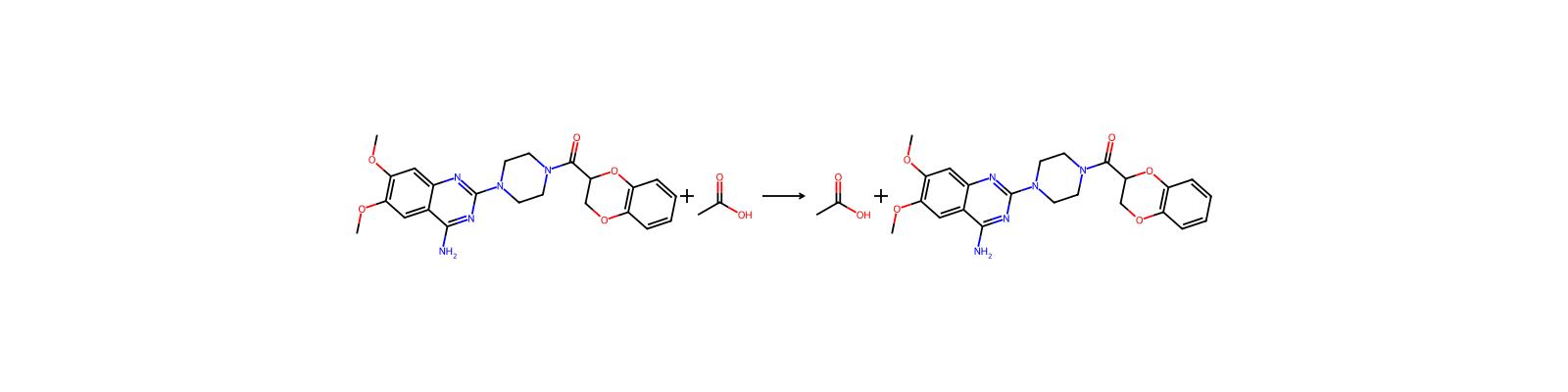
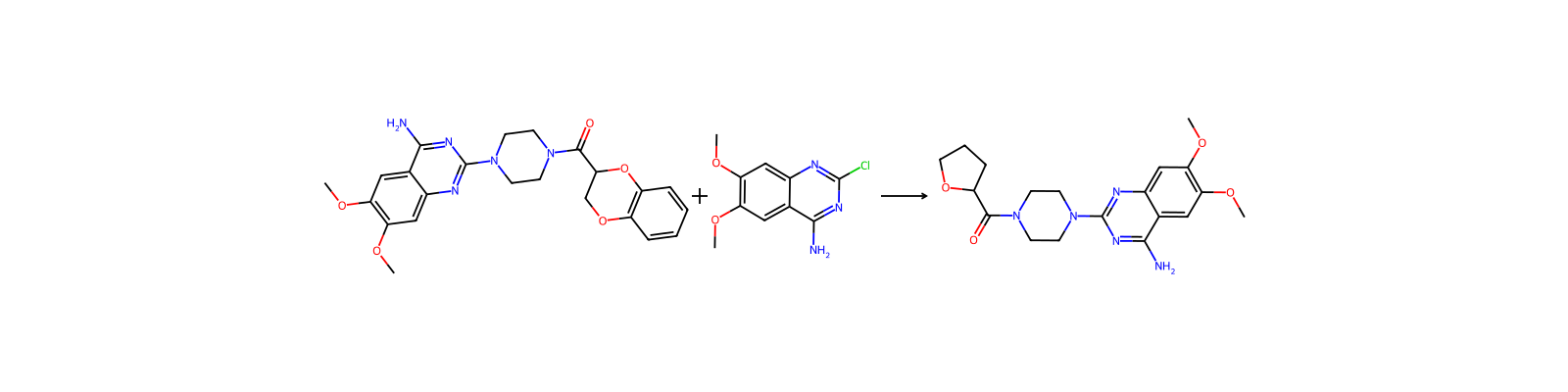
Related reactions
19 records




Compound notes
Loading…