HomeMCPWorkbenchSkills
HomeWorkbenchNotificationsMe
llms.txt · MCP GuidePrivacy Policy · Terms of Service · Supportv1.8.3
  1. Home
  2. /Compound

3-(2-Bromophenyl)propionic acid

HCID 316010
New reaction
Print
Basic informationNames & identifiersPropertiesSafety & regulationChemistry & industryRelated reactionsCompound notes
Substructure searchFind similar structures

Basic information

CAS
15115-58-9
Standard SMILES
O=C(O)CCc1ccccc1Br
InChIKey
AOACQJFIGWNQBC-UHFFFAOYSA-N
Molecular formula
C9H9BrO2
Average molar mass
229.07 g/mol
Monoisotopic mass
227.97859

Names & identifiers

Preferred name
3-(2-Bromophenyl)propionic acid
IUPAC
3-(2-bromophenyl)propanoic acid
English name
3-(2-Bromophenyl)propionic acid
Molecular formula
C9H9BrO2
Molecular weight
229.07

Names & synonyms

3-(2-Bromophenyl)propionic acidDTXSID30311434RefChem:490749DTXCID00262560629-087-915115-58-93-(2-bromophenyl)propanoic acidBENZENEPROPANOIC ACID, 2-BROMO-MFCD01310791SCHEMBL7573AB3202CS-W007510
Show more names
O-broMophenolpropionic acid2-bromobenzenepropionic acid3-(2-Bromophenyl)propionicaci2-BroMo-benzenepropanoic acidBenzenepropanoic acid,2-broMo-3-(2-Bromophenyl)propionicAcid>3-(2-Bromophenyl)propanoic acid 98%
NSC-2431893-(2-Bromophenyl)propionic acid, 97%3-(2-Bromophenyl)propionicacidBCP22392(r)-2-bromo-3-benzenepropanoic acidNSC243189FT-06020313-(bromophenyl)propionic acid

Database identifiers

CAS
15115-58-9
PubChem CID
316010
DTXSID
DTXSID30311434
EC Number
629-087-9
Nikkaji
J2.537.293J

Properties

Computed structural properties

XLogP
2.4
Topological polar surface area
37.3 Ų
Hydrogen bond donors
1
Hydrogen bond acceptors
2
Rotatable bonds
3
Heavy atoms
12
Formal charge
0
Complexity
159

Physicochemical properties

Melting point
98 · 98-102 °C (lit.)
Boiling point
186 °C/15mmHg · 186°C/15mmHg(lit.)
Density
1.531 · 1.531±0.06 g/cm3(Predicted)
refractive index
1.579 · 1.579
Flash point
154 · 154.0±20.9 °C
storage temp.
Sealed in dry,Room Temperature
solubility
soluble in Methanol
form
powder to crystal
pka
4.6 · 4.60±0.10(Predicted)
color
White to Orange to Green
InChI
InChI=1S/C9H9BrO2/c10-8-4-2-1-3-7(8)5-6-9(11)12/h1-4H,5-6H2,(H,11,12)
InChIKey
AOACQJFIGWNQBC-UHFFFAOYSA-N
SMILES
C1(CCC(O)=O)=CC=CC=C1Br
CAS DataBase Reference
15115 · 15115-58-9(CAS DataBase Reference)
Comptox DTXSID
30311434 · DTXSID30311434

Safety & regulation

Safety information is for reference only and does not replace the supplier’s Safety Data Sheet (SDS), applicable regulations, or professional assessment.

GHS classification

GHS Classification · 4 items

Warning

H302 (95.6%): Harmful if swallowed [Warning Acute toxicity, oral]

P261, P264, P264+P265, P270, P271, P280, P301+P317, P302+P352, P304+P340, P305+P351+P338, P319, P321, P330, P332+P317, P337+P317, P362+P364, P403+P233, P405, and P501 (click each P-code to see the statement)

Aggregated GHS information provided per 45 reports by companies from 5 notifications to the ECHA C&L Inventory. Each notification may be associated with multiple companies.

Hazard information

Hazard Classes and CategoriesAcute Tox. 4 (95.6%)

Safety data

PPE
dust mask type N95 (US), Eyeshields, Gloves
wgk
2
ridadr
3261
hs_code
2916399090
risk_code
22-36/37/38
Signal word
Warning
Symbol(GHS)
GHS07
hazard_code
Xn,Xi
safety_code
26-36
hazard_class
IRRITANT
Storage Class
11 - Combustible Solids
target organs
Respiratory system
Hazard statements
H302-H315-H319-H335
Hazard Classifications
Acute Tox. 4 OralEye Irrit. 2Skin Irrit. 2STOT SE 3

Chemistry & industry

Applications · 2 items

Uses3-(2-bromophenyl)propionic acid is an inexpensive and readily available raw material. The structure of the raw material itself is very similar to that of phenyllactic acid. If a hydroxyl group can be introduced at the α-position of its carboxylic acid branch, this would be a simple method for synthesizing tanshinone derivatives.

General Description3-(2-Bromophenyl)propionic acid is an important compound used as a pharmaceutical intermediate. It can be employed in the synthesis of compounds that reverse PD-1 resistance or macrolide compounds (MC4R agonists). The bromine atom and carboxyl group in its structure are key to the compound's high reactivity, facilitating the synthesis of other, more complex active molecules.

Upstream & downstream products

Downstream products

4-Bromo-2,3-dihydro-1H-inden-1-ol2-(2,3-dihydro-1H-inden-4-yl)-4,4,5,5-tetraMethyl-1,3,2-dioxaborolane2-(2-Carboxyethyl)phenylboronic acid, pinacol ester

Related reactions

37 records
New reaction record
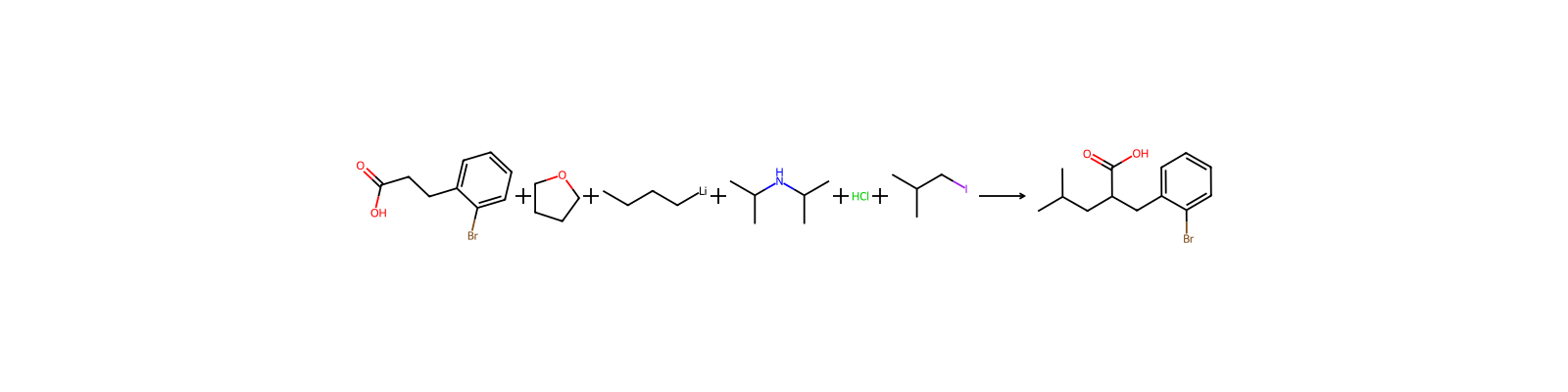
HRID 9281 reaction equation
HRID 9281As reactant
HRID 28741 reaction equation
HRID 28741As reactant
HRID 100737 reaction equation
HRID 100737As reactant
HRID 217783 reaction equation
HRID 217783As reactant
HRID 234076 reaction equation
HRID 234076As product
HRID 234077 reaction equation
HRID 234077As reactant
HRID 266035 reaction equation
HRID 266035As product
HRID 560059 reaction equation
HRID 560059As reactant
PreviousPage 1 of 5

Compound notes

On this pageBasic informationNames & identifiersPropertiesSafety & regulationChemistry & industryRelated reactionsCompound notes
UNSPSC Code
12352100 · 12352100
NACRES
22 · NA.22
Symbol(GHS)
7 · GHS07
Signal word
Warning
Hazard statements
302 · H302-H315-H319-H335
Precautionary statements
261 · P261-P264-P270-P301+P312-P302+P352-P305+P351+P338
target organs
Respiratory system
PPE
95 · dust mask type N95 (US), Eyeshields, Gloves
Hazard Codes
Xn,Xi
Risk Statements
22 · 22-36/37/38
Safety Statements
26 · 26-36
RIDADR
3261 · 3261
WGK Germany
2 · 2
HazardClass
IRRITANT
HS Code
2916399090 · 2916399090
Storage Class
11 · 11 - Combustible Solids
Hazard Classifications
4 OralEye · Acute Tox. 4 OralEye Irrit. 2Skin Irrit. 2STOT SE 3
Precautionary statements
P261-P264-P270-P301+P312-P302+P352-P305+P351+P338