
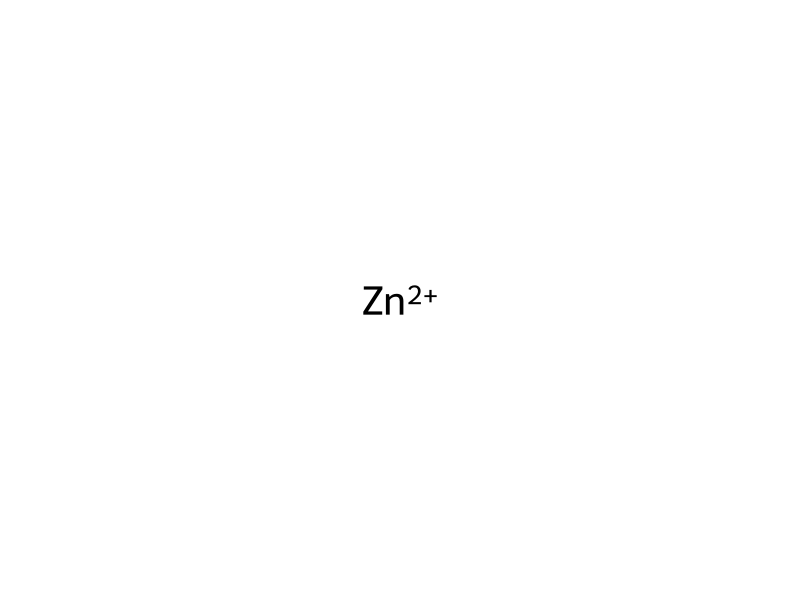
Basic information
- Standard SMILES
[Zn+2]- InChIKey
PTFCDOFLOPIGGS-UHFFFAOYSA-N- Molecular formula
- Zn+2
- Average molar mass
- 65.4 g/mol
- Monoisotopic mass
- 63.92804504
Overview
Zinc(2+) is a monoatomic dication, a divalent metal cation and a zinc cation. It has a role as a cofactor and a human metabolite.
Names & identifiers
- Preferred name
- Zinc(2+)
- IUPAC
- zinc(2+)
- English name
- zinc(+2) cation
- Molecular formula
- Zn+2
- Molecular weight
- 65.39
Names & synonyms
zinc ionzinc(2+)Zinc cation23713-49-7Zinc, ion (Zn2+)zinc(II)Zinc ionsZinc ion(2+)Zinc 2+13S1S8SF37Zn(II)CHEBI:29105
Show more names
RefChem:1101172CHEBI:27365CHEBI:63056Velmanase Alfa9025-42-7Topostin BZn2+Lamazym
Database identifiers
- CAS
1492823-75-2、23713-49-7、7440-66-6- PubChem CID
- 32051
- DTXSID
DTXSID40920495- ChEMBL
CHEMBL1236970- ChEBI
CHEBI:29105- UNII
- 13S1S8SF37
- Nikkaji
- J3.745.259I
Properties
Computed structural properties
- Topological polar surface area
- 0 Ų
- Hydrogen bond donors
- 0
- Hydrogen bond acceptors
- 0
- Rotatable bonds
- 0
- Heavy atoms
- 1
- Formal charge
- 2
- Complexity
- 0
Experimental & physicochemical properties
Melting Point419.5 °C
Physical DescriptionSolid
Physicochemical properties
- FDA UNII
- 13 S1S8SF37 · 13S1S8SF37
- EPA Substance Registry System
- Zinc, ion (Zn2+) (23713-49-7)
Safety & regulation
Safety & protection
Minimum Risk LevelIntermediate Oral: 0.3 mg/kg/day (L134)
Chronic Oral: 0.3 mg/kg/day (L134)
Toxicology
TreatmentZinc poisoning is treated symptomatically, often by administering fluids such as water or milk, or with gastric lavage. (L49)
Health Effects
Chronic exposure to zinc causes anemia, atazia, lethargy, and decreases the level of HDL (good) cholesterol in the body. It is also believed to cause pancreatic and reproductive damages. Unbalanced levels of copper and zinc binding to Cu,Zn-superoxide dismutase have been linked to amyotrophic lateral sclerosis (ALS). (L49)
Exposure RoutesOral (L49) ; inhalation (L49) ; dermal (113)
Toxicity Summary
Excessive zinc intake alters copper and iron absorption, most likely through competitive binding in intestinal mucosal cells. Stomach acid dissolves metallic zinc, producing zinc chloride, which is a corrosive product damaging the stomach lining. Metal fume fever is thought to be an immune response to inhaled zinc. (L48, L49, A49)
Signs and Symptoms
Ingestion of large doses of zinc causes stomach cramps, nausea, and vomiting. Acute inhalation of large amounts of zinc causes metal fume fever, which is characterized by chills, fever, headache, weakness, dryness of the nose and throat, chest pain, and coughing. Dermal contact with zinc results in skin irritation. (L49)
Carcinogen ClassificationNo indication of carcinogenicity to humans (not listed by IARC).
Toxicity DataLD50: 630 mg/kg (Oral, Rat) (T31)
Chemistry & industry
Pharmacology
ATC Code
A - Alimentary tract and metabolism
QA - Alimentary tract and metabolism
Protein BindingThere is no information.
Pharmacodynamics
Velmanase alfa is an enzyme replacement therapy that aims to reduce oligosaccharide levels in patients with alpha-mannosidosis. In clinical trials, reduced serum oligosaccharide levels and improvements in biochemical and functional measures were seen at 18 months and for up to four years of treatment. Reversing the organ damage or showing improvements in alpha-mannosidosis becomes increasingly difficult as the accumulation of end-organ damage progresses over time. Velmanase alfa has no effects on irreversible complications of the disorder, such as skeletal deformities, dysostosis multiplex, neurological manifestations, and impaired cognitive function.
Mechanism of Action
Alpha-mannosidosis is a rare autosomal recessive lysosomal storage disorder: it is a multi-systemic disease, characterized by a wide range of clinical manifestations including skeletal abnormalities, motor function impairment, intellectual disability, hearing loss, respiratory dysfunction, recurrent infections, and immunodeficiency usually presenting in early childhood. Alpha-mannosidosis is caused by pathogenic sequence variants in the MAN2B1 gene, leading to the deficiency of the lysosomal enzyme, alpha-mannosidase. Alpha-mannosidase is a lysosomal enzyme involved in glycoprotein catabolism. Deficient alpha-mannosidase results in the accumulation of mannose-rich oligosaccharides, causing impaired cellular function and apoptosis in all tissues. Velmanase alfa is a recombinant form of human alpha-mannosidase. Upon administration, velmanase alfa supplements or replaces natural alpha-mannosidase to properly break down hybrid and complex high-mannose oligosaccharides in the lysosome, reducing the amount of accumulated mannose-rich oligosaccharides.
Biological Half-LifeAt the end of intravenous infusion, velmanase alfa plasma concentrations fell in a biphasic fashion with a mean terminal elimination half-life of about 30 hours.
Metabolism/Metabolites
Velmanase alfa is expected to undergo nonspecific degradation into small peptides and subsequently amino acids, similar to other natural occurring proteins.
Zinc enters the body through the lungs, skin, and gastrointestinal tract. Intestinal absorption of zinc is controlled by zinc carrier protein CRIP and metallothioneins. Zinc is widely distributed in tissues and tissues fluids, and concentrated in the liver, gastrointestinal tract, kidney, skin, lung, brain, heart, and pancreas. Zinc binds to carbonic anhydrase in erythrocytes, and to albumin, α2-macroglobulin, and amino acids in the the plasma. Albumin and amino acid bound zinc can diffuse across tissue membranes. Zinc is excreted in the urine and faeces. (L49)
FDA Pharmacological Classification
13S1S8SF37
ZINC CATION
Established Pharmacologic Class [EPC] - Copper Absorption Inhibitor
Physiologic Effects [PE] - Decreased Copper Ion Absorption
Zinc cation is a Copper Absorption Inhibitor. The physiologic effect of zinc cation is by means of Decreased Copper Ion Absorption.
M91TG242P2
Absorption, Distribution and Excretion
Following weekly intravenous infusion of 1 mg/kg of velmanase alfa, the mean Cmax of 8 µg/mL at steady-state was reached at 1.8 hours after the start of administration.
There is no information.
The steady-state volume of distribution is 0.27 L/kg, indicating distribution confined to plasma. It does not cross the blood-brain barrier.
The mean clearance of velmanase alfa from plasma is 6.7 mL/h/kg: it is consistent with rapid cellular uptake of velmanase alfa via mannose receptors.
Metabolite Pathways2-Hydroxyglutric Aciduria (D And L Form)
Uses & manufacturing
Uses
Zinc has many commercial uses as coatings to prevent rust, in dry cell batteries, and can be mixed with other metals to produce alloys such as brass and bronze. Zinc compounds are widely used in industry to make paint, rubber, dyes, wood preservatives, and ointments. (L49)
Additional notes
DefinitionChEBI: Zinc(2+) is a divalent metal cation, a zinc cation and a monoatomic dication. It has a role as a human metabolite and a cofactor.
Related reactions
1,105 records


Linked notes
Loading…