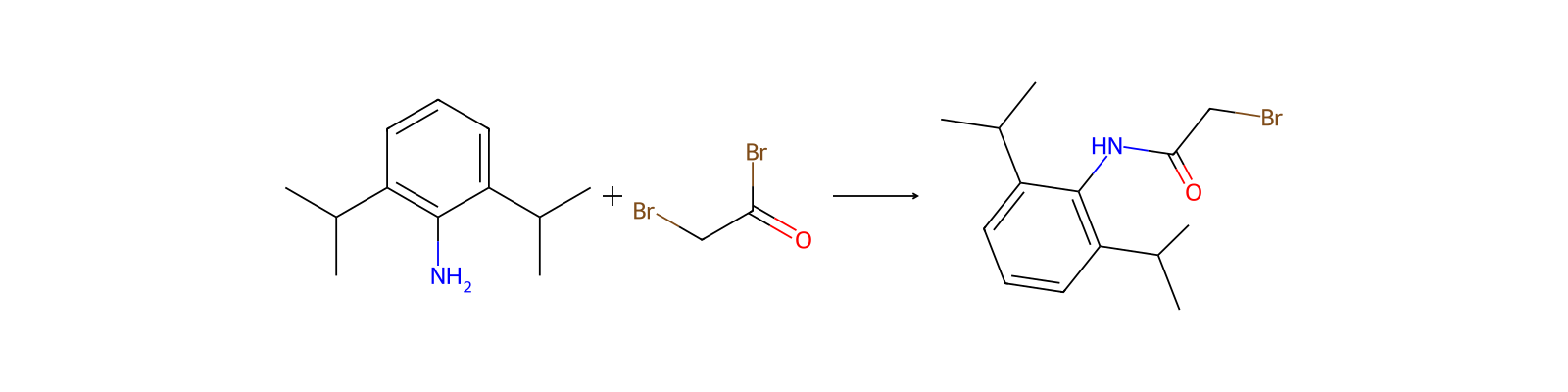
Diisopropylaniline

Basic information
- CAS
24544-04-5- Standard SMILES
CC(C)c1cccc(C(C)C)c1N- InChIKey
WKBALTUBRZPIPZ-UHFFFAOYSA-N- Molecular formula
- C12H19N
- Average molar mass
- 177.29 g/mol
- Monoisotopic mass
- 177.15174961
Names & identifiers
- Preferred name
- Diisopropylaniline
- IUPAC
- 2,6-di(propan-2-yl)aniline
- English name
- 2,6-Diisopropylaniline
- Molecular formula
- C12H19N
- Molecular weight
- 177.29
Names & synonyms
2,6-DIISOPROPYLANILINE24544-04-5Benzenamine, 2,6-bis(1-methylethyl)-diisopropylaniline2,6-DiisopropylphenylamineAniline, 2,6-diisopropyl-2,6-Diisopropyl aniline2,6-DilsopropylanilineDTXSID5022279BRN 2208763EINECS 246-305-4190BG0089I
Show more names
DIPA2,6-DiisopropylbenzenamineAmitraz E.C.2,6-Di(propan-2-yl)aniline2,6-bis(1-methylethyl)-benzenamin2,6-Di-i-propylaniline2,6-diisopropyl-anilin
DTXCID302279EC 246-305-43-12-00-02764 (Beilstein Handbook Reference)2,6diisopropyl aniline2,6DiisopropylphenylamineAniline, 2,6diisopropylRefChem:587932Benzenamine, 2,6bis(1methylethyl)
Database identifiers
- CAS
24544-04-5- PubChem CID
- 32484
- DTXSID
DTXSID5022279- ChEMBL
CHEMBL3183764- UNII
- 190BG0089I
- EC Number
- 246-305-4
- Nikkaji
- J33.769B
Properties
Computed structural properties
- XLogP
- 3.2
- Topological polar surface area
- 26 Ų
- Hydrogen bond donors
- 1
- Hydrogen bond acceptors
- 1
- Rotatable bonds
- 2
- Heavy atoms
- 13
- Formal charge
- 0
- Complexity
- 135
Experimental & physicochemical properties
Chemical ClassesNitrogen Compounds -> Amines, Aromatic
LogP3.18
Density0.94 @25 °C
Boiling Point257 °C @760 [mm Hg]
Melting Point-45 °C
Vapor Pressure0.00479 [mmHg]
Food Contact SubstancesFCS -> FDA Cumulative Estimated Daily Intake (CEDI)
Physical DescriptionLiquid; [Sigma-Aldrich MSDS]
Collision Cross Section146.6 Ų [M+H]+ [CCS Type: DT; Buffer gas: N2; Ionization: APCI+; Dataset: TOXCAST; Source Identifier: DTXSID5022279]
Physicochemical properties
Safety & regulation
Safety information is for reference only and does not replace the supplier’s Safety Data Sheet (SDS), applicable regulations, or professional assessment.
GHS classification
GHS Classification
This chemical does not meet GHS hazard criteria for 3.4% (2 of 58) of reports.
Warning
H319 (13.8%): Causes serious eye irritation [Warning Serious eye damage/eye irritation]
P264+P265, P273, P280, P305+P351+P338, P337+P317, and P501 (click each P-code to see the statement)
Aggregated GHS information provided per 58 reports by companies from 6 notifications to the ECHA C&L Inventory. Each notification may be associated with multiple companies.
Hazard information
Regulatory Information
Chemical: Benzenamine, 2,6-bis(1-methylethyl)-
Status: Active Update: 09-01-2019 https://echa.europa.eu/registration-dossier/-/registered-dossier/10001
Hazards SummaryCauses other liver changes and changes in bone marrow and spleen in oral lethal-dose studies of rats; [RTECS] May cause irritation; May induce methemoglobinemia; [Sigma-Aldrich MSDS]
Hazard Classes and CategoriesEye Irrit. 2 (13.8%)
Safety & protection
Protective Action Criteria (PAC)
9.6 [mg/m3]
110 [mg/m3]
630 [mg/m3]
Toxicology
Adverse EffectsMethemoglobinemia - The presence of increased methemoglobin in the blood; the compound is classified as secondary toxic effect
Chemistry & industry
Uses & manufacturing
General Manufacturing InformationBenzenamine, 2,6-bis(1-methylethyl)-: ACTIVE
Applications
Description2,6-Diisopropylaniline is an organic compound with the formula H2NC6H3(CHMe2)2 (Me = CH3). It is a colorless liquid although, like many anilines, samples can appear yellow or brown.
Uses2,6-Diisopropylaniline acts as an intermediate used in the production of carbodiimides stabilizers, synthetic resins, antioxidants and active pharmaceutical ingredients. It is also used in the preparation of multitopic Schiff-base ligand precursors and 4,5-bis(2,6-diisopropylanilino)-2,7-di-tert-butyl-9,9-dimethylthioxanthene. It also undergoes condensation reaction with triacetylmethane to get -[1-(2,6-diisopropylphenylamino)ethylidene]pentane-2,4-dione. Further, it is used to prepare N-heterocyclic carbene complexes for alfa-arylation of acyclic ketones, amination of haloarenes and aqueous Suzuki coupling. In addition to this, it is used in the prepartion of organocatalyst based on naphthalene diimides.
Uses2,6-Diisopropylaniline was used in the preparation of multitopic Schiff-base ligand precursors. It was also used in the preparation of NSN-donor proligand, 4,5-bis(2,6-diisopropylanilino)-2,7-di-tert-butyl-9,9-dimethylthioxanthene.
Uses2,6-Diisopropylaniline is used as intermediate for the manufacture of carbodiimides stabilizers, RIM-PUR, synthetic resins, pesticides, antioxidants, pharmaceuticals and other products. 2,6-Diisopropylaniline may be used in the preparation of multitopic Schiff-base ligand precursors.It may be used in the preparation of NSN-donor proligand, 4,5-bis(2,6-diisopropylanilino)-2,7-di-tert-butyl-9,9-dimethylthioxanthene. It may be used to prepare N-heterocyclic carbene complexes for α-arylation of acyclic ketones, amination of haloarenes, and aqueous Suzuki coupling. 2,6-Diisopropylaniline may be used in the preparation of organocatalyst based on naphthalene diimides (NDIs).
General Description2,6-Diisopropylaniline is an aromatic amine. It reacts with bis(trimethylsilylmethyl)yttrium complexes supported by bulky amidopyridinate (Ap) and amidinate (Amd) ligands to afford yttrium alkyl anilido species. This reaction involves the elimination of TMS (Trimethylsilane).
Related reactions
362 records


Compound notes
Loading…