
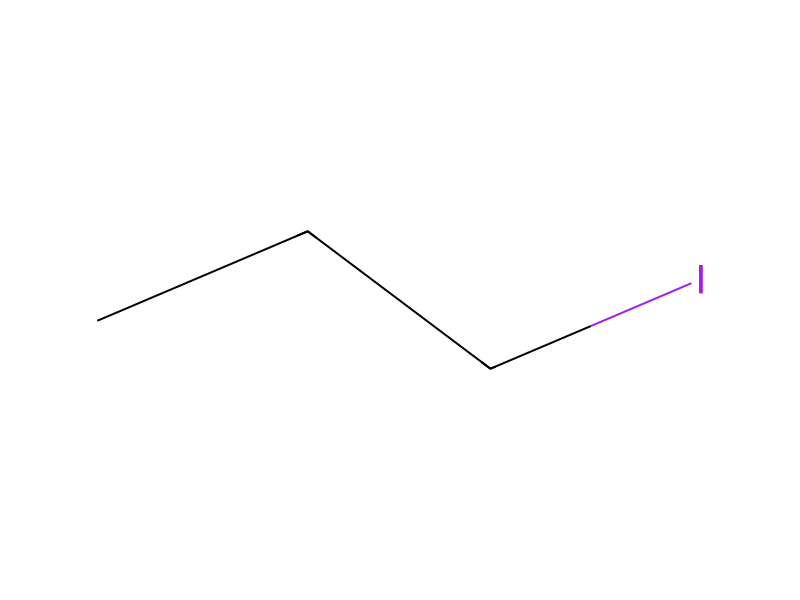
Basic information
- Standard SMILES
CCCI- InChIKey
PVWOIHVRPOBWPI-UHFFFAOYSA-N- Molecular formula
- C3H7I
- Average molar mass
- 169.99 g/mol
- Monoisotopic mass
- 169.95924822
Overview
Iodopropanes appears as a colorless liquid that discolors in air. Denser than water. The vapors are heavier than air. May be mildly toxic by inhalation. Used as a solvent and to make pharmaceuticals.
Names & identifiers
- Preferred name
- 1-Iodopropane
- IUPAC
- 1-iodopropane
- English name
- 1-Iodopropane
- Molecular formula
- C3H7I
- Molecular weight
- 169.99
Names & synonyms
1-IODOPROPANE107-08-4Propyl iodidePropane, 1-iodo-ND3629KE2KDTXSID501015653RefChem:869737DTXCID3037595203-460-2n-Propyl iodidePropane, iodo-1-iodo-propane
Show more names
n-C3H7IPropyljodid1-Iodpropanen-Propyliodid1-iodo-propanproopyl iodide
IODOPROPANE1-Jodpropan26914-02-3MFCD00001095PROPYLIODIDE1-Jodpropan [Czech]Propane Iodide; Propyl Iodide; n-Propyl Iodideiodopropan
Database identifiers
- CAS
107-08-4、26914-02-3- PubChem CID
- 33643
- DTXSID
DTXSID501015653- UNII
- ND3629KE2K
- EC Number
- 203-460-2
- Nikkaji
- J4.051G
Properties
Computed structural properties
- XLogP
- 2.6
- Topological polar surface area
- 0 Ų
- Hydrogen bond donors
- 0
- Hydrogen bond acceptors
- 0
- Rotatable bonds
- 1
- Heavy atoms
- 4
- Formal charge
- 0
- Complexity
- 7.2
Experimental & physicochemical properties
Chemical Classes
Other Classes -> Halogenated Aliphatics, Saturated
Flammable agents - 2nd degree
SpringerMaterials PropertiesCoriolis coupling
LogP2.54
Vapor Pressure43.1 [mmHg]
Physical Description
Iodopropanes appears as a colorless liquid that discolors in air. Denser than water. The vapors are heavier than air. May be mildly toxic by inhalation. Used as a solvent and to make pharmaceuticals.
Colorless or yellowish liquid; [Merck Index]
Physicochemical properties
- Melting point
- -101 °C · -101 °C
- Boiling point
- 101 · 101-102 °C(lit.)
- Density
- 1.743 g/mL · 1.743 g/mL at 25 °C(lit.)
- vapor pressure
- 43 mm · 43 mm Hg ( 25 °C)
- refractive index
- 20 · n20/D 1.504(lit.)
- Flash point
- 112 °F · 112 °F
- storage temp.
- 30 °C · Store below +30°C.
- solubility
- 1.1 g/l · 1.1g/l
- form
- Liquid
- color
- Clear colorless to yellow
- Water Solubility
- Fully miscible in water.
- Thermal Conductivity
- 0.087 W/ · 0.087 W/(m·K) at 25 ℃
- Sensitive
- Light Sensitive
- Merck
- 14 · 14,7862
- BRN
- 505937 · 505937
- Henry's Law Constant
- (x 10-3 atmm3/mol): 9.09 at 25 °C (Hine and Mookerjee, 1975)
- Dielectric constant
- 7.09 · 7.0899999999999999
- Stability
- Stable, but may discolour on exposure to light. Incompatible with strong oxidizing agents, strong bases. Flammable.
- InChI
- 1S/C3H7I/c1-2-3-4/h2-3H2,1H3
- InChIKey
- PVWOIHVRPOBWPI-UHFFFAOYSA-N
- SMILES
- CCCI
- CAS DataBase Reference
- 107 · 107-08-4(CAS DataBase Reference)
- FDA UNII
- 3629 KE2K · ND3629KE2K
- NIST Chemistry Reference
- 1 · Propane, 1-iodo-(107-08-4)
- EPA Substance Registry System
- 1 · Propane, 1-iodo- (107-08-4)
- UNSPSC Code
- 12352101 · 12352101
- NACRES
- 22 · NA.22
- Symbol(GHS)
- 2 · GHS02,GHS07
- Signal word
- Warning
- Hazard statements
- 332 · H332-H315-H319-H226
- Precautionary statements
- 501 · P501-P240-P261-P210-P233-P243-P241-P242-P271-P264-P280-P370+P378-P337+P313-P305+P351+P338-P362+P364-P303+P361+P353-P332+P313-P304+P340+P312-P403+P235
- target organs
- Respiratory system
- Hazard Codes
- Xn,Xi,N
- Risk Statements
- 10 · 10-20-36/37/38-52/53-2017/10/20
- Safety Statements
- 16 · 16-26-36/37-61
- RIDADR
- 2392 · UN 2392 (IODOPROPANES)
- WGK Germany
- 3 · 3
- RTECS
- 4100000 · TZ4100000
- F
- 8 · 8
- Hazard Note
- Irritant
- TSCA
- TSCA listed
- HazardClass
- 3 · 3
- PackingGroup
- III
- HS Code
- 29033080 · 29033080
- Storage Class
- 3 · 3 - Flammable liquids
- Hazard Classifications
- 4 InhalationAquatic · Acute Tox. 4 InhalationAquatic Chronic 1Carc. 2Eye Irrit. 2Flam. Liq. 3Muta. 2Skin Irrit. 2STOT SE 3
- Toxicity
- 50 · LD50 (inhalation) for rats 73,000 mg/m3/30-min (quoted, RTECS, 1985).
- REACH Registrations
- Active
- Limited Quantities
- 5 L · 5.0 L (1.3 gallons) (liquid)
- Excepted Quantities
- Max Inner Pack (30g or 30ml) and Max Outer Pack (1Kg or 1L)
Safety & regulation
GHS classification
GHS Classification
Warning
H226 (100%): Flammable liquid and vapor [Warning Flammable liquids]
P210, P233, P240, P241, P242, P243, P261, P264, P264+P265, P270, P271, P273, P280, P301+P317, P302+P352, P303+P361+P353, P304+P340, P305+P351+P338, P317, P319, P321, P330, P332+P317, P337+P317, P362+P364, P370+P378, P403+P233, P403+P235, P405, and P501 (click each P-code to see the statement)
Aggregated GHS information provided per 50 reports by companies from 9 notifications to the ECHA C&L Inventory. Each notification may be associated with multiple companies.
Hazard information
Regulatory Information
Chemical: Propane, 1-iodo-
Status: Active Update: 01-02-2018 https://echa.europa.eu/registration-dossier/-/registered-dossier/22093
1-Iodopropane: Does not have an individual approval but may be used under an appropriate group standard
The New Jersey Worker and Community Right to Know Act requires public and private employers to provide information about hazardous substances at their workplaces. (N.J.S.A. 34:5A-1 et. seq.)
DOT LabelFlammable Liquid
Fire HazardsExcerpt from ERG Guide 129 [Flammable Liquids (Water-Miscible / Noxious)]:
Health HazardsExcerpt from ERG Guide 129 [Flammable Liquids (Water-Miscible / Noxious)]:
Hazards SummaryAn irritant; Harmful by inhalation; [Alfa Aesar MSDS]
Reactive GroupHalogenated Organic Compounds
Reactivity AlertsHighly Flammable
Reactivity Profile
Halogenated aliphatic compounds, such as IODOPROPANE, are moderately or very reactive. Halogenated organics generally become less reactive as more of their hydrogen atoms are replaced with halogen atoms. Low molecular weight haloalkanes are highly flammable and can react with some metals to form dangerous products. Materials in this group are incompatible with strong oxidizing and reducing agents. Also, they are incompatible with many amines, nitrides, azo/diazo compounds, alkali metals, and epoxides.
Air and Water ReactionsHighly flammable. Slightly soluble in water.
Hazard Classes and Categories
Flam. Liq. 3 (100%)
Flammable agents - 2nd degree
Safety & protection
Fire FightingExcerpt from ERG Guide 129 [Flammable Liquids (Water-Miscible / Noxious)]:
First AidExcerpt from ERG Guide 129 [Flammable Liquids (Water-Miscible / Noxious)]:
Nonfire Spill ResponseExcerpt from ERG Guide 129 [Flammable Liquids (Water-Miscible / Noxious)]:
Isolation and EvacuationExcerpt from ERG Guide 129 [Flammable Liquids (Water-Miscible / Noxious)]:
Personal Protective Equipment (PPE)Excerpt from ERG Guide 129 [Flammable Liquids (Water-Miscible / Noxious)]:
Toxicology
Toxicity DataLC50 (rat) = 73,000 mg/m3/30min
Safety data
- F
- 8
- wgk
- 3
- tsca
- TSCA listed
- rtecs
- TZ4100000
- ridadr
- UN 2392 (IODOPROPANES)
- hs_code
- 29033080
- Toxicity
- LD50 (inhalation) for rats 73,000 mg/m3/30-min (quoted, RTECS, 1985).
- risk_code
- 10-20-36/37/38-52/53-2017/10/20
- Signal word
- Warning
- Symbol(GHS)
- GHS02,GHS07
- hazard_code
- Xn,Xi,N
- hazard_note
- Irritant
- safety_code
- 16-26-36/37-61
- hazard_class
- 3
- Storage Class
- 3 - Flammable liquids
- packing_group
- III
- target organs
- Respiratory system
- Hazard statements
- H332-H315-H319-H226
- Limited Quantities
- 5.0 L (1.3 gallons) (liquid)
- Excepted Quantities
- Max Inner Pack (30g or 30ml) and Max Outer Pack (1Kg or 1L)
- REACH Registrations
- Active
- Hazard Classifications
- Acute Tox. 4 InhalationAquatic Chronic 1Carc. 2Eye Irrit. 2Flam. Liq. 3Muta. 2Skin Irrit. 2STOT SE 3
- Precautionary statements
- P501-P240-P261-P210-P233-P243-P241-P242-P271-P264-P280-P370+P378-P337+P313-P305+P351+P338-P362+P364-P303+P361+P353-P332+P313-P304+P340+P312-P403+P235
Chemistry & industry
Pharmacology
Metabolism/Metabolites1-iodopropane has known human metabolites that include propyl-glutathione.
Uses & manufacturing
General Manufacturing InformationPropane, 1-iodo-: ACTIVE
Applications
Uses1-Iodopropane is used in wide range of medicals industrial applications as well as in human and animal nutrition products, pharmaceutical intermediates, polarizing films for Liquid Crystal Display (LCD) chemicals. Iodine derivatives are also used as organic building blocks, analytical reagents etc. It is also used as a solvent and intermediate of organic synthesis.
Upstream & downstream products
Upstream raw materials
Downstream products
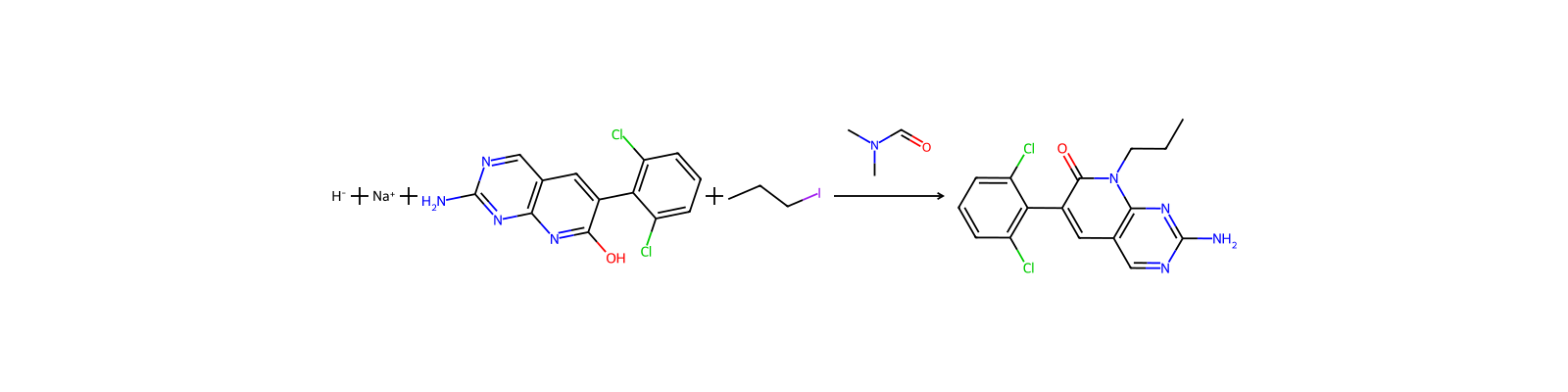
Related reactions
1,545 records



Linked notes
Loading…