HomeMCPWorkbenchSkills
HomeWorkbenchNotificationsMe
llms.txt · MCP GuidePrivacy Policy · Terms of Service · Supportv1.8.0
  1. Home
  2. /Compound

Flumazenil

HCID 3373
New noteNew reactionRequest quotes
Print preview
Basic informationOverviewNames & identifiersPropertiesSafety & regulationChemistry & industryRelated reactionsCompound notes
Substructure searchFind similar structures

Basic information

CAS
78755-81-4
Standard SMILES
CCOC(=O)c1ncn2c1CN(C)C(=O)c1cc(F)ccc1-2
InChIKey
OFBIFZUFASYYRE-UHFFFAOYSA-N
Molecular formula
C15H14FN3O3
Average molar mass
303.29 g/mol
Monoisotopic mass
303.10191953

Overview

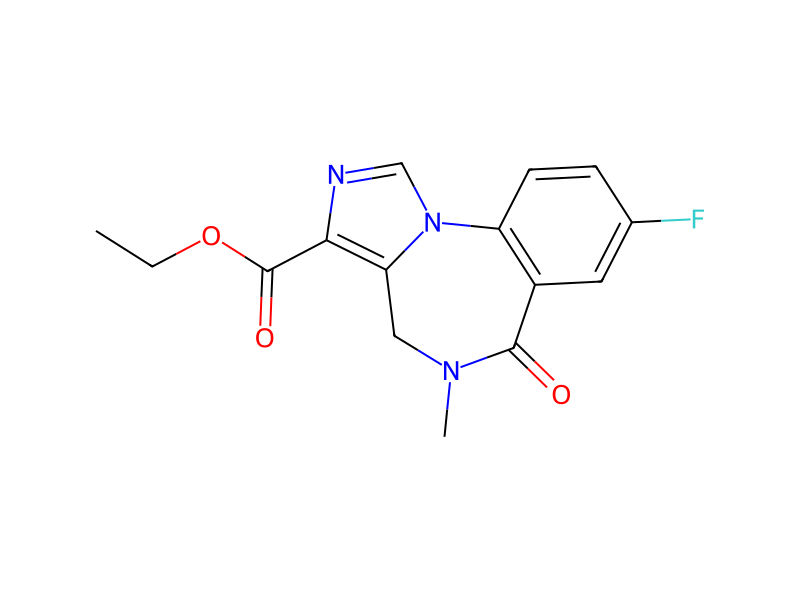
Flumazenil is an organic heterotricyclic compound that is 5,6-dihydro-4H-imidazo[1,5-a][1,4]benzodiazepine which is substituted at positions 3, 5, 6, and 8 by ethoxycarbonyl, methyl, oxo, and fluoro groups, respectively. It is used as an antidote to benzodiazepine overdose. It has a role as a GABA antagonist and an antidote to benzodiazepine poisoning. It is an imidazobenzodiazepine, an ethyl ester and an organofluorine compound.

Names & identifiers

Preferred name
Flumazenil
IUPAC
ethyl 8-fluoro-5-methyl-6-oxo-4H-imidazo[1,5-a][1,4]benzodiazepine-3-carboxylate
English name
Flumazenil
Molecular formula
C15H14FN3O3
Molecular weight
303.29

Names & synonyms

flumazenil78755-81-4AnexateFlumazepilRomaziconLanexatMaziconRo-15-1788FlumazenilumFlumazeniloDTXSID2023064Ro 151788
Show more names
FMZethyl 8-fluoro-5-Methyl-6-oxo-5,6-dihydro-4H-benzo[f]iMidazo[1,5-a][1,4]diazepine-3-carboxylateYM-684Ro 1722RO 15-1788
RO-151788NSC-759193DTXCID703064Ro 15-1788/000Ro-15-1788/0004H-Imidazo(1,5-a)(1,4)benzodiazepine-3-carboxylic acid, 8-fluoro-5,6-dihydro-5-methyl-6-oxo-, ethyl ester40P7XK9392RO-1722

Database identifiers

CAS
78755-81-4
PubChem CID
3373
DTXSID
DTXSID2023064
ChEMBL
CHEMBL407
ChEBI
CHEBI:5103
UNII
40P7XK9392
EC Number
616-650-9
Nikkaji
J23.594F

Properties

Computed structural properties

XLogP
1
Topological polar surface area
64.4 Ų
Hydrogen bond donors
0
Hydrogen bond acceptors
5
Rotatable bonds
3
Heavy atoms
22
Formal charge
0
Complexity
461

Experimental & physicochemical properties

Drugs · 2 items

Pharmaceuticals -> Listed in ZINC15

Pharmaceuticals -> Various

LogP · 2 items

1.9

1.26

Solubility1.04e+00 g/L
Human Drugs · 3 items

Breast Feeding; Lactation; Milk, Human; Antidotes; GABA Modulators; Benzodiazepines

FDA approved drugs -> Active ingredient

FDA approved drugs -> Active ingredient

Melting Point · 2 items

201-203 °C

201 - 203 °C

Physical DescriptionSolid
Collision Cross Section · 3 items

164.31 Ų [M+H]+ [CCS Type: TW; Method: calibrated with polyalanine and drug standards]

165.6 Ų [M+H]+ [CCS Type: TW; Method: calibrated with polyalanine and drug standards]

165.8 Ų [M+H]+ [CCS Type: TW; Method: Major Mix IMS/Tof Calibration Kit (Waters)]

Physicochemical properties

Safety & regulation

Safety information is for reference only and does not replace the supplier’s Safety Data Sheet (SDS), applicable regulations, or professional assessment.

GHS classification

GHS Classification · 5 items

This chemical does not meet GHS hazard criteria for 20% (1 of 5) of reports.

Warning

H302 (80%): Harmful if swallowed [Warning Acute toxicity, oral]

P261, P264, P270, P271, P301+P317, P304+P340, P317, P330, and P501 (click each P-code to see the statement)

Aggregated GHS information provided per 5 reports by companies from 2 notifications to the ECHA C&L Inventory. Each notification may be associated with multiple companies.

Hazard information

Hazard Classes and CategoriesAcute Tox. 4 (80%)

Toxicology

Adverse EffectsSerious Adverse Events
Toxicity SummaryFlumazenil has some associations with the precipitation of seizures in patients with benzodiazepine dependency with a history of seizures. However, flumazenil overdose is extremely rare.
Drug Induced Liver Injury · 6 items

Drug Induced Liver Injury Rank (DILIrank 2.0)

Flumazenil

vNo-DILI-concern

0

No match

DOI:10.1016/j.drudis.2016.02.015

Effects During Pregnancy and Lactation◉ Summary of Use during Lactation

Safety data

wgk
2
rtecs
NI2922170
hs_code

Chemistry & industry

Pharmacology

ATC Code · 2 items

V - Various

QV - Various

Protein BindingProtein binding is approximately 50%, mostly (66%) to albumin. Protein binding is reduced in patients with hepatic cirrhosis.
Pharmacodynamics · 1 item

Flumazenil antagonizes the CNS effects produced by benzodiazepines, but does not antagonize the central nervous system effects of drugs affecting GABA-ergic neurons by means other than the benzodiazepine receptor (including ethanol, barbiturates, or general anesthetics) and does not reverse the effects of opioids.

Mechanism of Action · 1 item

Flumazenil, an imidazobenzodiazepine derivative, is a benzodiazepine antagonist. It competitively inhibits the benzodiazepine binding site on the GABA/benzodiazepine receptor complex. Flumazenil is a weak partial agonist in some animal models of activity, but has little or no agonist activity in man.

Biological Half-Life · 1 item

Initial distribution half-life is 4 to 11 minutes and the terminal half-life is 40 to 80 minutes. Prolongation of the half-life to 1.3 hours in patients with moderate hepatic impairment and 2.4 hours in severely impaired patients. Compared to adults, the elimination half-life in pediatric patients was more variable, averaging 40 minutes (range: 20 to 75 minutes).

Metabolism/MetabolitesHepatic. Flumazenil is completely (99%) metabolized. The major metabolites of flumazenil identified in urine are the de-ethylated free acid and its glucuronide conjugate.
FDA Pharmacological Classification · 6 items

40P7XK9392

FLUMAZENIL

Established Pharmacologic Class [EPC] - Benzodiazepine Antagonist

Flumazenil is a Benzodiazepine Antagonist.

FLUMAZENIL

Benzodiazepine Antagonist [EPC]

MeSH Pharmacological Classification

Related reactions

68 records
New reaction record
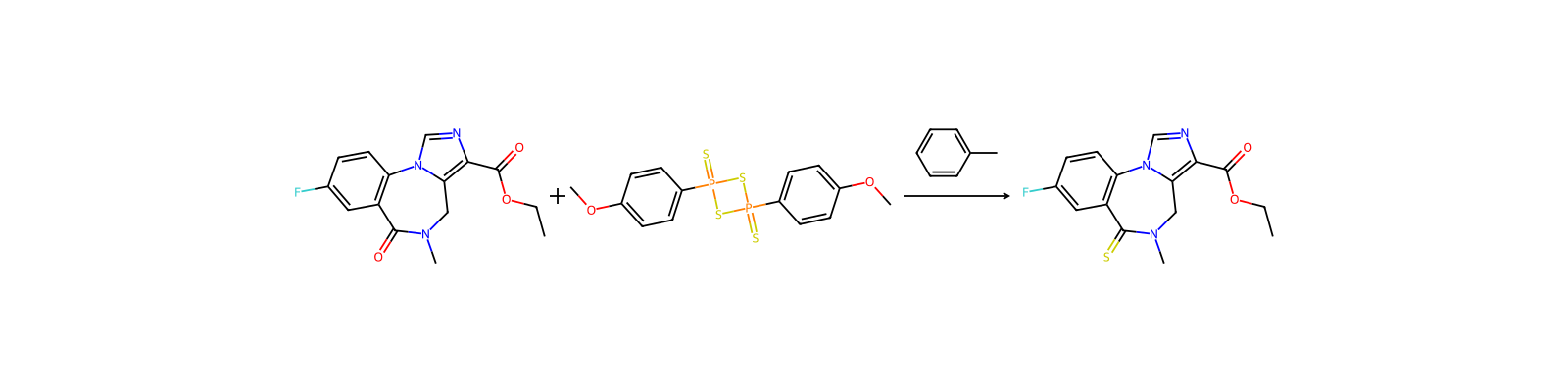
HRID 67291 reaction equation
HRID 67291As reactantuspto-grants-1982_08
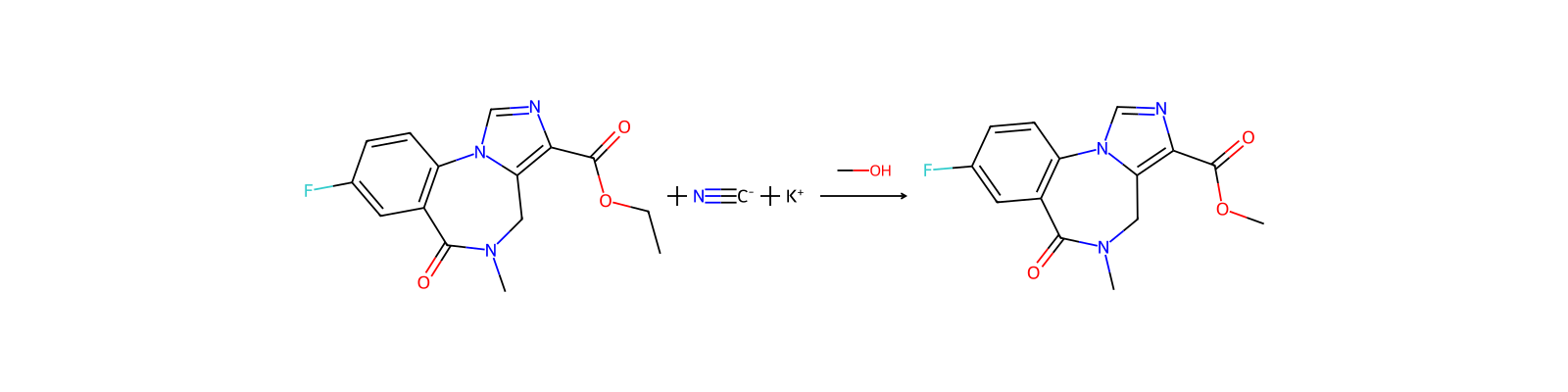
HRID 67292 reaction equation
HRID 67292As reactantuspto-grants-1982_08
HRID 67293 reaction equation
HRID 67293As reactantuspto-grants-1982_08
HRID 67294 reaction equation
HRID 67294As reactantuspto-grants-1982_08
HRID 67295 reaction equation
HRID 67295As reactantuspto-grants-1982_08
HRID 67299 reaction equation
HRID 67299As productuspto-grants-1982_08
HRID 67342 reaction equation
HRID 67342As reactantuspto-grants-1982_08
HRID 67343 reaction equation
HRID 67343As reactantuspto-grants-1982_08
Page 1 of 9

Compound notes

Loading…

On this pageBasic informationOverviewNames & identifiersPropertiesSafety & regulationChemistry & industryRelated reactionsCompound notes
More actions
New noteNew reactionRequest quotes
Melting point
201 · 201-203°C
Boiling point
528 · 528.0±50.0 °C(Predicted)
Density
1.39 · 1.39±0.1 g/cm3(Predicted)
storage temp.
2 · Sealed in dry,2-8°C
solubility
25 mM · Soluble in DMSO to 25mM
form
solid
pka
0.86 · 0.86±0.20(Predicted)
color
white
Water Solubility
128 mg/L · 128 mg/L
Merck
14 · 14,4135
Stability
2 years · Stable for 2 years from date of purchase as supplied. Solutions in DMSO may be stored at -20°C for up to 3 months.
Major Application
pharmaceutical (small molecule)
InChI
InChI=1S/C15H14FN3O3/c1-3-22-15(21)13-12-7-18(2)14(20)10-6-9(16)4-5-11(10)19(12)8-17-13/h4-6,8H,3,7H2,1-2H3
InChIKey
OFBIFZUFASYYRE-UHFFFAOYSA-N
SMILES
N12C=NC(C(OCC)=O)=C1CN(C)C(=O)C1=CC(F)=CC=C12
CAS DataBase Reference
78755 · 78755-81-4(CAS DataBase Reference)
FDA UNII
40 P7XK9392 · 40P7XK9392
ATC code
3 AB25 · V03AB25
NIST Chemistry Reference
Flumazenil(78755-81-4)
UNSPSC Code
41116107 · 41116107
NACRES
77 · NA.77
Protein binding
50 % · 50%
Excreted unchanged in urine
0.1 % · <0.1%
Volume of distribution
0.6 · 0.6-1.1
Biological half-life
0.7 · 0.7-1.3 / Unchanged
Symbol(GHS)
7 · GHS07
Signal word
Warning
Hazard statements
303 · H303
Precautionary statements
270 · P270-P301+P312-P403-P501c
Hazard Codes
Xi
Risk Statements
36 · 36/37/38
Safety Statements
26 · 26-27-36/37/39
WGK Germany
2 · 2
RTECS
2922170 · NI2922170
HS Code
2933997500 · 2933997500
Storage Class
11 · 11 - Combustible Solids
Toxicity
50 in · LD50 in mice, rats (mg/kg): 4000, 1360 i.p.; 4300, 6000 orally (Hunkeler)
2933997500
Toxicity
LD50 in mice, rats (mg/kg): 4000, 1360 i.p.; 4300, 6000 orally (Hunkeler)
risk_code
36/37/38
Signal word
Warning
Symbol(GHS)
GHS07
hazard_code
Xi
safety_code
26-27-36/37/39
Storage Class
11 - Combustible Solids
Hazard statements
H303
Precautionary statements
P270-P301+P312-P403-P501c
· 2 items

Agents counteracting or neutralizing the action of POISONS.

Substances that do not act as agonists or antagonists but do affect the GAMMA-AMINOBUTYRIC ACID receptor-ionophore complex. GABA-A receptors (RECEPTORS, GABA-A) appear to have at least three allosteric sites at which modulators act: a site at which BENZODIAZEPINES act by increasing the opening frequency of GAMMA-AMINOBUTYRIC ACID-activated chloride channels; a site at which BARBITURATES act to prolong the duration of channel opening; and a site at which some steroids may act. GENERAL ANESTHETICS probably act at least partly by potentiating GABAergic responses, but they are not included here.

Absorption, Distribution and Excretion · 3 items

Flumazenil is completely (99%) metabolized. Elimination of radiolabeled drug is essentially complete within 72 hours, with 90% to 95% of the radioactivity appearing in urine and 5% to 10% in the feces.

0.9 to 1.1 L/kg

1 L/hr/kg [healthy volunteers receiving a 5-minute infusion of a total of 1 mg]

Cellular LocationsMembrane

Applications

DescriptionFlumazenil is a benzodiazepine antagonist useful as a fast-acting antidote in the treatment of benzodiazepine intoxication, and in reversing the central sedative effects of benzodiazepines during anesthesia.

UsesFlumazenil is an imidazodiazepine which selectively blocks the central effects of classic benzodiazepines. It is used as benzodiazepine antagonist sedation reversal drug.

Preparation methods · 1 item

PreparationThe Synthesis of FlumazenilStarting with 4-fluoroaniline (15) the isatin 17 is synthesized via the Sandmeyer synthesis; isatin is then oxidized with peracetic acid to the isatoic anhydride 18. Reaction with sarcosine in DMF leads to the benzodiazepine-2,5-dione 19. This is converted to the iminochloride by reaction with POCI3 . In the key step the imidazoester is built up by reaction with deprotonated ethyl isocyanoacetate [8]. Since ethyl isocyanoacetate is not very stable, an alternative synthesis based on the synthesis of midazolam was developed for large scale-production. Tnthis synthesis diethylmalonate is used. The diester 21 is then transformed to the monoester 22 hy deethoxycarbonylation. Nitrosation and catalytic reduction lead to the amino compound 23. The final carbon atom is introduced by reaction with the orthoester.

Upstream & downstream products

Upstream raw materials

6-Fluoroisatoic anhydrideHydrogen peroxide5-FluoroisatinN,N-DimethylanilineSodium tert-butoxideAnthranilic acidSarcosineEthyl cyanoacetatePotassium Acetate

Downstream products

4H-Imidazo[1,5-a][1,4]benzodiazepine-3-carboxylic acid, 8-fluoro-5,6-dihydro-5-methyl-6-oxo-
Additional notes · 1 item

DefinitionChEBI: Flumazenil is an organic heterotricyclic compound that is 5,6-dihydro-4H-imidazo[1,5-a][1,4]benzodiazepine which is substituted at positions 3, 5, 6, and 8 by ethoxycarbonyl, methyl, oxo, and fluoro groups, respectively. It is used as an antidote to benzodiazepine overdose. It has a role as a GABA antagonist and an antidote to benzodiazepine poisoning. It is an ethyl ester, an organofluorine compound and an imidazobenzodiazepine.