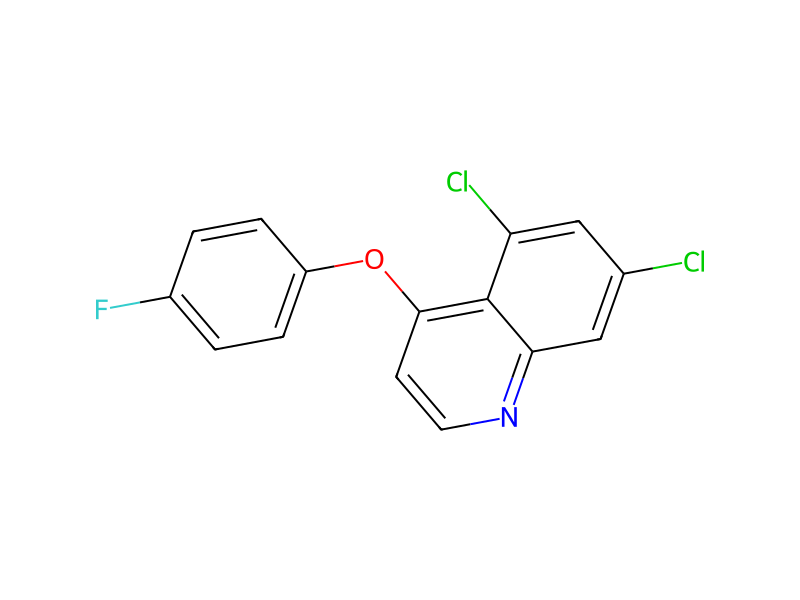
124495-18-7Fc1ccc(Oc2ccnc3cc(Cl)cc(Cl)c23)cc1WRPIRSINYZBGPK-UHFFFAOYSA-N124495-18-7DTXSID2034881CHEMBL1869863CHEBI:82040Crystals from heptane
Off-white solid
In acetone 116, dichloromethane 589, ethyl acetate 179, methanol 21.5, n-octanol 37.9, toluene 272, hexane 9.64, xylene 200 (all in g/L, 20 °C)
In water, 0.128 (pH 5); 0.047 (pH 7); 0.036 (pH 9) (all in g/L, 20 °C)
In water, 116 ug/L at 20 °C (pH 6.45)
105-106 °C
MP: 100-106 °C /Technical/
Warning
H317: May cause an allergic skin reaction [Warning Sensitization, Skin];H400: Very toxic to aquatic life [Warning Hazardous to the aquatic environment, acute hazard];H410: Very toxic to aquatic life with long lasting effects [Warning Hazardous to the aquatic environment, long-term hazard]
P261, P272, P273, P280, P302+P352, P321, P333+P317, P362+P364, P391, and P501 (click each P-code to see the statement)
Warning
Commission Regulation No 844/2012
Quinoxyfen is listed in the dataset of EPA Human Health Benchmarks for Pesticides under the Safe Drinking Water Act (40 eCFR 141)
04/60/EC, Reg. (EU) 2016/2016, Reg. (EU) 2018/1914, Reg. (EU) No 540/2011, Reg.(EU)2018/524
Status: Cease Manufacture Update: 04-12-2019 https://echa.europa.eu/registration-dossier/-/registered-dossier/28346
Quinoxyfen: Does not have an individual approval but may be used under an appropriate group standard
Tolerances are established for residues of the fungicide quinoxyfen, 5,7-dichloro-4-(4-fluorophenoxy)quinoline in or on the following raw agricultural commodities: [Table#7839]
Reregistration Eligibility Decision (RED) Scheduled for 2014
During a fire, smoke may contain the original material in addition to combustion products of varying composition which may be toxic and/or irritating. Combustion products may include and are not limited to: nitrogen oxides, fluorine, chlorine, carbon monoxide, and carbon dioxide. /Quintec Fungicide/
Skin Sens. 1B (100%);Aquatic Acute 1 (100%);Aquatic Chronic 1 (100%)
Skin sensitisation - category 1;Hazardous to the aquatic environment (acute) - category 1;Hazardous to the aquatic environment (chronic) - category 1
The jugular-vein cannulated rats (five males and five females per group) were killed at 48 hr after dosing. The bile-duct cannulated rats (three males per group) were killed at 24 hr after dosing. Blood samples were taken from the jugular cannula at 0.25, 0.5, 0.75, 1, 1.5, 3, 6, 12, 24 and 48 hr. Urine, feces and bile were collected regularly throughout the study. ... The elimination of plasma radioactivity followed a biphasic pattern with half-lives for the rapid and slow phases for the dose at 10 mg/kg bw of < 1 hr and 15-19 hr respectively, and 2-3 hr and 18-22 hr for the dose at 500 mg/kg bw. There were no significant differences between the repeat-dose and single-dose groups. ...
Groups of 5 Fischer 344 rats/sex were given a single 10 or 500 mg/kg oral dose of quinoline ring-labeled (14)C- quinoxyfen (XDE-795, >99% radiochemically pure, specific active 28.5 mCi/mmole), or 14 daily oral doses of 10 mg/kg of non-radiolabelled quinoxyfen (XDE-795, 99% pure) followed by a single 10 mg/kg oral dose of (14)C- quinoxyfen. Additional groups of 3 male bile duct cannulated rats received a single dose of 10 or 500 mg/kg quinoline ring-labelled (14)C- quinoxyfen and were sacrificed 24 hrs later. One rat/sex/group received 10 mg/kg of either phenyl ring (98.5% radiochemically pure, specific active 27.8 mCi/mmole) or quinoline ring-labelled (14)C- quinoxyfen for metabolite analysis. ... Major metabolites identified in the urine were derived from cleavage of the diaryl-ether linkage quinoxyfen resulting in the formation of acid-labile conjugates of 4-fluorophenol (4-FP) and 5, 7-dichloro-4-hydroxyquinoline (DCHQ), and lesser quantities of free DCHQ and 4-FP. Glucuronide and/or sulfate conjugates of two isomers of fluorophenyl ring-hydroxy- quinoxyfen were detected in the bile. Parent quinoxyfen and free forms of the same two isomers of fluorophenyl ring-hydroxy- quinoxyfen as seen in the bile were detected in feces. No substantive differences in the metabolism and disposition of quinoxyfen between sexes or single and repeated administration.
HPLC separation of pooled 0-12 hr urine samples from the preliminary study in rats given phenyl-ring-labelled (14)C-quinoxyfen produced eight peaks that were designated P1-P7 and P10. Peak P5 was the major urinary fraction in the unhydrolyzed urine sample (80% and 77.4% in the male and female respectively) followed by P3 (7.9% and 9.5%), P1 (4.2% and 4.7%) and P6 (3.1% and 3.0%). The remaining peaks contained less than 3% of the urinary radiolabel. Acid hydrolysis of the urine produced a significant change in the HPLC profile. The major fraction in unhydrolyzed urine was reduced to only 2.4% of the urine fraction; instead, P8 (not detectable in the unhydrolyzed sample) was the major fraction (73.6%). This suggested that P5 might be a conjugate of P8. The P8 fraction was found to co-elute with the standard for 4-fluorophenol. The remaining minor peaks after acid hydrolysis were P3 (11.7%), P9 (7.1%) and P1 (5.2%), but these metabolites were not identified. The standards used were 4-fluorophenol, 2-hydroxy-quinoxyfen and parent quinoxyfen. Parent quinoxyfen and 2-hydroxy-quinoxyfen retention times did not correspond to that of any of the HPLC urinary fractions. Fecal metabolites from phenyl-(14)C quinoxyfen showed a similar pattern to those from quinoline-(14)C quinoxyfen.
Loading…
Positive
3.97
2.7
Agilent XCT
Electrospray ionization
formic acid (5.3nM)
Skin Sens. 1;Aquatic Acute 1;Aquatic Chronic 1
Wear positive-pressure self-contained breathing apparatus (SCBA) and protective fire fighting clothing (includes fire fighting helmet, coat, trousers, boots, and gloves). If protective equipment is not available or not used, fight fire from a protective location or safe distance. /Quintec Fungicide/
Keep people away. Isolate fire and deny unnecessary entry. Consider feasibility of a controlled burn to minimize environment damage. foam fire extinguishing system is preferred because uncontrolled water can spread possible contamination. Burning liquids may be moved by flushing with water to protect personnel and minimize property damage. /Quintec Fungicide/
Extinguishing media: Water fog or fine spray, carbon dioxide, dry chemical, or foam. General purpose synthetic foams (including AFFF type) or protein foams are preferred if available. Alcohol resistant foams (ATC type) may function. /Quintec Fungicide/
Avoid freezing. Store in original container only.
Keep out of reach of children. Store in a dry place, 0-30 °C. use only with adequate ventilation. Protect from heat. Store in original container. /Quintec Fungicide/
Prevent from entering into soil, ditches, sewers, waterways, and/or groundwater.
Large spills: Dike area to contain spill.
Do not contaminate water when cleaning equipment or disposing of equipment washwaters.
SRP: The most favorable course of action is to use an alternative chemical product with less inherent propensity for occupational harm/injury/toxicity or environmental contamination. Recycle any unused portion of the material for its approved use or return it to the manufacturer or supplier. Ultimate disposal of the chemical must consider: the material's impact on air quality; potential migration in soil or water; effects on animal and plant life; and conformance with environmental and public health regulations.
Wastes resulting from the sue of this product must be disposed of on site or at an approved waste disposal facility.
Do not dump into any sewers, on the ground, or into any body of water. For unused and uncontaminated product, the preferred options include sending to a licensed, permitted: reclaimer or incinerator or other thermal destruction device. If wastes and/or containers cannot be disposed of according to the product label directions, disposal of this material must be in accordance with your local or area regulatory authorities.
SRP: Wastewater from contaminant suppression, cleaning of protective clothing/equipment, or contaminated sites should be contained and evaluated for subject chemical or decomposition product concentrations. Concentrations shall be lower than applicable environmental discharge or disposal criteria. Alternatively, pretreatment and/or discharge to a permitted wastewater treatment facility is acceptable only after review by the governing authority and assurance that "pass through" violations will not occur. Due consideration shall be given to remediation worker exposure (inhalation, dermal and ingestion) as well as fate during treatment, transfer and disposal. If it is not practicable to manage the chemical in this fashion, it must be evaluated in accordance with EPA 40 CFR Part 261, specifically Subpart B, in order to determine the appropriate local, state and federal requirements for disposal.
Use this product only in accordance with its labeling and with the Worker Protection Standard, 40 CFR Part 170. /Quintec Fungicide/
This product is toxic to fish and aquatic invertebrates. Do not apply directly to water, or to areas where surface water is present or to intertidal areas below the mean high water mark. Do not apply when weather conditions favor runoff or drift from the target areas. /Quintec Fungicide/
Follow manufacturer's instructions for cleaning/maintaining personal protective equipment (PPE). If not such instructions for wasables exist, use detergent and hot water. Keep and was PPE separately from other laundry. /Quintec Fungicide/
Users should: Wash hands before eating, drinking, chewing gum, using tobacco or using the toilet. Remove contaminated clothing immediately if pesticide gets inside. Then wash thoroughly and put on clean clothing. Remove personal protective equipment (PPE) immediately after handling this product. Wash the outside of gloves before removing. As soon as possible, wash thoroughly and change into clean clothing. /Quintec Fungicide/
For more Preventive Measures (Complete) data for Quinoxyfen (7 total), please visit the HSDB record page.
Applicators and other handlers must wear: Long-sleeved shirt and long pants, chemical-resistant gloves, shoes plus socks. /Quintec Fungicide/
... Restricted-entry interval (REI) of 12 hours. Personal protective equipment (PPE) required for early entry to treated areas that is permitted under the Worker Protection Standard and that involves contact with anything that has been treated, such as plants, soil, or water is: Coveralls, Chemical resistant gloves made of any waterproof material. Shoes plus socks. /Quintec Fungicide/
EC50; Species: Selenastrum capricornutum (Green Algae); Concentration: >0.058 mg/L for 72 hr; Effect: Biomass /Conditions of bioassay not specified in source examined/
EC50; Species: Daphnia magna (Water Flea); Concentration: >0.08 mg/L for 48 hr /Conditions of bioassay not specified in source examined/
LC50; Species: Oncorhynchus mykiss (Rainbow Trout); Concentration: 0.27 mg/L for 96 hr /Conditions of bioassay not specified in source examined/
LC50; Species: Lepomis macrochirus (Bluegill); Concentration: >0.28 mg/L for 96 hr /Conditions of bioassay not specified in source examined/
For more Ecotoxicity Values (Complete) data for Quinoxyfen (7 total), please visit the HSDB record page.
TERRESTRIAL FATE: Based on a classification scheme(1), an estimated Koc value of 3600(SRC), determined from a log Kow of 4.66(2) and a regression-derived equation(3), indicates that quinoxyfen is expected to have slight mobility in soil(SRC). Volatilization of quinoxyfen from moist soil surfaces is expected to be a minor environmental fate process(SRC) given an estimated Henry's Law constant of 9.6X10⁻⁹ atm-cu m/mole(SRC), using a fragment constant estimation method(4). Quinoxyfen is not expected to volatilize from dry soil surfaces(SRC) based upon a vapor pressure of 1.5X10⁻⁷ mm Hg at 25 °C(2). Quinoxyfen biodegradation half-lives in soils have been reported to range from 106-508 days(2), suggesting that biodegradation is not an important environmental fate process(SRC).
AQUATIC FATE: Based on a classification scheme(1), an estimated Koc value of 3600(SRC), determined from a log Kow of 4.66(2) and a regression-derived equation(3), indicates that quinoxyfen is expected to adsorb to suspended solids and sediment(SRC). Volatilization from water surfaces is not expected(4) based upon an estimated Henry's Law constant of 9.6X10⁻⁹ atm-cu m/mole(SRC), developed using a fragment constant estimation method(5). According to a classification scheme(6), an estimated BCF of 550(SRC), from its log Kow(2) and a regression-derived equation(7), suggests the potential for bioconcentration in aquatic organisms is high, provided the compound is not metabolized by the organism(SRC). Photolysis in water is an important environmental fate process with half-lives of 1.7 hours (June) and 22.8 hours (December) reported(2). Using a water/sediment inoculum, half-lives of 35 to 150 days have been reported(2), suggesting that biodegradation is an environmental fate process in water(SRC).
ATMOSPHERIC FATE: According to a model of gas/particle partitioning of semivolatile organic compounds in the atmosphere(1), quinoxyfen, which has a vapor pressure of 1.50X10⁻⁷ mm Hg at 25 °C(2), will exist in both the vapor and particulate phases in the ambient atmosphere. Vapor-phase quinoxyfen is degraded in the atmosphere by reaction with photochemically-produced hydroxyl radicals(SRC); the half-life for this reaction in air is estimated to be 1 day(SRC), calculated from its rate constant of 5.3X10⁻¹² cu cm/molecule-sec at 25 °C(SRC) that was derived using a structure estimation method(3). Particulate-phase quinoxyfen may be removed from the air by wet or dry deposition(SRC). Quinoxyfen contains chromophores that absorb at wavelengths >290 nm(4), and therefore may be susceptible to direct photolysis by sunlight(SRC).
EXPERIMENTAL: (14)C-quinoxyfen, labeled either in the phenoxy ring or the quinoline ring, was investigated in lactating dairy goats (n = 5; 51-60 kg bw). Two goats were orally dosed with phenoxy (14)C-quinoxyfen (purity: > 98%), twice per day for five consecutive days, at a concentration of 10.7 mg/kg feed. Similarly, two goats were treated with quinoline (14)C-quinoxyfen, twice per day for five consecutive days, at a concentration of 11.7 mg/kg feed. The remaining goat was used as the untreated control animal. Urine and feces were collected at intervals of 24 hrs until sacrifice. Milk samples were collected before the first treatment with quinoxyfen, and then twice daily throughout the study period until animals were sacrificed. ... The major component present in fat was quinoxyfen (approximately 90% TRR /total radio-labeled residue/), while milk contained quinoxyfen (approximately 40% TRR) and some very polar material. ...
The Koc of quinoxyfen is estimated as 3600(SRC), using a log Kow of 4.66(1) and a regression-derived equation(2). According to a classification scheme(3), this estimated Koc value suggests that quinoxyfen is expected to have slight mobility in soil.
/HUMAN EXPOSURE STUDIES/ A formulation chemist ... was shown to be sensitized to aqueous solutions containing 10% or more quinoxyfen. No other cases had been found after checking all employees who have worked with the material. In addition, 20 control individuals were patch-tested specifically with quinoxyfen and this produced an entirely negative reaction. The data from the formulation laboratory were suggested by the applicant to indicate that there is a small possibility for idiosyncratic skin sensitization. Since the formulation chemist may have been sufficiently exposed to be sensitized compared with other workers and given the additional evidence from animal experiments, this finding is consistent with quinoxyfen being a skin sensitizer.
/CASE REPORTS/ ... Two operators and a supervisor were exposed to quinoxyfen while decanting a returned batch of a 50% w/w soluble concentrate formulation. All three developed rashes of the wrist/forearm. The supervisor and one operator were tested for sensitization to quinoxyfen, with positive results. The other operator had left the company before the follow-up testing was performed.
/SURVEILLANCE/ None of 28 individuals in a health surveillance program reported or presented for health concerns related to quinoxyfen between June 1992 and March 1995. Audits of clinical records of all individuals involved in the investigations were performed and no health-related problems relating to quinoxyfen were noted.
AEROBIC: Quinoxyfen biodegradation half-lives in soils have been reported to range from 106-508 days using 7 unspecified soils incubated at 20 to 25 °C(1).
ANAEROBIC: Quinoxyfen biodegradation half-life in soil has been reported as 289 days at 20 °C. Using a water/sediment inoculum maintained in the dark, half-lives of 35 to 150 days have been reported, yielding 2-oxoquinoxyfen(1).
An estimated BCF of 550 was calculated in fish for quinoxyfen(SRC), using a log Kow of 4.66(1) and a regression-derived equation(2). According to a classification scheme(3), this BCF suggests the potential for bioconcentration in aquatic organisms is high(SRC), provided the compound is not metabolized by the organism(SRC).
The Henry's Law constant for quinoxyfen is estimated as 9.6X10⁻⁹ atm-cu m/mole(SRC) using a fragment constant estimation method(1). This Henry's Law constant indicates that quinoxyfen is expected to be essentially nonvolatile from water and moist soil surfaces(2). Quinoxyfen is not expected to volatilize from dry soil surfaces(SRC) based upon a vapor pressure of 1.5X10⁻⁷ mm Hg(3).
/LABORATORY ANIMALS: Acute Exposure/ Quinoxyfen was not irritating to skin, but was slightly irritating to rabbits' eyes. A study of skin sensitization by the Buehler method gave negative results, but a second study using the Magnusson & Kligman maximization method produced clear evidence of skin sensitization.
/LABORATORY ANIMALS: Subchronic or Prechronic Exposure/ Groups of four male and four female beagle dogs were fed diets containing quinoxyfen (purity: 98.7%) at nominal doses of 0 (control) 10, 50 or 100 mg/kg bw per day for 90 days. The parameters assessed were in-life observations, body weight and body-weight gain, feed consumption, hematology, clinical chemistry, urine analysis, organ weights, gross and histopathological evaluations. The achieved mean daily compound intakes were 10, 50 and 100 mg/kg bw per day in males and 10, 50 and 101 mg/kg bw per day in females at nominal doses of 10, 50 and 100 mg/kg bw per day. At the start of treatment, body weights ranged from 8.19 to 10.82 kg in male dogs and 7.48-9.30 kg in female dogs. No mortalities occurred during the study period. There were no adverse effects on animal behavior. Ophthalmological examinations at the beginning and on day 87 of the study did not reveal any treatment-related ocular defects. A slight transient reduction in food consumption was observed in the highest dose males but the animals adapted to the initial unpalatability. However, it was noted that females at the highest dose consumed more feed than did controls. Body-weight gain was not affected. Clinical chemistry, urine analysis and hematology parameters did not show any biologically significant treatment-related changes. The terminal body weights and organ weights did not show any significant treatment related intergroup differences; increased relative liver weights in the groups at 50 mg/kg bw per day were not reproduced at 100 mg/kg bw per day. Gross examination at necropsy did not reveal any significant treatment-related changes. Histopathological examination revealed only a single incidence of slight and midzonal centrilobular hepatocellular hypertrophy, with no associated clinical chemistry or additional histopathology findings, which indicated that the dose of 100 mg/kg bw per day may represent a threshold dose for histopathological
/LABORATORY ANIMALS: Subchronic or Prechronic Exposure/ In a GLP compliant study, groups of 10 male and 10 female Fischer 344 rats were given diets containing quinoxyfen (purity, 98.7%) at a dose of 0 (control), 10, 100 or 250 mg/kg bw per day for 13 weeks. All animals were killed at the end of the treatment period and underwent necropsy. Additional satellite groups of 10 male and 10 female rats were fed doses of 0 or 250 mg/kg bw per day for 13 weeks and then kept on a quinoxyfen-free diet for an additional 4 weeks in order to investigate recovery from any effects. The achieved daily intakes of quinoxyfen were 10, 102 and 253 mg/kg bw per day) in males and 10, 100 and 249 mg/kg bw per day in females at nominal doses of 10, 100 and 250 mg/kg bw per day, respectively. The parameters investigated included in-life observations, a battery of functional tests, hematology, clinical chemistry, urine analysis, organ weights, gross and histopathological examinations of organs and tissues. Histopathology was limited to the adrenal glands, kidneys, liver, lungs, testes and gross lesions for the groups at 10 and 100 mg/kg bw per day. At the start of the study, the body weights of male rats ranged from 150.1 to 185.8 g (group means, 170.6-171.4 g) and that of female rats 120.5-141.4 g (group means, 131.8-134.3 g). No mortalities occurred during the study period. There were no signs of treatment-related effects during regular observations and during the battery of functional tests on day 83. The changes in body-weight gain in males (overall body-weight gain was only 3-6% lower than that of controls at doses of >/= 100 mg/kg bw per day) were minimal and not of biological significance. However, reductions in body-weight gain were observed in females at 100 mg/kg bw per day (very slightly but statistically significantly lower than concurrent controls from day 63 to termination) and at 250 mg/kg bw per day (from day 14 onwards and including the recovery period). Terminal body weight
The rate constant for the vapor-phase reaction of quinoxyfen with photochemically-produced hydroxyl radicals has been estimated as 5.3X10⁻¹² cu cm/molecule-sec at 25 °C(SRC) using a structure estimation method(1). This corresponds to an atmospheric half-life of about 1 day at an atmospheric concentration of 5X10+5 hydroxyl radicals per cu cm(1). Quinoxyfen is stable to hydrolysis at pH 7 and pH 9; a hydrolysis half-life of 75 days has been reported at pH 4(2). Quinoxyfen contains chromophores that absorb at wavelengths >290 nm(3), and therefore may be susceptible to direct photolysis by sunlight(SRC). Photolysis on soil is slow with a half-life in the field of greater than 1 year reported(2). Photolysis in water is an important environmental fate process as indicated by half-lives of 1.7 hours (June) and 22.8 hours (December)(2).
Commission Regulation No 844/2012
Quinoxyfen is listed in the dataset of EPA Human Health Benchmarks for Pesticides under the Safe Drinking Water Act (40 eCFR 141)
04/60/EC, Reg. (EU) 2016/2016, Reg. (EU) 2018/1914, Reg. (EU) No 540/2011, Reg.(EU)2018/524
Status: Cease Manufacture Update: 04-12-2019 https://echa.europa.eu/registration-dossier/-/registered-dossier/28346
Quinoxyfen: Does not have an individual approval but may be used under an appropriate group standard
Tolerances are established for residues of the fungicide quinoxyfen, 5,7-dichloro-4-(4-fluorophenoxy)quinoline in or on the following raw agricultural commodities: [Table#7839]
Reregistration Eligibility Decision (RED) Scheduled for 2014
HPLC separation of pooled urine samples from groups receiving quinoline-(14)C quinoxyfen ... before and after acid hydrolysis produced up to 16 radiolabelled peaks that were designated Q1-Q16. In male rats receiving a single dose at 10 mg/kg bw, eight peaks were identified in unhydrolyzed urine: Q3, Q4, Q7, Q8, Q9, Q11, Q12 and Q13. In females rats receiving a single dose at 10 mg/kg bw, four additional peaks were detected: Q2, Q5, Q10 and Q15 (repeated-dose only). For the males and females at 500 mg/kg bw, the peaks in the radiochromatogram of pooled 0-12 hr urine samples were Q7, Q8, Q9, Q10 (female only), Q11, Q12 and Q13. The major peaks were Q11 (13-33%), Q8 (13-24%), Q9 (9-24%), Q12 (10-18%), Q13 (6-15%), Q7 (4-11%) and Q4 (< 13%). The only clearly identified urinary metabolite was 5,7 dichloro-4-hydroxyquinoline (DCHQ), which was found to co-elute with peak Q13. Acid hydrolysis resulted in a two- to four-times increase in Q13 (24-65%). In the males rats receiving a single dose at 10 mg/kg bw, increases were observed in peaks Q3, Q6 and Q14, while peaks Q1 and Q2 were increased after acid hydrolysis. In rats receiving a single dose at 500 mg/kg bw, peak Q14 was increased in males. Concomitantly, peaks Q4, Q5, Q7, Q8 and Q10 were observed to disappear from the respective radiochromatograms, while Q3 and Q9 were markedly reduced. Enzyme hydrolysis did not affect the metabolite profile.
HPLC separation of bile samples (taken at various time-points, 0-24 hr) from male rats receiving quinoline ring-labelled quinoxyfen at 10 mg/kg bw or 500 mg/kg bw produced six peaks (B2-B7). Peaks B6 and B7 constituted 20-66% and 26-59% of biliary excretion at various time-points. For the 10 mg/kg bw rats, the amount of radiolabel in the peaks at various time-points were B2 6-15%; B5 4-15%; B3 and B4 < 5%. Only peaks B6 and B7 were detected in the samples from rats at 500 mg/kg bw, but this was attributed to the higher detection limits required by the investigating laboratory. Additional peaks B1, B8, B9 and B10 were detected after enzyme hydrolysis. Peak B7 was noted to disappear with the appearance of peak B10 (approximately 25%) suggesting that B7 is the glucuronide or sulfatase of B10. Acid hydrolysis of the bile samples from rats at 10 or 500 mg/kg bw resulted in an increase in B6 by 20% of the biliary radioactivity compared with the control. Peaks B1, B8 and B9 appeared in the sample from rats at 10 mg/kg bw, but were not detected at 500 mg/kg bw. B10 eluted with quinoxyfen, but MS showed that the key ions were 16 mass units greater than the corresponding fragment ions from quinoxyfen. It was concluded that two metabolites associated with peak B10 were isomers of fluorophenyl-ring hydroxylated quinoxyfen.
For more Metabolism/Metabolites (Complete) data for Quinoxyfen (7 total), please visit the HSDB record page.
The jugular-vein cannulated rats (five males and five females per group) were killed at 48 hr after dosing. The bile-duct cannulated rats (three males per group) were killed at 24 hr after dosing. Blood samples were taken from the jugular cannula at 0.25, 0.5, 0.75, 1, 1.5, 3, 6, 12, 24 and 48 hr. Urine, feces and bile were collected regularly throughout the study. Peak plasma radioactivity (Cmax) was detected at approximately 0.5 hr (2-3 ug equiv./g) at 10 mg/kg bw and approximately 1.5 hr (80-90 mg equiv./g) at 500 mg/kg bw. ... There were no significant differences between the repeat-dose and single-dose groups. The elimination of radioactivity from blood followed a similar pattern. The area-under-the-curve (AUC) of the plasma versus time graph for the elimination of radiolabel in plasma (0-48 hr) was 22.3, 27.3 and 922 ug equiv. hr/g in males and 30.4, 29.6 and 963 ug equiv. hr/g in females after treatments with a single radiolabelled dose, a single radiolabelled dose after repeated dosing and 500 mg/kg bw (14)C-quinoxyfen respectively.
By 24 hr after dosing, 68-85% of the administered radioactivity had been recovered in the feces and urine, indicating rapid elimination from the body. After 48 hr, 90-96% of the administered (14)C-quinoline ring-labelled quinoxyfen was recovered in the urine, feces, cage wash and tissues. The feces represented the major route of elimination as 68-78% of the administered dose was eliminated via this route in 48 hr, while 13-20% was eliminated in the urine. Urinary half-lives ranged from 6 to 10 hr. The tissues and carcass accounted for 1-7%, contents of the gastrointestinal tract for < 3% and final cage wash for < 1% of the administered dose. There were no sex differences in the distribution of radiolabel. Repeated administration of quinoxyfen did not affect the distribution of the radio-labelled dose.
The distribution of radiolabel in organs and tissues (percentage of administered dose/g tissue) 48 hr after treatment with a single dose of quinoline ring-labelled quinoxyfen at 10 mg/kg bw showed that the highest amounts of radiolabel were present in perirenal fat (0.12 in males and 0.35 females) > ovaries (0.07) > liver (0.027 in males and 0.045 in females) and kidneys (0.014 in males and 0.033 in females). Significant levels were found in the skin. Similar amounts were obtained after repeated dosing and a similar pattern after the higher dose of 500 mg/kg bw. There were no data on tissue levels at times approximating to the plasma Cmax.
Comparison of the relative concentrations in bile and urine of intact and bile-duct cannulated rats indicated that enterohepatic recirculation is extensive with quinoxyfen at a dose of 10 mg/kg bw. In bile-duct cannulated rats, there was a marked difference in the amount of radiolabel in the feces of rats at 10 mg/kg bw (14.3%) compared with those at 500 mg/kg bw (57.3%) and in the amount of radiolabel in the bile of rats at 10 mg/kg bw (54.4%) compared with those at 500 mg/kg bw (21.4%). These findings indicated that absorption of quinoxyfen at a dose of 500 mg/kg bw dose was saturated.
For more Absorption, Distribution and Excretion (Complete) data for Quinoxyfen (7 total), please visit the HSDB record page.
For quinoxyfen (USEPA/OPP Pesticide Code: 055459) ACTIVE products with label matches. /SRP: Registered for use in the U.S. but approved pesticide uses may change periodically and so federal, state and local authorities must be consulted for currently approved uses./
Agricultural fungicide
This is a man-made compound that is used as a pesticide.
Soluble concentrate
Quinoxyfen Technical (Dow Agrosciences, LLC) Quinoxyfen 99.1%
Quinoxyfen Manufacturing Use Concentrate (Dow Agrosciences, LLC) Quinoxyfen 53.5%
Quintec (Dow Agrosciences, LLC) Quinoxyfen 22.58%
Environmental transformation -> Pesticides (parent, predecessor)
Fungicides
UsesQuinoxyfen is under development for the control of powdery mildew in cereals and grapes.
UsesAgricultural fungicide.
DefinitionChEBI: A member of the class of quinolines carrying two chloro substituents at positions 5 and 7 together with a 4-fluorophenoxy substituent at position 4. A fungicide used mainly to control powdery mildew in cereals.
/LABORATORY ANIMALS: Subchronic or Prechronic Exposure/ Quinoxyfen (XDE-795, purity = 97.4%), suspended in aqueous 0.5% methylcellulose, was applied to the clipped skin of 10 Fischer 344 rats per sex per dose at dose levels of 0 (vehicle only), 10, 100, or 1000 mg/kg/day for 6 hrs per day, 5 days a week for 4 weeks using an occlusive wrap. No animals died. No treatment-related signs of systemic toxicity or local skin irritation were observed. No treatment-related body weight, organ weight, hematological, or serum chemistry effects were observed. Macroscopic and microscopic examinations revealed no treatment-related abnormalities. ... NOEL (M/F, systemic and skin) = 1000 mg/kg/day (based on no effects at the highest dose tested). ...
For more Non-Human Toxicity Excerpts (Complete) data for Quinoxyfen (23 total), please visit the HSDB record page.