HomeMCPWorkbenchSkills
HomeWorkbenchNotificationsMe
llms.txt · MCP GuidePrivacy Policy · Terms of Service · Supportv1.8.0
  1. Home
  2. /Compound

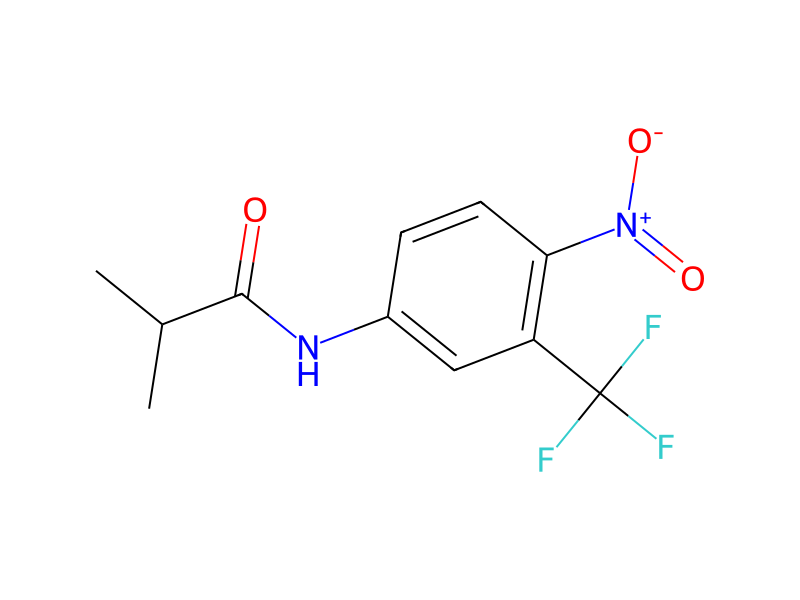
Flutamide

HCID 3397
New noteNew reactionRequest quotes
Print preview

Completing data — refresh the page later to see the latest
Basic informationOverviewNames & identifiersPropertiesSafety & regulationChemistry & industryRelated reactionsCompound notes
Substructure searchFind similar structures

Basic information

CAS
13311-84-7
Standard SMILES
CC(C)C(=O)Nc1ccc([N+](=O)[O-])c(C(F)(F)F)c1
InChIKey
MKXKFYHWDHIYRV-UHFFFAOYSA-N
Molecular formula
C11H11F3N2O3
Average molar mass
276.21 g/mol
Monoisotopic mass
276.0721767

Overview

Flutamide can cause developmental toxicity according to state or federal government labeling requirements.

Names & identifiers

Preferred name
Flutamide
IUPAC
2-methyl-N-[4-nitro-3-(trifluoromethyl)phenyl]propanamide
English name
Flutamide
Molecular formula
C11H11F3N2O3
Molecular weight
276.21

Names & synonyms

flutamide13311-84-7EulexinNiftolide2-Methyl-N-[4-nitro-3-(trifluoromethyl)phenyl]propanamideNFBASch 13521niftolidDrogenilFlutamidaFlutamidumSch-13521
Show more names
EunexOdyneEuflexDrognilFugerelEu.1eximFlucinom
4'-Nitro-3'-trifluoromethylisobutyranilide2-Methyl-N-(4-nitro-3-[trifluoromethyl]phenyl)propanamideEulexinePropanamide, 2-methyl-N-[4-nitro-3-(trifluoromethyl)phenyl]-SCH13521DTXSID7032004alpha,alpha,alpha-Trifluoro-2-methyl-4'-nitro-m-propionotoluidideNSC-215876

Database identifiers

CAS
13311-84-7
PubChem CID
3397
DTXSID
DTXSID7032004
ChEMBL
CHEMBL4759307、CHEMBL806
ChEBI
CHEBI:5132
UNII
76W6J0943E
EC Number
236-341-9
Nikkaji
J8.099C

Properties

Computed structural propertiesFilling in

XLogP
3.3
Topological polar surface area
74.9 Ų
Hydrogen bond donors
1
Hydrogen bond acceptors
6
Rotatable bonds
2
Heavy atoms
19
Formal charge
0
Complexity
352

Experimental & physicochemical properties

Drugs · 4 items

Pharmaceutical

Pharmaceuticals -> Antineoplastic and immunomodulating agents -> Antineoplastic agents

Pharmaceuticals -> Listed in ZINC15

Pharmaceuticals

LogP · 2 items

2.6

3.35

Solubility · 2 items

5.66e-03 g/L

>41.4 [ug/mL] (The mean of the results at pH 7.4)

Human Drugs · 3 items

FDA approved drugs -> Active ingredient

FDA approved drugs -> Active ingredient

Hormones and antihormones

Endocrine DisruptorsPotential endocrine disrupting compound
Melting Point · 2 items

111.5-112.5

111 - 113 °C

Physical DescriptionSolid
Collision Cross Section · 3 items

154.9 Ų [M-H]- [CCS Type: DT; Buffer gas: N2; Ionization: ESI-; Dataset: TOXCAST; Source Identifier: DTXSID7032004]

Safety & regulation

Safety information is for reference only and does not replace the supplier’s Safety Data Sheet (SDS), applicable regulations, or professional assessment.

GHS classification

GHS Classification · 6 items

Danger

H302+H312+H332 (29.8%): Harmful if swallowed, in contact with skin or if inhaled [Warning Acute toxicity, oral; acute toxicity, dermal; acute toxicity, inhalation]

P203, P260, P261, P264, P270, P271, P273, P280, P301+P317, P302+P352, P304+P340, P317, P318, P319, P321, P330, P362+P364, P405, and P501 (click each P-code to see the statement)

Aggregated GHS information provided per 94 reports by companies from 15 notifications to the ECHA C&L Inventory. Each notification may be associated with multiple companies.

Danger

H361: Suspected of damaging fertility or the unborn child [Warning Reproductive toxicity]

Hazard information

Regulatory InformationHazard Traits - Developmental Toxicity
Hazard Classes and Categories · 2 items

Acute Tox. 4 (88.3%)

Reproductive toxicity - Category 2

Toxicology

Hepatotoxicity · 1 item

Chronic therapy with flutamide is associated with elevations in serum aminotransferase levels in up to 62% of patients, but marked elevations (above 5 times ULN) in only 3% to 5%. Most of these abnormalities are transient, asymptomatic and do not require dose adjustment or drug discontinuation. However, in 0.1% to 1% of patients, acute liver injury with symptoms and jaundice arises which can be prolonged, severe and even fatal. The latency of onset ranges widely from 1 to 10 months (Cases 2 and 3), averaging 3 months. Allergic manifestations are rare as are autoantibodies. The pattern of liver enzyme elevations is most commonly hepatocellular, but many cases with cholestatic and mixed patterns have been described. Liver failure with a requirement for emergency liver transplantation or fatality has been described in many publications with 20 fatal cases reported from the FDA MedWatch program during the first 5 years of its availability. Fatal cases have been reported in children and young women being treated for hirsutism or acne (Case 1).

Chemistry & industry

Pharmacology

ATC Code · 3 items

L02BB01

L - Antineoplastic and immunomodulating agents

QL - Antineoplastic and immunomodulating agents

Protein Binding94-96%
Pharmacodynamics · 1 item

Flutamide is a nonsteroidal antiandrogen. In animal studies, flutamide demonstrates potent antiandrogenic effects. It exerts its antiandrogenic action by inhibiting androgen uptake and/or by inhibiting nuclear binding of androgen in target tissues or both. Prostatic carcinoma is known to be androgen-sensitive and responds to treatment that counteracts the effect of androgen and/or removes the source of androgen, e.g. castration. Elevations of plasma testosterone and estradiol levels have been noted following flutamide administration.

Mechanism of Action · 1 item

Flutamide is a nonsteroidal antiandrogen that blocks the action of both endogenous and exogenous testosterone by binding to the androgen receptor. In addition Flutamide is a potent inhibitor of testosterone-stimulated prostatic DNA synthesis. Moreover, it is capable of inhibiting prostatic nuclear uptake of androgen.

Biological Half-LifeThe plasma half-life for the alpha-hydroxylated metabolite of flutamide (an active metabolite) is approximately 6 hours.
Metabolism/Metabolites · 3 items

Flutamide is rapidly and extensively metabolized, with flutamide comprising only 2.5% of plasma radioactivity 1 hour after administration.

Flutamide has known human metabolites that include 2-hydroxy-flutamide.

Flutamide is rapidly and extensively metabolized, with flutamide comprising only 2.5% of plasma radioactivity 1 hour after administration. Route of Elimination: Flutamide and its metabolites are excreted mainly in the urine with only 4.2% of a single dose excreted in the feces over 72 hours. Half Life: The plasma half-life for the alpha-hydroxylated metabolite of flutamide (an active metabolite) is approximately 6 hours.

FDA Pharmacological Classification

Related reactions

11 records
New reaction record
HRID 92637 reaction equation
HRID 92637As productTraining data from https://doi.org/10.1039/C8SC04228D (2/10)
HRID 614291 reaction equation
HRID 614291As productuspto-grants-1979_03
HRID 614293 reaction equation
HRID 614293As reactantuspto-grants-1979_03
HRID 961939 reaction equation
HRID 961939As reactantValidation data from https://doi.org/10.1039/C8SC04228D
HRID 971859 reaction equation
HRID 971859As productuspto-grants-1979_07
HRID 971861 reaction equation
HRID 971861As reactantuspto-grants-1979_07
HRID 1155579 reaction equation
HRID 1155579As productuspto-grants-1981_11
HRID 1390641 reaction equation
HRID 1390641As productuspto-grants-1979_02
Page 1 of 2

Compound notes

Loading…

On this pageBasic informationOverviewNames & identifiersPropertiesSafety & regulationChemistry & industryRelated reactionsCompound notes
More actions
New noteNew reactionRequest quotes

160 Ų [M+H]+ [CCS Type: TW; Method: calibrated with polyalanine and drug standards]

158.04 Ų [M+Na]+ [CCS Type: TW; Method: calibrated with polyalanine and drug standards]

Physicochemical properties

Melting point
112 °C · 112 °C
Boiling point
400.3 · 400.3±45.0 °C(Predicted)
Density
1.3649 · 1.3649 (estimate)
storage temp.
2 · 2-8°C
solubility
Practically insoluble in water, freely soluble in acetone and in ethanol (96 per cent).
form
Solid
pka
13.12 · 13.12±0.70(Predicted)
color
Pale Yellow to Light Yellow
Merck
14 · 14,4208
Major Application
pharmaceutical (small molecule)
InChI
InChI=1S/C11H11F3N2O3/c1-6(2)10(17)15-7-3-4-9(16(18)19)8(5-7)11(12,13)14/h3-6H,1-2H3,(H,15,17)
InChIKey
MKXKFYHWDHIYRV-UHFFFAOYSA-N
SMILES
C(NC1=CC=C([N+]([O-])=O)C(C(F)(F)F)=C1)(=O)C(C)C
CAS DataBase Reference
13311 · 13311-84-7(CAS DataBase Reference)
NCI Dictionary of Cancer Terms
flutamide
FDA UNII
76 W6J0943E · 76W6J0943E
NCI Drug Dictionary
flutamide
ATC code
2 BB01 · L02BB01
Proposition 65 List
Flutamide
EPA Substance Registry System
Flutamide (13311-84-7)
UNSPSC Code
51111800 · 51111800
NACRES
77 · NA.77
Protein binding
90 % · >90%
Excreted unchanged in urine
45 % · 45%
Biological half-life
6 · 6 / Slightly increased (active metabolite
Symbol(GHS)
7 · GHS07,GHS08,GHS09
Signal word
Warning
Hazard statements
302 · H302-H351-H361-H373-H411
Precautionary statements
202 · P202-P260-P264-P273-P301+P312-P308+P313
target organs
Liver
Hazard Codes
Xn,Xi
Risk Statements
20 · 20/21/22-63-36/37/38
Safety Statements
22 · 22-36-36/37/39-27-26
RIDADR
3077 · UN3077
WGK Germany
3 · 3
RTECS
5700000 · UG5700000
HazardClass
9 · 9
HS Code
29242990 · 29242990
Storage Class
11 · 11 - Combustible Solids
Hazard Classifications
4 OralAquatic · Acute Tox. 4 OralAquatic Chronic 2Carc. 2Repr. 2STOT RE 2
Limited Quantities
5 kg · 5.0 kg (11 lbs) (solid)
Excepted Quantities
Max Inner Pack (30g or 30ml) and Max Outer Pack (1Kg or 1L)
Adverse Effects · 1 item

Flutamide comes with a black box warning due to the risk of hepatic failure. Hospitalization and death have occurred, although rarely, due to flutamide use; this is due to cholestatic hepatitis, which leads to failure. Cholestatic hepatitis results from the mitochondrial toxicity that occurs due to flutamide's major metabolite, hydroxyflutamide. This metabolite inhibits enzymes that are necessary for the electron transport chain within the mitochondria of the hepatocyte, leading to a halt of cellular respiration and, ultimately, cellular death. Hepatic failure would most likely be evident within the first three months of use. If the hepatic injury does occur in a patient, discontinuation of flutamide may help reverses the injury. Estimates of the rate at which this adverse effect occurs are three persons in 10,000 or 0.03% of all patients who use the drug. Due to this risk, it is advisable to perform liver function tests if symptoms suggest hepatic dysfunction. Such signs to watch for are abdominal pain, anorexia, nausea, vomiting, jaundice, and right upper quadrant pain and tenderness. Recommendations are to discontinue therapy if jaundice develops or if alanine aminotransferase increased to two times the upper limit of normal.

Exposure RoutesRapidly and completely absorbed.
Toxicity Summary · 2 items

There is a risk for severe hepatic injury leading to hepatic failure. There is a potential for aniline toxicity, which may cause methemoglobinemia or hemolytic anemia. The risk of cardiovascular disease may increase due to androgen deprivation.

Flutamide is a nonsteroidal antiandrogen that blocks the action of both endogenous and exogenous testosterone by binding to the androgen receptor. In addition Flutamide is a potent inhibitor of testosterone-stimulated prostatic DNA synthesis. Moreover, it is capable of inhibiting prostatic nuclear uptake of androgen.

Signs and SymptomsIn animal studies with flutamide alone, signs of overdose included hypoactivity, piloerection, slow respiration, ataxia, and/or lacrimation, anorexia, tranquilization, emesis, and methemoglobinemia.
Carcinogen ClassificationNo indication of carcinogenicity to humans (not listed by IARC).
Drug Induced Liver Injury · 6 items

Drug Induced Liver Injury Rank (DILIrank 2.0)

Flutamide

vMost-DILI-concern

8

Box warning

DOI:10.1016/j.drudis.2016.02.015

EPA Human Health Benchmarks for Pharmaceuticals · 6 items

Flutamide

17.5

74.0

The recommended dosage is two 125-mg capsules three times a day at 8-hour intervals for a total daily dose of 750 mg.

Data used to generate the benchmarks include the following: Lowest Daily Dose (LDD): 750 mg/day, Lowest Therapeutic Dose (LTD): 9.4 mg/kg-day, and Screening Dose: 0.003 mg/kg-day.

29-Nov-18

Safety data

wgk
3
rtecs
UG5700000
ridadr
UN3077
hs_code
29242990
risk_code
20/21/22-63-36/37/38
Signal word
Warning
Symbol(GHS)
GHS07,GHS08,GHS09
hazard_code
Xn,Xi
safety_code
22-36-36/37/39-27-26
hazard_class
9
Storage Class
11 - Combustible Solids
target organs
Liver
Hazard statements
H302-H351-H361-H373-H411
Limited Quantities
5.0 kg (11 lbs) (solid)
Excepted Quantities
Max Inner Pack (30g or 30ml) and Max Outer Pack (1Kg or 1L)
Hazard Classifications
Acute Tox. 4 OralAquatic Chronic 2Carc. 2Repr. 2STOT RE 2
Precautionary statements
P202-P260-P264-P273-P301+P312-P308+P313
· 6 items

76W6J0943E

FLUTAMIDE

Mechanisms of Action [MoA] - Androgen Receptor Antagonists

Established Pharmacologic Class [EPC] - Androgen Receptor Inhibitor

Flutamide is an Androgen Receptor Inhibitor. The mechanism of action of flutamide is as an Androgen Receptor Antagonist.

FLUTAMIDE

MeSH Pharmacological Classification · 2 items

Compounds which inhibit or antagonize the biosynthesis or actions of androgens.

Antineoplastic agents that are used to treat hormone-sensitive tumors. Hormone-sensitive tumors may be hormone-dependent, hormone-responsive, or both. A hormone-dependent tumor regresses on removal of the hormonal stimulus, by surgery or pharmacological block. Hormone-responsive tumors may regress when pharmacologic amounts of hormones are administered regardless of whether previous signs of hormone sensitivity were observed. The major hormone-responsive cancers include carcinomas of the breast, prostate, and endometrium; lymphomas; and certain leukemias. (From AMA Drug Evaluations Annual 1994, p2079)

Absorption, Distribution and Excretion · 2 items

Rapidly and completely absorbed.

Flutamide and its metabolites are excreted mainly in the urine with only 4.2% of a single dose excreted in the feces over 72 hours.

Cellular LocationsCytoplasm

Uses & manufacturing

Uses · 2 items

Use (kg; approx.) in Germany (2009): >1000

For the management of locally confined Stage B2-C and Stage D2 metastatic carcinoma of the prostate

Applications · 6 items

DescriptionFlutamide is a kind of synthetic, non-steroidal antiandrogen which is mainly used for the treatment of prostate cancer. It is a kind of toluidine derivative and a nonsteroidal antiandrogen with a similar structure of bicalutamide and nilutamide. The mechanism of its anti-cancer property is through acting as a selective antagonist of the androgen receptor (AR), preventing androgens such as testosterone and its active metabolite dihydrotestosterone from binding to ARs in the prostate gland. This process inhibits androgen-dependent DNA and protein synthesis in the tumor cell. Therefore, it can prevent androgens from stimulating the growth of prostate cancer cells. Moreover, it can also be used for the treatment of hyperandrogenism in women. It is quite effective in alleviating symptoms such as acne, seborrhea, hirsutism and androgenetic alopecia. Finally, it is also useful as a component in the transgender hormone therapy.

DescriptionFlutamide is an orally active, non-steroidal antiandrogen indicated for the treatment of prostatic cancer in both castrates and noncastrates.

HistoryFlutamide was first described as a member of a series of N-acyl anilides synthesized at Monsanto in the 1960s during a compound finding program aiming at bacteriostatic agents. Soon after, at Schering Corp., the compound was characterized pharmacologically and further developed as SCH-13521. It was found that flutamide inhibits agonist action at the AR by replacing the agonist at the ligand binding site, being the first nonsteroidal compound possessing anti-androgenic activity in animals. In contrast to steroidal anti-androgens, for instance, cyproterone acetate, which also displays significant progestational activity, flutamide has no other hormonal activity. There is also no reduction of serum testosterone levels seen with flutamide but rather a slight increase in luteinizing hormone (LH) and follicle-stimulating hormone (FSH) resulting in elevated serum testosterone levels. This accounts for the beneficial maintenance of libido and potency in sexually active patients. On the other hand, elevated serum estradiol levels resulting from peripheral testosterone aromatization leading to gynecomastia were observed in patients.

UsesBesides prostate cancer, flutamide has also been tested and/or used off-label in other hyperandrogenism-related disorders like benign prostatic hyperplasia, acne vulgaris, and hirsutism syndrome. Due to its teratogenic potential, flutamide is restricted for premenopausal women and used only in combination with effective contraception.

UsesFlutamide is a nonsteroidal antiandrogen drug; antineoplastic (hormonal).

General DescriptionFlutamide, 2-methyl-N-[4-nitro-3-(trifluoromethyl)phenyl]propanamide, is dosed 3 times daily(250-mg dose; 750-mg total daily dose). A major metaboliteof flutamide, hydroxyflutamide, is a more potent AR antagonistthan the parent compound. This metabolite, which ispresent at a much higher steady-state concentration than isflutamide, contributes a significant amount of the antiandrogen action of this drug. A limiting factor in the useof flutamide is hepatotoxicity in from 1% to 5% of patients.Although the hepatotoxicity usually is reversible followingcessation of treatment, rare cases of death associated withhepatic failure have been reported to be associated with flutamidetherapy. Diarrhea is also a limiting side effect withflutamide therapy for some patients.

Upstream & downstream products

Upstream raw materials

3-NitrobenzotrifluorideBenzotrifluoride4-Nitro-3-trifluoromethyl anilinePyridineIsobutyryl chloride3-Aminobenzotrifluoride3'-Trifluoromethylisobutyranilide

Additional notes

DefinitionChEBI: Flutamide is a monocarboxylic acid amide and a member of (trifluoromethyl)benzenes. It has a role as an androgen antagonist and an antineoplastic agent.