HomeMCPWorkbenchSkills
HomeWorkbenchNotificationsMe
llms.txt · MCP GuidePrivacy Policy · Terms of Service · Supportv1.8.0
  1. Home
  2. /Compound

Furfurylamine

HCID 3438
New noteNew reactionRequest quotes
Print preview

Completing data — refresh the page later to see the latest

Basic informationNames & identifiersPropertiesSafety & regulationChemistry & industryRelated reactionsCompound notes
Substructure searchFind similar structures

Basic information

CAS
617-89-0
Standard SMILES
NCc1ccco1
InChIKey
DDRPCXLAQZKBJP-UHFFFAOYSA-N
Molecular formula
C5H7NO
Average molar mass
97.12 g/mol
Monoisotopic mass
97.05276385

Names & identifiers

Preferred name
Furfurylamine
IUPAC
furan-2-ylmethanamine
English name
Furfurylamine
Molecular formula
C5H7NO
Molecular weight
97.12

Names & synonyms

Furfurylamine617-89-02-Furfurylamine2-(Aminomethyl)furan2-Furanmethylamine2-FURANMETHANAMINE(2-Furylmethyl)aminealpha-Furfurylamine(2-Furanylmethyl)amineDTXSID605229586GAN59F7RNSC-49136
Show more names
FAMFFA2-Furylmethanamine2-FURYLMETHYLAMINEC-Furan-2-yl-methylamineusafq-1NSC 49136
NSC-61168DTXCID6030867RefChem:141809210-536-9furan-2-ylmethanamine2-AminomethylfuranFuranmethanamineUSAF Q-1

Database identifiers

CAS
617-89-0
PubChem CID
3438
DTXSID
DTXSID6052295
ChEMBL
CHEMBL3561633
UNII
86GAN59F7R
EC Number
210-536-9
Nikkaji
J2.084B

Properties

Computed structural propertiesFilling in

XLogP
0.4
Topological polar surface area
39.2 Ų
Hydrogen bond donors
1
Hydrogen bond acceptors
2
Rotatable bonds
1
Heavy atoms
7
Formal charge
0
Complexity
56

Experimental & physicochemical properties

Flash Point99 °F (NFPA, 2010)
Vapor Pressure4.73 [mmHg]
Physical Description · 3 items

Furfurylamine appears as a colorless liquid. About the same density as water. Used as a corrosion inhibitor and to make soldering flux.

Liquid

Colorless liquid; [CAMEO] Colorless liquid with an amine-like odor; [Alfa Aesar MSDS]

Kovats Retention Index854;854

Physicochemical properties

Melting point
70 °C · −70 °C(lit.)
Boiling point
145 · 145-146 °C(lit.)
Density
1.099 g/mL · 1.099 g/mL at 25 °C(lit.)
vapor density
3.35 · 3.35 (vs air)
vapor pressure
4 mm · 4 mm Hg ( 20 °C)
refractive index
20 · n20/D 1.490(lit.)

Safety & regulation

Safety information is for reference only and does not replace the supplier’s Safety Data Sheet (SDS), applicable regulations, or professional assessment.

GHS classification

GHS Classification · 6 items

This chemical does not meet GHS hazard criteria for 4.3% (4 of 92) of reports.

Danger

H226 (95.7%): Flammable liquid and vapor [Warning Flammable liquids];H301 (32.6%): Toxic if swallowed [Danger Acute toxicity, oral];H302 (62%): Harmful if swallowed [Warning Acute toxicity, oral];H310 (28.3%): Fatal in contact with skin [Danger Acute toxicity, dermal];H311 (17.4%): Toxic in contact with skin [Danger Acute toxicity, dermal];H312 (47.8%): Harmful in contact with skin [Warning Acute toxicity, dermal];H314 (95.7%): Causes severe skin burns and eye damage [Danger Skin corrosion/irritation];H332 (30.4%): Harmful if inhaled [Warning Acute toxicity, inhalation]

P210, P233, P240, P241, P242, P243, P260, P261, P262, P264, P270, P271, P280, P301+P316, P301+P317, P301+P330+P331, P302+P352, P302+P361+P354, P303+P361+P353, P304+P340, P305+P354+P338, P316, P317, P321, P330, P361+P364, P362+P364, P363, P370+P378, P403+P235, P405, and P501 (click each P-code to see the statement)

Aggregated GHS information provided per 92 reports by companies from 11 notifications to the ECHA C&L Inventory. Each notification may be associated with multiple companies.;Reported as not meeting GHS hazard criteria per 4 of 92 reports by companies.;There are 10 notifications provided by 88 of 92 reports by companies with hazard statement code(s).;Information may vary between notifications depending on impurities, additives, and other factors. The percentage value in parenthesis indicates the notified classification ratio from companies that provide hazard codes. Only hazard codes with percentage values above 10% are shown. For more detailed information, please visit ECHA C&L website.

Hazard information

Regulatory Information · 5 items

Chemical: 2-Furanmethanamine

2-Furanmethanamine is listed on the EPA's Chemical Data Reporting (CDR) system. Manufacturers and importers of 2-Furanmethanamine are required to report information about their production and use of this chemical to the EPA under the Toxic Substances Control Act (TSCA). (40 eCFR Part 711)

Chemistry & industry

Uses & manufacturing

UsesUsed as a corrosion inhibitor and in the manufacture of soldering flux; [CAMEO] Used as a reactant intermediate; [ExPub: ECHA REACH Registrations]
U.S. Production2023: <50,000 lb;2022: <50,000 lb;2021: 50,000 - <250,000 lb;2020: 250,000 - <550,000 lb
Industry UsesIntermediate
General Manufacturing Information · 2 items

Pharmaceutical and Medicine Manufacturing

2-Furanmethanamine: ACTIVE

Applications · 2 items

UsesFurfurylamine is used as a water miscible solvent and as an intermediate in manufacturing pharmaceuticals like diuretics, antihypertensive, and antiseptic agents.Furfurylamine also has use in the synthesis of Barmastine.2-Furfurylamine is used in the synthesis of 2-Amino-N-(2-furylmethyl)propanamide, as a novel alanylglycine equivalent synthesized by bacilysin synthetase.

General DescriptionFurfurylamine appears as a colorless liquid. About the same density as water. Used as a corrosion inhibitor and to make soldering flux.

Preparation methods · 1 item

PreparationSynthesis of furfurylamine by Zn/HCl system: To a solution of furfuryloxime (2g, 18mmol) in hydrochloric acid (6.0M, 24ml) was added drop-wise zinc dust (4.71g, 72mmol), and the resultant solution was stirred at room temperature for 2 h. To the resulting slurry was added drop-wise a solution of ammonia (30%, 5.1 mL) and sodium hydroxide (6M, 24mL), the mixture was heated to 60° and stirred for 15mn. After, the resultant solution was cooled and filtered. Then, the mother liquid was extracted with cyclohexane, dried over anhydrous sodium sulfate and filtered. The solvent was removed under vacuum to afford the furfurylamine as a yellow liquid without further purification in 96% of yield (1.68g). The purity determined by NMR was found to be superior to 95%.SIMPLE, NOVEL SYNTHESIS OF FURFURYLAMINE FROM FURFURAL BY ONE-POT REDUCTIVE AMINATION IN WATER USING ZINC METAL

Related reactions

900 records
New reaction record
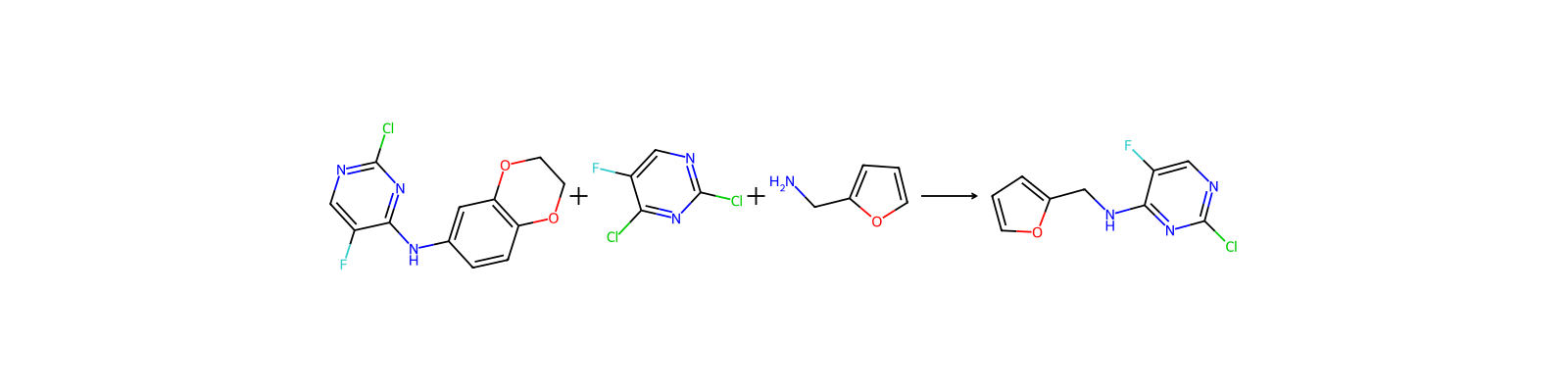
HRID 28384 reaction equation
HRID 28384As reactantuspto-grants-2008_09
HRID 34027 reaction equation
HRID 34027As reactantuspto-grants-2008_09
HRID 71283 reaction equation
HRID 71283As reactantuspto-grants-2014_09
HRID 71393 reaction equation
HRID 71393As reactantuspto-grants-2014_09
HRID 76394 reaction equation
HRID 76394As reactantuspto-grants-2014_09
HRID 76502 reaction equation
HRID 76502As reactantuspto-grants-2014_09
HRID 109925 reaction equation
HRID 109925As reactantTraining data from https://doi.org/10.1039/C8SC04228D (2/10)
HRID 123124 reaction equation
HRID 123124As reactantTraining data from https://doi.org/10.1039/C8SC04228D (2/10)
Page 1 of 113

Compound notes

Loading…

On this pageBasic informationNames & identifiersPropertiesSafety & regulationChemistry & industryRelated reactionsCompound notes
More actions
New noteNew reactionRequest quotes
Flash point
116 °F · 116 °F
storage temp.
30 °C · Store below +30°C.
solubility
Chloroform, Ethyl Acetate (Slightly)
form
Liquid
pka
9.12 · 9.12±0.29(Predicted)
color
Clear colorless to yellow-brown
Odor
strong fishy ammonia-like odor
PH
11.6 · 11.6 (100g/l, H2O, 20℃)
explosive limit
1.8 % · 1.8%(V)
Water Solubility
soluble
Sensitive
Air Sensitive
BRN
1614 · 1614
Stability
Volatile
InChI
1S/C5H7NO/c6-4-5-2-1-3-7-5/h1-3H,4,6H2
InChIKey
DDRPCXLAQZKBJP-UHFFFAOYSA-N
SMILES
NCc1ccco1
LogP
0.37 · 0.37
CAS DataBase Reference
617 · 617-89-0(CAS DataBase Reference)
EWG's Food Scores
1 · 1
FDA UNII
86 GAN59F7R · 86GAN59F7R
NIST Chemistry Reference
2 · 2-Furanmethanamine(617-89-0)
EPA Substance Registry System
Furfurylamine (617-89-0)
UNSPSC Code
12352116 · 12352116
NACRES
22 · NA.22
Symbol(GHS)
2 · GHS02,GHS05
Signal word
Danger
Hazard statements
314 · H314-H226
Precautionary statements
501 · P501-P240-P210-P233-P243-P241-P242-P264-P280-P370+P378-P303+P361+P353-P301+P330+P331-P363-P304+P340+P310-P305+P351+P338+P310-P403+P235-P405
PPE
Faceshields, Gloves, Goggles, type ABEK (EN14387) respirator filter
Hazard Codes
C,F,Xi
Risk Statements
10 · 10-21/22-34-20/21/22
Safety Statements
26 · 26-36/37/39-45-23-16
RIDADR
2526 · UN 2526
WGK Germany
3 · 3
RTECS
9275000 · LU9275000
Autoignition Temperature
350 °C · 350 °C DIN 51794
Hazard Note
Harmful/Corrosive/Flammable
TSCA
TSCA listed
HazardClass
3 · 3
PackingGroup
III
HS Code
29321900 · 29321900
Storage Class
3 · 3 - Flammable liquids
Hazard Classifications
2 DermalAcute · Acute Tox. 2 DermalAcute Tox. 3 OralAcute Tox. 4 InhalationEye Dam. 1Flam. Liq. 3Skin Corr. 1B
Toxicity
50 orally · LD50 orally in Rabbit: 200 - 2000 mg/kg LD50 dermal Rat 100 mg/kg
REACH Registrations
Active
Limited Quantities
5 L · 5.0 L (1.3 gallons) (liquid)
Excepted Quantities
Max Inner Pack (30g or 30ml) and Max Outer Pack (1Kg or 1L)

Status: Active Update: 16-07-2018 https://echa.europa.eu/registration-dossier/-/registered-dossier/11249

Furfurylamine: Does not have an individual approval but may be used under an appropriate group standard

The New Jersey Worker and Community Right to Know Act requires public and private employers to provide information about hazardous substances at their workplaces. (N.J.S.A. 34:5A-1 et. seq.)

DOT LabelFlammable Liquid Corrosive
Fire Hazards · 2 items

Excerpt from ERG Guide 132 [Flammable Liquids - Corrosive]:;Flammable/combustible material. May be ignited by heat, sparks or flames. Vapors may form explosive mixtures with air. Vapors may travel to source of ignition and flash back. Most vapors are heavier than air. They will spread along the ground and collect in low or confined areas (sewers, basements, tanks, etc.). Vapor explosion hazard indoors, outdoors or in sewers. Those substances designated with a (P) may polymerize explosively when heated or involved in a fire. Runoff to sewer may create fire or explosion hazard. Containers may explode when heated. Many liquids will float on water. (ERG, 2024)

· Flammable/combustible material.;· May be ignited by heat, sparks or flames.;· Vapors may form explosive mixtures with air.;· Vapors may travel to source of ignition and flash back.;· Most vapors are heavier than air. They will spread along the ground and collect in low or confined areas (sewers, basements, tanks, etc.).;· Vapor explosion hazard indoors, outdoors or in sewers.;· Those substances designated with a (P) may polymerize explosively when heated or involved in a fire.;· Runoff to sewer may create fire or explosion hazard.;· Containers may explode when heated.;· Many liquids will float on water.

Health Hazards · 2 items

Excerpt from ERG Guide 132 [Flammable Liquids - Corrosive]:;May cause toxic effects if inhaled or ingested. Contact with substance may cause severe burns to skin and eyes. Fire will produce irritating, corrosive and/or toxic gases. Vapors may cause dizziness or asphyxiation, especially when in closed or confined areas. Runoff from fire control or dilution water may cause environmental contamination. (ERG, 2024)

· May cause toxic effects if inhaled or ingested.;· Contact with substance may cause severe burns to skin and eyes.;· Fire will produce irritating, corrosive and/or toxic gases.;· Vapors may cause dizziness or asphyxiation, especially when in closed or confined areas.;· Runoff from fire control or dilution water may cause environmental contamination.

Hazards Summary · 1 item

Intraperitoneal LD50 (mouse) = 200 mg/kg; [RTECS] Causes burns; Inhalation may cause corrosive injuries to upper respiratory tract and lungs; Toxic by ingestion; Highly toxic by inhalation and skin absorption; Oral LD50 (rat) = 200-2,000 mg/kg; [Alfa Aesar MSDS]

DOT ID and Guide2526 132
Reactive GroupAmines, Phosphines, and Pyridines;Ethers
Reactivity AlertsHighly Flammable
Reactivity Profile · 1 item

Amines, such as FURFURYLAMINE, are chemical bases. They neutralize acids to form salts plus water. These acid-base reactions are exothermic. The amount of heat that is evolved per mole of amine in a neutralization is largely independent of the strength of the amine as a base. Amines may be incompatible with isocyanates, halogenated organics, peroxides, phenols (acidic), epoxides, anhydrides, and acid halides. Flammable gaseous hydrogen is generated by amines in combination with strong reducing agents, such as hydrides.

DOT Hazard Classification · 6 items

Furfurylamine

UN2526

Class 3 Flammable and combustible liquid (49 eCFR § 173.120)

Class 3 Flammable and combustible liquid (49 eCFR § 173.120);Class 8 Corrosive material (49 eCFR § 173.136)

PG III: the degree of danger presented by the material is minor;For more information about the packing group assignment, please visit 49 eCFR § 173

Air and Water ReactionsHighly flammable. Soluble in water.
Hazard Classes and Categories · 2 items

Flam. Liq. 3 (95.7%);Acute Tox. 3 (32.6%);Acute Tox. 4 (62%);Acute Tox. 2 (28.3%);Acute Tox. 3 (17.4%);Acute Tox. 4 (47.8%);Skin Corr. 1B (95.7%);Acute Tox. 4 (30.4%)

Flammable agents - 3rd degree

Safety & protection

Fire Fighting · 1 item

Excerpt from ERG Guide 132 [Flammable Liquids - Corrosive]:;Some of these materials may react violently with water.;SMALL FIRE: Dry chemical, CO2, water spray or alcohol-resistant foam.;LARGE FIRE: Water spray, fog or alcohol-resistant foam. If it can be done safely, move undamaged containers away from the area around the fire. Dike runoff from fire control for later disposal. Do not get water inside containers.;FIRE INVOLVING TANKS, RAIL TANK CARS OR HIGHWAY TANKS: Fight fire from maximum distance or use unmanned master stream devices or monitor nozzles. Cool containers with flooding quantities of water until well after fire is out. Withdraw immediately in case of rising sound from venting safety devices or discoloration of tank. ALWAYS stay away from tanks in direct contact with flames. For massive fire, use unmanned master stream devices or monitor nozzles; if this is impossible, withdraw from area and let fire burn. (ERG, 2024)

Accidental Release Measures · 2 items

· CALL 911. Then call emergency response telephone number on shipping paper. If shipping paper not available or no answer, refer to appropriate telephone number listed on the inside back cover.;· Keep unauthorized personnel away.;· Stay upwind, uphill and/or upstream.;· Ventilate closed spaces before entering, but only if properly trained and equipped.

· ELIMINATE all ignition sources (no smoking, flares, sparks or flames) from immediate area.;· All equipment used when handling the product must be grounded.;· Do not touch or walk through spilled material.;· Stop leak if you can do it without risk.;· Prevent entry into waterways, sewers, basements or confined areas.;· A vapor-suppressing foam may be used to reduce vapors.;· Absorb with earth, sand or other non-combustible material.;· For hydrazine, absorb with DRY sand or inert absorbent (vermiculite or absorbent pads).;· Use clean, non-sparking tools to collect absorbed material.;Large Spill;· Dike far ahead of liquid spill for later disposal.;· Water spray may reduce vapor, but may not prevent ignition in closed spaces.

First Aid · 2 items

Excerpt from ERG Guide 132 [Flammable Liquids - Corrosive]:;Refer to the "General First Aid" section. Specific First Aid: For corrosives, in case of contact, immediately flush skin or eyes with running water for at least 30 minutes. Additional flushing may be required. In case of burns, immediately cool affected skin for as long as possible with cold water. Do not remove clothing if adhering to skin. (ERG, 2024)

General First Aid:;· Call 911 or emergency medical service.;· Ensure that medical personnel are aware of the material(s) involved, take precautions to protect themselves and avoid contamination.;· Move victim to fresh air if it can be done safely.;· Administer oxygen if breathing is difficult.;· If victim is not breathing:;-- DO NOT perform mouth-to-mouth resuscitation; the victim may have ingested or inhaled the substance.;-- If equipped and pulse detected, wash face and mouth, then give artificial respiration using a proper respiratory medical device (bag-valve mask, pocket mask equipped with a one-way valve or other device).;-- If no pulse detected or no respiratory medical device available, provide continuous compressions. Conduct a pulse check every two minutes or monitor for any signs of spontaneous respirations.;· Remove and isolate contaminated clothing and shoes.;· For minor skin contact, avoid spreading material on unaffected skin.;· In case of contact with substance, remove immediately by flushing skin or eyes with running water for at least 20 minutes.;· For severe burns, immediate medical attention is required.;· Effects of exposure (inhalation, ingestion, or skin contact) to substance may be delayed.;· Keep victim calm and warm.;· Keep victim under observation.;· For further assistance, contact your local Poison Control Center.;· Note: Basic Life Support (BLS) and Advanced Life Support (ALS) should be done by trained professionals.;Specific First Aid:;· For corrosives, in case of contact, immediately flush skin or eyes with running water for at least 30 minutes. Additional flushing may be required.

Exposure Control and Personal Protection · 1 item

· Wear positive pressure self-contained breathing apparatus (SCBA).;· Wear chemical protective clothing that is specifically recommended by the manufacturer when there is NO RISK OF FIRE.;· Structural firefighters' protective clothing provides thermal protection but only limited chemical protection.

Nonfire Spill Response · 1 item

Excerpt from ERG Guide 132 [Flammable Liquids - Corrosive]:;ELIMINATE all ignition sources (no smoking, flares, sparks or flames) from immediate area. All equipment used when handling the product must be grounded. Do not touch or walk through spilled material. Stop leak if you can do it without risk. Prevent entry into waterways, sewers, basements or confined areas. A vapor-suppressing foam may be used to reduce vapors. Absorb with earth, sand or other non-combustible material. For hydrazine, absorb with DRY sand or inert absorbent (vermiculite or absorbent pads). Use clean, non-sparking tools to collect absorbed material.;LARGE SPILL: Dike far ahead of liquid spill for later disposal. Water spray may reduce vapor, but may not prevent ignition in closed spaces. (ERG, 2024)

Isolation and Evacuation · 2 items

Excerpt from ERG Guide 132 [Flammable Liquids - Corrosive]:;IMMEDIATE PRECAUTIONARY MEASURE: Isolate spill or leak area for at least 50 meters (150 feet) in all directions.;SPILL: Increase the immediate precautionary measure distance, in the downwind direction, as necessary.;FIRE: If tank, rail tank car or highway tank is involved in a fire, ISOLATE for 800 meters (1/2 mile) in all directions; also, consider initial evacuation for 800 meters (1/2 mile) in all directions. (ERG, 2024)

Immediate precautionary measure;· Isolate spill or leak area for at least 50 meters (150 feet) in all directions.;Spill;· For highlighted materials: see Table 1 - Initial Isolation and Protective Action Distances.;· For non-highlighted materials: increase the immediate precautionary measure distance, in the downwind direction, as necessary.;Fire;· If tank, rail tank car or highway tank is involved in a fire, ISOLATE for 800 meters (1/2 mile) in all directions; also, consider initial evacuation for 800 meters (1/2 mile) in all directions.

Personal Protective Equipment (PPE) · 1 item

Excerpt from ERG Guide 132 [Flammable Liquids - Corrosive]:;Wear positive pressure self-contained breathing apparatus (SCBA). Wear chemical protective clothing that is specifically recommended by the manufacturer when there is NO RISK OF FIRE. Structural firefighters' protective clothing provides thermal protection but only limited chemical protection. (ERG, 2024)

Emergency Response Planning Guidelines · 1 item

· Some of these materials may react violently with water.;Small Fire;· Dry chemical, CO2, water spray or alcohol-resistant foam.;Large Fire;· Water spray, fog or alcohol-resistant foam.;· If it can be done safely, move undamaged containers away from the area around the fire.;· Dike runoff from fire control for later disposal.;· Do not get water inside containers.;Fire Involving Tanks, Rail Tank Cars or Highway Tanks;· Fight fire from maximum distance or use unmanned master stream devices or monitor nozzles.;· Cool containers with flooding quantities of water until well after fire is out.;· Withdraw immediately in case of rising sound from venting safety devices or discoloration of tank.;· ALWAYS stay away from tanks in direct contact with flames.;· For massive fire, use unmanned master stream devices or monitor nozzles; if this is impossible, withdraw from area and let fire burn.

Toxicology

Adverse EffectsDermatotoxin - Skin burns.;Toxic Pneumonitis - Inflammation of the lungs induced by inhalation of metal fumes or toxic gases and vapors.
Toxicity DataLC50 (rat) = 1,300 mg/m3/4hr

Regulatory information

Regulatory Information · 5 items

Chemical: 2-Furanmethanamine

2-Furanmethanamine is listed on the EPA's Chemical Data Reporting (CDR) system. Manufacturers and importers of 2-Furanmethanamine are required to report information about their production and use of this chemical to the EPA under the Toxic Substances Control Act (TSCA). (40 eCFR Part 711)

Status: Active Update: 16-07-2018 https://echa.europa.eu/registration-dossier/-/registered-dossier/11249

Furfurylamine: Does not have an individual approval but may be used under an appropriate group standard

The New Jersey Worker and Community Right to Know Act requires public and private employers to provide information about hazardous substances at their workplaces. (N.J.S.A. 34:5A-1 et. seq.)

Safety data

PPE
Faceshields, Gloves, Goggles, type ABEK (EN14387) respirator filter
wgk
3
tsca
TSCA listed
rtecs
LU9275000
ridadr
UN 2526
hs_code
29321900
Toxicity
LD50 orally in Rabbit: 200 - 2000 mg/kg LD50 dermal Rat 100 mg/kg
risk_code
10-21/22-34-20/21/22
Signal word
Danger
Symbol(GHS)
GHS02,GHS05
hazard_code
C,F,Xi
hazard_note
Harmful/Corrosive/Flammable
safety_code
26-36/37/39-45-23-16
hazard_class
3
Storage Class
3 - Flammable liquids
packing_group
III
Hazard statements
H314-H226
Limited Quantities
5.0 L (1.3 gallons) (liquid)
Excepted Quantities
Max Inner Pack (30g or 30ml) and Max Outer Pack (1Kg or 1L)
REACH Registrations
Active
Hazard Classifications
Acute Tox. 2 DermalAcute Tox. 3 OralAcute Tox. 4 InhalationEye Dam. 1Flam. Liq. 3Skin Corr. 1B
Autoignition Temperature
350 °C DIN 51794
Precautionary statements
P501-P240-P210-P233-P243-P241-P242-P264-P280-P370+P378-P303+P361+P353-P301+P330+P331-P363-P304+P340+P310-P305+P351+P338+P310-P403+P235-P405

Upstream & downstream products

Upstream raw materials

Stainless steel reactor

Downstream products

FurosemideFUBERIDAZOLEN-(2-FURYLMETHYL)-N-(THIEN-2-YLMETHYL)AMINEN-FURAN-2-YLMETHYL-SUCCINAMIC ACID6-Chloro-4-(furfurylaMino)pyriMidine, 96%4-cyano-N-(furan-2-ylmethyl)benzene-1-sulfonamide2-[(2-furylmethyl)amino]nicotinonitrile4-(4-CHLORO-6-[(FURAN-2-YLMETHYL)-AMINO]-[1,3,5]TRIAZIN-2-YLAMINO)-PHENOL2-CYANO-3-FURANE-2-YL-ACRYLIC ACID ETHYL ESTERAcetamide,N-(2-furanylmethyl)-