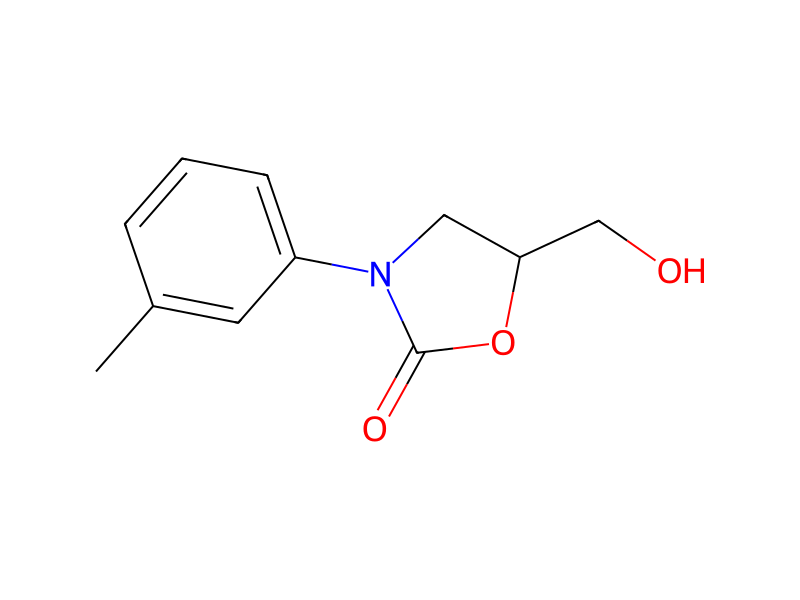
Basic information
- Standard SMILES
Cc1cccc(N2CC(CO)OC2=O)c1- InChIKey
MXUNKHLAEDCYJL-UHFFFAOYSA-N- Molecular formula
- C11H13NO3
- Average molar mass
- 207.23 g/mol
- Monoisotopic mass
- 207.08954328
Overview
5-(hydroxymethyl)-3-(3-methylphenyl)-1,3-oxazolidin-2-one is a member of the class of oxazolidinones that is 5-(hydroxymethyl)-1,3-oxazolidin-2-one substituted by a 3-methylphenyl group at position 3. It is a primary alcohol, a member of toluenes and an oxazolidinone.
Names & identifiers
- Preferred name
- Toloxatone
- IUPAC
- 5-(hydroxymethyl)-3-(3-methylphenyl)-1,3-oxazolidin-2-one
- English name
- Toloxatone
- Molecular formula
- C11H13NO3
- Molecular weight
- 207.23
Names & synonyms
Show more names
Database identifiers
- CAS
29218-27-7- PubChem CID
- 34521
- DTXSID
DTXSID40865478- ChEMBL
CHEMBL18116- ChEBI
CHEBI:156575- UNII
- 5T206015T5
- EC Number
- 249-522-2
- Nikkaji
- J21.701H
Properties
Computed structural properties
- XLogP
- 1.2
- Topological polar surface area
- 49.8 Ų
- Hydrogen bond donors
- 1
- Hydrogen bond acceptors
- 3
- Rotatable bonds
- 2
- Heavy atoms
- 15
- Formal charge
- 0
- Complexity
- 244
Physicochemical properties
- Melting point
- 76 ° · 76°
- Boiling point
- 358.9 · 358.9±21.0 °C(Predicted)
- Density
- 1.245 · 1.245±0.06 g/cm3(Predicted)
- storage temp.
- 2 · Inert atmosphere,2-8°C
- solubility
- 10 mg/mL · DMSO: >10mg/mL
- form
- solid
- pka
- 14.05 · 14.05±0.10(Predicted)
- color
- White to off-white
- InChI
- 1S/C11H13NO3/c1-8-3-2-4-9(5-8)12-6-10(7-13)15-11(12)14/h2-5,10,13H,6-7H2,1H3
- InChIKey
- MXUNKHLAEDCYJL-UHFFFAOYSA-N
- SMILES
- Cc1cccc(c1)N2CC(CO)OC2=O
- FDA UNII
- 5 T206015T5 · 5T206015T5
- ATC code
- 6 AG03 · N06AG03
- UNSPSC Code
- 12161501 · 12161501
- NACRES
- 77 · NA.77
- Symbol(GHS)
- 7 · GHS07
- Signal word
- Warning
- Hazard statements
- 302 · H302
- Precautionary statements
- 280 · P280-P305+P351+P338
- PPE
- 95 · dust mask type N95 (US), Eyeshields, Gloves
- Hazard Codes
- Xn
- Risk Statements
- 22 · 22
- RIDADR
- 3249 · 3249
- WGK Germany
- 3 · 3
- RTECS
- 2867500 · RQ2867500
- HazardClass
- 6.1 · 6.1(b)
- PackingGroup
- III
- Storage Class
- 11 · 11 - Combustible Solids
- Hazard Classifications
- 4 Oral · Acute Tox. 4 Oral
- Toxicity
- 50 orally · LD50 orally in mice (mg/kg): 1850 (Fauran); also reported as 1500 (Raynaud)
Safety & regulation
GHS classification
GHS Classification
Warning
H302 (100%): Harmful if swallowed [Warning Acute toxicity, oral]
P264, P270, P301+P317, P330, and P501 (click each P-code to see the statement)
Aggregated GHS information provided per 39 reports by companies from 1 notifications to the ECHA C&L Inventory.
Hazard information
Safety data
- PPE
- dust mask type N95 (US), Eyeshields, Gloves
- wgk
- 3
- rtecs
- RQ2867500
- ridadr
- 3249
- Toxicity
- LD50 orally in mice (mg/kg): 1850 (Fauran); also reported as 1500 (Raynaud)
- risk_code
- 22
- Signal word
- Warning
- Symbol(GHS)
- GHS07
- hazard_code
- Xn
- hazard_class
- 6.1(b)
- Storage Class
- 11 - Combustible Solids
- packing_group
- III
- Hazard statements
- H302
- Hazard Classifications
- Acute Tox. 4 Oral
- Precautionary statements
- P280-P305+P351+P338
Chemistry & industry
Pharmacology
ATC Code
N - Nervous system
QN - Nervous system
Mechanism of Action
This medication is a reversible inhibitor of monoamine oxidase type-A (also known as RIMA). MAO-A can be found in norepinephrinergic and serotonergic neurons and regulates the metabolism of serotonin and catecholamines, allowing for increased circulation in the synaptic cleft. Traditional monoamine oxidase inhibitors irreversibly inhibit monoamine oxidase and therefore, side effects, drug interactions, and food interactions persist as long as 2-3 weeks after discontinuing toloxatone. The elevation of serotonin and norepinephrine levels occurs rapidly after medication administration. However, the therapeutic relief of depressive symptoms requires weeks of daily treatment to observe results. Selective and reversible MAO-A inhibitors are more effective in treating major depression without several of the drug and food interactions associated with traditional monoamine oxidase inhibitors.
MeSH Pharmacological Classification
Mood-stimulating drugs used primarily in the treatment of affective disorders and related conditions. Several MONOAMINE OXIDASE INHIBITORS are useful as antidepressants apparently as a long-term consequence of their modulation of catecholamine levels. The tricyclic compounds useful as antidepressive agents (ANTIDEPRESSIVE AGENTS, TRICYCLIC) also appear to act through brain catecholamine systems. A third group (ANTIDEPRESSIVE AGENTS, SECOND-GENERATION) is a diverse group of drugs including some that act specifically on serotonergic systems.
A chemically heterogeneous group of drugs that have in common the ability to block oxidative deamination of naturally occurring monoamines. (From Gilman, et al., Goodman and Gilman's The Pharmacological Basis of Therapeutics, 8th ed, p414)
Absorption, Distribution and Excretion
Mainly hepatic 1% of drug is excreted unchanged in the urine
High hepatic excretion rate
Applications
DescriptionToloxatone is a selective, reversible and competitive inhibitor of type A monoamine oxidase (MAO-A) which shows clinical utility as an antidepressant. It is reportedly free of the "cheese effect" in man, possibly due to the reversible nature of its inhibitory effect on intestinal MAO-A in the presence of high concentrations of tyramine.
UsesToloxatone is a monoamine oxidase-A (MAO-A) inhibitor.
Upstream & downstream products
Upstream raw materials
Suppliers35 total
Additional notes
DefinitionChEBI: 5-(hydroxymethyl)-3-(3-methylphenyl)-1,3-oxazolidin-2-one is a member of the class of oxazolidinones that is 5-(hydroxymethyl)-1,3-oxazolidin-2-one substituted by a 3-methylphenyl group at position 3. It is a member of toluenes, an oxazolidinone and a primary alcohol.
Related reactions
No reaction records under the current filter.
Linked notes
Loading…