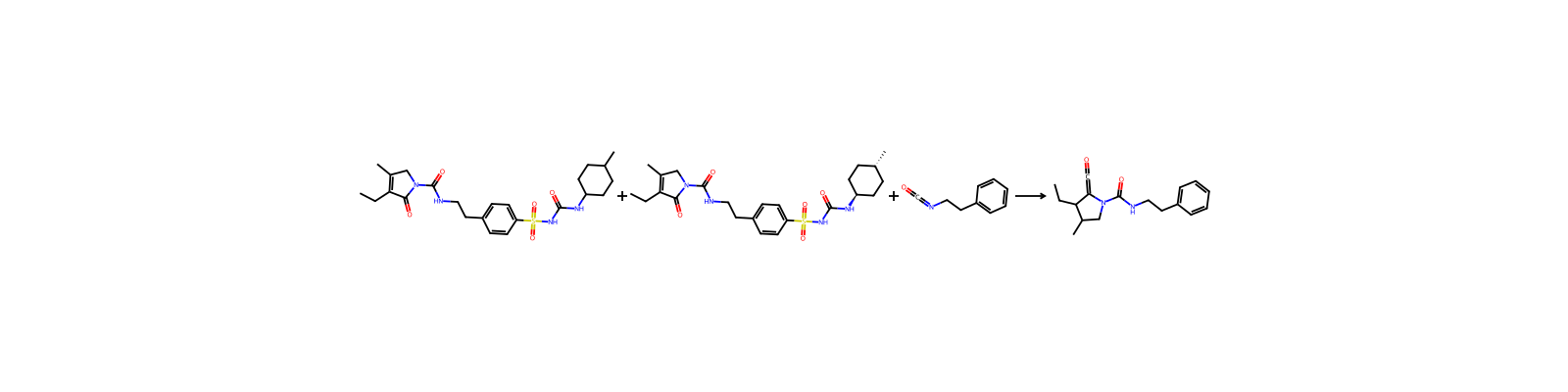
HRID 719565As reactant
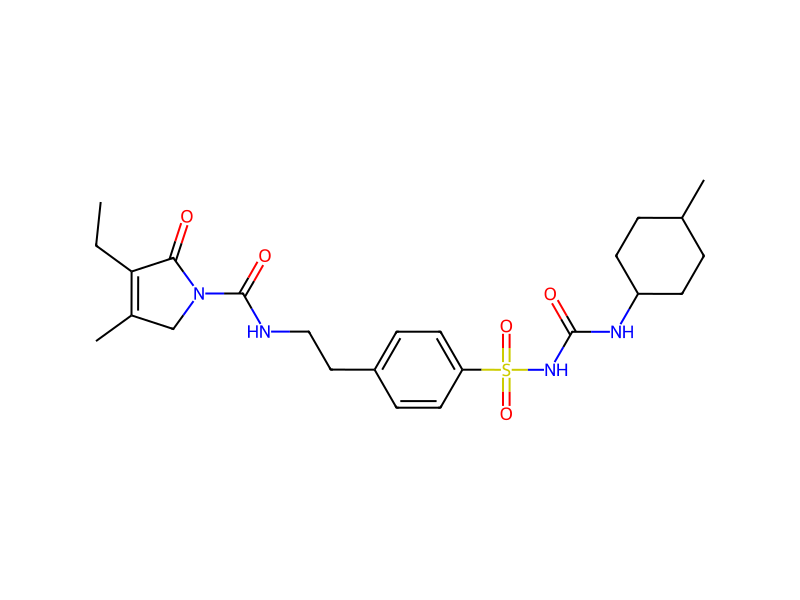
261361-60-8CCC1=C(C)CN(C(=O)NCCc2ccc(S(=O)(=O)NC(=O)NC3CCC(C)CC3)cc2)C1=OWIGIZIANZCJQQY-UHFFFAOYSA-NGlimepiride is a sulfonamide, a N-acylurea and a N-sulfonylurea. It has a role as a hypoglycemic agent and an insulin secretagogue.
Pharmaceuticals
Pharmaceuticals -> Listed in ZINC15
3.5
2.67
Partly miscible
3.84e-02 g/L
>73.6 [ug/mL] (The mean of the results at pH 7.4)
Safety information is for reference only and does not replace the supplier’s Safety Data Sheet (SDS), applicable regulations, or professional assessment.
Warning
H302 (50%): Harmful if swallowed [Warning Acute toxicity, oral]
P203, P264, P270, P280, P301+P317, P318, P330, P405, and P501 (click each P-code to see the statement)
Aggregated GHS information provided per 2 reports by companies from 2 notifications to the ECHA C&L Inventory. Each notification may be associated with multiple companies.
Glimepiride stimulates the secretion of insulin granules from the pancreatic beta cells and improves the sensitivity of peripheral tissues to insulin to increase peripheral glucose uptake, thus reducing plasma blood glucose levels and glycated hemoglobin (HbA1C) levels. A multi-center, randomized, placebo-controlled clinical trial evaluated the efficacy of glimepiride (1–8 mg) as monotherapy titrated over 10 weeks compared with placebo in T2DM subjects who were not controlled by diet alone. In this study, there was a reduction in fasting plasma glucose (FPG) by 46 mg/dL, post-prandial glucose (PPG) by 72 mg/dL, and HbA1c by 1.4% more than the placebo. In another randomized study comprising of patients with T2DM receiving either placebo or one of the three doses (1, 4, or 8 mg) of glimepiride during a 14-week study period, all glimepiride regimens significantly reduced FPG, PPG, and HbA1c values (P < 0.001) compared to placebo by the end of the study period. The 4- and 8-mg doses of glimepiride were more effective than the 1-mg dose; however, the 4-mg dose provided a nearly maximal antihyperglycemic effect.
ATP-sensitive potassium channels on pancreatic beta cells that are gated by intracellular ATP and ADP. The hetero-octomeric complex of the channel is composed of four pore-forming Kir6.2 subunits and four regulatory sulfonylurea receptor (SUR) subunits. Alternative splicing allows the formation of channels composed of varying subunit isoforms expressed at different concentrations in different tissues. In pancreatic beta cells, ATP-sensitive potassium channels play a role as essential metabolic sensors and regulators that couple membrane excitability with glucose-stimulated insulin secretion (GSIS). When there is a decrease in the ATP:ADP ratio, the channels are activated and open, leading to K+ efflux from the cell, membrane hyperpolarization, and suppression of insulin secretion. In contrast, increased uptake of glucose into the cell leads to elevated intracellular ATP:ADP ratio, leading to the closure of channels and membrane depolarization. Depolarization leads to activation and opening of the voltage-dependent Ca2+ channels and consequently an influx of calcium ions into the cell. Elevated intracellular calcium levels causes the contraction of the filaments of actomyosin responsible for the exocytosis of insulin granules stored in vesicles. Glimepiride blocks the ATP-sensitive potassium channel by binding non-specifically to the B sites of both sulfonylurea receptor-1 (SUR1) and sulfonylurea receptor-2A (SUR2A) subunits as well as the A site of SUR1 subunit of the channel to promote insulin secretion from the beta cell.
261361-60-8、684286-46-2、93479-97-1DTXSID20861130CHEMBL149223CHEBI:5383Glimepiride is reported to undergo hepatic metabolism. Following either an intravenous or oral dose, glimepiride undergoes oxidative biotransformation mediated by CYP2C9 enzyme to form a major metabolite, cyclohexyl hydroxymethyl derivative (M1), that is pharmacologically active. M1 can be further metabolized to the inactive metabolite carboxyl derivative (M2) by one or several cytosolic enzymes. M1 retained approximately one third of the pharmacologic activity of its parent in an animal model, with a half-life of 3-6 hours. However, whether the glucose-lowering effect of M1 is clinically significant is not clear.
Glimepiride has known human metabolites that include Cyclohexylhydroymethylglimepiride.
Glimepiride is completely absorbed after oral administration within 1 hour of administration with a linear pharmacokinetics profile. Following administration of a single oral dose of glimepiride in healthy subjects and with multiple oral doses with type 2 diabetes, the peak plasma concentrations (Cmax) were reached after 2 to 3 hours post-dose. Accumulation does not occur after multiple doses. When glimepiride was given with meals, the time to reach Cmax was increased by 12% while the mean and AUC (area under the curve) were decreased by 8 to 9%, respectively. In a pharmacokinetic study of Japanese patients with T2DM, Cmax value in once-daily dose was higher than those in twice-daily doses. The absolute bioavailability of glimepiride is reported to be complete following oral administration.
Following oral administration of glimepiride in healthy male subjects, approximately 60% of the total radioactivity was recovered in the urine in 7 days, with M1 and M2 accounting for 80-90% of the total radioactivity recovered in the urine. The ratio of M1 to M2 was approximately 3:2 in two subjects and 4:1 in one subject. Approximately 40% of the total radioactivity was recovered in feces where M1 and M2 accounted for about 70% of the radioactivity and a ratio of M1 to M2 being 1:3. No parent drug was recovered from urine or feces.
Following intravenous dosing in healthy subjects, the volume of distribution was 8.8 L (113 mL/kg).
A single-dose, crossover, dose-proportionality (1, 2, 4, and 8 mg) study in normal subjects and from a single- and multiple-dose, parallel, dose proportionality (4 and 8 mg) study in patients with type 2 diabetes (T2D) were performed. In these studies, the total body clearance was 52.1 +/- 16.0 mL/min, 48.5 +/- 29.3 mL/min in patients with T2D given a single oral dose, and 52.7 +/- 40.3 mL/min in patients with T2D given multiple oral doses. Following intravenous dosing in healthy subjects, the total body clearance was 47.8 mL/min.
Usescis-Glimepiride (Glimepiride EP Impurity A) is the cis-isomer of Glimepiride found in a bulk drug substance.
DefinitionChEBI: Glimepiride is a sulfonamide, a N-acylurea and a N-sulfonylurea. It has a role as a hypoglycemic agent and an insulin secretagogue.