
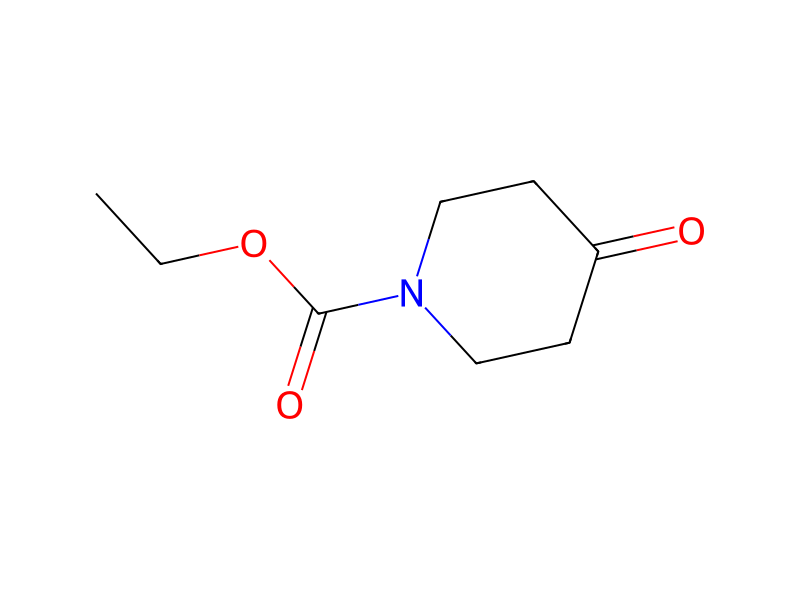
Basic information
- Standard SMILES
CCOC(=O)N1CCC(=O)CC1- InChIKey
LUBGFMZTGFXIIN-UHFFFAOYSA-N- Molecular formula
- C8H13NO3
- Average molar mass
- 171.19 g/mol
- Monoisotopic mass
- 171.08954328
Names & identifiers
- Preferred name
- Ethyl 4-oxo-1-piperidinecarboxylate
- IUPAC
- ethyl 4-oxopiperidine-1-carboxylate
- English name
- N-Carbethoxy-4-piperidone
- Molecular formula
- C8H13NO3
- Molecular weight
- 171.19
Names & synonyms
N-Carbethoxy-4-piperidone29976-53-2Ethyl 4-oxopiperidine-1-carboxylateEthyl 4-oxo-1-piperidinecarboxylate1-Carbethoxy-4-piperidoneN-Carboethoxy-4-piperidone4-Oxo-1-piperidinecarboxylic acid ethyl ester1-(Ethoxycarbonyl)-4-piperidoneN-Ethoxycarbonyl-4-piperidone1-Ethoxycarbonyl-4-piperidinoneDTXSID0057704UNII-7H5JX1S259
Show more names
1-ETHOXYCARBONYL-4-PIPERIDONELoratadine EP IMpurity HLUBE-007AURORA KA-3057N-Carbethoxypiperidonecarbethoxy-4-piperidone
N-Ethoxycarbonyl-4-piperidinone7H5JX1S259EINECS 249-984-5NSC-139022n-carbethoxy-4-piperidinoneDTXCID8031493NSC 1390221-(CARBOETHOXY)-4-PIPERIDINONE
Database identifiers
- CAS
29976-53-2- PubChem CID
- 34767
- DTXSID
DTXSID0057704- UNII
- 7H5JX1S259
- EC Number
- 249-984-5
- Nikkaji
- J27.978A
Properties
Computed structural properties
- XLogP
- -0.1
- Topological polar surface area
- 46.6 Ų
- Hydrogen bond donors
- 0
- Hydrogen bond acceptors
- 3
- Rotatable bonds
- 2
- Heavy atoms
- 12
- Formal charge
- 0
- Complexity
- 181
Experimental & physicochemical properties
SpringerMaterials PropertiesChemical shift
Physicochemical properties
- Boiling point
- 95 · 95-98 °C (1 mmHg)
- Density
- 1.135 g/mL · 1.135 g/mL at 25 °C (lit.)
- vapor pressure
- 0.2 · 0.2-0.37Pa at 20-25℃
- refractive index
- 20 · n20/D 1.475(lit.)
- Flash point
- 190 °F · 190 °F
- storage temp.
- Inert atmosphere,Room Temperature
- solubility
- Chloroform (Slightly), Methanol (Slightly)
- form
- Liquid
- pka
- -1.59 · -1.59±0.20(Predicted)
- color
- Clear colorless to pale yellow
- PH
- 4.6 · 4.6 (H2O, 20℃)(saturated solution)
- Water Solubility
- slightly soluble
- BRN
- 640967 · 640967
- InChI
- 1S/C8H13NO3/c1-2-12-8(11)9-5-3-7(10)4-6-9/h2-6H2,1H3
- InChIKey
- LUBGFMZTGFXIIN-UHFFFAOYSA-N
- SMILES
- CCOC(=O)N1CCC(=O)CC1
- LogP
- 0 at · 0 at 20℃ and pH6.5-6.7
- CAS DataBase Reference
- 29976 · 29976-53-2(CAS DataBase Reference)
- FDA UNII
- 7 H5JX1S259 · 7H5JX1S259
- UNSPSC Code
- 41116107 · 41116107
- NACRES
- 24 · NA.24
- Symbol(GHS)
- 7 · GHS07
- Signal word
- Warning
- Hazard statements
- 319 · H319
- Precautionary statements
- 264 · P264-P280-P305+P351+P338-P337+P313
- PPE
- Eyeshields, Gloves, multi-purpose combination respirator cartridge (US)
- Hazard Codes
- Xn,Xi
- Risk Statements
- 36 · 36/38-22-36/37/38-20/21/22
- Safety Statements
- 23 · 23-24/25-37/39-26-36
- WGK Germany
- 3 · 3
- HazardClass
- IRRITANT
- HS Code
- 29333999 · 29333999
- Storage Class
- 10 · 10 - Combustible liquids
- Hazard Classifications
- 2 · Eye Irrit. 2
- REACH Registrations
- Active
Safety & regulation
GHS classification
GHS Classification
This chemical does not meet GHS hazard criteria for 30.8% (4 of 13) of reports.
Danger
H302 (46.2%): Harmful if swallowed [Warning Acute toxicity, oral]
P264, P264+P265, P270, P280, P301+P317, P302+P352, P305+P351+P338, P305+P354+P338, P317, P321, P330, P332+P317, P337+P317, P362+P364, and P501 (click each P-code to see the statement)
Aggregated GHS information provided per 13 reports by companies from 7 notifications to the ECHA C&L Inventory. Each notification may be associated with multiple companies.
Hazard information
Regulatory Information
Status: Active Update: 27-02-2023 https://echa.europa.eu/registration-dossier/-/registered-dossier/21330
Ethyl 4-oxopiperidine-1-carboxylate: Does not have an individual approval but may be used under an appropriate group standard
Hazard Classes and CategoriesAcute Tox. 4 (46.2%)
Safety data
- PPE
- Eyeshields, Gloves, multi-purpose combination respirator cartridge (US)
- wgk
- 3
- hs_code
- 29333999
- risk_code
- 36/38-22-36/37/38-20/21/22
- Signal word
- Warning
- Symbol(GHS)
- GHS07
- hazard_code
- Xn,Xi
- safety_code
- 23-24/25-37/39-26-36
- hazard_class
- IRRITANT
- Storage Class
- 10 - Combustible liquids
- Hazard statements
- H319
- REACH Registrations
- Active
- Hazard Classifications
- Eye Irrit. 2
- Precautionary statements
- P264-P280-P305+P351+P338-P337+P313
Chemistry & industry
Applications
UsesEthyl 4-oxo-1-piperidinecarboxylate (1-carbethoxy-4-piperidone) was used to prepare tertiary alcohols.
UsesN-Carbethoxy-4-piperidone (Loratadine EP Impurity H) is used in the preparation of 3-hydrazinopyridazines as antihypertensive agents as well as γ-carboline derivatives as potential serotonergic agents. It is also an impurity of Loratadine (L469575).
Upstream & downstream products
Upstream raw materials
Downstream products
Related reactions
202 records


Linked notes
Loading…