HomeMCPSkillsWorkbenchOpenChem
HomeWorkbenchNotificationsMe
llms.txt · skill.md · MCP GuidePrivacy Policy · Terms of Service · Supportv1.8.5
  1. Home
  2. /Compound

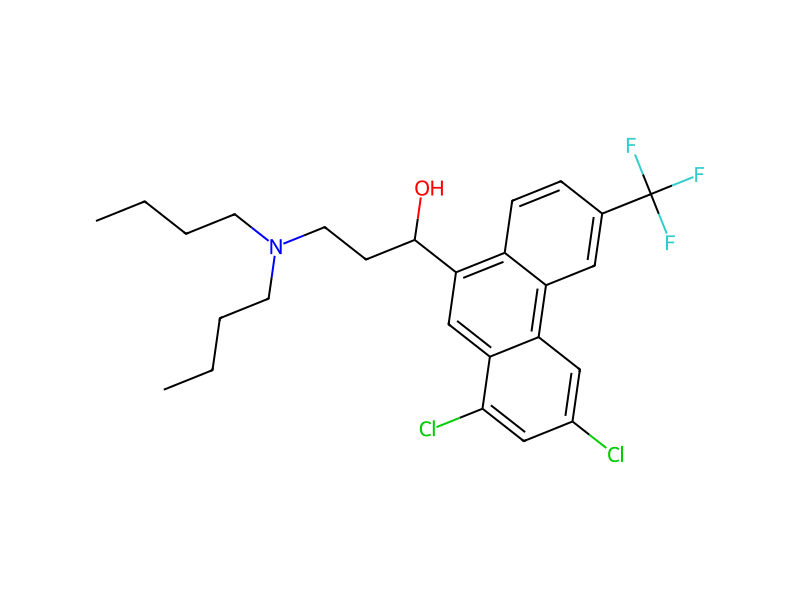
Halofantrine

HCID 37393
New reaction
Print
Basic informationOverviewNames & identifiersPropertiesSafety & regulationChemistry & industryRelated reactionsCompound notes
Substructure searchFind similar structures

Basic information

CAS
66051-74-9
Standard SMILES
CCCCN(CCCC)CCC(O)c1cc2c(Cl)cc(Cl)cc2c2cc(C(F)(F)F)ccc12
InChIKey
FOHHNHSLJDZUGQ-UHFFFAOYSA-N
Molecular formula
C26H30Cl2F3NO
Average molar mass
500.4 g/mol
Monoisotopic mass
499.1656546

Overview

3-(dibutylamino)-1-[1,3-dichloro-6-(trifluoromethyl)-9-phenanthrenyl]-1-propanol is a member of phenanthrenes.

Names & identifiers

Preferred name
Halofantrine
IUPAC
3-(dibutylamino)-1-[1,3-dichloro-6-(trifluoromethyl)phenanthren-9-yl]propan-1-ol
English name
HALOFANTRINE
Molecular formula
C26H30Cl2F3NO
Molecular weight
500.42

Names & synonyms

Halofantrine69756-53-2Halofantrinum3-(dibutylamino)-1-[1,3-dichloro-6-(trifluoromethyl)phenanthren-9-yl]propan-1-ol3-(Dibutylamino)-1-(1,3-dichloro-6-(trifluoromethyl)phenanthren-9-yl)propan-1-olQ2OS4303HZDL-WR-171669DTXSID0023119WR-171699RefChem:783364DTXCID403119P01BX01
Show more names
HalofanWR-171669SKF-102886Halofantrine D18HALOFANTRINE USP/EP/BPHalofantrine hydrochloride CRS3-(Dibutylamino)-1-(1,3-dichloro-6-(trifluoromethyl)-phenanthren-9-yl)propan-1-ol1,3-Dichloro-α-[2-(dibutylamino)ethyl]-6-(trifluoromethyl)-9-phenanthrenemethanol3-DIBUTYLAMINO-1-(1,3-DICHLORO-6-TRIFLUOROMETHYL-PHENANTHREN-9-YL)-PROPAN-1-OL HCL
274-104-1Halofantrine, (-)-Halofantrinum [INN-Latin]Halofantrina [INN-Spanish]66051-76-1dl-WR 171669(+)-HalofantrineHalofantrine (INN)

Properties

Computed structural properties

XLogP
8.6
Topological polar surface area
23.5 Ų
Hydrogen bond donors
1
Hydrogen bond acceptors
5
Rotatable bonds
10
Heavy atoms
33
Formal charge
0
Complexity
584

Experimental & physicochemical properties

DrugsPharmaceuticals -> Antiparasitic products, insecticides and repellents -> Antiprotozoals
LogP8.9
Solubility1.11e-04 g/L
Human DrugsBreast Feeding; Lactation; Milk, Human; Anti-infective Agents; Antiparasitic Agents; Antimalarials; Antiprotozoal Agents
Physical DescriptionSolid

Physicochemical properties

Density
1.244 · 1.244±0.06 g/cm3 (20 ºC 760 Torr)
storage temp.
2 · 2-8°C
Water Solubility
0.59 mg/L · 0.59mg/L(37 ºC)
FDA UNII
2 OS4303HZ · Q2OS4303HZ
ATC code
1 BX01 · P01BX01
Comptox DTXSID
23119 · DTXSID0023119

Safety & regulation

Safety information is for reference only and does not replace the supplier’s Safety Data Sheet (SDS), applicable regulations, or professional assessment.

Toxicology

Drug Induced Liver Injury · 4 items

Drug-Induced Liver Injury Severity and Toxicity (DILIst)

Halofantrine

DILI Positive

DOI:10.1016/j.drudis.2019.09.022

Effects During Pregnancy and Lactation◉ Summary of Use during Lactation

Chemistry & industry

Pharmacology

ATC CodeP - Antiparasitic products, insecticides and repellents
Protein Binding60-70%;
PharmacodynamicsHalofantrine is a synthetic antimalarial which acts as a blood schizonticide. It is effective against multi drug resistant (including mefloquine resistant) <i>P. falciparum</i> malaria.
Mechanism of ActionThe mechanism of action of Halofantrine may be similar to that of chloroquine, quinine, and mefloquine; by forming toxic complexes with ferritoporphyrin IX that damage the membrane of the parasite.
Biological Half-Life6-10 days
Metabolism/MetabolitesHepatic
FDA Pharmacological Classification · 4 items

Q2OS4303HZ

HALOFANTRINE

Established Pharmacologic Class [EPC] - Antimalarial

Halofantrine is an Antimalarial.

MeSH Pharmacological ClassificationAgents used in the treatment of malaria. They are usually classified on the basis of their action against plasmodia at different stages in their life cycle in the human. (From AMA, Drug Evaluations Annual, 1992, p1585)
Cellular LocationsMembrane
Applications · 2 items

DescriptionHalofantrine is an orally-active blood schizonticide reportedly highly effective in the treatment of fulcipurum malaria and other types of parasitemia. Cure rate is claimed to be over 95%.

Related reactions

1 records
New reaction record
HRID 2164723As reactant
Compound notes

On this pageBasic informationOverviewNames & identifiersPropertiesSafety & regulationChemistry & industryRelated reactionsCompound notes

Database identifiers

CAS
66051-74-9、66051-76-1、69756-53-2
PubChem CID
37393
DTXSID
DTXSID0023119
ChEMBL
CHEMBL1107
ChEBI
CHEBI:94392
UNII
Q2OS4303HZ
EC Number
274-104-1
Nikkaji
J18.879D

General DescriptionStructurally, halofantrine differs from allother antimalarial drugs. It is a good example of drug designthat incorporates bioisosteric principles as evidenced by thetrifluromethyl moiety. Halofantrine is a schizonticide and has no affect on the sporozoite, gametocyte,or hepatic stages. Both the parent compound and Ndesbutylmetabolite are equally active in vitro. Halfantrine’sspecific mechanism of action against the parasite is notknown. There is contradictory evidence that its mechanismranges from requiring heme to disrupting the mitochondria.There is a prominent warning that halfantrine can affectnerve conduction in cardiac tissue.

Upstream & downstream products

Upstream raw materials

1-BromobutaneDiboranePhenanthrenePhosphonic acid

Additional notes

DefinitionChEBI: 3-(dibutylamino)-1-[1,3-dichloro-6-(trifluoromethyl)-9-phenanthrenyl]-1-propanol is a member of phenanthrenes.