4-Nitrophenyl Phosphate
Basic information
- CAS
12778-12-0- Standard SMILES
O=[N+]([O-])c1ccc(OP(=O)(O)O)cc1- InChIKey
XZKIHKMTEMTJQX-UHFFFAOYSA-N- Molecular formula
- C6H6NO6P
- Average molar mass
- 219.09 g/mol
- Monoisotopic mass
- 218.99327391
Overview
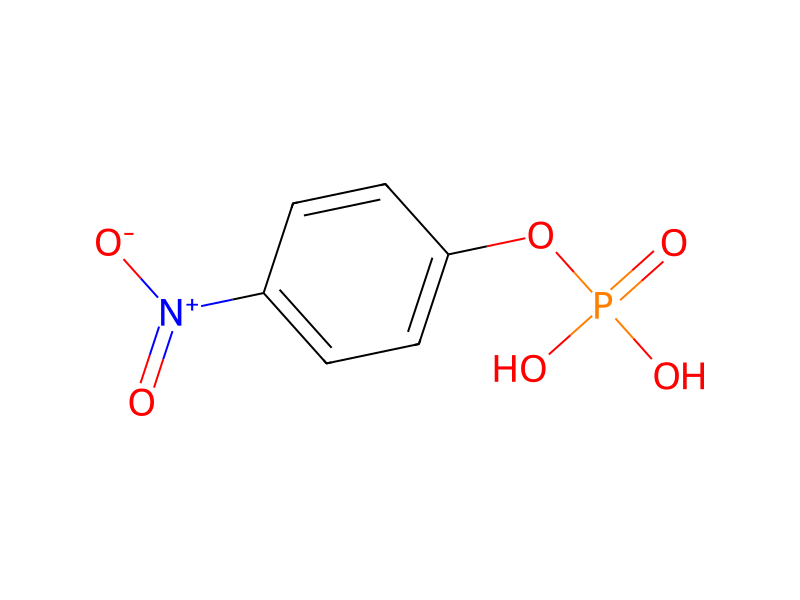
4-nitrophenyl phosphate is an aryl phosphate resulting from the mono-esterification of phosphoric acid with 4-nitrophenol. It has a role as a mouse metabolite. It is functionally related to a 4-nitrophenol. It is a conjugate acid of a 4-nitrophenyl phosphate(2-).
Names & identifiers
- Preferred name
- 4-Nitrophenyl Phosphate
- IUPAC
- (4-nitrophenyl) dihydrogen phosphate
- English name
- p-Nitrophenyl phosphate di(Tris) salt
- Molecular formula
- C6H6NO6P
- Molecular weight
- 219.09
Names & synonyms
4-nitrophenyl phosphate330-13-24-Nitrophenyl dihydrogen phosphatep-nitrophenyl phosphateNitrophenylphosphatePhosphoric acid, mono(4-nitrophenyl) esterp-Nitrophenyl dihydrogen phosphatep-Nitrophenol phosphate(4-nitrophenyl) dihydrogen phosphate(4-nitrophenoxy)phosphonic acidPhenol, p-nitro-, dihydrogen phosphate4-nitrophenylphosphate
Show more names
pNNPp NNPp-NNPCPD-194PNPP-TRISNO2-phen-PPNPP, 2TRISnitrophenol-PP-NPP, DITRIS SALT
Phosphoric acid, mono(p-nitrophenyl) ester59NF9TE3BADTXSID60861876NSC-40408612778-12-0CHEBI:17440DTXSID00925981RefChem:526001
Database identifiers
- CAS
12778-12-0、330-13-2- PubChem CID
- 378
- DTXSID
Properties
Computed structural properties
- XLogP
- 0.3
- Topological polar surface area
- 113 Ų
- Hydrogen bond donors
- 2
- Hydrogen bond acceptors
- 6
- Rotatable bonds
- 2
- Heavy atoms
- 14
- Formal charge
- 0
- Complexity
- 250
Experimental & physicochemical properties
Chemical ClassesOther Classes -> Organophosphates, Other
DrugsPharmaceuticals -> Listed in ZINC15
Physicochemical properties
- Melting point
- 153 °C · 153 °C
- Boiling point
- 457.8 · 457.8±47.0 °C(Predicted)
- Density
- 1.712 · 1.712±0.06 g/cm3(Predicted)
- storage temp.
- 2 · 2-8°C
- solubility
- 2 O: · H2O: 0.1 g/mL, clear
- pka
- 0.86 · 0.86±0.30(Predicted)
- color
- White to light yellow crystalline powder
- FDA UNII
- 59 NF9TE3BA · 59NF9TE3BA
- EPA Substance Registry System
- Phosphoric acid, mono(4-nitrophenyl) ester (330-13-2)
- Symbol(GHS)
- 7 · GHS07
- Signal word
- Warning
Safety & regulation
Safety information is for reference only and does not replace the supplier’s Safety Data Sheet (SDS), applicable regulations, or professional assessment.
GHS classification
GHS Classification
Warning
H302 (66.7%): Harmful if swallowed [Warning Acute toxicity, oral]
P261, P264, P264+P265, P270, P271, P280, P301+P317, P302+P352, P304+P340, P305+P351+P338, P319, P321, P330, P332+P317, P337+P317, P362+P364, P403+P233, P405, and P501 (click each P-code to see the statement)
Aggregated GHS information provided per 3 reports by companies from 3 notifications to the ECHA C&L Inventory. Each notification may be associated with multiple companies.
Hazard information
Hazards SummarySee Paraoxon. See o-Nitroanisole.
Hazard Classes and CategoriesAcute Tox. 4 (66.7%)
Safety data
- F
- 8-10-21
- wgk
- 3
- tsca
- TSCA listed
- Signal word
- Warning
- Symbol(GHS)
- GHS07
- Hazard statements
- H302, H315, H319, H335
- Precautionary statements
- P280, P305+P351+P338
Chemistry & industry
Pharmacology
MeSH Pharmacological Classification
Colorless, endogenous or exogenous pigment precursors that may be transformed by biological mechanisms into colored compounds; used in biochemical assays and in diagnosis as indicators, especially in the form of enzyme substrates. Synonym: chromogens (not to be confused with pigment-synthesizing bacteria also called chromogens).
Substances used for the detection, identification, analysis, etc. of chemical, biological, or pathologic processes or conditions. Indicators are substances that change in physical appearance, e.g., color, at or approaching the endpoint of a chemical titration, e.g., on the passage between acidity and alkalinity. Reagents are substances used for the detection or determination of another substance by chemical or microscopical means, especially analysis. Types of reagents are precipitants, solvents, oxidizers, reducers, fluxes, and colorimetric reagents. (From Grant & Hackh's Chemical Dictionary, 5th ed, p301, p499)
Uses & manufacturing
General Manufacturing InformationPhosphoric acid, mono(4-nitrophenyl) ester: ACTIVE
Applications
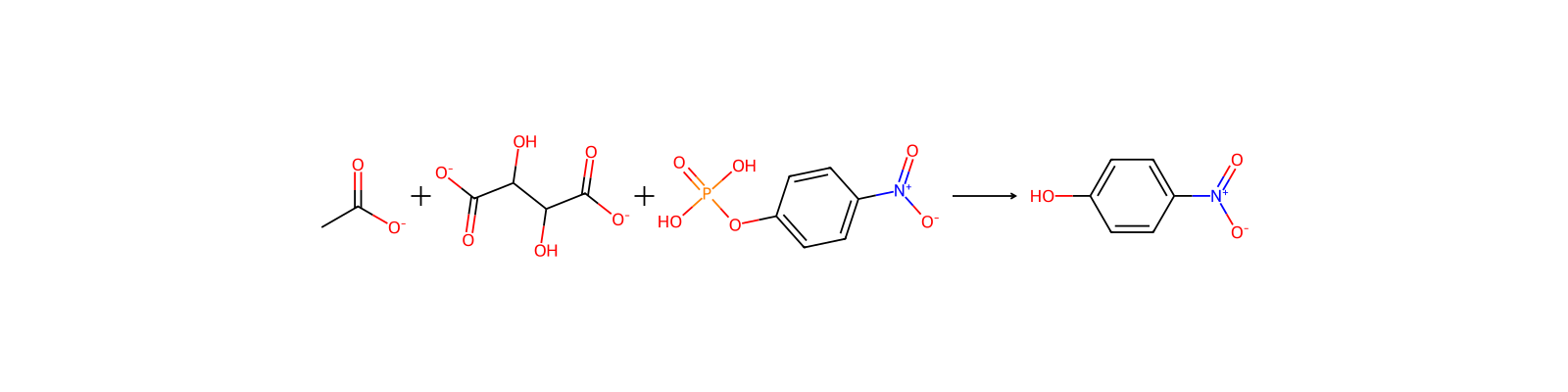
Uses4-Nitrophenyl phosphate undergoes hydrolysis readily, and is used for measuring alkaline phosphatase activity in human serum.
Upstream & downstream products
Downstream products
Additional notes
Related reactions
2 records

Compound notes
Loading…