
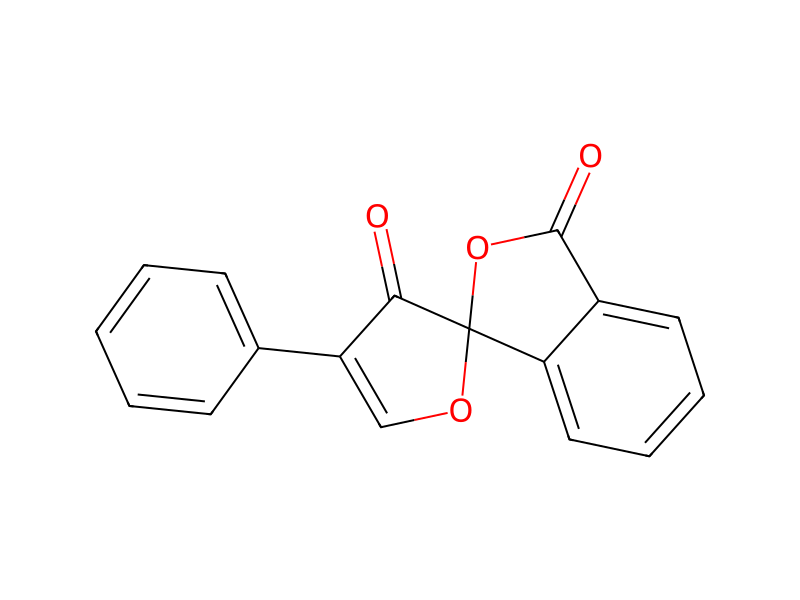
Basic information
- Standard SMILES
O=C1OC2(OC=C(c3ccccc3)C2=O)c2ccccc21- InChIKey
ZFKJVJIDPQDDFY-UHFFFAOYSA-N- Molecular formula
- C17H10O4
- Average molar mass
- 278.26 g/mol
- Monoisotopic mass
- 278.0579088
Overview
A nonfluorescent reagent for the detection of primary amines, peptides and proteins. The reaction products are highly fluorescent.
Names & identifiers
- Preferred name
- Fluorescamine
- IUPAC
- 4'-phenylspiro[2-benzofuran-3,2'-furan]-1,3'-dione
- English name
- Fluorescamine
- Molecular formula
- C17H10O4
- Molecular weight
- 278.26
Names & synonyms
Fluorescamine38183-12-9FluramSpiro[furan-2(3H),1'(3'H)-isobenzofuran]-3,3'-dione, 4-phenyl-Y6859V58YWDTXSID50872017Spiro(furan-2(3H),1'(3'H)-isobenzofuran)-3,3'-dione, 4-phenyl-RO-20-7234RefChem:388984DTXCID30819622253-814-54'-phenylspiro[2-benzofuran-3,2'-furan]-1,3'-dione
Show more names
FluaramFLURAM(R)FluorescaminFluorescamineA.R.Fluorescamine, pureFLURAMANALYTICAL GRADEFluorescamine Labeling
4-Phenylspiro[furan-2(3H),1-phthalan]-3,3'-dioneMFCD00005928EINECS 253-814-5FLUORESCAMINE [MI]4-phenyl-3H,3'H-spiro[furan-2,1'-isobenzofuran]-3,3'-dioneRo 20-7234CS-3522AS-14756
Database identifiers
- CAS
38183-12-9- PubChem CID
- 37927
- DTXSID
DTXSID50872017- UNII
- Y6859V58YW
- EC Number
- 253-814-5
- Nikkaji
- J22.287I
Properties
Computed structural properties
- XLogP
- 2.9
- Topological polar surface area
- 52.6 Ų
- Hydrogen bond donors
- 0
- Hydrogen bond acceptors
- 4
- Rotatable bonds
- 1
- Heavy atoms
- 21
- Formal charge
- 0
- Complexity
- 503
Experimental & physicochemical properties
Chemical ClassesDyes -> Indicator Dyes
Physical DescriptionOff-white odorless powder; [Alfa Aesar MSDS]
Physicochemical properties
- Melting point
- 153 · 153-157 °C (lit.)
- Boiling point
- 381.08 °C · 381.08°C (rough estimate)
- Density
- 1.2661 · 1.2661 (rough estimate)
- refractive index
- 1.5447 · 1.5447 (estimate)
- Flash point
- -17 °C · -17 °C
- storage temp.
- room temp
- solubility
- acetonitrile: soluble
- form
- powder
- color
- off-white to yellow
- Water Solubility
- Soluble in acetone, ethanol, chloroform, dimethylsulfoxide and acetonitrile. Slightly soluble in water.
- Merck
- 14 · 14,4158
- BRN
- 921143 · 921143
- Stability
- Stable. Incompatible with strong oxidizing agents.
- InChI
- 1S/C17H10O4/c18-15-13(11-6-2-1-3-7-11)10-20-17(15)14-9-5-4-8-12(14)16(19)21-17/h1-10H
- InChIKey
- ZFKJVJIDPQDDFY-UHFFFAOYSA-N
- SMILES
- O=C1OC2(OC=C(C2=O)c3ccccc3)c4ccccc14
- CAS DataBase Reference
- 38183 · 38183-12-9(CAS DataBase Reference)
- FDA UNII
- 6859 V58YW · Y6859V58YW
- NIST Chemistry Reference
- -2 · Spiro[furan-2(3h),1'(3'h)-isobenzofuran]-3,3'-dione, 4-phenyl-(38183-12-9)
- UNSPSC Code
- 12352204 · 12352204
- NACRES
- 32 · NA.32
- Symbol(GHS)
- 7 · GHS07
- Signal word
- Warning
- Hazard statements
- 315 · H315-H319-H335
- Precautionary statements
- 280 · P280-P302+P352-P305+P351+P338
- PPE
- 95 · Eyeshields, Gloves, type N95 (US)
- Hazard Codes
- F,Xi
- Risk Statements
- 11 · 11-36/38-66-67-36-36/37/38
- Safety Statements
- 22 · 22-24/25-36/37-33-29-26-16-9-37/39
- RIDADR
- 1090 · UN 1090 3/PG 2
- WGK Germany
- 3 · 3
- F
- 10 · 10-21
- HS Code
- 29322090 · 29322090
- Storage Class
- 13 · 13 - Non Combustible Solids
Safety & regulation
GHS classification
GHS Classification
Warning
H319 (100%): Causes serious eye irritation [Warning Serious eye damage/eye irritation]
P261, P264+P265, P271, P280, P304+P340, P305+P351+P338, P319, P337+P317, P403+P233, P405, and P501 (click each P-code to see the statement)
The GHS information provided by 1 company from 1 notification to the ECHA C&L Inventory.
Hazard information
Regulatory InformationSpiro[furan-2(3H),1'(3'H)-isobenzofuran]-3,3'-dione, 4-phenyl-: Does not have an individual approval but may be used under an appropriate group standard
Hazards SummaryMay cause irritation; [Alfa Aesar MSDS]
Safety data
- F
- 10-21
- PPE
- Eyeshields, Gloves, type N95 (US)
- wgk
- 3
- ridadr
- UN 1090 3/PG 2
- hs_code
- 29322090
- risk_code
- 11-36/38-66-67-36-36/37/38
- Signal word
- Warning
- Symbol(GHS)
- GHS07
- hazard_code
- F,Xi
- safety_code
- 22-24/25-36/37-33-29-26-16-9-37/39
- Storage Class
- 13 - Non Combustible Solids
- Hazard statements
- H315-H319-H335
- Precautionary statements
- P280-P302+P352-P305+P351+P338
Chemistry & industry
Pharmacology
MeSH Pharmacological Classification
Substances used for the detection, identification, analysis, etc. of chemical, biological, or pathologic processes or conditions. Indicators are substances that change in physical appearance, e.g., color, at or approaching the endpoint of a chemical titration, e.g., on the passage between acidity and alkalinity. Reagents are substances used for the detection or determination of another substance by chemical or microscopical means, especially analysis. Types of reagents are precipitants, solvents, oxidizers, reducers, fluxes, and colorimetric reagents. (From Grant & Hackh's Chemical Dictionary, 5th ed, p301, p499)
Uses & manufacturing
UsesUsed as an analytical reagent; [Merck Index]
Applications
UsesFor fluorescent detection of amino acids, peptides and proteins.Fluorescamine plays an important role as a reagent for the detection of amines, peptides and proteins. It is also used as a substrate for measuring protease activity. It is utilized in the detection and quantitation of residual aminopenicillins and sulfonamides in honey by HPLC. It finds application in the determination of lisinopril in human plasma and urine.
UsesFluorescamine is a non-fluorescent reagent that reacts readily under mild conditions with primary amines in amino acids and peptides to form stable, highly fluorescent compounds. Reaction takes place under mild conditions. Low background due to hydrolysis.
UsesAnalytical reagent.
Upstream & downstream products
Upstream raw materials
Suppliers50 total
国药集团化学试剂有限公司86-21-63210123 · [email protected]
北京华美互利生物化工010-56205725 · [email protected]
梯希爱(上海)化成工业发展有限公司021-67121386 · [email protected]
上海阿拉丁生化科技股份有限公司400-6206333 13167063860 · [email protected]
湖北万得化工有限公司15377098680 15377098680 · [email protected]
上海康朗生物科技有限公司021-61998208 18217752821 · [email protected]
北京阿克曼科技有限公司18001219251
上海如吉生物科技发展有限公司+86-21-65211385-8001 36031160 · [email protected]
上海赫文斯化工有限公司15721252604 17321035817 · [email protected]
Dayang Chem (Hangzhou) Co.,Ltd.+86-0571-88938639 17705817739 · [email protected]
上海弘顺生物科技有限公司15901914505 · [email protected]
Syntechem Co.,Ltd[email protected]
上海迈瑞尔生化科技有限公司4006356688 18621169109 · [email protected]
上海晶抗生物工程有限公司021-54721350 13524668266 · [email protected]
阿法埃莎(中国)化学有限公司400-6106006 · [email protected]
安耐吉化学&3A(安徽泽升科技股份有限公司)400-0056266 · [email protected]
南京奥生化学技术有限公司+86 (25) 82263158
常州科化生物科技有限公司0519-68985668 13685222090 · [email protected]
南京圣亿来化工有限公司19951936396 · [email protected]
上海柯维化学技术有限公司021-64609169 18901607656 · [email protected]
上海泰坦科技股份有限公司400-6009262 15618770481 · [email protected]
MedChemexpress LLC021-58955995 · [email protected]
山东西亚化学有限公司13355009207 13355009207 · [email protected]
玛雅试剂+86 (573) 82222445 (0)18006601000 452520369 · [email protected]
四川库利南科技有限公司400-1166-196 18981987031 · [email protected]
天津希恩思生化科技有限公司400 638 7771 · [email protected]
湖南汇百侍生物科技有限公司0731-85526065 13308475853 · [email protected]
斯百全化学(上海)有限公司021-021-021-67601398-809-809-809 15221380277 · [email protected]
上海源叶生物科技有限公司13636370518 · [email protected]
上海思域化工科技有限公司86-21-34053660 · [email protected]
赛默飞世尔科技(中国)有限公司800-810-5118 · [email protected]
北京伊诺凯科技有限公司400-810-7969 010-59572699 · [email protected]
上海健超生物科技有限公司150-2103-5486 18017383231 · [email protected]
TCI AMERICA800-4238616 · [email protected]
TOKYO CHEMICAL INDUSTRY CO., LTD.03-36680489 · [email protected]
TCI Europe320-37350700 · [email protected]
上海昶衍化工科技有限公司021-20242659 18930833303 · [email protected]
上海将来实业股份有限公司400-0066400 13621662912 · [email protected]
上海将来实业股份有限公司021-61552785 · [email protected]
成都零六生物科技有限公司400-1166-196 13458535857 · [email protected]
上海鑫圭生物科技有限公司15121041756 · [email protected]
上海麦克林生化科技股份有限公司15221275939 15221275939 · [email protected]
成都润泽本土化工有限公司13096311329 028-88469284 616445927 · [email protected]
上海市凯瑜琳医药科技有限公司021-18721936-595 18721936595 · [email protected]
Sigma-Aldrich西格玛奥德里奇(上海)贸易有限公司021-61415566 800-8193336 · [email protected]
TargetMol中国(陶术生物)021-021-33632979 15002134094 · [email protected]
上海陶术生物科技股份有限公司+1-781-999-5354; +1-00000000000 · [email protected]
北京诺其雅盛生物科技有限公司4000-819-385 010-62329685 13718666987
九鼎化学(上海)科技有限公司4009209199 · [email protected]
资川生化科技(苏州)有限公司0512-66317708 13372112871 · [email protected]
Related reactions
3 records


Linked notes
Loading…