
Ketanserin
Basic information
- CAS
74050-98-9- Standard SMILES
O=C(c1ccc(F)cc1)C1CCN(CCn2c(=O)[nH]c3ccccc3c2=O)CC1- InChIKey
FPCCSQOGAWCVBH-UHFFFAOYSA-N- Molecular formula
- C22H22FN3O3
- Average molar mass
- 395.4 g/mol
- Monoisotopic mass
- 395.16451978
Overview
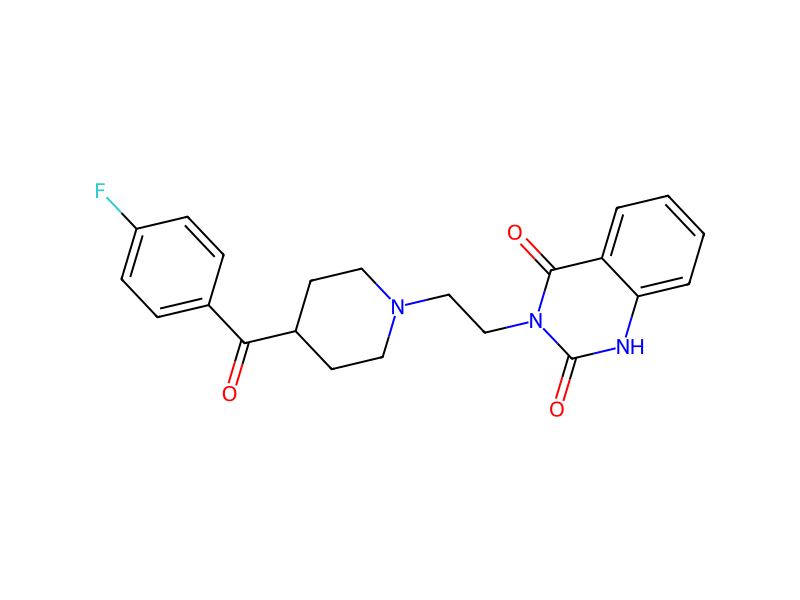
Ketanserin is a member of the class of quinazolines that is quinazoline-2,4(1H,3H)-dione which is substituted at position 3 by a 2-[4-(p-fluorobenzoyl)piperidin-1-yl]ethyl group. It has a role as a cardiovascular drug, an antihypertensive agent, an alpha-adrenergic antagonist, a serotonergic antagonist and an EC 3.4.21.26 (prolyl oligopeptidase) inhibitor. It is a member of piperidines, an organofluorine compound, a member of quinazolines and an aromatic ketone. It is a conjugate base of a ketanserin(1+).
Names & identifiers
- Preferred name
- Ketanserin
- IUPAC
- 3-[2-[4-(4-fluorobenzoyl)piperidin-1-yl]ethyl]-1H-quinazoline-2,4-dione
- English name
- Ketanserin
- Molecular formula
- C22H22FN3O3
- Molecular weight
- 395.43
Names & synonyms
Ketanserin74050-98-9KetanserineKetanserinumKetanserinaKetaserin3-(2-(4-(4-Fluorobenzoyl)piperidin-1-yl)ethyl)quinazoline-2,4(1H,3H)-dioneSerefrexR-41468DTXSID3023188R-41,4683-[2-[4-(4-fluorobenzoyl)piperidin-1-yl]ethyl]-1H-quinazoline-2,4-dione
Show more names
KetRHSOFC8EEC3p73Hp73Lp53CPSHFM4TP73L
R 41468R 41,46897F9DE4CT43-(2-(4-(4-Fluorobenzoyl)piperidinol)ethyl)-2,4(1H,3H)-quinazolinedioneNSC-7589592,4(1H,3H)-Quinazolinedione, 3-(2-(4-(4-fluorobenzoyl)-1-piperidinyl)ethyl)-CHEBI:6123DTXCID103188
Database identifiers
- CAS
74050-98-9、83846-83-7- PubChem CID
- 3822
- DTXSID
DTXSID3023188- ChEMBL
CHEMBL1628637、CHEMBL51- ChEBI
CHEBI:6123- UNII
- 97F9DE4CT4
- EC Number
- 277-680-2
- Nikkaji
- J12.099E
Properties
Computed structural properties
- XLogP
- 2.6
- Topological polar surface area
- 69.7 Ų
- Hydrogen bond donors
- 1
- Hydrogen bond acceptors
- 5
- Rotatable bonds
- 5
- Heavy atoms
- 29
- Formal charge
- 0
- Complexity
- 627
Experimental & physicochemical properties
Drugs
Pharmaceuticals -> Cardiovascular system -> Antihypertensives
Pharmaceuticals -> Listed in ZINC15
LogP2.9
Collision Cross Section191.99 Ų [M+H]+ [CCS Type: TW; Method: calibrated with polyalanine and drug standards]
Physicochemical properties
- Melting point
- 227 · 227-235°C
- Density
- 1.28 · 1.280±0.06 g/cm3(Predicted)
- storage temp.
- 2 · Sealed in dry,2-8°C
- solubility
- 10 mg/mL, · DMF: 10 mg/mL, clear, colorless
- form
- Solid
- pka
- 7.5 · 7.5(at 25℃)
- color
- White to Off-White
- biological source
- human
- Merck
- 14 · 14,5296
- CAS DataBase Reference
- 74050 · 74050-98-9(CAS DataBase Reference)
- FDA UNII
- 97 F9DE4CT4 · 97F9DE4CT4
- ATC code
- 2 KD01 · C02KD01
- UNSPSC Code
- 12352200 · 12352200
- NACRES
- 32 · NA.32
- Symbol(GHS)
- 7 · GHS07
- Signal word
- Warning
- Hazard statements
- 302 · H302
- Precautionary statements
- 501 · P501-P270-P264-P301+P312+P330
- WGK Germany
- 3 · 3
- RTECS
- 1411190 · VA1411190
- HS Code
- 29339900 · 29339900
Safety & regulation
Safety information is for reference only and does not replace the supplier’s Safety Data Sheet (SDS), applicable regulations, or professional assessment.
GHS classification
GHS Classification
Warning
H302 (100%): Harmful if swallowed [Warning Acute toxicity, oral]
P264, P270, P301+P317, P330, and P501 (click each P-code to see the statement)
Aggregated GHS information provided per 36 reports by companies from 1 notifications to the ECHA C&L Inventory.
Hazard information
Other Safety InformationIMAP assessments - 2,4(1H,3H)-Quinazolinedione, 3-[2-[4-(4-fluorobenzoyl)-1-piperidinyl]ethyl]-: Environment tier I assessment
Hazard Classes and CategoriesAcute Tox. 4 (100%)
Safety data
- wgk
- 3
- rtecs
- VA1411190
- hs_code
- 29339900
- Signal word
- Warning
- Symbol(GHS)
- GHS07
- Hazard statements
- H302
- Precautionary statements
- P501-P270-P264-P301+P312+P330
Chemistry & industry
Pharmacology
ATC Code
C - Cardiovascular system
QC - Cardiovascular system
QD - Dermatologicals
MeSH Pharmacological Classification
Drugs used in the treatment of acute or chronic vascular HYPERTENSION regardless of pharmacological mechanism. Among the antihypertensive agents are DIURETICS; (especially DIURETICS, THIAZIDE); ADRENERGIC BETA-ANTAGONISTS; ADRENERGIC ALPHA-ANTAGONISTS; ANGIOTENSIN-CONVERTING ENZYME INHIBITORS; CALCIUM CHANNEL BLOCKERS; GANGLIONIC BLOCKERS; and VASODILATOR AGENTS.
Drugs or agents which antagonize or impair any mechanism leading to blood platelet aggregation, whether during the phases of activation and shape change or following the dense-granule release reaction and stimulation of the prostaglandin-thromboxane system.
Drugs that bind to but do not activate serotonin receptors, thereby blocking the actions of serotonin or SEROTONIN RECEPTOR AGONISTS.
Applications
DescriptionKetanserin is an antihypertensive agent with antagonist properties at both the serotonin-S2 and α1-adrenergic receptors. Its mechanism of action, while still controversial, may involve interactions at both of these loci.
UsesAn antihypertensive, with affinity for multiple GPCR receptors.
Usesreceptor antagonist
Upstream & downstream products
Upstream raw materials
Additional notes
DefinitionChEBI: A member of the class of quinazolines that is quinazoline-2,4(1H,3H)-dione which is substituted at position 3 by a 2-[4-(p-fluorobenzoyl)piperidin-1-yl]ethyl group.
Related reactions
7 records





Compound notes
Loading…