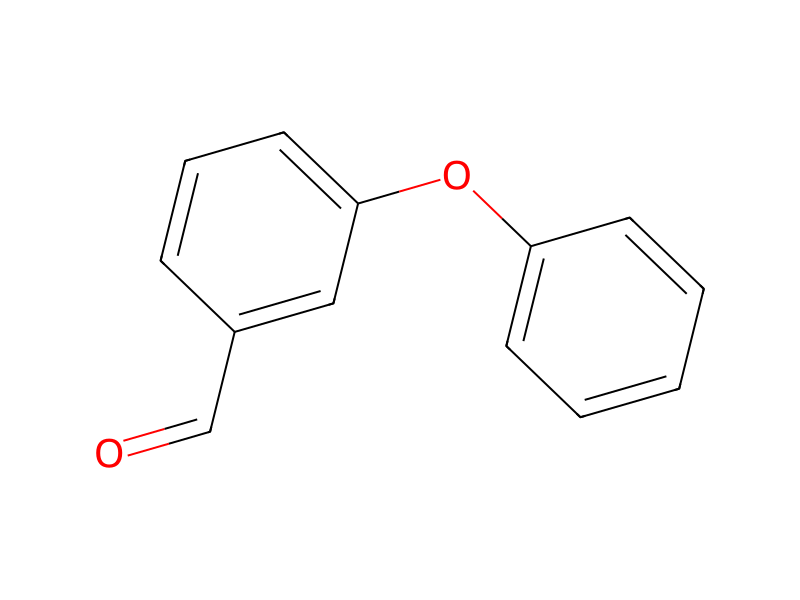
3-Phenoxybenzaldehyde
Basic information
- CAS
39515-51-0- Standard SMILES
O=Cc1cccc(Oc2ccccc2)c1- InChIKey
MRLGCTNJRREZHZ-UHFFFAOYSA-N- Molecular formula
- C13H10O2
- Average molar mass
- 198.22 g/mol
- Monoisotopic mass
- 198.06807956
Overview
3-phenoxybenzaldehyde has been reported in Streptomyces aureus with data available.
Names & identifiers
- Preferred name
- 3-Phenoxybenzaldehyde
- IUPAC
- 3-phenoxybenzaldehyde
- English name
- 3-Phenoxybenzaldehyde
- Molecular formula
- C13H10O2
- Molecular weight
- 198.22
Names & synonyms
3-PHENOXYBENZALDEHYDE39515-51-0m-PhenoxybenzaldehydeBenzaldehyde, 3-phenoxy-m-(Phenyloxy)benzaldehydeDTXSID3028005DTXCID8080052ZI2173196RefChem:504775254-487-13-Phenoxy-benzaldehyde3-Formyldiphenyl Ether
Show more names
META PHENOXY BENZALDEHYE3-PhenoxybenzaLAKOS BBS-00003181Phenoxybenzaldehyde3-Phenoxy-benzaldehy3-phenoxy-benzaldehydM-PHENOXY BENZALDEHYDE
MFCD000033535-phenoxybenzaldehydeUNII-2ZI2173196SCHEMBL98478PHENOXYBENZALDEHYDE, 3-MRLGCTNJRREZHZ-UHFFFAOYSA-DS-0482AC-10909
Database identifiers
- CAS
39515-51-0- PubChem CID
- 38284
- DTXSID
DTXSID3028005- ChEMBL
CHEMBL22531- UNII
- 2ZI2173196
- EC Number
- 254-487-1
- Nikkaji
- J324G
Properties
Computed structural properties
- XLogP
- 3.4
- Topological polar surface area
- 26.3 Ų
- Hydrogen bond donors
- 0
- Hydrogen bond acceptors
- 2
- Rotatable bonds
- 3
- Heavy atoms
- 15
- Formal charge
- 0
- Complexity
- 197
Experimental & physicochemical properties
Chemical ClassesOther Classes -> Other Aromatic Compounds
PesticidesEnvironmental transformation -> Pesticide transformation products (metabolite, successor)
LogP3.38
Vapor Pressure0.000164 [mmHg]
Physical DescriptionYellow liquid; [Alfa Aesar MSDS]
Physicochemical properties
- Melting point
- 13 °C · 13 °C
- Boiling point
- 184 °C/14 · 184 °C/14 mmHg
- Density
- 1.15 · 1.15
- refractive index
- 1.6 · 1.60
- Flash point
- 113 °C · 113 °C - closed cup - (External MSDS)
- storage temp.
- Keep in dark place,Sealed in dry,Room Temperature
- solubility
- Chloroform, Dichloromethane (Slightly), Methanol (Slightly)
Safety & regulation
Safety information is for reference only and does not replace the supplier’s Safety Data Sheet (SDS), applicable regulations, or professional assessment.
GHS classification
GHS Classification
Danger
H302 (100%): Harmful if swallowed [Warning Acute toxicity, oral]
P260, P264, P270, P271, P273, P280, P284, P301+P317, P302+P352, P304+P340, P316, P317, P320, P321, P330, P362+P364, P391, P403+P233, P405, and P501 (click each P-code to see the statement)
Aggregated GHS information provided per 134 reports by companies from 10 notifications to the ECHA C&L Inventory. Each notification may be associated with multiple companies.
Hazard information
Regulatory Information
Chemical: Benzaldehyde, 3-phenoxy-
Status: Cease Manufacture Update: 02-12-2020 https://echa.europa.eu/registration-dossier/-/registered-dossier/2116
3-Phenoxybenzaldehyde: Does not have an individual approval but may be used under an appropriate group standard
Hazards Summary
Causes somnolence, dyspnea, and salivary gland changes in inhalation lethal-concentration studies of rats; Causes CNS effects in 17-week inhalation study of rats; [RTECS] An irritant; Toxic by ingestion; May be fatal by inhalation; [Alfa Aesar MSDS]
Hazard Classes and CategoriesAcute Tox. 4 (100%)
Toxicology
Adverse EffectsNeurotoxin - Other CNS neurotoxin
Toxicity DataLC50 (rat) = 270 mg/m3/4hr
Safety data
- PPE
Chemistry & industry
Uses & manufacturing
Use ClassificationEnvironmental transformation -> Pesticide transformation products (metabolite, successor)
General Manufacturing InformationBenzaldehyde, 3-phenoxy-: ACTIVE
Applications
Uses3-phenoxybenzaldehyde is an important intermediate for the synthesis of pyrethroid pesticides phenothrin, cypermethrin, deltamethrin,fenvalerate, fenpropathrin, flucythrinate, cyhalothrin, etc.
General DescriptionEnantioselective autoinduction during asymmetric hydrocyanation of 3-phenoxybenzaldehyde catalyzed by cyclo[(R)-phenylalanyl-(R)-histidyl] has been investigated. It undergoes hydrogenation catalyzed by Au/Pt bimetallic core/shell nanoparticles to yield 3-phenoxyphenyl methanol.
Preparation methods
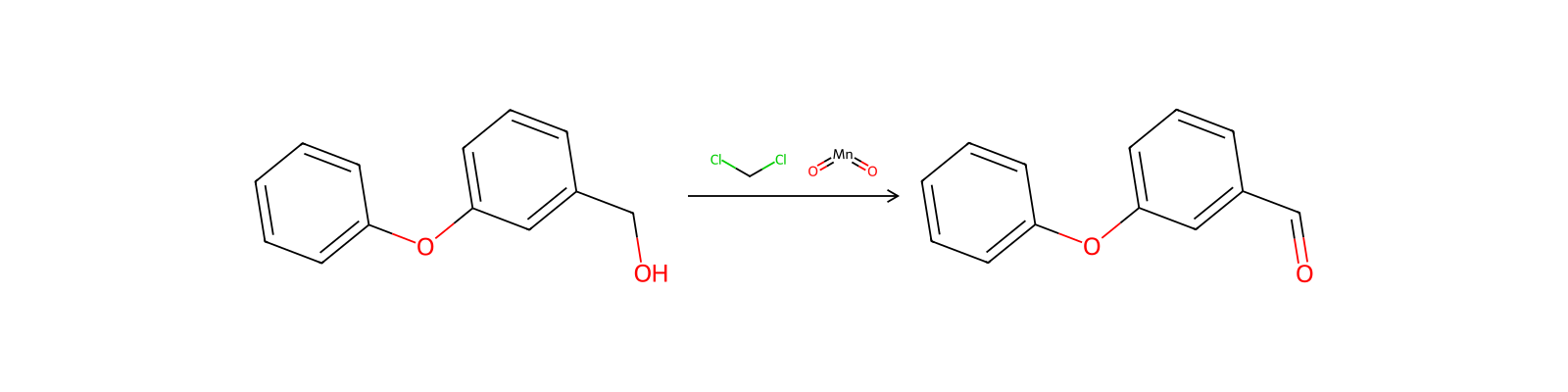
PreparationSynthesis of 3-Phenoxybenzaldehyde: 3-phenoxybenzoic acid is generated by catalytic oxidation of 3-phenoxytoluene, followed by electrolytic reduction to obtain Phenoxybenzyl alcohol , and then selective oxidation with sodium hypochlorite to obtain 3-Phenoxybenzaldehyde.
Upstream & downstream products
Upstream raw materials
Related reactions
189 records







Compound notes
Loading…