
Isoprothiolane
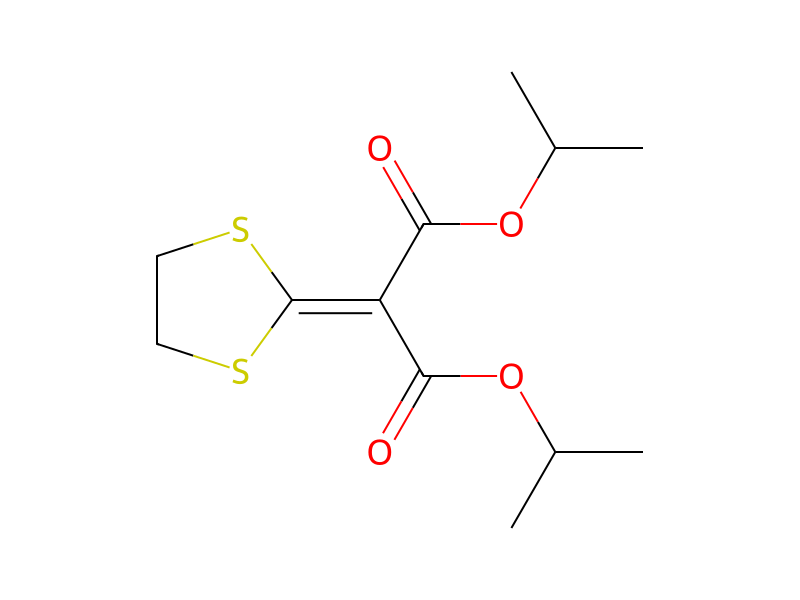
Basic information
- CAS
50512-35-1- Standard SMILES
CC(C)OC(=O)C(C(=O)OC(C)C)=C1SCCS1- InChIKey
UFHLMYOGRXOCSL-UHFFFAOYSA-N- Molecular formula
- C12H18O4S2
- Average molar mass
- 290.4 g/mol
- Monoisotopic mass
- 290.0646514
Overview
Isoprothiolane is a malonate ester that is diisopropyl malonate in which the two methylene hydrogens at position 2 are replaced by a 1,3-dithiolan-2-ylidene group. An insecticide and fungicide used to control a range of diseases including Pyricularia oryzae, Helminthosporium sigmoideum and Fusarium nivale. It has a role as an insecticide, an environmental contaminant, a phospholipid biosynthesis inhibitor and an antifungal agrochemical. It is an isopropyl ester, a malonate ester and a member of dithiolanes. It is functionally related to a malonic acid. It derives from a hydride of a 1,3-dithiolane.
Names & identifiers
- Preferred name
- Isoprothiolane
- IUPAC
- dipropan-2-yl 2-(1,3-dithiolan-2-ylidene)propanedioate
- English name
- Isoprothiolane
- Molecular formula
- C12H18O4S2
- Molecular weight
- 290.4
Names & synonyms
ISOPROTHIOLANE50512-35-1Fuji-oneNKK 100bis(1-methylethyl) 1,3-dithiolan-2-ylidenepropanedioateDi-isopropyl 1,3-dithiolane-2-ylidenemalonatediisopropyl 1,3-dithiolan-2-ylidenemalonatePropanedioic acid, 1,3-dithiolan-2-ylidene-, bis(1-methylethyl) esterDTXSID8058110NNF 10988HCS898G6di(propan-2-yl) 1,3-dithiolan-2-ylidenemalonate
Show more names
IPTPropanedioicacid,1,3-dithiolan-2-ylidene-,bis(1-methylethyl)esterfuji1nkk100Fuji 1ISORANVIFUSINNF-109
CHEBI:60471,3-Dithiolan-2-ylidenepropanedioic acid, bis(1-methylethyl) ester1,3-bis(propan-2-yl) 2-(1,3-dithiolan-2-ylidene)propanedioateRefChem:792266DTXCID7031878FudiolanDiisopropyl 2-(1,3-dithiolan-2-ylidene)malonateFujione
Database identifiers
- CAS
Properties
Computed structural properties
- XLogP
- 3.3
- Topological polar surface area
- 103 Ų
- Hydrogen bond donors
- 0
- Hydrogen bond acceptors
- 6
- Rotatable bonds
- 6
- Heavy atoms
- 18
- Formal charge
- 0
- Complexity
- 329
Experimental & physicochemical properties
Pesticides
Fungicides
Active substance -> EU Pesticides database: Not approved
Pesticide (Isoprothiolane) -> USDA PDB
LogP
2.88
3.3
Solubility0.054 mg/mL at 25 °C
Endocrine DisruptorsPotential endocrine disrupting compound
Melting Point50 - 54.5 °C
Physical DescriptionSolid
Physicochemical properties
- Melting point
- 54 °C · 54°C
- Boiling point
- 402.48 °C · 402.48°C (rough estimate)
- Density
- 1.3402 · 1.3402 (rough estimate)
- vapor pressure
- 1.9 Pa · 1.9 Pa (25 °C)
- refractive index
- 1.495 · 1.4950 (estimate)
Safety & regulation
Safety information is for reference only and does not replace the supplier’s Safety Data Sheet (SDS), applicable regulations, or professional assessment.
GHS classification
GHS Classification
Warning
H302 (100%): Harmful if swallowed [Warning Acute toxicity, oral]
P264, P270, P273, P301+P317, P330, P391, and P501 (click each P-code to see the statement)
Aggregated GHS information provided per 83 reports by companies from 2 notifications to the ECHA C&L Inventory. Each notification may be associated with multiple companies.
H401: Toxic to aquatic life [Hazardous to the aquatic environment, acute hazard]
P273, P391, and P501 (click each P-code to see the statement)
Hazard information
Regulatory Information2002/2076
Hazard Classes and Categories
Acute Tox. 4 (100%)
Acute toxicity (Oral) - Category 4
Hazardous to the aquatic environment (Acute) - Category 2
Safety data
- wgk
- 3
- ridadr
- UN 3077 9 / PGIII
- hs_code
- 29341000
- Toxicity
- LD50 oral in rabbit: 2320mg/kg
- risk_code
- 22-51/53
- Signal word
- Warning
- Symbol(GHS)
- GHS07
- hazard_code
- Xn,N
- safety_code
- 61
- Storage Class
- 11 - Combustible Solids
- Hazard statements
- H302
- Hazard Classifications
Chemistry & industry
Pharmacology
Cellular LocationsMembrane
Applications
UsesIsoprothiolane is a dithiolane pesticide. Isoprothiolane is commonly used in agriculture as a fungicide to control planthoppers and blast disease in rice plants.
UsesIsoprothiolane is a fungicide that is used to control rice blast (Pyriculuriu aryzae), rice stem rot and Fusarium leaf spot on rice. It also reduces the plant-hopper population on rice.
Upstream & downstream products
Upstream raw materials
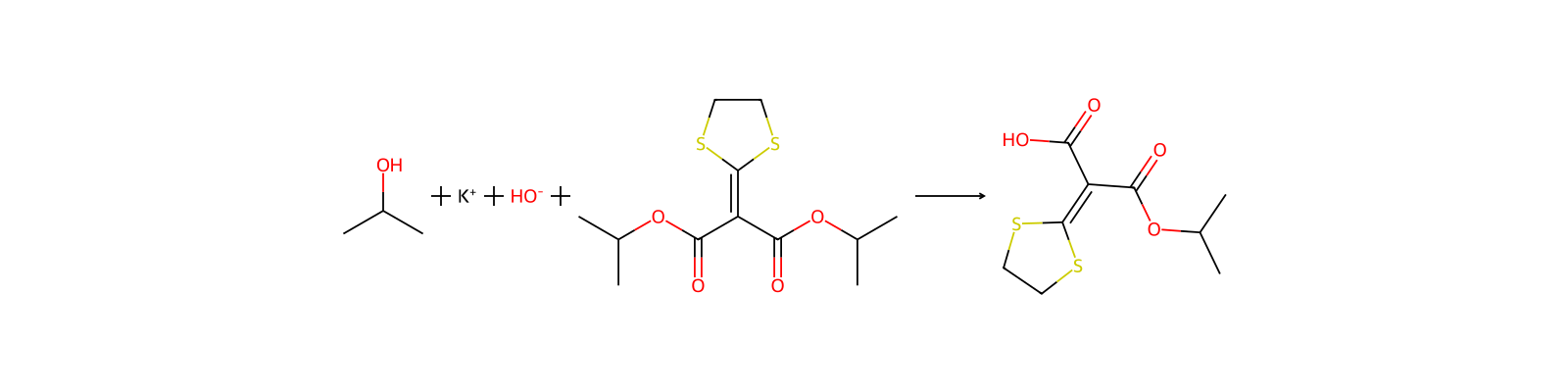
Related reactions
4 records


Compound notes
Loading…