

Basic information
- Standard SMILES
CCOC(=O)CC(SP(=S)(OC)OC)C(=O)OCC- InChIKey
JXSJBGJIGXNWCI-UHFFFAOYSA-N- Molecular formula
- C10H19O6PS2
- Average molar mass
- 330.4 g/mol
- Monoisotopic mass
- 330.03606696
Overview
Malathion is an insecticide that does not occur naturally. Pure malathion is a colorless liquid, and technical-grade malathion, which contains >90% malathion and impurities in a solvent, is a brownish-yellow liquid that smells like garlic. Malathion is used to kill insects on farm crops and in gardens, to treat lice on humans, and to treat fleas on pets. Malathion is also used to kill mosquitos and Mediterranean fruit flies on (medflies) in large outdoor areas.
Names & identifiers
- Preferred name
- Malathion
- IUPAC
- diethyl 2-dimethoxyphosphinothioylsulfanylbutanedioate
- English name
- Malathion
- Molecular formula
- C10H19O6PS2
- Molecular weight
- 330.36
Names & synonyms
malathion121-75-5CarbophosCarbofosMercaptothionKarbofosCythionPriodermPhosphothionCarbetoxEthiolacarMaldison
Show more names
takMERCAPTOMalphosMalation4049MalathioneS-[1,2-DICARBETHOXYETHYL]-O,O-DIMETHYL-DITHIOPHOSPHATE1,2-di(ethoxycarbonyl)ethylo,o-dimethylphosphorodithioate
SadophosOleophosphothionOvideChemathionMalasprayMalathonFyfanonMalamar
Database identifiers
- CAS
121-75-5- PubChem CID
- 4004
- DTXSID
DTXSID4020791- ChEMBL
CHEMBL1200468- ChEBI
CHEBI:141474- UNII
- U5N7SU872W
- EC Number
- 204-497-7
- Nikkaji
- J381F
Properties
Computed structural properties
- XLogP
- 2.4
- Topological polar surface area
- 128 Ų
- Hydrogen bond donors
- 0
- Hydrogen bond acceptors
- 8
- Rotatable bonds
- 11
- Heavy atoms
- 19
- Formal charge
- 0
- Complexity
- 341
Experimental & physicochemical properties
SpringerMaterials PropertiesBoiling point
Pesticides
Pesticides
Pesticide -> EPA IRIS
Acaricides, Insecticides
Active substance -> EU Pesticides database: Approved
Pesticides -> Organophosphate Insecticides
Pesticide (Malathion) -> USDA PDB
LogP
log Kow = 2.36
2
2.89
Odor
Skunk-like odor
Garlic-like odor
Mercaptan odor
Density
1.234 at 77 °F (USCG, 1999) - Denser than water; will sink
1.2076 g/cu cm at 20 °C
Relative density (water = 1): 1.2
1.234 at 77 °F
1.2076 @ 20°C
1.21
Color/Form
Colorless or slightly yellow
Clear colorless liquid when pure
Deep-brown to yellow liquid ... [Note: A solid below 37 degrees F]
Solubility
less than 1 mg/mL at 70.7 °F (NTP, 1992)
In water, 143 mg/L at 20 °C
Miscible with many organic solvents including alcohols, esters, ketones, ethers, aromatic and alkylated aromatic hydrocarbons and vegetable oils. Limited solubility in certain paraffin hydrocarbons
Soluble in ethanol, benzene and ethyl ether
1.65e-01 g/L
Corrosivity
Corrosive to iron and some other metals
Malathion will attack some forms of plastics, rubber, and coatings
Corrosive to metals
Flash Point
greater than 325 °F (NTP, 1992)
Above 325 °F (tag open cup)
163 °C c.c.
>325 °F (open-cup)
(oc) >325 °F
Human Drugs
Breast Feeding; Lactation; Milk, Human; Anti-Infective Agents; Antiparasitic Agents; Insecticides
FDA approved drugs -> Active ingredient
FDA approved drugs -> Active ingredient
Endocrine DisruptorsPotential endocrine disrupting compound
Boiling Point
313 to 315 °F at 0.7 mmHg (decomposes) (NTP, 1992)
156-157 °C at 7.00E-01 mm Hg
BP: 156-157 °C at 0.7 mm Hg
140 °F (decomposes)
140 °F (Decomposes)
Physicochemical properties
- Melting point
- 2.85 °C · 2.85°C
- Boiling point
- 156 °C · 156°C
- Density
- 1.2076 · 1.2076
- vapor pressure
- 7.95 at · 7.95 at 25 °C (gas saturation method-GC, Kim et al., 1984)
- refractive index
- 25 · nD25 1.4985
- Flash point
- -18 °C · -18 °C
- storage temp.
- 4 °C · APPROX 4°C
- solubility
- Slightly soluble in water, miscible with acetone, with cyclohexane, with ethanol (96 per cent) and with vegetable oils.
- form
- liquid
- Specific Gravity
- 1.23 · 1.23 (25℃)
- color
- Light yellow to yellow
- biological source
- human
- Water Solubility
- 0.0145 g/100 · 0.0145 g/100 mL
- Specific Heat Capacity
- 0.1 J/ · Cp(gas): 0.1 J/(g·K), at 25℃
- Specific Activity
- 15 · 15-21nmol/min·mg
- Henry's Law Constant
- (x 10-9 atmm3/mol): 4.89 at 25 °C (wetted-wall column, Fendinger and Glotfelty, 1990)
- Exposure limits
- 1 mg/m3,Inhalable · ACGIH:TLV-TWA 1 mg/m3,Inhalable fraction and vaporOSHA:PEL-TWA 15 mg/m3NIOSH:REL-TWA 10 mg/m3
- Stability
- Stable. Incompatible with oxidizing agents, metals.
- Major Application
- agriculture
- InChI
- 1S/C10H19O6PS2/c1-5-15-9(11)7-8(10(12)16-6-2)19-17(18,13-3)14-4/h8H,5-7H2,1-4H3
- InChIKey
- JXSJBGJIGXNWCI-UHFFFAOYSA-N
- SMILES
- CCOC(=O)CC(SP(=S)(OC)OC)C(=O)OCC
- LogP
- 2.36 · 2.360
- Toxicology and Carcinogenesis
- Bioassay of Malathion for Possible Carcinogenicity (CASRN 121-75-5)Bioassay of Malathion for Possible Carcinogenicity (CASRN 121-75-5)
- CAS DataBase Reference
- 121 · 121-75-5(CAS DataBase Reference)
- EWG's Food Scores
- 3 · 3-5
- FDA UNII
- 5 N7SU872W · U5N7SU872W
- Proposition 65 List
- Malathion
- ATC code
- 3 AX03 · P03AX03
- NIST Chemistry Reference
- Malathion(121-75-5)
- IARC
- 2 A · 2A (Vol. 30, Sup 7, 112) 2017
- EPA Substance Registry System
- Malathion (121-75-5)
- Pesticides Freedom of Information Act (FOIA)
- Malathion
- Toxicological Profile|ATSDR
- Malathion|Toxicological Profile|ATSDR
- UNSPSC Code
- 41116107 · 41116107
- NACRES
- 32 · NA.32
- Symbol(GHS)
- 7 · GHS07,GHS09
- Signal word
- Warning
- Hazard statements
- 302 · H302-H317-H410
- Precautionary statements
- 261 · P261-P264-P273-P280-P301+P312-P302+P352
- target organs
- Central nervous system
- PPE
- Eyeshields, Faceshields, Gloves, type ABEK (EN14387) respirator filter
- Hazard Codes
- Xn;N,N,Xn,F
- Risk Statements
- 22 · 22-50/53-67-65-38-11-43
- Safety Statements
- 2 · 2-24-60-61-62-46-37-16
- RIDADR
- 2783 · UN 2783
- OEB
- B
- OEL
- 10 mg/m3 · TWA: 10 mg/m3 [skin]
- WGK Germany
- 3 · WGK 3
- RTECS
- 8400000 · WM8400000
- HazardClass
- 6.1 · 6.1(b)
- PackingGroup
- III
- HS Code
- 29309090 · 29309090
- Storage Class
- 3 · 3 - Flammable liquids
- Hazard Classifications
- 1 Aquatic · Aquatic Acute 1Aquatic Chronic 1Asp. Tox. 1Flam. Liq. 2Skin Irrit. 2STOT SE 3
- Hazardous Substances Data
- 121 · 121-75-5(Hazardous Substances Data)
- Toxicity
- 50 in · LD50 in female, male rats (mg/kg): 1000, 1375 orally (Gaines)
- IDLA
- 250 mg/m3 · 250 mg/m3
Safety & regulation
GHS classification
GHS Classification
Warning
H302: Harmful if swallowed [Warning Acute toxicity, oral]
P261, P264, P270, P272, P273, P280, P301+P317, P302+P352, P321, P330, P333+P317, P362+P364, P391, and P501 (click each P-code to see the statement)
Danger
H302 (97.4%): Harmful if swallowed [Warning Acute toxicity, oral]
P261, P264, P270, P271, P272, P273, P280, P301+P317, P302+P352, P304+P340, P316, P321, P330, P333+P317, P362+P364, P391, P403+P233, P405, and P501 (click each P-code to see the statement)
Hazard information
Regulatory Information
Hazard Traits - Carcinogenicity; Developmental Toxicity; Environmental tox; Neurotoxicity
Commission Regulation (EC) No 451/2000
2010/17/EU, Reg. (EU) 2017/1527, Reg. (EU) 2018/1495, Reg. (EU) 2022/378, Reg. (EU) 2023/689, Reg. (EU) No 540/2011
Malathion: HSNO Approval: HSR003011 Approved with controls
The New Jersey Worker and Community Right to Know Act requires public and private employers to provide information about hazardous substances at their workplaces. (N.J.S.A. 34:5A-1 et. seq.)
Other Safety InformationIMAP assessments - Butanedioic acid, [(dimethoxyphosphinothioyl)thio]-, diethyl ester: Environment tier I assessment
DOT LabelPoison
Fire Hazards
Special Hazards of Combustion Products: Vapors and fumes from fires are hazardous. They include sulfur dioxide and phosphoric acid.
Combustible. Gives off irritating or toxic fumes (or gases) in a fire. Risk of fire and explosion if formulations contain flammable/explosive solvents.
Fire Potential
Malathion is combustible but ignites with difficulty.
Malathion is a noncombustible ... liquid.
The commercially available malathion 0.5% lotion is flammable and should not be exposed to an open flame (e.g., a lighted cigarette) or heat sources (e.g., hair dryer, electric curlers).
Health Hazards
Exposure to fumes from a fire or to liquid causes headache, blurred vision, constricted pupils of the eyes, weakness, nausea, cramps, diarrhea, and tightness in the chest. Muscles twitch and convulsions may follow. The symptoms may develop over a period of 8 hours. (USCG, 1999)
Hazards Summary
Malathion is an insecticide that does not occur naturally. Pure malathion is a colorless liquid, and technical-grade malathion, which contains >90% malathion and impurities in a solvent, is a brownish-yellow liquid that smells like garlic. Malathion is used to kill insects on farm crops and in gardens, to treat lice on humans, and to treat fleas on pets. Malathion is also used to kill mosquitos and Mediterranean fruit flies on (medflies) in large outdoor areas.
Malathion is one of the less potent organophosphate insecticides. It has an oral LD50 of 500-1000 mg/kg compared to an LD50 of 1-5 mg/kg for parathion. [LaDou, p. 584] Allergic contact dermatitis has been reported in farmers. [Kanerva, p. 1808] Inhalation is not a significant route of exposure to malathion at ordinary temperatures because of its low volatility, but toxic effects can occur after inhalation of malathion sprays or dusts. [ATSDR Medical Management] The average of two baseline respective cholinesterase activity determinations three days apart, with no exposures to enzyme inhibiting pesticides for at least 30 days, is recommended for each worker prior to exposure to cholinesterase inhibitors because of large inter-individual differences in published baseline values. To be established at least once a year. Removal from workplace exposures is recommended until the cholinesterase activity returns to within 20% of baseline. [TLVs and BEIs]
DOT ID and Guide2783 152
FDA Requirements
The Approved Drug Products with Therapeutic Equivalence Evaluations identifies currently marketed prescription drug products, including malathion, approved on the basis of safety and effectiveness by FDA under sections 505 of the Federal Food, Drug, and Cosmetic Act.
Reactive GroupEsters, Sulfate Esters, Phosphate Esters, Thiophosphate Esters, and Borate Esters
UN ClassificationUN Hazard Class: 9; UN Pack Group: III
Special Reports
USEPA/Office of Prevention, Pesticides and Toxic Substances; Reregistration Eligibility Decision Document - Malathion, Revised May 2009 EPA 738-R-06-030 (May 2009). The RED summarizes the risk assessment conclusions and outlines any risk reduction measures necessary for the pesticide to continue to be registered in the USA.[Available from, as of June 23, 2016: http://www.epa.gov/pesticides/reregistration/status.htm]
HHS/ATSDR; Toxicological Profile for Malathion PB2004-100003 (September 2003). The ATSDR toxicological profile succinctly characterizes the toxicologic and adverse health effects information for the hazardous substance described here. Each peer-reviewed profile identifies and reviews the key literature that describes a hazardous substance's toxicologic properties. Other pertinent literature is also presented, but is described in less detail than the key studies.[Available from, as of July 14, 2016: http://www.atsdr.cdc.gov/toxprofiles/index.asp]
Mulla MS, Mian LS; Residue Rev 78: 101-35 (1981). Information on the impact of malathion on non-target flora and fauna in aquatic ecosystems and their persistence & distribution in aquatic habitats is collected and interpreted.
NIOSH; Criteria Document: Malathion (1976) DHEW Pub. NIOSH 76-205
For more Special Reports (Complete) data for MALATHION (9 total), please visit the HSDB record page.
Safety & protection
Fire Fighting
Fire Extinguishing Agents: Dry chemical, carbon dioxide, water spray, foam (USCG, 1999)
Use foam, powder, carbon dioxide.
First Aid Measures
Fresh air, rest. Half-upright position. Refer immediately for medical attention.
Remove contaminated clothes. Rinse and then wash skin with water and soap. Refer immediately for medical attention.
First rinse with plenty of water for several minutes (remove contact lenses if easily possible), then refer for medical attention.
Rinse mouth. Refer immediately for medical attention.
First Aid
EYES: First check the victim for contact lenses and remove if present. Flush victim's eyes with water or normal saline solution for 20 to 30 minutes while simultaneously calling a hospital or poison control center. Do not put any ointments, oils, or medication in the victim's eyes without specific instructions from a physician. IMMEDIATELY transport the victim after flushing eyes to a hospital even if no symptoms (such as redness or irritation) develop.
(General first aid procedures)
Safe StorageStore only in original packaging. Separated from strong oxidants and food and feedstuffs. Keep in a well-ventilated room. Store in an area without drain or sewer access.
Firefighting HazardsContainers may explode in fire.
Exposure Control and Personal Protection
Biological Exposure Indices (BEI) [ACGIH] - Acetylcholinesterase activity in red blood cells = 70% of individual's baseline; Butylcholinesterase activity in serum or plasma = 60% of individual's baseline; Sample at end of shift; [TLVs and BEIs]
15.0 [mg/m3], inhalable fraction[German Research Foundation (DFG)]
Fire Fighting Procedures
Suitable extinguishing media: Use water spray, alcohol-resistant foam, dry chemical or carbon dioxide.
Advice for firefighters: Wear self-contained breathing apparatus for firefighting if necessary.
A fire should be extinguished with agents suitable to the surrounding combustibles. ... If material or contaminated runoff enters waterways, notify downstream users of potentially contaminated waters. Notify local health and fire officials and pollution control agencies. ... From a secure, explosion-proof location, use water spray to cool exposed containers. If cooling streams are ineffective (venting sound increases in volume and pitch, tank discolors, or shows any signs of deforming), withdraw immediately to a secure position. ... The only respirators recommended for firefighting are self-contained breathing apparatuses that have full face-pieces and are operated in a pressure-demand or other positive-pressure mode.
Fire extinguishing media: Water, foam, carbon dioxide, dry chemical.
For more Fire Fighting Procedures (Complete) data for MALATHION (6 total), please visit the HSDB record page.
Storage Conditions
Keep container tightly closed in a dry and well-ventilated place. Containers which are opened must be carefully resealed and kept upright to prevent leakage. Recommended storage temperature 2 - 8 °C
Store in a secure poison location. ... Store in tightly closed containers in a cool, well-ventilated, uninhabited area below 25 °C. Store to avoid contact with oxidizers and alkaline pesticides. Store where possible leakage from containers cannot endanger the worker. Maintain regular inspection of containers for any leakage. Sources of ignition, such as smoking and open flames, are prohibited where this chemical is handled, used, or stored.
Store in cool, dry, well-ventilated, secure area out or reach of children and animals. ... Do not contaminate food or feed.
Storage of malathion at 54 °C for 2 weeks resulted in an increase of isomalathion from about 0.05% to 0.2%.
For more Storage Conditions (Complete) data for MALATHION (6 total), please visit the HSDB record page.
Cleanup Methods
ACCIDENTAL RELEASE MEASURES: Personal precautions, protective equipment and emergency procedures: Use personal protective equipment. Avoid breathing vapors, mist or gas. Ensure adequate ventilation. Environmental precautions: Prevent further leakage or spillage if safe to do so. Do not let product enter drains. Discharge into the environment must be avoided. Methods and materials for containment and cleaning up: Soak up with inert absorbent material and dispose of as hazardous waste. Keep in suitable, closed containers for disposal.
Evacuate persons not wearing protective equipment from area of spill or leak until cleanup is complete. Remove all ignition sources. Ventilate the area of spill or leak. Absorb liquids in vermiculite, dry sand, earth, peat, carbon, or a similar material and deposit in sealed containers. Collect powdered material in the most convenient and safe manner and deposit in sealed containers. It may be necessary to contain and dispose of this chemical as a hazardous waste. If material or contaminated runoff enters waterways, notify downstream users of potentially contaminated waters.
Do not contaminate water when disposing of equipment washwater or rinsate. /Malathion 8/
Environmental considerations: Air spill: Apply water spray or mist to knock down vapors. /Organophosphorus pesticides, liquid, NOS; Organophosphorus pesticides, solid, NOS/
For more Cleanup Methods (Complete) data for MALATHION (12 total), please visit the HSDB record page.
Nonfire Spill ResponseNeutralizing Agents for Acids and Caustics: Liquid bleach solution for decontamination. (USCG, 1999)
Disposal Methods
SRP: Recycle any unused portion of the material for its approved use or return it to the manufacturer or supplier. Ultimate disposal of the chemical must consider: the material's impact on air quality; potential migration in air, soil or water; effects on animal, aquatic and plant life; and conformance with environmental and public health regulations. If it is possible or reasonable use an alternative chemical product with less inherent propensity for occupational harm/injury/toxicity or environmental contamination.
SRP: Wastewater from contaminant suppression, cleaning of protective clothing/equipment, or contaminated sites should be contained and evaluated for subject chemical or decomposition product concentrations. Concentrations shall be lower than applicable environmental discharge or disposal criteria. Alternatively, pretreatment and/or discharge to a permitted wastewater treatment facility is acceptable only after review by the governing authority and assurance that "pass through" violations will not occur. Due consideration shall be given to remediation worker exposure (inhalation, dermal and ingestion) as well as fate during treatment, transfer and disposal. If it is not practicable to manage the chemical in this fashion, it must be evaluated in accordance with EPA 40 CFR Part 261, specifically Subpart B, in order to determine the appropriate local, state and federal requirements for disposal.
Product: Offer surplus and non-recyclable solutions to a licensed disposal company; Contaminated packaging: Dispose of as unused product.
MALATHION MAY BE DISPOSED OF BY ABSORBING IN VERMICULITE, DRY SAND, EARTH, OR A SIMILAR MATERIAL ... & /DISPOSING OF SO AS TO MEET LOCAL, STATE, & FEDERAL REGULATIONS/.
For more Disposal Methods (Complete) data for MALATHION (10 total), please visit the HSDB record page.
Spillage Disposal
Personal protection: filter respirator for organic gases and vapours adapted to the airborne concentration of the substance. Do NOT let this chemical enter the environment. Collect leaking and spilled liquid in sealable containers as far as possible. See Chemical Dangers. Absorb remaining liquid in sand or inert absorbent. Then store and dispose of according to local regulations.
Toxicology
Toxicological InformationCDC-ATSDR Toxicological Profile
Body Burden
According to a national survey performed in the US from 1976-1980, malathion was detected in 1.6% of the urine analyses for persons 12-74 years of age(1). Trace amounts of metabolites in urine showed 4.1% of the persons tested were exposed to malathion(2). Of 267 samples of human urine, 0.4% were positive for malathion, at concentrations <0.1 ppm(3). The malathion metabolite, malathion dicarboxylic acid, was detected in 43% of 88, 29% of 89 and 36% of 89 urine samples after 3, 5 and 7 days, respectively, in samples collected for the Minnesota Children's Pesticide Exposure Survey (MNCPES)(4). Malathion was detected in 38, 27 and 32 out of 89 urine samples of children at levels of 0.3-5.6, 0.1-17.0 and 0.4-26.1 ug/g creatinine, respectively, during the MNCPES(5). Urinary metabolites of malathion were detected in 17 of 60 urine samples from 60 children 1-6 years old in eastern North Carolina farm-worker households at a median of 0.33 ug/g creatinine; samples were collected 2004(6).
Malathion was detected in one of 57 personal air samples at a concentration of 16.1 ng/cu m, samples were collected over a 48 hour period from the mother during the 32nd week of pregnancy, mothers reside in New York City, NY(1). Malathion was detected, not quantified in the respired air of a resident in 1 of 9 residents from 9 households sampled in Jacksonville, FL(6).
Treatment
If the compound has been ingested, rapid gastric lavage should be performed using 5% sodium bicarbonate. For skin contact, the skin should be washed with soap and water. If the compound has entered the eyes, they should be washed with large quantities of isotonic saline or water. In serious cases, atropine and/or pralidoxime should be administered. Anti-cholinergic drugs work to counteract the effects of excess acetylcholine and reactivate AChE. Atropine can be used as an antidote in conjunction with pralidoxime or other pyridinium oximes (such as trimedoxime or obidoxime), though the use of '-oximes' has been found to be of no benefit, or possibly harmful, in at least two meta-analyses. Atropine is a muscarinic antagonist, and thus blocks the action of acetylcholine peripherally.
Interactions
An important characteristic of malathion acute toxicity is its potentiation by other organophosphates. When malathion and EPN were administered to rats separately, LD50s were 1400 and 65 mg/kg, respectively. However, when malathion and EPN were administered simultaneously at a ratio of about 25:1, oral LD50s were reduced to 167 and 7 mg/kg, respectively. The onset of symptoms for individual compounds was slow, and death usually occurred several hours after administration. However, when given together at or near the LD50, symptoms developed much more rapidly, and death usually occurred within 1 hour. In dogs, oral doses of 2000 or 4000 mg/kg malathion alone were not fatal; however, when EPN was given simultaneously (2 or 5 mg/kg) with malathion, doses of 50, 100, and 200 mg/kg were lethal. Potentiation of malathion toxicity is due to the inhibition of carboxyesterase by EPN (and other organophosphates), an enzyme important in detoxifying of malathion (as well as the more toxic metabolic product, malaoxon).
This study was performed to investigate the antidepressant-like effect of minocycline in mice exposed to organophosphate pesticide malathion and possible involvement of nitric oxide/cGMP pathway in this paradigm. Mice were administered specific doses of malathion once daily for 7 consecutive days. After induction of depression, different doses of minocycline were daily injected alone or combined with non-specific NOS inhibitor, L-NAME, specific inducible NOS inhibitor, AG, NO precursor, L-arginine, and PDE5I, sildenafil. After locomotion assessment in open-field test, immobility times were recorded in the FST and TST. Moreover, hippocampal nitrite concentrations and acetylcholinesterase activity were measured. The results showed that repeated exposure to malathion induces depressive-like behavior at a dose of 250 mg/kg. Minocycline (160 mg/kg) significantly reduced immobility times in FST and TST (P < 0.001). Combination of sub-effective doses of minocycline (80 mg/kg) with either L-NAME (3 mg/kg) or AG (25 mg/kg) significantly exerted a robust antidepressant-like effect in FST and TST (P < 0.001). Furthermore, minocycline at the same dose which has antidepressant-like effect, significantly reduced hippocampal nitrite concentration. The investigation indicates the essential role for NO/cGMP pathway in malathion-induced depressive-like behavior and antidepressant-like effect of minocycline. Moreover, the interaction between nitrergic and cholinergic systems are suggested to be involved in malathion-induced depression.
It was established in experiments on noninbred albino rats that acute intoxication with malathion (0.75 LD50) reduced the function of Th1 cells more significantly than the function of Th2 lymphocyte, decreases the activity of B cells and NK cells, blood levels of TNFa, IL-1b and IL-6, IFN-g, IL-2, and IL-4, while not significantly affecting the concentration of IL-10 and IL-13. Atropine (10 mg/kg) under conditions of acute malathion intoxication improved the function of T cells and B lymphocytes, NK cells, as well as the synthesis of immunoregulatory cytokines IFN-g, IL-2, and IL-4. At the same time, atropine in malathion intoxicated rats had no effect on suppression of the synthesis of proinflammatory cytokines TNF, IL-1g and IL-6 as well as the content of anti-inflammatory cytokines IL-10 and IL-13.
In this study the effect of crocin, a carotenoid isolated from saffron, on malathion (an organophosphate insecticide) induced depressive- like behavior in subacute exposure was investigated. Moreover the molecular mechanism of malathion induced depressive- like behavior and its decreasing effect on the level of brain derived neurotrophic factor (BDNF) in rat hippocampus and cerebral cortex were evaluated. Male Wistar rats were exposed to malathion (50 mg/kg/day, IP) alone or in combination with crocin (10, 20 and 40 mg/kg/day, IP), imipramine (20 mg/kg/day, IP) and vitamin E (200 mg/kg, three times a week, IP) respectively for 14 days. The forced swimming test (FST) was performed on days 1, 7 and 14. The level of malondealdehyde (MDA) and reduced glutathione (GSH) were measured in cerebral cortex and hippocampus of rats. The protein level of BDNF was evaluated using Western blot analysis. Malathion (50 mg/kg, IP) increased immobility time in the FST, without affecting total locomotor activity in open-field test. Malathion increased the malondealdehyde (MDA) and decreased the glutathione (GSH), whereas these effects were reversed by crocin and vitamin E. Malathion decreased plasma acetylcholinesterase activity, however this effect was not reversed by crocin or vitamin E. Malathion reduced the protein level of BDNF in rat hippocampus. Imipramine and crocin prevented the decreasing effect of malathion on BDNF. These results showed that crocin attenuates some neurochemical and behavioral effects induced by malathion. This neuroprotective effect of crocin may be in part due to its effect on BDNF.
For more Interactions (Complete) data for MALATHION (13 total), please visit the HSDB record page.
Target Organs
Neurological (Nervous System), Respiratory (From the Nose to the Lungs)
Nervous
Eyes, skin, respiratory system, liver, blood cholinesterase, central nervous system, cardiovascular system, gastrointestinal tract
Health Effects
Acute exposure to cholinesterase inhibitors can cause a cholinergic crisis characterized by severe nausea/vomiting, salivation, sweating, bradycardia, hypotension, collapse, and convulsions. Increasing muscle weakness is a possibility and may result in death if respiratory muscles are involved. Accumulation of ACh at motor nerves causes overstimulation of nicotinic expression at the neuromuscular junction. When this occurs symptoms such as muscle weakness, fatigue, muscle cramps, fasciculation, and paralysis can be seen. When there is an accumulation of ACh at autonomic ganglia this causes overstimulation of nicotinic expression in the sympathetic system. Symptoms associated with this are hypertension, and hypoglycemia. Overstimulation of nicotinic acetylcholine receptors in the central nervous system, due to accumulation of ACh, results in anxiety, headache, convulsions, ataxia, depression of respiration and circulation, tremor, general weakness, and potentially coma. When there is expression of muscarinic overstimulation due to excess acetylcholine at muscarinic acetylcholine receptors symptoms of visual disturbances, tightness in chest, wheezing due to bronchoconstriction, increased bronchial secretions, increased salivation, lacrimation, sweating, peristalsis, and urination can occur. Certain reproductive effects in fertility, growth, and development for males and females have been linked specifically to organophosphate pesticide exposure. Most of the research on reproductive effects has been conducted on farmers working with pesticides and insecticdes in rural areas. In females menstrual cycle disturbances, longer pregnancies, spontaneous abortions, stillbirths, and some developmental effects in offspring have been linked to organophosphate pesticide exposure. Prenatal exposure has been linked to impaired fetal growth and development. Neurotoxic effects have also been linked to poisoning with OP pesticides causing four neurotoxic effects in humans: cholinergic syndrome, intermediate syndrome, organophosphate-induced delayed polyneuropathy (OPIDP), and chronic organophosphate-induced neuropsychiatric disorder (COPIND). These syndromes result after acute and chronic exposure to OP pesticides.
Ecotoxicity Values
LD50; Species: Anas platyrhynchos (Mallard Duck) female age 3-4 months; oral 1485 mg/kg (95% confidence limit: 1020-2150 mg/kg) (sample purity 95%)
LC50; Species: Anas platyrhynchos (Mallard Duck) age 16 days; oral via capsule ad libitum >5000 ppm for 8 days
LC50; Species: Colinus virginianus (Bobwhite Quail) age 14 days; oral 3497 ppm in 5 day diet (95% confidence limit: 2959-4117 ppm) /Technical 95%/
LC50; Species: Coturnix japonica (Japanese quail) age 2 weeks; oral 2128 ppm in 5 day diet (95% confidence limit: 1780-2546 ppm) /Technical 95%/
For more Ecotoxicity Values (Complete) data for MALATHION (153 total), please visit the HSDB record page.
Environmental Fate
TERRESTRIAL FATE: Based on a classification scheme(1), Koc values of 927-17,620(2), indicate that malathion is expected to have low to no mobility in soil(SRC). Volatilization of malathion from moist soil surfaces is not expected to be an important fate process(SRC) given a Henry's Law constant of 4.89X10⁻⁹ atm-cu m/mole(3). Malathion is not expected to volatilize from dry soil surfaces(SRC) based upon a vapor pressure of 3.97X10⁻⁵ mm Hg at 30 °C(4). The degradation half-life of malathion in five different soils was 1.33-4.14 days(5). Half-lives for malathion for radish and carrot soil for the seasons of winter, summer, and post-monsoon were determined to be 6.4, 2.1, and 5.3 days, and 6.6, 2.6, and 5.6 days, respectively(6). Malathion levels found in Southern California after a single spraying event at soil depths of 1 and 0.1 cm were 1.4 ug/g and 14.1 ug/g, respectively(7). Malathion is rapidly degraded in soils with reported degradation in 10 days in various non sterile loam soils of 81-94%, degradation in the same loam soils that were sterile were 5-19%(8).
TERRESTRIAL FATE: The degradation half-life of malathion was reported for five different soils in China(1).[Table#1931]
AQUATIC FATE: Based on a classification scheme(1), Koc values of 927-17,620(2), indicate that malathion is expected to adsorb to suspended solids and sediment(SRC). Volatilization from water surfaces is not expected(3) based upon a Henry's Law constant of 4.89X10⁻⁹ atm-cu m/mole(4). Malathion did not bioconcentrate in the freshwater fish topmouth gudgeon (Pseudorasbora parva)(5) or in pinfish (Lagodon sp)(6). Hydrolysis half-life for malathion in seawater/sediment systems at pH 7.3-7.7 is 2.0 days and in freshwater at pH 7.4 and 20 °C is 11 days(7). Products of hydrolysis include malaoxon, malathion alpha and beta monoacid, O,O-dimethylphosphorodithioic acid, diethyl fumarate, diethyl thiomalate, O,O-dimethylphosphorothionic acid(8). Hydrolysis is the main route of malathion degradation in water with pH >7.0; at pH <7.0, the rate of hydrolysis is slow relative to the rate of biodegradation(9). Photodegradation may also compete with hydrolysis based on a study finding the first order photolysis rate of malathion in river water as 0.0013/min, this calculates to a half-life of 533 minutes(10). Malathion sorbed by algae was photodegraded more than 25 times faster than malathion in distilled water(11). The half-life for malathion in Limon River water was reported as 10.87, 10.41, 9.73 and 10.50 days under respective experimental conditions of filtered-dark, filtered-sunlight, non-filtered open to the air and non-filtered closed(12). The degradation half-life of malathion in different types of waters was 1.03-3.93 days(13). Malathion proposed degradation pathway in river water proceeds via hydrolysis to O,O-dimethyldithiophosphoric acid followed by oxidation to O,O-dimethylthiophosporic acid(14).
AQUATIC FATE: The degradation half-life (T1/2) and first-order degradation rate constant (k/day) of malathion were reported for five different waters in China(1).[Table#1932]
ATMOSPHERIC FATE: According to a model of gas/particle partitioning of semivolatile organic compounds in the atmosphere(1), malathion, which has a vapor pressure of 3.97X10⁻⁵ mm Hg at 30 °C(2), will exist in both the vapor and particulate phases in the ambient atmosphere. Vapor-phase malathion is degraded in the atmosphere by reaction with photochemically-produced hydroxyl radicals(SRC); the half-life for this reaction in air is estimated to be 5 hours(SRC), calculated from its rate constant of 7.7X10⁻¹¹ cu cm/molecule-sec at 25 °C(SRC) that was derived using a structure estimation method(3). Particulate-phase malathion may be removed from the air by wet or dry deposition(SRC). Malathion absorbs light at wavelengths >290 nm(4) and, therefore, may be susceptible to direct photolysis by sunlight(SRC).
Food Survey Values
Results for market basket surveys of malathion in the USA Fiscal Year 1965 through 1969(1).[Table#1936]
Results for market basket surveys of malathion in the USA Fiscal Year 1971 through 1976(1).[Table#1937]
Total Diet Studies conducted by the US Food and Drug Administration reported malathion concentrations for adults for each of the following time frames: Oct 1978 - Sept 1979(1), Oct 1979 - Sept 1980(2), and Oct 1980 - March 1982(3):[Table#1938]
Total Diet Studies conducted by the US Food and Drug Administration reported malathion concentrations for infants and toddlers for each of the following time frames: for infants Oct 1979 - Sept 1980(1), and infants and toddlers Oct 1980 - March 1982(2).[Table#1939]
For more Food Survey Values (Complete) data for MALATHION (9 total), please visit the HSDB record page.
Adverse EffectsOther Poison - Organophosphate
Exposure Routes
The substance can be absorbed into the body by inhalation, through the skin and by ingestion.
inhalation, skin absorption, ingestion, skin and/or eye contact
Malathion in an acetone vehicle has been reported to be absorbed through normal human skin only to the extent of 8% of the applied dose. Absorption may be increased when malathion is applied to damaged skin. Malathion is rapidly and effectively absorbed by practically all routes including the gastrointestinal tract, skin, mucous membranes, and lungs. However, it is readily excreted in the urine, and does not accumulate in organs or tissues.
Milk Concentrations
Malathion was detected in 2 of 96 samples collected from 4 brands of Mexican commercial pasteurized milk, sampled over a 12 month period(1). Malathion was not detected (detection limit 0.01 mg/kg) in 20 milk samples from the market in Beijing, China(2). Malathion was detected in some of the 312 bovine milk samples from Punjab, India(3).
Regulatory information
FDA Requirements
The Approved Drug Products with Therapeutic Equivalence Evaluations identifies currently marketed prescription drug products, including malathion, approved on the basis of safety and effectiveness by FDA under sections 505 of the Federal Food, Drug, and Cosmetic Act.
FIFRA Requirements
Tolerances are established for residues of the insecticide malathion ( O,O -dimethyl dithiophosphate of diethyl mercaptosuccinate) in or on the following food commodities: [Table#1933]
Tolerances are established for the combined residues of the insecticide malathion (O,O-dimethyl dithiophosphate of diethyl mercaptosuccinate) and its metabolite, malaoxon (O,O-dimethyl thiophosphate of diethyl mercaptosuccinate), in or on the following food commodities: [Table#1934]
Tolerances are established for residues of the insecticide malathion (O,O-dimethyl dithiophosphate of diethyl mercaptosuccinate), in or on the following food commodities: [Table#1935]
Malathion may be safely used in accordance with the following conditions: (i) It is incorporated into paper trays in amounts not exceeding 100 milligrams per square foot. (ii) Treated paper trays are intended for use only in the drying of grape (raisins). (iii) Total residues of malathion resulting from drying of grape on treated trays and from application to grape before harvest shall not exceed 12 parts per million on processed ready-to-eat raisins.
For more FIFRA Requirements (Complete) data for MALATHION (10 total), please visit the HSDB record page.
CERCLA Reportable Quantities
Persons in charge of vessels or facilities are required to notify the National Response Center (NRC) immediately, when there is a release of this designated hazardous substance, in an amount equal to or greater than its reportable quantity of 100 lb or 45.4 kg. The toll free number of the NRC is (800) 424-8802. The rule for determining when notification is required is stated in 40 CFR 302.4 (section IV.D.3.b).
Clean Water Act Requirements
Malathion is designated as a hazardous substance under section 311(b)(2)(A) of the Federal Water Pollution Control Act and further regulated by the Clean Water Act Amendments of 1977 and 1978. These regulations apply to discharges of this substance. This designation includes any isomers and hydrates, as well as any solutions and mixtures containing this substance.
State Drinking Water Guidelines
(AZ) ARIZONA 140 ug/L
(CA) CALIFORNIA 160 ug/L
(FL) FLORIDA 140 ug/L
(ME) MAINE 140 ug/L
Federal Drinking Water GuidelinesEPA 500 ug/L
Safety data
- OEB
- B
- OEL
- TWA: 10 mg/m3 [skin]
- PPE
- Eyeshields, Faceshields, Gloves, type ABEK (EN14387) respirator filter
- wgk
- WGK 3
- IDLA
- 250 mg/m3
- rtecs
- WM8400000
- ridadr
- UN 2783
- hs_code
- 29309090
- Toxicity
- LD50 in female, male rats (mg/kg): 1000, 1375 orally (Gaines)
- risk_code
- 22-50/53-67-65-38-11-43
- Signal word
- Warning
- Symbol(GHS)
- GHS07,GHS09
- hazard_code
- Xn;N,N,Xn,F
- safety_code
- 2-24-60-61-62-46-37-16
- hazard_class
- 6.1(b)
- Storage Class
- 3 - Flammable liquids
- packing_group
- III
- target organs
- Central nervous system
- Hazard statements
- H302-H317-H410
- Hazard Classifications
- Aquatic Acute 1Aquatic Chronic 1Asp. Tox. 1Flam. Liq. 2Skin Irrit. 2STOT SE 3
- Precautionary statements
- P261-P264-P273-P280-P301+P312-P302+P352
- Hazardous Substances Data
- 121-75-5(Hazardous Substances Data)
Chemistry & industry
Pharmacology
ATC Code
P03AX03
P - Antiparasitic products, insecticides and repellents
QP - Antiparasitic products, insecticides and repellents
Pharmacodynamics
Malathion is an organophosphate insecticide commonly used to control mosquitos and other flying insects. Pharmaceutically, malathion is used to eliminate head lice. The principal toxicological effect of malathion is cholinesterase inhibition, due primarily to malaoxon and to phosphorus thionate impurities.
Mechanism of Action
Malathion is a nonsystemic, wide-spectrum organophosphate insecticide. It inhibits acetylcholinesterase activity of most eukaryotes. Malathion is toxic to aquatic organisms, but has a relatively low toxicity for birds and mammals. The major metabolites of malathion are mono- and di-carboxylic acid derivatives, and malaoxon is a minor metabolite. However, it is malaoxon that is the strongest cholinesterase inhibitor. Cholinesterases catalyze the hydrolysis of the neurotransmitter acetylcholine into choline and acetic acid, a reaction necessary to allow a cholinergic neuron to return to its resting state after activation. Because of its essential function, chemicals that interfere with the action of cholinesterase are potent neurotoxins, causing muscle spasms and ultimately death.
Muscle dysfunction in acute organophosphorus (OP) poisoning is a cause of death in human. The present study was conducted to identify the mechanism of action of OP in terms of muscle mitochondrial dysfunction. Electromyography (EMG) was conducted on rats exposed to the acute oral dose of malathion (400 mg/kg) that could inhibit acetylcholinesterase activity up to 70%. The function of mitochondrial respiratory chain and the rate of production of reactive oxygen species (ROS) from intact mitochondria were measured. The bioenergetic pathways were studied by measurement of adenosine triphosphate (ATP), lactate, and glycogen. To identify mitochondrial-dependent apoptotic pathways, the messenger RNA (mRNA) expression of bax and bcl-2, protein expression of caspase-9, mitochondrial cytochrome c release, and DNA damage were measured. The EMG confirmed muscle weakness. The reduction in activity of mitochondrial complexes and muscular glycogen with an elevation of lactate was in association with impairment of cellular respiration. The reduction in mitochondrial proapoptotic stimuli is indicative of autophagic process inducing cytoprotective effects in the early stage of stress. Downregulation of apoptotic signaling may be due to reduction in ATP and ROS, and genotoxic potential of malathion. The maintenance of mitochondrial integrity by means of artificial electron donors and increasing exogenous ATP might prevent toxicity of OPs.
... The current study investigates the influence of malathion on insulin signaling pathways and the protective effects of N-acetylcysteine (NAC). Malathion (200 mg/kg) and NAC (2 g/L) were administered orally to rats, during 28 consecutive days. Malathion increases plasma glucose, plasma insulin and glycated hemoglobin levels. Further, we observed an increase of insulin resistance biomarkers and a decrease of insulin sensitivity indices. The GP, GSK3beta and PEPCK mRNA expressions were amplified by malathion while, the expression of glucokinase gene is down-regulated. On the basis of biochemical and molecular findings, it is concluded that malathion impairs glucose homeostasis through insulin resistance and insulin signaling pathways disruptions in a way to result in a reduced function of insulin into hepatocytes. Otherwise, when malathion-treated rats were compared to NAC supplemented rats, fasting glucose and insulin levels, as well as insulin resistance indices were reduced. Furthermore, NAC restored liver GP and PEPCK expression. N-acetylcysteine showed therapeutic effects against malathion-induced insulin signaling pathways disruption in liver. These data support the concept that antioxidant therapies attenuate insulin resistance and ameliorate insulin sensitivity.
The cardiovascular actions of antic-ChE agents are complex, since they reflect both ganglionic and postganglionic effects of accumulated ACh on the heart and blood vessels and actions in the CNS. The predominant effect on the heart from the peripheral action of accumulated ACh is bradycardia, resulting in a fall in cardiac output. Higher doses usually cause a fall in blood pressure, often as a consequence of effects of anti-ChE agents on the medullary vasomotor centers of the CNS. /Anticholinesterase agents/
/LABORATORY ANIMALS: Acute Exposure/ It was established in experiments on noninbred albino rats that acute intoxication with malathion (0.75 LD50) /administered instramuscularly/ reduced the function of Th1 cells more significantly than the function of Th2 lymphocyte, decreases the activity of B cells and NK cells, blood levels of TNFa, IL-1b and IL-6, IFN-g, IL-2, and IL-4, while not significantly affecting the concentration of IL-10 and IL-13. Atropine (10 mg/kg) under conditions of acute malathion intoxication improved the function of T cells and B lymphocytes, NK cells, as well as the synthesis of immunoregulatory cytokines IFN-g, IL-2, and IL-4. At the same time, atropine in malathion intoxicated rats had no effect on suppression of the synthesis of proinflammatory cytokines TNF, IL-1g and IL-6 as well as the content of anti-inflammatory cytokines IL-10 and IL-13.
Biological Half-Life
8-24 hours
In a patient who injected about 1.8 g of malathion as a 50% solution IV, the apparent half-life was 2.9 hours.
Among male volunteers, approximately 90% of an intravenous dose of malathion was excreted in the urine within 5 days and the elimination half-life was 3 hours.
In rats given malathion orally, it is distributed to blood, adipose tissue, muscle, liver, and brain and then eliminated from these tissues at half-lives of 1.4, 2.4, 3.7, 19.4, and 17.6 days, respectively.
Metabolism/Metabolites
The major metabolites of malathion are the diacid and monoacid metabolites, namely, malathion dicarboxylic acid (DCA) and malathion monocarboxylic acid (MCA). Malaoxon, the active cholinesterase-inhibiting metabolite of malathion, is a minor metabolite. Both malathion and malaoxon are detoxified by carboxyesterases leading to polar, water-soluble compounds that are excreted.
Malathion is either oxidized in the liver to malaoxon by microsomal cytochrome P450 enzymes or to monoacids by a microsomal carboxyesterase. ... The other products of malathion and malaoxon metabolism are detoxification products. Malaoxon is also subject to hydrolysis and carboxyesterase. There is evidence that the linkage at P-S is enzymatically broken by another cytosolic esterase as well (A-esterase) and forms O,O-dimethyl phosphorothioate. There is some evidence that the monoacids can then be S-methylated, and that the C-S bond of either malaoxon or malathion can be further hydrolyzed.
Malathion is rapidly metabolized in vivo principally by hydrolysis of the carboxyl ester linkage to inactive metabolites by carboxylesterases. Because this detoxification reaction occurs much more rapidly in mammals than in susceptible insects, malathion exhibits a relative degree of selective toxicity in insects.
Malathion ... is oxidized by the hepatic microsomal monooxygenase system to malaoxon, an active, toxic metabolite. Metabolism of malaoxon typically occurs at a faster rate than its formation from malathion, and little accumulation of this highly toxic metabolite occurs in mammals.
Malathion is metabolically converted to its structurally similar metabolite, malaoxon (oxidation of the P=S moiety to P=O), in insects and mammals. Both malathion and malaoxon are detoxified by carboxyesterases leading to polar, water-soluble, compounds that are excreted. Mammalian systems show greater carboxyesterase activity, as compared with insects, so that the toxic agent malaoxon builds up more in insects than in mammals. This accounts for the increased toxicity of malathion in insects.
For more Metabolism/Metabolites (Complete) data for MALATHION (16 total), please visit the HSDB record page.
FDA Pharmacological Classification
U5N7SU872W
MALATHION
Established Pharmacologic Class [EPC] - Cholinesterase Inhibitor
Mechanisms of Action [MoA] - Cholinesterase Inhibitors
Malathion is a Cholinesterase Inhibitor. The mechanism of action of malathion is as a Cholinesterase Inhibitor.
MALATHION
MeSH Pharmacological Classification
Drugs that inhibit cholinesterases. The neurotransmitter ACETYLCHOLINE is rapidly hydrolyzed, and thereby inactivated, by cholinesterases. When cholinesterases are inhibited, the action of endogenously released acetylcholine at cholinergic synapses is potentiated. Cholinesterase inhibitors are widely used clinically for their potentiation of cholinergic inputs to the gastrointestinal tract and urinary bladder, the eye, and skeletal muscles; they are also used for their effects on the heart and the central nervous system.
Pesticides designed to control insects that are harmful to man. The insects may be directly harmful, as those acting as disease vectors, or indirectly harmful, as destroyers of crops, food products, or textile fabrics.
Absorption, Distribution and Excretion
Malathion in an acetone vehicle has been reported to be absorbed through normal human skin only to the extent of 8% of the applied dose. Absorption may be increased when malathion is applied to damaged skin. Malathion is rapidly and effectively absorbed by practically all routes including the gastrointestinal tract, skin, mucous membranes, and lungs. However, it is readily excreted in the urine, and does not accumulate in organs or tissues.
Concentrations of pesticides and selected metabolites in rat urine and amniotic fluid were determined as biomarker upon oral administration of Wistar rats to two pesticide mixtures consisting of three to five pesticides (bitertanol, propiconazole, cypermethrin, malathion, and terbuthylazine). The pesticides and their metabolites were found in rat amniotic fluid and urine, generally in dose-response concentrations in relation to dosage. The measurement of the substances in the amniotic fluid indicated that the fetus was exposed to the pesticides as well as their metabolites. Moreover, the pesticides detected in urine demonstrated the exposure as well as the ability of the rat to excrete these compounds.
O,O,S-Trimethyl phosphorothioate (OOS-TMP) is an impurity present in widely used organophosphorus insecticides such as malathion. Oral treatment of rats with the compound produces prominent bronchiolar epithelial necrosis. Following the administration of [(3)H]OOS-TMP to rats, substantial amounts of radiolabeled material were covalently bound to lung with a concomitant depletion of glutathione (GSH). Other organs showing significant covalently bound radioactivity were liver, kidneys, and ileum. The maximal accumulation occurred in the tissues within 6 hr, and reached a plateau between 6 and 12 hr. Pretreatment of rats with either phenobarbital or piperonyl butoxide decreased the level of radiolabeled material bound in lung, GSH depletion, and the toxicity of OOS-TMP. These results suggest that the covalent binding is due to a metabolite(s) of OOS-TMP and that the metabolite(s) is involved in the mechanism of toxicity of OOS-TMP. ... /(3)H-O,O,S-trimethyl phosphorothioate/
... /The/ objective was to determine the percutaneous absorption of chronically applied malathion in man and to compare chronic absorption to single-dose absorption. The experimental design was to first topically apply [(14)C]malathion to human male volunteers. This procedure was followed by repeated administration of nonradioactive malathion to the same site of application (ventral forearm). [(14)C]Malathion was reapplied (Day 8) when urinary excretion of radioactivity from the first application reached minimum detectable levels. The first [(14)C]malathion absorption was compared to the second [(14)C]malathion application. The percutaneous absorption from the first [(14)C]malathion application was 4.48 +/- 1.3% (SD) of the applied dose. The absorption from the second [(14)C]malathion administration was 3.53 +/- 1.0%, a value not significantly (p greater than 0.05) different from the first application. Therefore, for malathion the single-dose application data are relevant for predicting the toxic potential for longer-term exposure.
Eight autopsy samples from an individual who had ingested a large amount of malathion were analyzed. ... The highest concentrations were found in gastric contents (8621 ppm) and adipose tissue (76.4 ppm). Malaoxon was identified in some tissues at very low levels; a significant amount was found only in fat (8.2 ppm). Malathion monocarboxylic acid & malathion dicarboxylic acid were found in greater abundance: 221 ppm in bile, 106 ppm in kidney, and 103 ppm in the gastric contents.
For more Absorption, Distribution and Excretion (Complete) data for MALATHION (20 total), please visit the HSDB record page.
Cellular LocationsCytoplasm
Uses & manufacturing
Uses
Used on fruits and vegetables, and to control mosquitoes, flies, and animal parasites; Malathion is often used in mixtures with other pesticides. [EXTOXNET]
Farming (Pesticides) [Category: Industry]
For malathion (USEPA/OPP Pesticide Code: 057701) ACTIVE products with label matches. /SRP: Registered for use in the U.S. but approved pesticide uses may change periodically and so federal, state and local authorities must be consulted for currently approved uses./
Insecticide for non agricultural uses-eg, aquatic uses, livestock, poultry, home & garden uses, lawns, turf & ornamentals, commercial, household & industrial uses, cotton, vegetables, & citrus, other field crops-eg, corn & sorghum, deciduous fruits/nuts & wheat, storage bins & transportation equipment acaricide.
... Malathion has been employed in aerial spraying of relatively populous areas for control of citrus orchard-destructive Mediterranean fruit flies and mosquitoes.
It is used widely in agriculture for various food and feed crops, homeowner outdoor uses, ornamental nursery stock, building perimeters, pastures and rangeland, and regional pest eradication programs.
Impurities
As many as 14 impurities have been identified in technical-grade malathion. The identities of the impurities and their percent (w/w) in technical grade malathion were found to be as follows: S-1,2-ethyl-O,S-dimethyl phosphorodithioate (isomalathion; 0.2%), S-1,2-bis(ethoxycarbonyl)-ethyl-O,O-dimethyl phosphorothioate (malaxon; 0.1%), diethylfumarate (DEF; 0.9%), O,S,S-trimethyl phosphorodithioate (0.003-1.2%), O,O,S-trimethyl phosphorothioate (0.04%), O,O,S-trimethyl phosphorodithioate (1.2%), O,O,O-trimethyl phosphorothioate (0.45%), diethylhydroxysuccinate (0.05%), ethyl nitrite (0.03%), diethyl mercaptosuccinate (0.15%), diethyl methylthiosuccinate (1.0%), O,O-dimethylphosphorothioate (0.05%), diethyl ethylthiosuccinate (0.1%), and sulfuric acid (0.05%).
Technical grade malathion may contain malaoxon, isomalathion, or other organophosphates as impurities. These compounds inactivate carboxylesterases, thus increasing malathion toxicity by decreasing the hydrolysis of the drug and increasing the amount of the drug that is oxidized to malaoxon.
The analysis of technical organophosphorus insecticides by (31)P nuclear magnetic resonance showed the major known toxic contaminants to be simple trialkyl phosphorothio- and -dithioic acid esters and the S-alkyl insecticide isomers. Small amt of the bis derivatives and the dithiopyrophosphate were also detected. These contaminants included both byproducts from the synthesis as well as degradation products. This procedure was used to analyze the following technical grade products: ronnel, sulfotepp, methyl parathion, dimethoate, malathion, methidathion, ethion, phosalone, and fenitrothion.
U.S. Imports
(1977) 2.93X10+6 G (PRINCPL CUSTMS DISTS)
(1982) 6.50X10+7 G (PRINCPL CUSTMS DISTS)
U.S. Production
(1978) 6.86X10+9 G (CONSUMPTION)
(1982) 6.13X10+9 G (CONSUMPTION)
Consumption Patterns
INSECTICIDE FOR AQUATIC USES, 15%; LIVESTOCK/POULTRY, 7%; OTHER NON AGRICULTURAL USES-EG, HOME & GARDEN, LAWN, TURF, ORNAMENTAL, COMMERCIAL, HOUSEHOLD & INDUSTRIAL USES, 33%; COTTON, 14%; VEGETABLES, 10%; ALFALFA, 4%; TOBACCO, 3%; CITRUS, 1%; OTHER FIELD CROPS-EG, CORN, DECIDUOUS FRUITS/NUTS, SORGHUM & WHEAT, 11% (1982)
Methods of Manufacturing
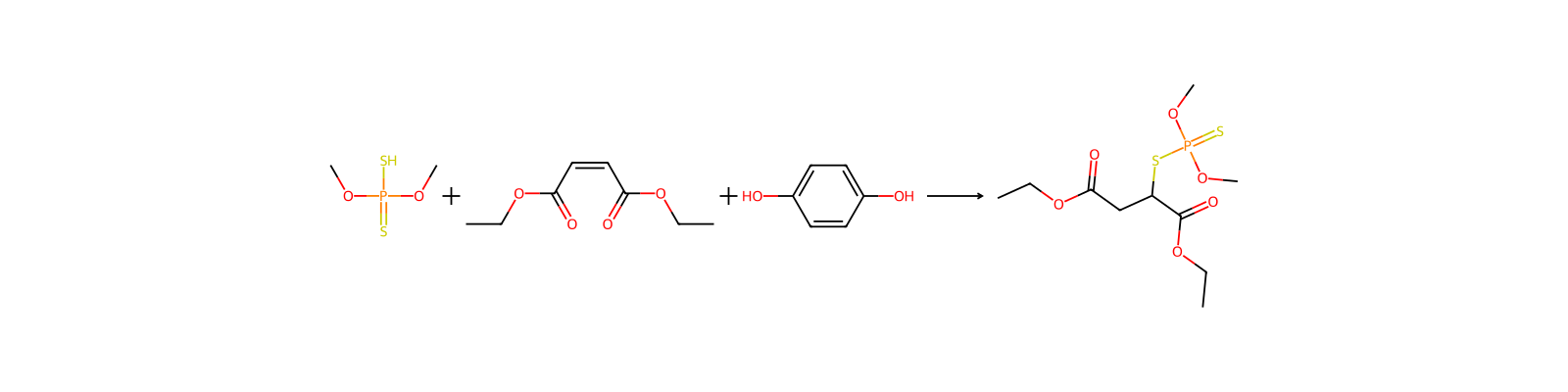
Malathion is typically manufactured using a condensation reaction (at 70-80 °C) of O,O-dimethyl phosphorodithioic acid and diethyl maleate or diethyl fumarate in the presence of hydroquinone.
The feed materials for malathion manufacture are O,O-dimethyl phosphorodithioic acid and diethyl maleate or fumarate. ... An antipolymerization agent such as hydroquinone may be added to the reaction mixture to inhibit polymerization of the maleate or fumarate compound under reaction conditions. This reaction is preferably carried out at temperatures within the range of 20 deg to 150 °C. This reaction is preferably carried out at atmospheric pressure. ... The reaction is preferably carried out in a solvent such as the low molecular weight aliphatic monohydric alcohols, ketones, aliphatic esters, aromatic hydrocarbons or trialkyl phosphates. ... A stirred, jacketed reactor of conventional design may be used. After cooling, the reaction mixture may be taken up in benzene. It is then washed with 10% Na2CO3 and with water. The organic layer is dried over anhydrous Na2SO4, filtered and concentrated in vacuo to give the final product as residue.
Formulations/Preparations
The National Pesticide Information Retrieval System (NPIRS) identifies 22 companies with active labels for products containing the chemical malathion. To view the complete list of companies, product names and percent malathion in formulated products click the following url and enter the CAS Registry number in the Active Ingredient field.
Malathion 50% EC (Bonide Products, Inc.): Active ingredient: malathion 50.0%.
Bonide A Complete Fruit Tree Spray (Bonide Products, Inc.): Active Ingredients: carbaryl 0.3%; malathion 6.0%; and captan 11.76%.
Bonide Malathion Insect Spray (Bonide Products, Inc.): Active Ingredient: malathion 55.0%.
For more Formulations/Preparations (Complete) data for MALATHION (44 total), please visit the HSDB record page.
Household ProductsInformation on 24 consumer products that contain Malathion in the following categories is provided:
Use Classification
Chemical Classes -> Organophosphates and carbamates
INSECTICIDES
General Manufacturing Information
The WHO Recommended Classification of Pesticides by Hazard identifies malathion (technical grade) as Class III: slightly hazardous; Main Use: insecticide.
The WHO has specified that the content of isomalathion ... in water dispersible powders of malathion shall not exceed 1.8% of the nominal malathion content after storage of the powder for six days at 55 °C.
Malathion is about one-half to one-twentieth as toxic as parathion to insects, but it is only about one one-hundredth as toxic to humans and higher animals.
Half-life values for ... malathion: apple fruit (2-3 days), lettuce (3-4 days), onions (1-2 days), citrus fruit (17-32 days), peach fruit (4-6 days), stored wheat (150-190 days). /From table/
Applications
DescriptionMalathion, a clear amber liquid, is sparingly soluble in water but soluble in a majority of organic solvents. The U.S. Environmental Protection Agency (U.S. EPA) grouped malathion under GUP, meaning general use pesticide. It is used as an insecticide as well as an acaricide for the control of pests. Malathion is used for the control of sucking insects and chewing insects on fruits and vegetables. Malathion is an effective insecticide for the control of several household pests such as houseflies, cockroaches, mosquitoes, aphids, animal ectoparasites, and human head and body lice. Malathion is also found in formulations with many other pesticides.
UsesMalathion is used to control a wide spectrum of insect pests in many types of crops and disease vectors in public health programmes. It is also used to control ectoparasites of both humans and animals.
UsesInsecticide for control of sucking and chewing insects and spider mites on vegetables, fruits, ornamentals, field crops, greenhouses, gardens and forestry.
UsesUsed as an insecticide
UsesOrganophosphorus insecticide.
Usesanticholinergic
UsesMalation is a pestanal and used primarily as an insecticide.
General DescriptionYellow to dark-brown liquid with a skunk-like odor. Sinks in water. Freezing point is 37°F.
General DescriptionMalathion, 2-[(dimethoxyphosphinothioyl)thio]butanedioic acid diethyl ester, is a water-insolublephosphodithioate ester that has been used as an agriculturalinsecticide. Malathion is a poor inhibitor of cholinesterases.Its effectiveness as a safe insecticide is a result of the differentrates at which humans and insects metabolize the chemical.Microsomal oxidation, which causes desulfuration,occurs slowly to form the phosphothioate (malaoxon),which is 10,000 times more active than the phosphodithioate(malathion) as a cholinesterase inhibitor. Insects detoxifythe phosphothioate by a phosphatase, forming dimethylphosphorothioate, which is inactive as an inhibitor.Humans, however, can rapidly hydrolyze malathion by acarboxyesterase enzyme, yielding malathion acid, a stillpoorer inhibitor of AChE. Phosphatases and carboxyesterasesfurther metabolize malathion acid to dimethylphosphothioate.
Upstream & downstream products
Upstream raw materials
Downstream products
Additional notes
DefinitionChEBI: A diester that is butanedioate substituted by a (dimethoxyphosphorothioyl)sulfanediyl group at position 2.
Related reactions
11 records


Linked notes
Loading…