HomeMCPWorkbenchSkills
HomeWorkbenchNotificationsMe
llms.txt · MCP GuidePrivacy Policy · Terms of Service · Supportv1.8.3
  1. Home
  2. /Compound

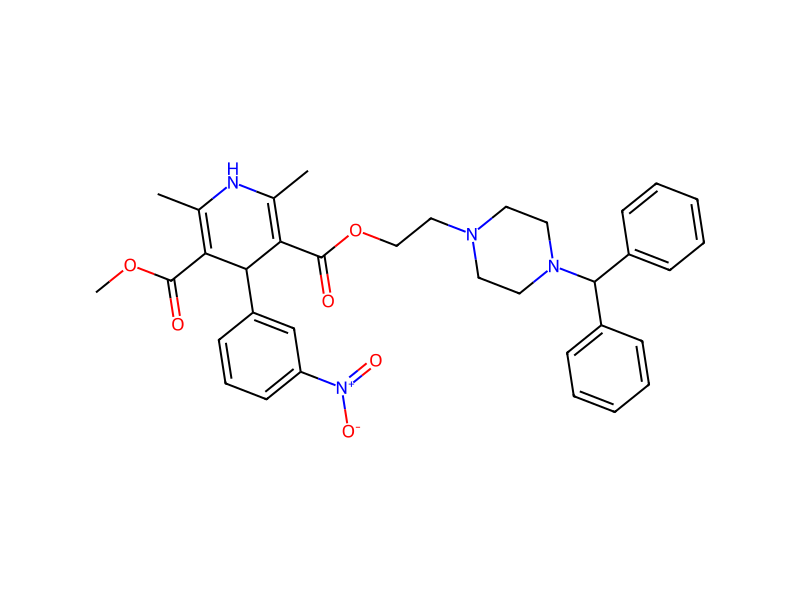
Manidipine

HCID 4008
New reaction
Print
Basic informationOverviewNames & identifiersPropertiesSafety & regulationChemistry & industryRelated reactionsCompound notes
Substructure searchFind similar structures

Basic information

CAS
89226-50-6
Standard SMILES
COC(=O)C1=C(C)NC(C)=C(C(=O)OCCN2CCN(C(c3ccccc3)c3ccccc3)CC2)C1c1cccc([N+](=O)[O-])c1
InChIKey
ANEBWFXPVPTEET-UHFFFAOYSA-N
Molecular formula
C35H38N4O6
Average molar mass
610.7 g/mol
Monoisotopic mass
610.27913494

Overview

Manidipine is a diarylmethane.

Names & identifiers

Preferred name
Manidipine
IUPAC
5-O-[2-(4-benzhydrylpiperazin-1-yl)ethyl] 3-O-methyl 2,6-dimethyl-4-(3-nitrophenyl)-1,4-dihydropyridine-3,5-dicarboxylate
English name
Manidipine
Molecular formula
C35H38N4O6
Molecular weight
610.7

Names & synonyms

manidipine89226-50-6FranidipineArtedilManidipine 63005-O-[2-(4-benzhydrylpiperazin-1-yl)ethyl] 3-O-methyl 2,6-dimethyl-4-(3-nitrophenyl)-1,4-dihydropyridine-3,5-dicarboxylateManidipino6O4754US88DTXSID20437452-(4-Diphenylmethyl-1-piperazinyl)ethyl methyl-1,4-dihydro-2,6-dimethyl-4-(3-nitrophenyl)-3,5-pyridinedicarboxylate3-{2-[4-(diphenylmethyl)piperazin-1-yl]ethyl} 5-methyl 2,6-dimethyl-4-(3-nitrophenyl)-1,4-dihydropyridine-3,5-dicarboxylatemanidipinum
Show more names
Manidipine (Manyper)IpertenManidipine(base)Manidipine(CV-4093)Manidipine Impurity1254Manidipine (10mM in DMSO)
3-(2-(4-(diphenylmethyl)piperazin-1-yl)ethyl) 5-methyl 2,6-dimethyl-4-(3-nitrophenyl)-1,4-dihydropyridine-3,5-dicarboxylate5-O-(2-(4-benzhydrylpiperazin-1-yl)ethyl) 3-O-methyl 2,6-dimethyl-4-(3-nitrophenyl)-1,4-dihydropyridine-3,5-dicarboxylatemanidipine, (+-)-RefChem:809939DTXCID0023745C08CA11120092-68-43-(2-(4-Benzhydrylpiperazin-1-yl)ethyl) 5-methyl 2,6-dimethyl-4-(3-nitrophenyl)-1,4-dihydropyridine-3,5-dicarboxylate

Properties

Computed structural properties

XLogP
5.6
Topological polar surface area
117 Ų
Hydrogen bond donors
1
Hydrogen bond acceptors
9
Rotatable bonds
11
Heavy atoms
45
Formal charge
0
Complexity
1,090

Experimental & physicochemical properties

DrugsPharmaceuticals
LogP5.2
Solubility<1mg/mL

Physicochemical properties

Melting point
125 · 125-128°C
Boiling point
722 · 722.0±60.0 °C(Predicted)
Density
1.232 · 1.232±0.06 g/cm3(Predicted)
storage temp.
2 · Sealed in dry,2-8°C
solubility
10 mM · Soluble in DMSO > 10 mM
form
Powder
pka
6.12 · 6.12±0.10(Predicted)
color
Light yellow to yellow
LogP
4.135 · 4.135
FDA UNII
6 O4754US88 · 6O4754US88
Comptox DTXSID
2043745 · DTXSID2043745

Safety & regulation

Safety information is for reference only and does not replace the supplier’s Safety Data Sheet (SDS), applicable regulations, or professional assessment.

GHS classification

GHS Classification · 4 items

Danger

H301 (100%): Toxic if swallowed [Danger Acute toxicity, oral]

P264, P270, P301+P316, P321, P330, P405, and P501 (click each P-code to see the statement)

Aggregated GHS information provided per 3 reports by companies from 1 notifications to the ECHA C&L Inventory.

Hazard information

Regulatory InformationREACH registered substance: 3,5-Pyridinedicarboxylic acid, 1,4-dihydro-2,6-dimethyl-4-(3-nitrophenyl)-, 2-(4-(diphenylmethyl)-1-piperazinyl)ethyl methyl ester (EC: 855-394-4)
Hazard Classes and CategoriesAcute Tox. 3 (100%)

Toxicology

Drug Induced Liver Injury · 4 items

Drug-Induced Liver Injury Severity and Toxicity (DILIst)

Manidipine

DILI Positive

DOI:10.1016/j.drudis.2019.09.022

Safety data

Signal word
Warning
Symbol(GHS)
GHS07
Hazard statements
H302
REACH Registrations
Active
Precautionary statements
P280-P305+P351+P338

Chemistry & industry

Pharmacology

ATC Code · 2 items

C - Cardiovascular system

QC - Cardiovascular system

Protein BindingManidipine is 99% bound to human plasma proteins.
PharmacodynamicsManidipine produces vasodilation resulting in lower blood pressure.
Mechanism of Action · 1 item

Contraction of vascular smooth muscle is stimulated by Gq coupled receptors which produce calcium release from the sarcoplasmic reticulum. This is followed by opening of voltage dependent calcium channels and an influx of calcium into the cell ultimately producing contraction. Manidipine binds to and dissociates slowly from L- and T-type voltage dependent calcium channels on smooth muscle cells, blocking the entrance of extracellular calcium into the cell and preventing this contraction. This produces vasodilation which decreases blood pressure. Manidipine produces renal vasodilation and an increase in natriuresis. This likely contributes to the antihypertensive effect by reducing blood volume. Manidipine is selective for the vasculature and does not produce significant effects on the heart or central nervous system at clinically relevant dosages.

Biological Half-LifeThe half life of elimination has been observed to be dose dependent. Doses of 5, 10, and 20 mg produced half lives of 3.94, 5.02, and 7.95 h respectively.
Metabolism/MetabolitesManidipine is extensively metabolized by CYP enzymes to pyridine derivatives and diphenylmethane derivatives which make up 4-7% and 22-24% of the dose excreted in the urine.
MeSH Pharmacological Classification · 2 items

Drugs used in the treatment of acute or chronic vascular HYPERTENSION regardless of pharmacological mechanism. Among the antihypertensive agents are DIURETICS; (especially DIURETICS, THIAZIDE); ADRENERGIC BETA-ANTAGONISTS; ADRENERGIC ALPHA-ANTAGONISTS; ANGIOTENSIN-CONVERTING ENZYME INHIBITORS; CALCIUM CHANNEL BLOCKERS; GANGLIONIC BLOCKERS; and VASODILATOR AGENTS.

Related reactions

2 records
New reaction record
HRID 1475169 reaction equation
HRID 1475169As product
HRID 1475170 reaction equation
HRID 1475170As reactant

Compound notes

On this pageBasic informationOverviewNames & identifiersPropertiesSafety & regulationChemistry & industryRelated reactionsCompound notes

Database identifiers

CAS
89226-50-6
PubChem CID
4008
DTXSID
DTXSID2043745
ChEMBL
CHEMBL1085699、CHEMBL312176
ChEBI
CHEBI:135849
UNII
6O4754US88
EC Number
855-394-4
Nikkaji
J313.870D
Symbol(GHS)
7 · GHS07
Signal word
Warning
Hazard statements
302 · H302
Precautionary statements
280 · P280-P305+P351+P338
REACH Registrations
Active

A class of drugs that act by selective inhibition of calcium influx through cellular membranes.

Absorption, Distribution and Excretion · 2 items

The median Tmax is 1.5 h. Administration with food produces an 1.3-1.6-fold increase in Cmax but no change in Tmax. Manidipine does not accumulate significantly with multiple doses.

Manidipine is eliminated through extensive metabolism. 63% is eliminated in the feces and 31% in the urine as metabolites.

Uses & manufacturing

UsesUse (kg; approx.) in Germany (2009): >25
Applications · 3 items

DescriptionManidipine is a dihydropyridine L- and T-type calcium channel blocker. It blocks recombinant rabbit L-type (α1Cα2/δβ1a) and human T-type (α1H) calcium channels expressed in Xenopus oocytes and native L-type channels in dissociated guinea pig cardiac ventricular cells (IC50 = 2.6 nM). Manidipine inhibits intracellular calcium increases induced by endothelin-1 (ET-1; ) in A7r5 rat vascular smooth muscle cells (ED50 = 1 nM) and potassium-induced contraction of isolated dog femoral and portal veins (IC50s = 24 and 2.1 nM, respectively). In vivo, it lowers blood pressure in spontaneously hypertensive rats (SHRs) when administered at a dose of 10 mg/kg and inhibits left ventricular hypertrophy in rats induced by isoproterenol when administered at a dose of 3 mg/kg. Formulations containing manidipine have been used in the treatment of hypertension.

UsesA dihydropyridine calcium channel blocker. Antihypertensive.

UsesManidipine (Manyper) is a lipophilic, third-generation, highly vasoselective dihydropyridine calcium antagonist with an IC50 of 2.6 nM. It causes systemic vasodilation by inhibiting the voltage-dependent calcium inward currents in smooth muscle cells. It

Upstream & downstream products

Upstream raw materials

ManidipineAcetyl keteneMethyl 3-aminocrotonateManidipine hydrochloride1-(2-Hydroxyethyl)piperazineDiisopropyl etherMagnesium sulfate2-(4-Benzhydrylpiperazino)ethyl acetoacetate5-(Methoxycarbonyl)-2,6-dimethyl-4-(3-nitrophenyl)-1,4-dihydropyridine-3-carboxylic acid2-(4-benzhydrylpiperazin-1-yl)ethanolMethyl 3-nitrobenzylideneacetoacetate3-Nitrobenzaldehyde1-Benzhydrylpiperazine

Additional notes

DefinitionChEBI: Manidipine is a diarylmethane.