
Basic information
- CAS
1816-92-8- Standard SMILES
COC(=O)CN=[N+]=[N-]- InChIKey
RXYCUKSOYJWGPE-UHFFFAOYSA-N- Molecular formula
- C3H5N3O2
- Average molar mass
- 115.09 g/mol
- Monoisotopic mass
- 115.0381764
Names & identifiers
- Preferred name
- Methyl 2-azidoacetate
- IUPAC
- methyl 2-azidoacetate
- English name
- Azidoacetic acid methyl ester
- Molecular formula
- C3H5N3O2
- Molecular weight
- 115.0907
Names & synonyms
Methyl 2-azidoacetate1816-92-8DTXSID70398587RefChem:1089321DTXCID00349446Methyl azidoacetateMETHYLAZIDOACETATEMFCD01311034Acetic acid, 2-azido-, methyl estermethyl 3-diazo-3-azaprop-3-enoateAzidoacetic acid methyl esterAcetic acid, azido-, methyl ester
Show more names
Methyl 2-azidoacetate 97%Methyl Azido Acetate-BulkMethyl 2-azidoacetate - M34612-Azido-acetic acid Methyl ester
azido-acetic acid methyl esterAzidoacetic acid, methyl estermethyl azido acetatemethyl azido-acetatemethyl-2-azidoacetateMethyl 2-azidoacetate, 97%SCHEMBL13482799SBB001917
Database identifiers
- CAS
1816-92-8- PubChem CID
- 4020482
- DTXSID
DTXSID70398587- EC Number
- 687-878-4
- Nikkaji
- J1.247.582I
Properties
Computed structural properties
- XLogP
- 1.2
- Topological polar surface area
- 40.7 Ų
- Hydrogen bond donors
- 0
- Hydrogen bond acceptors
- 4
- Rotatable bonds
- 3
- Heavy atoms
- 8
- Formal charge
- 0
- Complexity
- 126
Physicochemical properties
- Boiling point
- 35 °C · 35 °C
- Density
- 1.182 g/mL · 1.182 g/mL at 25 °C
- refractive index
- 20 · n20/D1.440
- Flash point
- 48 ℃ · 48℃
- form
- liquid
- InChI
- InChI=1S/C3H5N3O2/c1-8-3(7)2-5-6-4/h2H2,1H3
- InChIKey
- RXYCUKSOYJWGPE-UHFFFAOYSA-N
- SMILES
- C(=O)(OC)CN=[N+]=[N-]
- UNSPSC Code
- 12352100 · 12352100
- NACRES
- 22 · NA.22
- Symbol(GHS)
- 2 · GHS02,GHS07
- Signal word
- Warning
- Hazard statements
- 226 · H226-H315-H319-H335
- Precautionary statements
- 261 · P261-P305+P351+P338
- target organs
- Respiratory system
- Hazard Codes
- Xi
- Risk Statements
- 5 · 5-10-36/37/38
- Safety Statements
- 26 · 26
- RIDADR
- 1993 C · UN 1993C 3 / PGIII
- WGK Germany
- 3 · 3
- HazardClass
- 3 · 3
- Storage Class
- 3 · 3 - Flammable liquids
- Hazard Classifications
- 2 Flam · Eye Irrit. 2Flam. Liq. 3Skin Irrit. 2STOT SE 3
- Limited Quantities
- 5 L · 5.0 L (1.3 gallons) (liquid)
- Excepted Quantities
- Max Inner Pack (30g or 30ml) and Max Outer Pack (1Kg or 1L)
Safety & regulation
GHS classification
GHS Classification
Warning
H226 (100%): Flammable liquid and vapor [Warning Flammable liquids]
P210, P233, P240, P241, P242, P243, P261, P264, P264+P265, P271, P280, P302+P352, P303+P361+P353, P304+P340, P305+P351+P338, P319, P321, P332+P317, P337+P317, P362+P364, P370+P378, P403+P233, P403+P235, P405, and P501 (click each P-code to see the statement)
Aggregated GHS information provided per 39 reports by companies from 2 notifications to the ECHA C&L Inventory. Each notification may be associated with multiple companies.
Hazard information
Hazard Classes and CategoriesFlam. Liq. 3 (100%)
Safety data
- wgk
- 3
- ridadr
- UN 1993C 3 / PGIII
- risk_code
- 5-10-36/37/38
- Signal word
- Warning
- Symbol(GHS)
- GHS02,GHS07
- hazard_code
- Xi
- safety_code
- 26
- hazard_class
- 3
- Storage Class
- 3 - Flammable liquids
- target organs
- Respiratory system
- Hazard statements
- H226-H315-H319-H335
- Limited Quantities
- 5.0 L (1.3 gallons) (liquid)
- Excepted Quantities
- Max Inner Pack (30g or 30ml) and Max Outer Pack (1Kg or 1L)
- Hazard Classifications
- Eye Irrit. 2Flam. Liq. 3Skin Irrit. 2STOT SE 3
- Precautionary statements
- P261-P305+P351+P338
Chemistry & industry
Applications
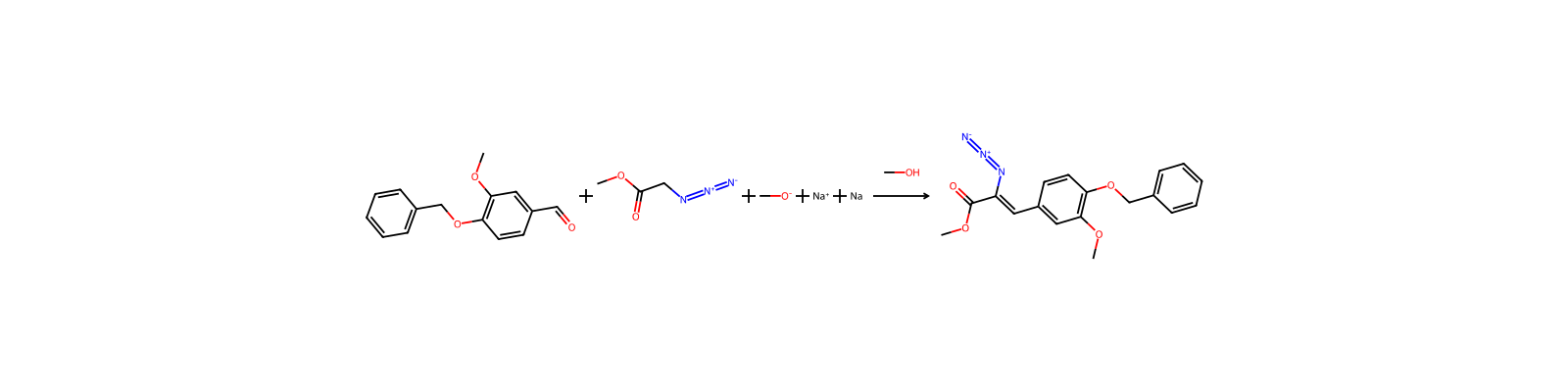
UsesMethyl 2-azidoacetate is widely used as a precursor to build triazole derivatives via alkyne-azide click chemistry. Some of the examples include the synthesis of coumarin-triazole derivatives as potential antiplasmodial agents and macrocyclic triazole containing largazole analogs as histone deacetylases-1 (HDAC1) inhibitors.It can be used to synthesize various pyrrole derivatives by Knoevenagel condensation as in the synthesis of near-infrared boron dipyrromethene (BODIPY) donors for organic tandem solar cells.It can also be used in Hemetsberger-Knittel synthesis of substituted 5-, 6-, and 7-azaindoles.Synthesis of highly fluorescent pyreno[2,1-b]pyrroles using methyl 2-azidoacetate as one of the reagents.
Preparation methods
PreparationAzidoacetic acid methyl ester is widely used in the azidoclick chemistry synthesis of triazole derivatives. Some examples include the synthesis of coumarin-triazole derivatives as potential antimalarial drugs and histone deacetylase-1 (HDAC1) inhibitors containing macrocyclic triazole compounds. It can be used to synthesize various pyrrole derivatives via Knoevenagel condensation, similar to its use in the synthesis of near-infrared bispyrrole (BODIPY) donors for organic tandem solar cells. It can also be used in the hemetsberg-knittel synthesis of substituted 5-, 6-, and 7-azaindole. Highly fluorescent pyrene [2,1-b]pyrrole can be synthesized using Azidoacetic acid methyl ester as a reagent.
Upstream & downstream products
Upstream raw materials
Downstream products
Suppliers73 total
武汉英诺医药科技有限公司+86-027-59232304 15387063101 · [email protected]
上海麦克林生化科技股份有限公司021-50706066 15221275939 · [email protected]
合肥翰刚医药科技有限公司+8618062405514 · [email protected]
韶远科技(上海)有限公司021-50795510 4000665055 · [email protected]
上海凯曼化工科技有限公司021-021-50400622 15618790390 · [email protected]
扬州倍尔盾新材料科技有限公司13776432722 · [email protected]
Syntechem Co.,Ltd[email protected]
Hangzhou Sage Chemical Co., Ltd.+86057186818502 13588463833 · [email protected]
安耐吉化学&3A(安徽泽升科技股份有限公司)400-0056266 · [email protected]
欧利希(湖北)医药科技有限公司17316404525 17316404525 · [email protected]
上海相辉医药科技有限公司13761987713; 13761987713 · [email protected]
南京诺利斯医药科技有限公司13901585132 · [email protected]
郑州研德生物科技有限公司0371-63682289 15538176268 · [email protected]
上海瀚香生物科技有限公司177-54423994 17754423994 · [email protected]
吉林中科研伸科技有限公司18143011203 · [email protected]
湖北成海化工有限公司027-59220433 18327245847 · [email protected]
吉林中科研伸科技有限公司0431-80514535 19917294565 · [email protected]
宝鸡缔都医药化工有限公司029-81145305 17791533577 · [email protected]
HONG KONG IPURE BIOLOGY CO.,LIMITED86 18062405514 18062405514 · [email protected]
上海珂华生物科技有限公司021-60455363 18019463053 · [email protected]
南京诺利斯医药科技有限公司13901585132 · [email protected]
上海健超生物科技有限公司150-2103-5486 18017383231 · [email protected]
苏州爱玛特生物科技有限公司0512-56316828 4008675858 · [email protected]
HBCChem, Inc.+1-510-219-6317 · [email protected]
北京奥秘佳得医药科技有限公司+86-13522808617 · [email protected]
上海马氏化学科技有限公司19916721580 · [email protected]
无锡亚肽生物科技有限公司0510-83583050 13771062561 · [email protected]
台州市一川化工有限公司0576-88652780 13906597690 · [email protected]
普善实业(陕西)有限公司029-81310890 18165209495 · [email protected]
Sigma-Aldrich西格玛奥德里奇(上海)贸易有限公司021-61415566 800-8193336 · [email protected]
南京市元明化工有限公司025-57885806 18951785526 · [email protected]
上海超岚化工科技中心(原宁波市超明生物科技有限公司)13301662590 · [email protected]
上海阿拉丁生化科技股份有限公司6206333 13167063860 · [email protected]
南京艾比克斯生化科技有限公司025-87193546 18652950785 · [email protected]
Guangzhou Yuheng Pharmaceutical Technology Co., Ltd+8613580539051 · [email protected]
上海源叶生物科技有限公司13636370518 · [email protected]
南京博米尔生物科技有限公司025-83453382-8005 · [email protected]
上海凌凯科技股份有限公司021-58950110 13124863828 · [email protected]
Shanghai Acmec Biochemical Technology Co., Ltd.+86-18621343501 · [email protected]
江苏艾康生物医药研发有限公司025-58859352 19370895928 · [email protected]
郑州如科生物科技有限公司15981811963 · [email protected]
天津希恩思生化科技有限公司400-6387771-6039 18920764717 · [email protected]
career henan chemical co+86-0371-86658258 · [email protected]
ATK CHEMICAL COMPANY LIMITED+undefined-21-51877795 · [email protected]
上海吉至生化科技有限公司021-4009004166/18616739031 18616739031 · [email protected]
河南万象精细化工有限公司0371-56669001 13949088811 · [email protected]
上海瀚香生物科技有限公司17754423994 · [email protected]
北京迈瑞达科技有限公司010-82387566 · [email protected]
深圳聚合生化科技有限公司+86-400-002-6226 · [email protected]
康化(上海)新药研发有限公司021-61263370 18516560301 · [email protected]
Related reactions
62 records





Compound notes
Loading…