2-Methoxy-4-((2-(5,6,7,8-tetrahydrobenzo[4,5]thieno[2,3-d]pyrimidin-4-yl)hydrazineylidene)methyl)phenol
Exo2 · Exo2 >=98% (HPLC) · 2-Methoxy-4-[(5,6,7,8-tetrahydro-benzo[4,5]thieno[2,3-d]pyrimidin-4-yl)-hydrazonomethyl]-phenol · Benzaldehyde, 4-hydroxy-3-methoxy-, 2-(5,6,7,8-tetrahydro[1]benzothieno[2,3-d]pyrimidin-4-yl)hydrazone
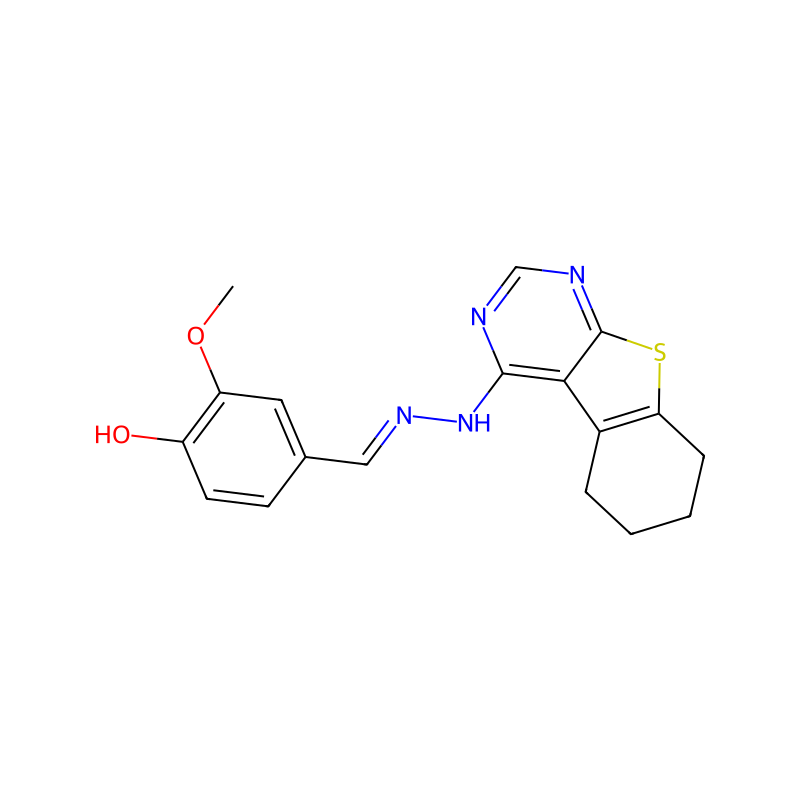
Identifiers & Physical Properties
| CAS No. | 304684-77-3 |
|---|---|
| Molecular formula | C18H18N4O2S |
| Average molar mass | 354.4 g/mol |
| Monoisotopic mass | 354.115047 g/mol |
| SMILES | COc1cc(C=NNc2ncnc3sc4c(c23)CCCC4)ccc1O |
| InChIKey | VFNUTEMVQGLDAG-UHFFFAOYSA-N |
| PubChem CID | 4040780 |
| DTXSID | DTXSID50893484 |
Chemical & Physical Properties
| XLogP | 4.3 |
|---|---|
| Topological polar surface area | 108 |
| Hydrogen bond donors | 2 |
| Hydrogen bond acceptors | 7 |
| Rotatable bonds | 4 |
| Heavy atoms | 25 |
| Formal charge | 0 |
| Complexity | 480 |
| Boiling point | 591.0±50.0 °C(Predicted) |
| Density | 1.44±0.1 g/cm3(Predicted) |
| Storage conditions | 2-8°C |
| Solubility | DMSO: >20mg/mL |
| Physical state | powder |
| pKa (acidity coefficient) | 8.79±0.35(Predicted) |
| Color | yellow |
| Stability | Stable for 1 year from date of purchase as supplied. Solutions in DMSO may be stored at -20°C for up to 1 month. |
| InChI | 1S/C18H18N4O2S/c1-24-14-8-11(6-7-13(14)23)9-21-22-17-16-12-4-2-3-5-15(12)25-18(16)20-10-19-17/h6-10,23H,2-5H2,1H3,(H,19,20,22)/b21-9+ |
| InChIKey | VFNUTEMVQGLDAG-ZVBGSRNCSA-N |
| SMILES | COc1cc(ccc1O)\C=N\Nc2ncnc3sc4CCCCc4c23 |
| UNSPSC Code | 12352200 |
| NACRES | NA.77 |
| Water hazard class (WGK) | 3 |
| Storage class | 11 - Combustible Solids |
Safety & Regulations
| Water hazard class (WGK) | 3 |
|---|---|
| Storage class | 11 - Combustible Solids |
Applications & Uses
Description
Exo2 (304684-77-3) disrupts the Golgi apparatus and stimulates Golgi-ER fusion in mammalian cells.1 May be used to completely ablate the Golgi apparatus.1 Like brefeldin A (BFA), it inhibits anterograde transport and disrupts morphology of the trans-Golgi network (TGN) but unlike BFA, it does not induce tubulation and merging of the TGN and endosomal compartments.2 It perturbs trafficking of Shiga toxin between endosomes and the trans-Golgi network, in contrast to cholera toxin.1,2 Accelerates degradation of perilipin-2 proteins.3
Uses
Exo2 is a secretion inhibitor. Exo2 perturbs trafficking of Shiga toxin between endosomes and the trans-Golgi network. Exo2 blocks secretory cargo exit from the ER (endoplasmic reticulum) and disrupts the Golgi apparatus, but does not affect the morphology of the TGN (trans-Golgi network) Exo2 can stimulate calcium-dependent exocytosis in permeabilized adrenal chromaff in cells[1][2].