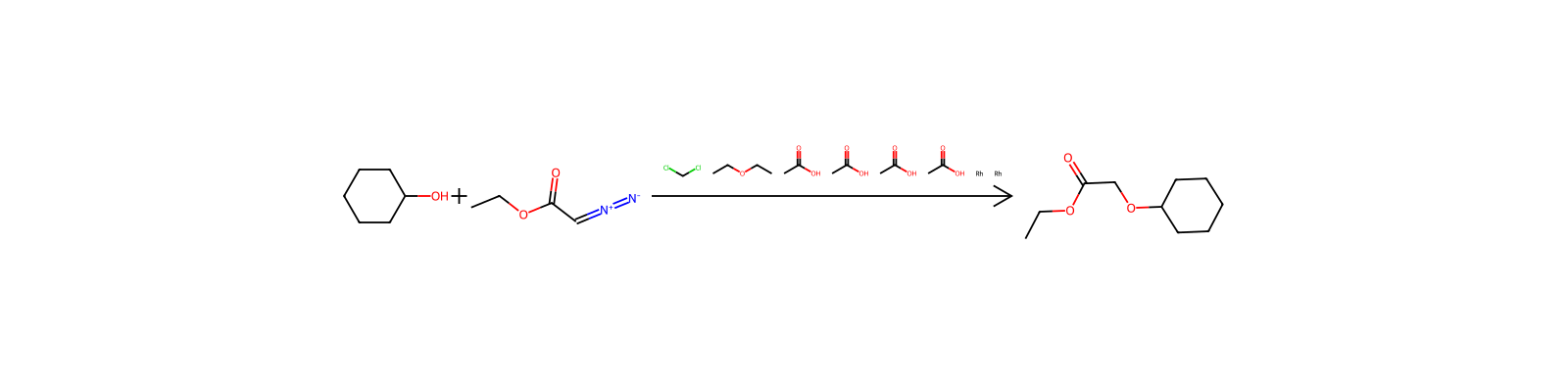
HRID 18802As catalyst

15956-28-2CC(=O)O.CC(=O)O.CC(=O)O.CC(=O)O.[Rh].[Rh]DRGVLUZIGUIMLB-UHFFFAOYSA-N15956-28-2Safety information is for reference only and does not replace the supplier’s Safety Data Sheet (SDS), applicable regulations, or professional assessment.
UsesRhodium (II) Acetate Dimer is a effective catalyst for ylide formation and it is also catalyst for cyclopropanation of alkenes, oxidation of alcohols, cyclization reactions involving -diazo carbonyl groups, insertion into C-H and X-H bonds (X-H is NH or SH or OH). More reactive and useful in differentiating ribonucleosides and deoxynucleosides. It is also used in functionalizing fullerenes into polymers. Efficient catalyst for hydrogen transfer from 2-propanol to cyclohexanone and other unsaturated compounds.
PreparationRhodium(II) acetate dimer synthesis: A suspension of 10.0g. of Rh(OH)3.H20 in 400 ml. of glacial acetic acid dissolved upon refluxing for 18 hr. to give a deep emerald-green solution. Most of the acetic acid was evaporated on a steam bath; remaining traces mere removed by heating the residue at 120° for 1hr. The residue was then extracted with boiling acetone until the extract was colorless rather than bluish green. The extract was quickly passed through a fritted glass filter, concentrated on a steam bath to 1/3 its original volume, and placed in the freezing compartment of a refrigerator for 18hr. The resulting large dark green crystals were collected on a filter, washed with small portions of ice-cold acetone, and dried at 110°. When first collected, the product is the weak adduct [Rh(OOCCH3)2(CH3)2C0]2; however, acetone is lost fairly readily at room temperature and immediately in the drying oven; yield, 6.2g. (48%).