
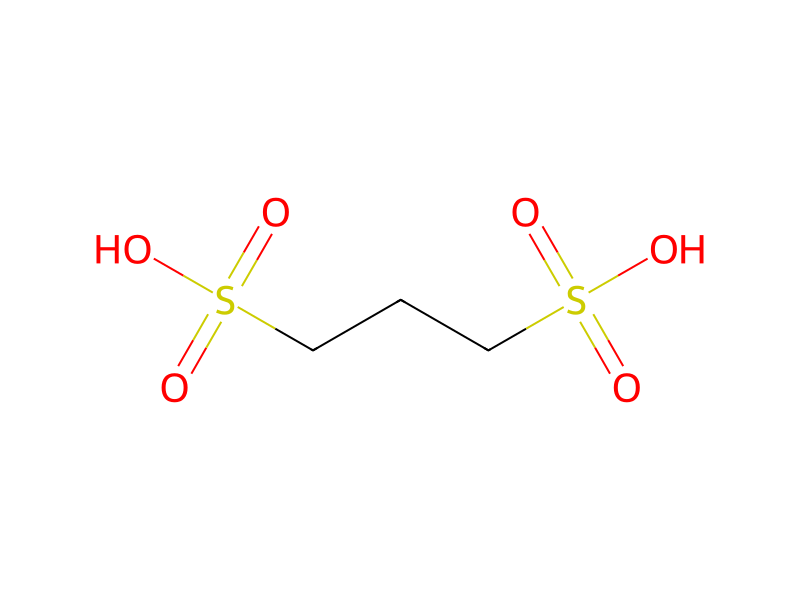
Basic information
- Standard SMILES
O=S(=O)(O)CCCS(=O)(=O)O- InChIKey
MGNVWUDMMXZUDI-UHFFFAOYSA-N- Molecular formula
- C3H8O6S2
- Average molar mass
- 204.2 g/mol
- Monoisotopic mass
- 203.97623032
Names & identifiers
- Preferred name
- 1,3-Propanedisulfonic acid
- IUPAC
- propane-1,3-disulfonic acid
- English name
- Eprodisate
- Molecular formula
- C3H8O6S2
- Molecular weight
- 204.22
Names & synonyms
Eprodisate21668-77-91,3-Propanedisulfonic acidPropane-1,3-disulfonateEprodisatoPropane-1,3-disulphonate6QFP76V7S7eprodisatumRefChem:590996propane-1,3-disulfonic acid1,3-Propanedisulfonic Acid (50-60% in Water)Eprodisate [INN]
Show more names
(50-60% in Water)propane-1,3-disulfonicaciDISODIUM 1,3-PROPANEDISULFONATE1,3-Propanedisulfonic Acid DISODIUM 1,3-PROPANEDISULPHONATEDISODIUM PROPANE-1,3-DISULFONATE1,3-PROPANEDISULFONIC ACID DISODIUM SALT
MFCD00191482starbld000931250-60% in Water1,3-propanesulfonic acid1,3-propanedisulphonic acidEPRODISATE [WHO-DD]UNII-6QFP76V7S7SCHEMBL34216
Database identifiers
- CAS
21668-77-9- PubChem CID
- 428573
- DTXSID
DTXSID4048301- ChEMBL
CHEMBL2111092- UNII
- 6QFP76V7S7
- EC Number
- 679-154-1
- Nikkaji
- J534.155H
Properties
Computed structural properties
- XLogP
- -1.6
- Topological polar surface area
- 126 Ų
- Hydrogen bond donors
- 2
- Hydrogen bond acceptors
- 6
- Rotatable bonds
- 4
- Heavy atoms
- 11
- Formal charge
- 0
- Complexity
- 254
Physicochemical properties
- Melting point
- 120 · 120-124 ºC
- Boiling point
- 157 °C · 157 °C(Press: 1.4 Torr)
- Density
- 1.33 · 1.33
- refractive index
- 1.422 · 1.4220
- storage temp.
- -20 °C · Store at -20°C
- solubility
- 125 mg/mL · DMSO: ≥ 125 mg/mL (612.09 mM)
- pka
- 1.21 · 1.21±0.50(Predicted)
- form
- clear liquid
- color
- Colorless to Light yellow
- InChI
- InChI=1S/C3H8O6S2/c4-10(5,6)2-1-3-11(7,8)9/h1-3H2,(H,4,5,6)(H,7,8,9)
- InChIKey
- MGNVWUDMMXZUDI-UHFFFAOYSA-N
- SMILES
- C(S(O)(=O)=O)CCS(O)(=O)=O
- CAS DataBase Reference
- 21668 · 21668-77-9(CAS DataBase Reference)
- FDA UNII
- 6 QFP76V7S7 · 6QFP76V7S7
- UNSPSC Code
- 12352100 · 12352100
- NACRES
- 22 · NA.22
- Symbol(GHS)
- 5 · GHS05
- Signal word
- Danger
- Hazard statements
- 314 · H314
- Precautionary statements
- 280 · P280-P303+P361+P353-P304+P340+P310-P305+P351+P338-P363-P405
- Hazard Codes
- Xi,C
- Risk Statements
- 36 · 36/37/38-34-20/21/22
- Safety Statements
- 26 · 26-36-45-36/37/39-27
- RIDADR
- 3265 · 3265
- WGK Germany
- 3 · 3
- HS Code
- 2904.1 · 2904.10.5000
- HazardClass
- 8 · 8
- PackingGroup
- III
- Storage Class
- 8 A · 8A - Combustible corrosive hazardous materials
- Hazard Classifications
- 1 Skin · Eye Dam. 1Skin Corr. 1B
Safety & regulation
GHS classification
GHS Classification
Danger
H302 (88.4%): Harmful if swallowed [Warning Acute toxicity, oral];H312 (88.4%): Harmful in contact with skin [Warning Acute toxicity, dermal];H314 (100%): Causes severe skin burns and eye damage [Danger Skin corrosion/irritation];H332 (88.4%): Harmful if inhaled [Warning Acute toxicity, inhalation]
P260, P261, P264, P270, P271, P280, P301+P317, P301+P330+P331, P302+P352, P302+P361+P354, P304+P340, P305+P354+P338, P316, P317, P321, P330, P362+P364, P363, P405, and P501 (click each P-code to see the statement)
Aggregated GHS information provided per 43 reports by companies from 3 notifications to the ECHA C&L Inventory. Each notification may be associated with multiple companies.;Information may vary between notifications depending on impurities, additives, and other factors. The percentage value in parenthesis indicates the notified classification ratio from companies that provide hazard codes. Only hazard codes with percentage values above 10% are shown. For more detailed information, please visit ECHA C&L website.
Hazard information
Hazard Classes and CategoriesAcute Tox. 4 (88.4%);Acute Tox. 4 (88.4%);Skin Corr. 1B (100%);Acute Tox. 4 (88.4%)
Safety data
- wgk
- 3
- ridadr
- 3265
- hs_code
- 2904.10.5000
- risk_code
- 36/37/38-34-20/21/22
- Signal word
- Danger
- Symbol(GHS)
- GHS05
- hazard_code
- Xi,C
- safety_code
- 26-36-45-36/37/39-27
- hazard_class
- 8
- Storage Class
- 8A - Combustible corrosive hazardous materials
- packing_group
- III
- Hazard statements
- H314
- Hazard Classifications
- Eye Dam. 1Skin Corr. 1B
- Precautionary statements
- P280-P303+P361+P353-P304+P340+P310-P305+P351+P338-P363-P405
Chemistry & industry
Pharmacology
Mechanism of Action
Decline in renal function associated with Amyloid A (AA) amyloidosis can be slowed by eprodisate (Kiacta), a drug that inhibits the deposit of the complex protein in tissues. AA amyloidosis is a serious, frequently fatal disorder involving deposits of amyloid fibrils in various organs and tissues. It is a complication of many chronic inflammatory disorders, but little is known about its etiology or natural history. Eprodisate delays the progression of AA amyloidosis-associated renal disease.
Applications
UsesTreatment of secondary (AA) amyloidosis.
Suppliers43 total
国药集团化学试剂有限公司86-21-63210123 · [email protected]
梯希爱(上海)化成工业发展有限公司021-67121386 · [email protected]
宁波君龙新材料有限公司0574 88552216 19032109277 · [email protected]
Hebei Chuanghai Biotechnology Co., Ltd+86-17732866630 · [email protected]
上海麦克林生化科技股份有限公司021-50706066 15221275939 · [email protected]
上海瀚麟生物科技有限公司183-0212-4410 18302124410 · [email protected]
安徽合诺生物科技有限公司0555-2761852
阿法埃莎(中国)化学有限公司400-6106006 · [email protected]
安耐吉化学&3A(安徽泽升科技股份有限公司)400-0056266 · [email protected]
浦拉司科技(上海)有限责任公司21-58661250 18217085189 · [email protected]
上海瀚鸿科技股份有限公司021-54306202 13764082696 · [email protected]
广东方信生物科技有限公司0751-2838688 13376594225 · [email protected]
玛雅试剂+86 (573) 82222445 (0)18006601000 452520369 · [email protected]
ZHEJIANG JIUZHOU CHEM CO., LTD+86-0576225566889 +86-13454675544 · [email protected];[email protected];[email protected]
上海复和化学科技有限公司0086-21-67651709 · [email protected]
TargetMol 中国(陶术生物)400-821-0310 15002144251 · [email protected]
TCI AMERICA800-4238616 · [email protected]
TOKYO CHEMICAL INDUSTRY CO., LTD.03-36680489 · [email protected]
TCI Europe320-37350700 · [email protected]
普善实业(陕西)有限公司029-81310890 18165209495 · [email protected]
Sigma-Aldrich西格玛奥德里奇(上海)贸易有限公司021-61415566 800-8193336 · [email protected]
天津荣燊化工有限公司18317763565; 18317763565 · [email protected]
武汉峰耀同辉化学制品有限公司027-87466205 15377579727 · [email protected]
安阳鸿蒙新材料有限公司19588588067 · [email protected]
上海阿拉丁生化科技股份有限公司6206333 13167063860 · [email protected]
陕西缔都医药化工有限公司029-029-81120477 17792793610 · [email protected]
安阳鸿蒙新材料有限公司0372-19588588067 19588588067 · [email protected]
石家庄斯迪亚诺精细化工有限公司0311-89250318 031166536426 · [email protected]
上海源叶生物科技有限公司13636370518 · [email protected]
上海颖心实验室设备有限公司021-021-59178156 15300768757 · [email protected]
广东翁江化学试剂有限公司0751-2886750 13927877953 · [email protected]
上海贤鼎生物科技有限公司021-021-52271985 17721149837 · [email protected]
江苏艾康生物医药研发有限公司025-58859352 19370895928 · [email protected]
上海启乔生物科技有限公司021-37653318 15221675714 · [email protected]
武汉峰耀同辉化学制品有限公司027-87466105 15377573527 · [email protected]
厦门盈融达化工有限公司+86-0592-6210733 · [email protected]
TCI Chemicals (India) Pvt. Ltd.[email protected]
Aladdin Scientific[email protected]
XIAMEN AMITY INDUSTRY AND TRADE CO., LTD.+8618950047208 · [email protected]
北京百灵威科技有限公司18210857532 18210857532 · [email protected]
河北贞田食品添加剂有限公司0551-77777777-5 13333333333
上海鼓臣生物技术有限公司021-34675735 19147740836 · [email protected]
Dideu Industries Group Limited+8617392712697 · [email protected]
Related reactions
1 records
Linked notes
Loading…