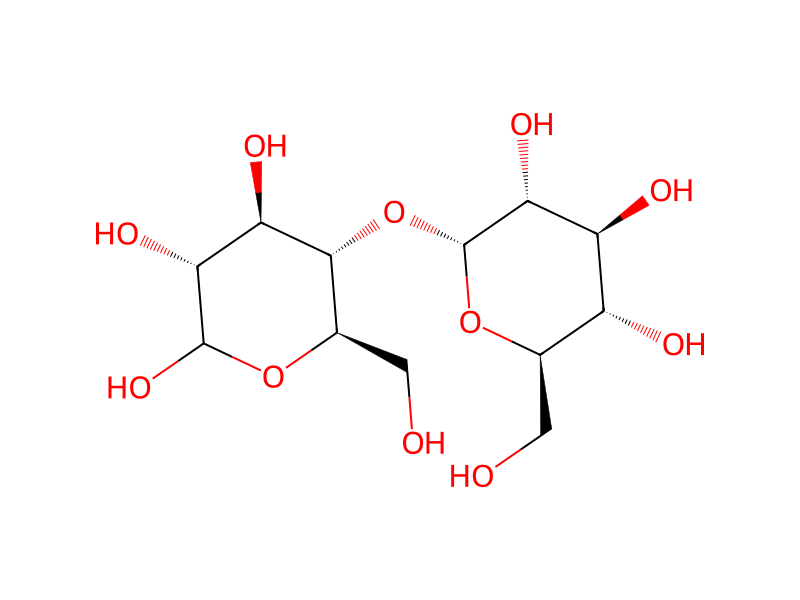
Basic information
- CAS
16984-36-4- Standard SMILES
OC[C@H]1O[C@H](O[C@H]2[C@H](O)[C@@H](O)C(O)O[C@@H]2CO)[C@H](O)[C@@H](O)[C@@H]1O- InChIKey
GUBGYTABKSRVRQ-PICCSMPSSA-N- Molecular formula
- C12H22O11
- Average molar mass
- 342.3 g/mol
- Monoisotopic mass
- 342.11621152
Overview
Maltose is a glycosylglucose consisting of two D-glucopyranose units connected by an alpha-(14)-linkage. It has a role as a sweetening agent, a mouse metabolite, a Saccharomyces cerevisiae metabolite, an Escherichia coli metabolite and a human metabolite. It is a maltooligosaccharide and a glycosylglucose.
Names & identifiers
- Preferred name
- Maltose
- IUPAC
- (2R,3S,4S,5R,6R)-2-(hydroxymethyl)-6-[(2R,3S,4R,5R)-4,5,6-trihydroxy-2-(hydroxymethyl)oxan-3-yl]oxyoxane-3,4,5-triol
- English name
- Maltose
- Molecular formula
- C12H22O11
- Molecular weight
- 342.3
Names & synonyms
maltoseD-(+)-Maltose69-79-4MaltobioseCextromaltoseAdvanctose 100Malt sugarFinetoseMaltodioseSunmaltFinetose FSunmalt S
Show more names
Galactosyl--(1->4)-glucose4-O-α-D-Glucopyranosyl-D-glucopyranoseD-Glucopyranose, 4-O-a-D-glucopyranosyl- (8CI, 9CI)
CHEBI:173064-(alpha-D-Glucosido)-D-glucosealpha-D-glucopyranosyl-(1->4)-D-glucopyranoseMaltose, pureMaltose anhydrousCHEBI:181474-(alpha-D-Glucopyranosido)-alpha-glucopyranose(2R,3S,4S,5R,6R)-2-(hydroxymethyl)-6-[(2R,3S,4R,5R)-4,5,6-trihydroxy-2-(hydroxymethyl)oxan-3-yl]oxyoxane-3,4,5-triol
Database identifiers
- CAS
16984-36-4、69-79-4- PubChem CID
- 439186
- DTXSID
DTXSID101018093- ChEMBL
CHEMBL1908365- ChEBI
CHEBI:17306- EC Number
- 200-716-5
- Nikkaji
- J4.871B
Properties
Computed structural properties
- XLogP
- -4.7
- Topological polar surface area
- 190 Ų
- Hydrogen bond donors
- 8
- Hydrogen bond acceptors
- 11
- Rotatable bonds
- 4
- Heavy atoms
- 23
- Formal charge
- 0
- Complexity
- 382
Experimental & physicochemical properties
Chemical ClassesBiological Agents -> Disaccharides
Cosmetics
Cosmetic ingredients (Maltose) -> CIR (Cosmetic Ingredient Review)
Masking; Moisturising; Skin conditioning
FragrancesFragrance Ingredient (D-_Glucose, 4-_O-__-_D-_glucopyranosyl-) -> IFRA transparency List
Food AdditivesNUTRITIVE SWEETENER -> FDA Substance added to food
Melting Point102-103 °C
Physical DescriptionWhite odorless crystals; [Mallinckrodt Baker MSDS]
Collision Cross Section181.9 Ų [M+K]+
Physicochemical properties
- Boiling point
- 667.931 · 667.931±55.00 °C(Press: 760.00 Torr)(predicted)
- Density
- 1.768 · 1.768±0.10 g/cm3(Temp: 25 °C; Press: 760 Torr)(predicted)
Safety & regulation
GHS classification
GHS Classification
This chemical does not meet GHS hazard criteria for 99.5% (206 of 207) of all reports.
Not Classified
Aggregated GHS information provided per 207 reports by companies from 3 notifications to the ECHA C&L Inventory.
Hazard information
Regulatory InformationREACH registered substance: Maltose (EC: 200-716-5)
Hazards SummaryNo evidence of teratogenicity in rabbits, rats, or mice at extremely high intravenous doses (10, 30, and 10 gm/kg, respectively); [Shepard's Catalog of Teratogenic Agents] May cause irritation; [Mallinckrodt Baker MSDS]
Hazard Classes and CategoriesNot Classified
Toxicology
Toxicity SummarySafe in the present practices of use and concentration. Ingredient, concentration, and use information are available in documents discoverable at https://cir-reports.cir-safety.org
Chemistry & industry
Pharmacology
MeSH Pharmacological ClassificationSubstances that sweeten food, beverages, medications, etc., such as sugar, saccharine or other low-calorie synthetic products. (From Random House Unabridged Dictionary, 2d ed)
Uses & manufacturing
Uses
CIR ingredient: Maltose
Used as a nutrient, sweetener, stabilizer for polysulfides, and in pharmaceuticals; [Merck Index] Used as a nutritive sweetener; [FDA] Permitted for use as an inert ingredient in non-food pesticide products; [EPA]
Household ProductsInformation on 4 consumer products that contain Maltose in the following categories is provided:
Use Classification
Fragrance Ingredients
Cosmetics -> Masking; Moisturising; Skin conditioning
Suppliers5 total
XIAMEN AMITY INDUSTRY AND TRADE CO., LTD.+8618950047208 · [email protected]
陕西萃康医药科技有限公司13186333400 19299362551 · [email protected]
HANGZHOU CLAP TECHNOLOGY CO.,LTD86-571-88216897,88216896 13588875226 · [email protected]
江苏艾康生物医药研发有限公司025-58859352 18651614124 · [email protected]
Hefei TNJ Chemical Industry Co.,Ltd.+86-0551-65418671 +86-189 4982 3763 · [email protected]
Additional notes
Related reactions
0 records
No reaction records under the current filter.
Compound notes
Loading…