
HRID 135958As reactant
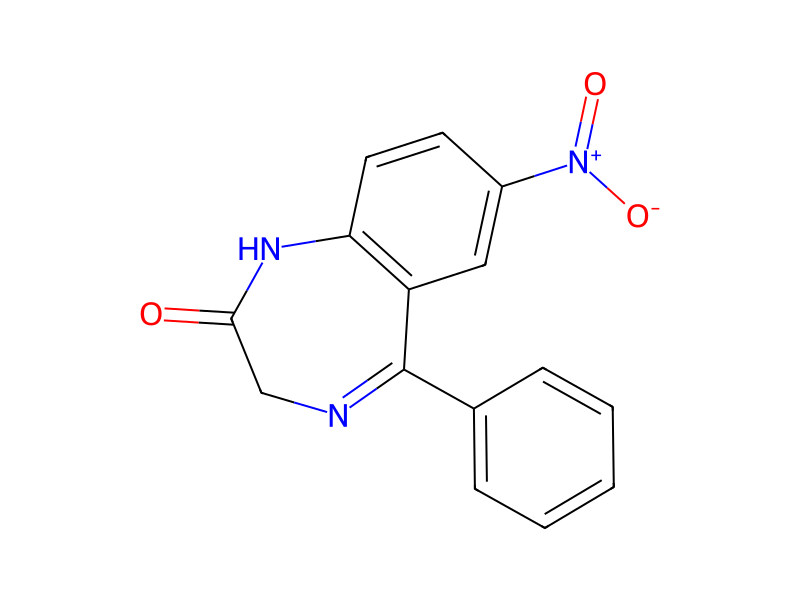
146-22-5O=C1CN=C(c2ccccc2)c2cc([N+](=O)[O-])ccc2N1KJONHKAYOJNZEC-UHFFFAOYSA-NNitrazepam is a 1,4-benzodiazepinone that is 1,3-dihydro-2H-1,4-benzodiazepin-2-one which is substituted at positions 5 and 7 by phenyl and nitro groups, respectively. It is used as a hypnotic for the short-term management of insomnia and for the treatment of epileptic spasms in infants (West's syndrome). It has a role as an anticonvulsant, a sedative, a drug metabolite, a GABA modulator and an antispasmodic drug. It is a 1,4-benzodiazepinone and a C-nitro compound.
146-22-5DTXSID5023372CHEMBL13209CHEBI:7581DEA NFLIS-Drug Category -> Benzodiazepines
DEA Schedule IV Controlled Substance -> Depressants
Pharmaceuticals -> Benzodiazepines
Pharmaceuticals -> Listed in ZINC15
Pharmaceuticals
Pharmaceuticals -> Synthetic Cannabinoids or Psychoactive Compounds
2.25
2.06
2.99e-02 g/L
>42.2 [ug/mL] (The mean of the results at pH 7.4)
Breast Feeding; Lactation; Milk, Human; Hypnotics and Sedatives; Anti-Anxiety Agents; Benzodiazepines
Pharmaceuticals
166.3 Ų [M+H]+ [CCS Type: DT; Method: single field calibrated]
163.6 Ų [M+H]+ [CCS Type: TW; Method: Major Mix IMS/Tof Calibration Kit (Waters)]
Safety information is for reference only and does not replace the supplier’s Safety Data Sheet (SDS), applicable regulations, or professional assessment.
Warning
H302 (100%): Harmful if swallowed [Warning Acute toxicity, oral]
P264, P270, P301+P317, P330, and P501 (click each P-code to see the statement)
Aggregated GHS information provided per 49 reports by companies from 3 notifications to the ECHA C&L Inventory.
DEA schedule IV controlled substance
Nitrazepam: Does not have an individual approval but may be used under an appropriate group standard
General supportive measures should be employed, along with intravenous fluids, and an adequate airway maintained. Hypotension may be combated by the use of norepinephrine or metaraminol. Dialysis is of limited value. Flumazenil (Anexate) is a competitive benzodiazepine receptor antagonist that can be used as an antidote for benzodiazepine overdose. In particular, flumazenil is very effective at reversing the CNS depression associated with benzodiazepines but is less effective at reversing respiratory depression. Its use, however, is controversial as it has numerous contraindications. It is contraindicated in patients who are on long-term benzodiazepines, those who have ingested a substance that lowers the seizure threshold, or in patients who have tachycardia or a history of seizures. As a general rule, medical observation and supportive care are the mainstay of treatment of benzodiazepine overdose. Although benzodiazepines are absorbed by activated charcoal, gastric decontamination with activated charcoal is not beneficial in pure benzodiazepine overdose as the risk of adverse effects often outweigh any potential benefit from the procedure. It is recommended only if benzodiazepines have been taken in combination with other drugs that may benefit from decontamination. Gastric lavage (stomach pumping) or whole bowel irrigation are also not recommended.
N05CD02
N - Nervous system
QN - Nervous system
Nitrazepam is a type of benzodiazepine drug. It is a powerful hypnotic drug which possesses strong sedative, anxiolytic, amnestic, anticonvulsant, and skeletal muscle relaxant properties. Nitrazepam shortens the time required to fall asleep and lengthens the duration of sleep. It is also useful for the management of myoclonic seizures.
Nitrazepam belongs to a group of medicines called benzodiazepines. This drug affects central benzodiazepine receptors, which are associated with inhibitory GABA (gamma amino butyric acid)receptors, leading to enhanced GABA binding activity. GABA is a major neurotransmitter in the brain, which causes somnolence, relaxation of muscles, a decrease in anxiety and general central nervous system depression. Nitrazepam has anticonvulsant properties that may be attributed to its ability to bind to voltage-dependent sodium channels. Sustained repetitive firing seems to be limited by benzodiazepines effect of slowing recovery of sodium channels from inactivation.
Drugs used to prevent SEIZURES or reduce their severity.
Drugs used to induce drowsiness or sleep or to reduce psychological excitement or anxiety.
Agents that alleviate ANXIETY, tension, and ANXIETY DISORDERS, promote sedation, and have a calming effect without affecting clarity of consciousness or neurologic conditions. ADRENERGIC BETA-ANTAGONISTS are commonly used in the symptomatic treatment of anxiety but are not included here.
Substances that do not act as agonists or antagonists but do affect the GAMMA-AMINOBUTYRIC ACID receptor-ionophore complex. GABA-A receptors (RECEPTORS, GABA-A) appear to have at least three allosteric sites at which modulators act: a site at which BENZODIAZEPINES act by increasing the opening frequency of GAMMA-AMINOBUTYRIC ACID-activated chloride channels; a site at which BARBITURATES act to prolong the duration of channel opening; and a site at which some steroids may act. GENERAL ANESTHETICS probably act at least partly by potentiating GABAergic responses, but they are not included here.




They cause slurred speech, disorientation and "drunken" behavior. They are physically and psychologically addictive. May cause a potentially dangerous rash that may develop into Stevens Johnson syndrome, an extremely rare but potentially fatal skin disease.
Nitrazepam belongs to a group of medicines called benzodiazepines. It acts on benzodiazepine receptors in the brain which are associated with the GABA receptors causing an enhanced binding of GABA (gamma amino butyric acid) to GABAA receptors. GABA is a major inhibitory neurotransmitter in the brain, involved in inducing sleepiness, muscular relaxation and control of anxiety and fits, and slows down the central nervous system. The anticonvulsant properties of nitrazepam and other benzodiazepines may be in part or entirely due to binding to voltage-dependent sodium channels rather than benzodiazepine receptors. Sustained repetitive firing seems to be limited by benzodiazepines effect of slowing recovery of sodium channels from inactivation.
Nitrazepam is a drug which is very frequently involved in drug intoxication, including overdose. Nitrazepam overdose may result in stereotypical symptoms of benzodiazepine overdose including intoxication, impaired balance, slurred speech. In cases of severe overdose this may progress to a comatose state with the possibility of death.
Drug-Induced Liver Injury Severity and Toxicity (DILIst)
Nitrazepam
DILI Positive
DOI:10.1016/j.drudis.2019.09.022
Use (kg; approx.) in Germany (2009): ?100
Used to treat short-term sleeping problems (insomnia), such as difficulty falling asleep, frequent awakenings during the night, and early-morning awakening.
UsesAnticonvulsant; hypnotic. Controlled substance (depressant)
DefinitionChEBI: A 1,4-benzodiazepinone that is 1,3-dihydro-2H-1,4-benzodiazepin-2-one which is substituted at positions 5 and 7 by phenyl and nitro groups, respectively. It is used as a hypnotic for the short-term management of insomnia and for the trea ment of epileptic spasms in infants (West's syndrome).