HomeMCPWorkbenchSkills
HomeWorkbenchNotificationsMe
llms.txt · MCP GuidePrivacy Policy · Terms of Service · Supportv1.8.3
  1. Home
  2. /Compound

Npc182939

HCID 456410
New reaction
Print
Basic informationOverviewNames & identifiersPropertiesSafety & regulationChemistry & industryRelated reactionsCompound notes
Substructure searchFind similar structures

Basic information

CAS
71939-50-9
Standard SMILES
C[C@H]1[C@@H](O)O[C@@H]2OC3(C)CC[C@H]4[C@H](C)CC[C@@H]1[C@@]24OO3
InChIKey
BJDCWCLMFKKGEE-ISOSDAIHSA-N
Molecular formula
C15H24O5
Average molar mass
284.35 g/mol

Overview

dihydroartemisinin has been reported in Tomophagus and Aspergillus sclerotiorum with data available.

Names & identifiers

Preferred name
Npc182939
IUPAC
(4S,5R,8S,9R,10S,12R,13R)-1,5,9-trimethyl-11,14,15,16-tetraoxatetracyclo[10.3.1.04,13.08,13]hexadecan-10-ol
English name
DHQHS 2
Molecular formula
C15H24O5
Molecular weight
284.35

Names & synonyms

RefChem:1092800Npc182939Dihydroartemisinin71939-50-9DHQHS 2Artemisinin, dihydroCHEMBL307261DihydroquinghoasuUNII-6A9O50735XArtenimol (USAN/INN)Dihydroartemisinin + ProveblueSCHEMBL2132158
Show more names
(3r,5as,6r,8as,9r,10r,12r,12ar)-decahydro-3,6,9-trimethyl-3,12-epoxy-12h-pyrano[4,3-j]-1,2-benzodioxepin-10-olDihydroartemisinDihydroarteminisinDihydroartemisinin (DHA)AlaxinCotexinSalaxinCotecxin
JAV-110BJDCWCLMFKKGEE-KXTPALSWSA-N3,12-Epoxy-12H-pyrano(4,3-j)-1,2-benzodioxepin-10-ol, decahydro-3,6,9-trimethyl-, (3R,5aS,6R,8aS,9R,10S,12R,12aR)-BDBM50578409VM3352AKOS015962875AKOS026749923AC-2067

Database identifiers

CAS
71939-50-9、81496-81-3
PubChem CID
456410
EC Number
615-698-8

Properties

Computed structural properties

XLogP
2.5
Topological polar surface area
57.2 Ų
Hydrogen bond donors
1
Hydrogen bond acceptors
5
Rotatable bonds
0
Heavy atoms
20
Formal charge
0
Complexity
415

Physicochemical properties

Melting point
144 · 144-149°C
Boiling point
375.6 · 375.6±42.0 °C(Predicted)
Density
1.24 · 1.24
storage temp.
2 · Inert atmosphere,2-8°C
solubility
41.67 mg/mL · DMSO : 41.67 mg/mL (146.54 mM; Need ultrasonic)
pka
12.61 · 12.61±0.70(Predicted)
form
solid
color
White to Almost white
Merck
14 · 14,817
Major Application
pharmaceutical (small molecule)
InChI
InChI=1S/C15H24O5/c1-8-4-5-11-9(2)12(16)17-13-15(11)10(8)6-7-14(3,18-13)19-20-15/h8-13,16H,4-7H2,1-3H3/t8-,9-,10+,11+,12+,13-,14-,15-/m1/s1
InChIKey
BJDCWCLMFKKGEE-ISOSDAIHSA-N
SMILES
O1[C@]23[C@@]4([H])O[C@@](C)(CC[C@@]2([H])[C@H](C)CC[C@@]3([H])[C@@H](C)[C@@H](O)O4)O1
CAS DataBase Reference
71939 · 71939-50-9(CAS DataBase Reference)
FDA UNII
6 A9O50735X · 6A9O50735X
Comptox DTXSID
501021652 · DTXSID501021652
UNSPSC Code
41116107 · 41116107
NACRES
24 · NA.24
Symbol(GHS)
2 · GHS02,GHS09
Signal word
Danger
Hazard statements
242 · H242-H411
Precautionary statements
210 · P210-P235-P273-P280-P370+P378-P410
Safety Statements
22 · 22-24/25
WGK Germany
2 · 2
RTECS
4165550 · KD4165550
HS Code
2932999099 · 2932999099
Storage Class
5.2 · 5.2 - Organic peroxides and self-reacting hazardous materials
Hazard Classifications
2 Org · Aquatic Chronic 2Org. Perox. C
REACH Registrations
Active

Safety & regulation

Safety information is for reference only and does not replace the supplier’s Safety Data Sheet (SDS), applicable regulations, or professional assessment.

GHS classification

GHS Classification · 4 items

Danger

H242 (100%): Heating may cause a fire [Danger Self-reactive substances and mixtures; Organic peroxides]

P210, P234, P235, P240, P273, P280, P370+P378, P391, P403, P410, P411, P420, and P501 (click each P-code to see the statement)

Aggregated GHS information provided per 3 reports by companies from 2 notifications to the ECHA C&L Inventory. Each notification may be associated with multiple companies.

Hazard information

Regulatory InformationStatus: Active Update: 17-09-2018 https://echa.europa.eu/registration-dossier/-/registered-dossier/26782
Hazard Classes and CategoriesOrg. Perox. C (100%)

Safety data

wgk
2
rtecs
KD4165550
hs_code
2932999099
Signal word
Danger
Symbol(GHS)
GHS02,GHS09
safety_code
22-24/25
Storage Class
5.2 - Organic peroxides and self-reacting hazardous materials
Hazard statements
H242-H411
REACH Registrations
Active
Hazard Classifications
Aquatic Chronic 2Org. Perox. C
Precautionary statements
P210-P235-P273-P280-P370+P378-P410

Chemistry & industry

Pharmacology

Tissue LocationsKidney
Cellular LocationsCytoplasm

Applications

UsesThe main metabolite of Artemisinin, Arteether, Artemether, Artesunate. An active antimalarial metabolite

Upstream & downstream products

Upstream raw materials

TetrahydrofuranLithium TriethylborohydrideArtemisinin

Downstream products

ArtesunateanhydrodihydroartemisininDeoxy Artemisinin(3R,12aR)-3,6α,9β-Trimethyl-3β,12α-epoxy-3,4,5,5aα,6,7,8,8aα,9,10-decahydro-10α-ethoxypyrano[4,3-j]-1,2-benzodioxepinArteetheralpha-Dihydroartemisinin

Additional notes

DefinitionChEBI: Artenimol is an artemisinin derivative.

Related reactions

22 records
New reaction record
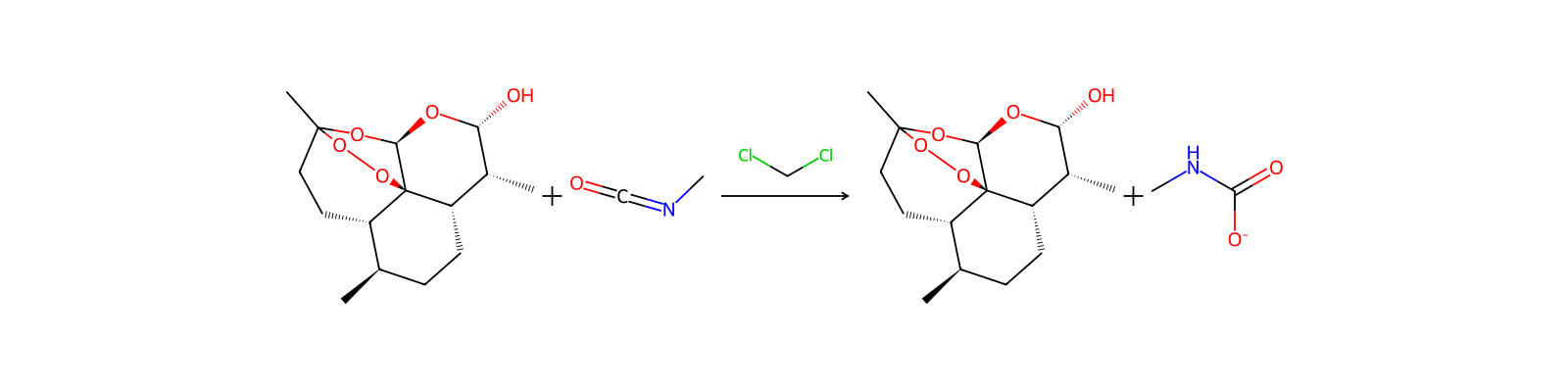
HRID 1644 reaction equation
HRID 1644As reactant
HRID 1645 reaction equation
HRID 1645As reactant
HRID 271547 reaction equation
HRID 271547As reactant
HRID 414273 reaction equation
HRID 414273As product
HRID 480211 reaction equation
HRID 480211As reactant
HRID 480213 reaction equation
HRID 480213As reactant
HRID 553405 reaction equation
HRID 553405As reactant
HRID 1085932 reaction equation
HRID 1085932As product
PreviousPage 1 of 3

Compound notes

On this pageBasic informationOverviewNames & identifiersPropertiesSafety & regulationChemistry & industryRelated reactionsCompound notes