
Completing data — refresh the page later to see the latest

Basic information
- CAS
171179-06-9- Standard SMILES
CNc1cc2c(Nc3cccc(Br)c3)ncnc2cn1- InChIKey
KFHMLBXBRCITHF-UHFFFAOYSA-N- Molecular formula
- C14H12BrN5
- Average molar mass
- 330.18 g/mol
- Monoisotopic mass
- 329.02761
Names & identifiers
- Preferred name
- Pd 158780
- IUPAC
- 4-N-(3-bromophenyl)-6-N-methylpyrido[3,4-d]pyrimidine-4,6-diamine
- English name
- PD158780
- Molecular formula
- C14H12BrN5
- Molecular weight
- 330.18
Names & synonyms
pd 158780PD-158780DTXSID20274443RefChem:858796DTXCID90225922171179-06-9PD158780N4-(3-bromophenyl)-N6-methylpyrido[3,4-d]pyrimidine-4,6-diamine4-N-(3-bromophenyl)-6-N-methylpyrido[3,4-d]pyrimidine-4,6-diamineN4-(3-Bromophenyl)-N6-methyl-pyrido[3,4-d]pyrimidine-4,6-diamineMFCD00942160CHEMBL53753
Show more names
PD 158780 solutionInSolution? PD 158780PD158780, 10 mM in DMSOPD 158780 - CAS 171179-06-9 - CalbiochemPD 158780, ErbB receptor tyrosine kinase inhibitorInSolution PD 158780 - CAS 171179-06-9 - CalbiochemN4-(3-Bromophenyl)-N6-methylpyrido[3,4-d]-4,6-pyrimidinediaminePyrido[3,4-d]pyriMidine-4,6-diaMine,N4-(3-broMophenyl)-N6-Methyl-
CHEBI:928434-(3-bromoanilino)-6-methylaminopyrido[3,4-d]pyrimidine4-[(3-bromophenyl)amino]-6-(methylamino)pyrido[3,4-d]pyrimidine4-(3-bromoanilino)-6-(methylamino)pyrido[3,4-d]pyrimidineN(4)-(3-bromophenyl)-N(6)-methylpyrido[3,4-d]pyrimidine-4,6-diamineC14H12BrN5AC1L1IRVN4-(3-Bromophenyl)-N6-methylpyrido(3,4-d)pyrimidine-4,6-diamine
Database identifiers
- CAS
171179-06-9- PubChem CID
- 4707
- DTXSID
DTXSID20274443- ChEMBL
CHEMBL53753- ChEBI
CHEBI:92843- EC Number
- 683-576-1
- Nikkaji
- J746.179H
Properties
Computed structural propertiesFilling in
- XLogP
- 3.4
- Topological polar surface area
- 62.7 Ų
- Hydrogen bond donors
- 2
- Hydrogen bond acceptors
- 5
- Rotatable bonds
- 3
- Heavy atoms
- 20
- Formal charge
- 0
- Complexity
- 316
Physicochemical properties
- Melting point
- 174 to · 174.0 to 178.0 °C
- Boiling point
- 499.6 · 499.6±45.0 °C(Predicted)
- Density
- 1.611 · 1.611±0.06 g/cm3 (20 ºC 760 Torr)
- storage temp.
- -20 °C · Keep in dark place,Inert atmosphere,Store in freezer, under -20°C
- solubility
- 20 mg/mL · DMSO: ≥20mg/mL
- form
- Yellow solid
- pka
- 5.8 · 5.80±0.30(Predicted)
- color
- yellow
- InChI
- 1S/C14H12BrN5/c1-16-13-6-11-12(7-17-13)18-8-19-14(11)20-10-4-2-3-9(15)5-10/h2-8H,1H3,(H,16,17)(H,18,19,20)
- InChIKey
- KFHMLBXBRCITHF-UHFFFAOYSA-N
- UNSPSC Code
- 12352200 · 12352200
- NACRES
- 77 · NA.77
- Symbol(GHS)
- 7 · GHS07
- Signal word
- Warning
- Hazard statements
- 302 · H302
Safety & regulation
Safety information is for reference only and does not replace the supplier’s Safety Data Sheet (SDS), applicable regulations, or professional assessment.
GHS classification
GHS Classification
Warning
H302 (100%): Harmful if swallowed [Warning Acute toxicity, oral]
P264, P270, P301+P317, P330, and P501 (click each P-code to see the statement)
Aggregated GHS information provided per 38 reports by companies from 1 notifications to the ECHA C&L Inventory.;Information may vary between notifications depending on impurities, additives, and other factors. The percentage value in parenthesis indicates the notified classification ratio from companies that provide hazard codes. Only hazard codes with percentage values above 10% are shown. For more detailed information, please visit ECHA C&L website.
Hazard information
Hazard Classes and CategoriesAcute Tox. 4 (100%)
Safety data
- wgk
- WGK 2
- hs_code
- 2912.49.2600
- risk_code
- 22
- Signal word
- Warning
- Symbol(GHS)
- GHS07
- hazard_code
- Xn
- Storage Class
- 10 - Combustible liquids
- Hazard statements
- H302
- Precautionary statements
- P264-P270-P301+P312-P330-P501
Chemistry & industry
Applications
UsesPD 158780 is a potent tyrosine kinase inhibitor of the epidermal growth factor receptor and has been shown to delay substantial growth of tumors in vivo tumor models.
General DescriptionA potent inhibitor of the EGFR tyrosine kinase activity (8 pM). Also inhibits heregulin-stimulated autophosphorylation in SK-BR-3 (IC50 =49 nM) and MDA-MB-453 (IC50 = 52 nM) breast carcinomas. The inhibition is competitive and results from binding of the inhibitor at the ATP site of the enzymes. Inhibits the LPA-stimulated MAP kinase kinase 1/2 (MKK1/2) activation and EGFR tyrosine phosphorylation in HeLa and NIH3T3 cells.
Upstream & downstream products
Upstream raw materials
Suppliers57 total
武汉英诺医药科技有限公司+86-027-59232304 15387063101 · [email protected]
上海仲因实业有限公司2537653158 16621191650 · [email protected]
武汉易泰科技有限公司上海分公司18930552037 · [email protected]
安耐吉化学&3A(安徽泽升科技有限公司)021-58432009 400-005-6266 · [email protected]
欧利希(湖北)医药科技有限公司17316404525 17316404525 · [email protected]
United Life Science020-82099279 18988968278 · [email protected]
Related reactions
7 records


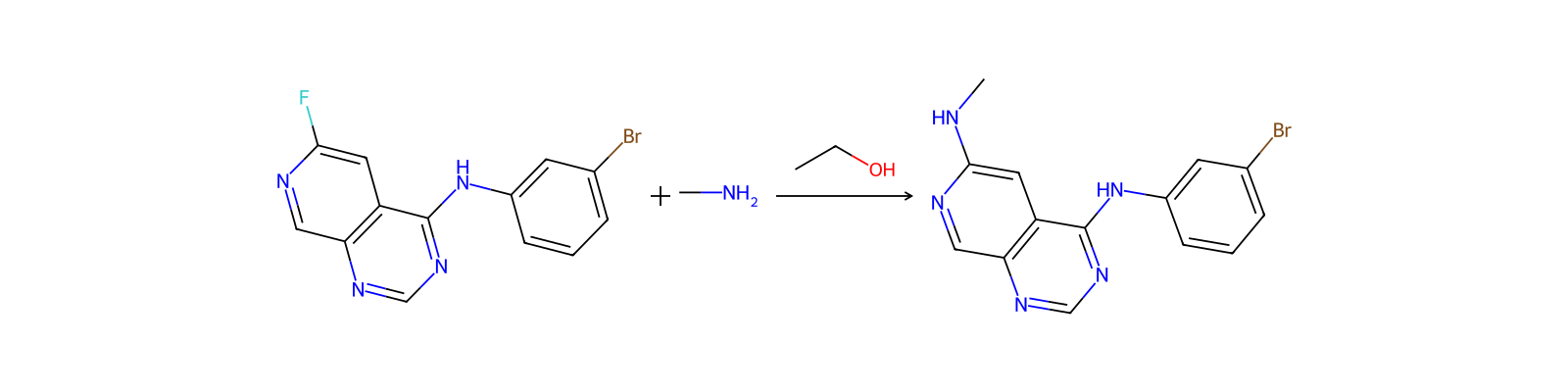

Compound notes
Loading…