
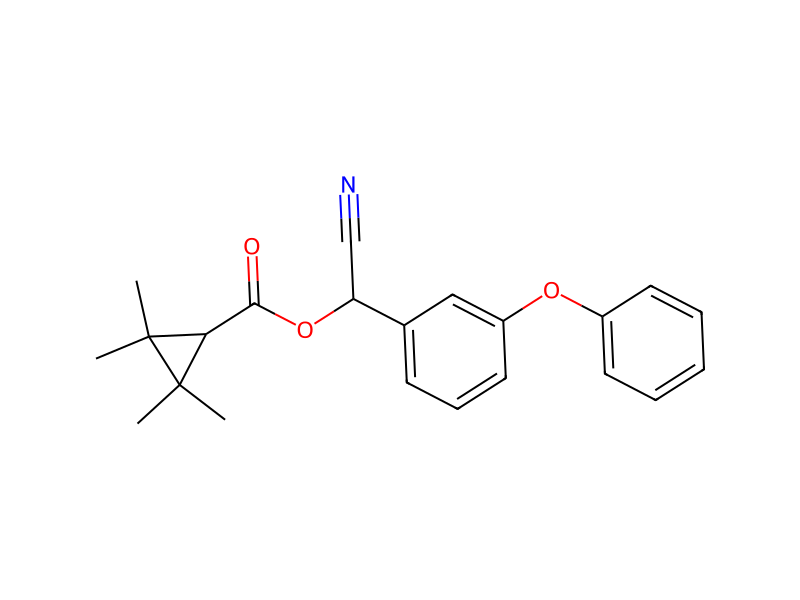
Basic information
- Standard SMILES
CC1(C)C(C(=O)OC(C#N)c2cccc(Oc3ccccc3)c2)C1(C)C- InChIKey
XQUXKZZNEFRCAW-UHFFFAOYSA-N- Molecular formula
- C22H23NO3
- Average molar mass
- 349.4 g/mol
- Monoisotopic mass
- 349.1677936
Overview
Yellowish to brown liquid or solid, depending on purity and temperature. Used as an acaricide and insecticide.
Names & identifiers
- Preferred name
- Fenpropathrin
- IUPAC
- [cyano-(3-phenoxyphenyl)methyl] 2,2,3,3-tetramethylcyclopropane-1-carboxylate
- English name
- Fenpropathrin
- Molecular formula
- C22H23NO3
- Molecular weight
- 349.42
Names & synonyms
Fenpropathrin39515-41-8MeothrinRodyDanimenDanitolFENPROPANATEKilumalMeiothrinMiothrinHeraldSmash
Show more names
DIGITAL2,2,3,3-tetramethyl-cyclopropanecarboxylicacicyano(3-phenoxyphenyl)methyls3206AMITOLXE-938
Danitol FioriOrtho Danitol(+-)-FenpropathrinS 32062,2,3,3-Tetramethylcyclopropanecarboxylic acid cyano(3-phenoxyphenyl)methyl esterFenpropathrineDTXSID0024002Cyano(3-phenoxyphenyl)methyl 2,2,3,3-tetramethylcyclopropanecarboxylate
Database identifiers
- CAS
39515-41-8、64257-84-7- PubChem CID
- 47326
- DTXSID
DTXSID0024002- ChEMBL
CHEMBL522994- ChEBI
CHEBI:39353- UNII
- 87BH96P0MX
- EC Number
- 254-485-0
- Nikkaji
- J15.832A
Properties
Computed structural properties
- XLogP
- 5.7
- Topological polar surface area
- 59.3 Ų
- Hydrogen bond donors
- 0
- Hydrogen bond acceptors
- 4
- Rotatable bonds
- 6
- Heavy atoms
- 26
- Formal charge
- 0
- Complexity
- 553
Experimental & physicochemical properties
Pesticides
Pesticide -> EPA IRIS
Acaricides, Insecticides
Active substance -> EU Pesticides database: Not approved
Pesticides -> Pyrethrins/Pyrethroids
Pesticide (Fenpropathrin) -> USDA PDB
LogP
log Kow = 6.0 @ 20 °C
5.5
Density1.15 @ 25 °C
Color/Form
Pale yellow oil
Yellow brown liquid or solid
Solubility
In xylene 1000, cyclohexanone 1000, methanol 337 (all in g/kg at 25 °C)
Soluble in common organic solvents (chloroform, acetone, methanol).
In water, 1.41X10⁻² mg/l @ 25 °C.
Melting Point45-50 °C
Vapor Pressure
0.00000548 [mmHg]
5.48X10⁻⁶ mm Hg @ 20 °C
Refractive IndexIndex of refraction: 1.5283 at 26 °C/D
Physical Description
Yellowish to brown liquid or solid, depending on purity and temperature. Used as an acaricide and insecticide.
Pale yellow liquid; [Merck Index] Yellowish-brown liquid or solid; mp = 45-50 deg C; [HSDB] Yellow to brown liquid or solid (purity and temperature dependent); [CAMEO] Yellow-brown liquid or solid (depends on storage); mp = 45-50 deg C; [MSDSonline]
Stability/Shelf Life
Decomposed in alkaline solutions. Exposure to light & air leads to oxidation & loss of activity.
Pyrethrins ... /are/ stable for long periods in water-based aerosols where ... emulsifiers give neutral water systems. /Pyrethrins/
Collision Cross Section186.0 Ų [M+Na]+ [CCS Type: DT; Buffer gas: N2; Ionization: ESI+; Dataset: TOXCAST; Source Identifier: DTXSID0024002]
Other Experimental Properties
Yellow-brown solid /Technical fenpropathrin/
Stable except in alkaline solution.
Physicochemical properties
- Melting point
- 47 °C · 47 °C
- Boiling point
- 483.6 °C · 483.6°C (rough estimate)
- Density
- 1.17 · 1.1700 (rough estimate)
- refractive index
- 26 · nD26 1.5283
- Flash point
- 100 °C · 100 °C
- storage temp.
- -20 °C · -20°C
- solubility
- 30 mg/ml,DMSO: · DMF: 30 mg/ml,DMSO: 30 mg/ml,Ethanol: 15 mg/ml
- form
- A solid
- color
- White to off-white
- Water Solubility
- 14.24 ug/L · 14.24ug/L(temperature not stated)
- Henry's Law Constant
- 5.5 · 5.5×10-2 mol/(m3Pa) at 25℃, HSDB (2015)
- Major Application
- agricultureenvironmental
- InChI
- 1S/C22H23NO3/c1-21(2)19(22(21,3)4)20(24)26-18(14-23)15-9-8-12-17(13-15)25-16-10-6-5-7-11-16/h5-13,18-19H,1-4H3
- InChIKey
- XQUXKZZNEFRCAW-UHFFFAOYSA-N
- SMILES
- CC1(C)C(C(=O)OC(C#N)c2cccc(Oc3ccccc3)c2)C1(C)C
- CAS DataBase Reference
- 39515 · 39515-41-8(CAS DataBase Reference)
- FDA UNII
- 87 BH96P0MX · 87BH96P0MX
- NIST Chemistry Reference
- 2 · Cyclopropanecarboxylic acid, 2,2,3,3-tetramethyl-, cyano(3-phenoxyphenyl)methyl ester(39515-41-8)
- EPA Substance Registry System
- Fenpropathrin (39515-41-8)
- Pesticides Freedom of Information Act (FOIA)
- Danitol, Fenpropathrin
- UNSPSC Code
- 41116107 · 41116107
- NACRES
- 24 · NA.24
- Symbol(GHS)
- 6 · GHS06,GHS09
- Signal word
- Danger
- Hazard statements
- 301 · H301-H312-H330-H410
- Precautionary statements
- 260 · P260-P264-P273-P280-P302+P352+P312-P304+P340+P310
- PPE
- 95 · dust mask type N95 (US), Eyeshields, Faceshields, Gloves, type P2 (EN 143) respirator cartridges
- Hazard Codes
- T+,N
- Risk Statements
- 21 · 21-25-26-50/53
- Safety Statements
- 28 · 28-36/37-38-45-60-61
- RIDADR
- 2811 · UN 2811 6.1/PG 2
- WGK Germany
- 3 · WGK 3
- RTECS
- 2090000 · GZ2090000
- HS Code
- 29269090 · 29269090
- Storage Class
- 6.1 A · 6.1A - Combustible acute toxic Cat. 1 and 2very toxic hazardous materials
- Hazard Classifications
- 2 InhalationAcute · Acute Tox. 2 InhalationAcute Tox. 3 OralAcute Tox. 4 DermalAquatic Acute 1Aquatic Chronic 1
- Toxicity
- 50 · LC50 (24 hr) in rainbow trout: 76.7 ppb (Coats); LD50 in rats (mg/kg): 2.5 i.v. (Verschoyle); in male, female rats (mg/kg): 24-36, 18-24 orally (Crawford)
Safety & regulation
GHS classification
GHS Classification
Danger
H301: Toxic if swallowed [Danger Acute toxicity, oral]
P260, P264, P270, P271, P273, P280, P284, P301+P316, P302+P352, P304+P340, P316, P317, P320, P321, P330, P362+P364, P391, P403+P233, P405, and P501 (click each P-code to see the statement)
Danger
H301 (100%): Toxic if swallowed [Danger Acute toxicity, oral]
P260, P264, P270, P271, P273, P280, P284, P301+P316, P302+P352, P304+P340, P316, P317, P320, P321, P330, P362+P364, P391, P403+P233, P405, and P501 (click each P-code to see the statement)
Hazard information
Regulatory Information
Hazard Traits - Environmental tox; Neurotoxicity
Hazard Traits - Developmental Toxicity; Endocrine Toxicity; Neurotoxicity; Reproductive Toxicity
Fenpropathrin is listed in the dataset of EPA Human Health Benchmarks for Pesticides under the Safe Drinking Water Act (40 eCFR 141)
2002/2076
Cyclopropanecarboxylic acid, 2,2,3,3-tetramethyl-, cyano(3-phenoxyphenyl)methyl ester: Does not have an individual approval but may be used as a component in a product covered by a group standard. It is not approved for use as a chemical in its own right.
The New Jersey Worker and Community Right to Know Act requires public and private employers to provide information about hazardous substances at their workplaces. (N.J.S.A. 34:5A-1 et. seq.)
DOT LabelPoison
Fire HazardsExcerpt from ERG Guide 154 [Substances - Toxic and/or Corrosive (Non-Combustible)]:
Health HazardsExcerpt from ERG Guide 154 [Substances - Toxic and/or Corrosive (Non-Combustible)]:
Hazards SummaryIn high-dose animal studies, causes tremor, ataxia, rigidity, and liver changes; [RTECS] May cause irritation; [MSDSonline] See Pyrethrum.
Reactive GroupEsters, Sulfate Esters, Phosphate Esters, Thiophosphate Esters, and Borate Esters
Special Reports
Miyamoto J; Environ Health Perspect 14: 15-28 (1976). Degradation, metabolism, and toxicity of synthetic pyrethroids.
Miyamoto J, et al; Pure Appl Chem 53: 1967-2022 (1981). The chemistry, metabolism, and residue analysis of synthetic pyrethroids.
Hutson DH; Progress in Drug Metabolism 3: 215-252 (1979). The metabolic fate of synthetic pyrethroid insecticides in mammals.
Gammon DW; Fundam Appl Toxicol (5) 1: 9-23 (1985). Correlations between in vitro and in vivo mechanisms of pyrethroid insecticide action.
For more Special Reports (Complete) data for FENPROPATHRIN (6 total), please visit the HSDB record page.
FIFRA Requirements
Tolerances are established for residues of the pesticide chemical fenpropathrin )(alpha-cyano-3-phenoxy-benzyl 2,2,3,3-tetramethylcyclopropanecarboxylate) in or on the following agricultural commodities: brassica, head and stem, crop subgroup 5-A; cattle, fat; cattle, mbyp; cattle, meat; citrus, dried pulp; citrus, oil; cottonseed; cottonseed, oil; eggs; fruits, cirtrus, crop group 10; fruits, pome, crop group 11; goats, fat; goats, mbyp; goats, meat; grapes; hogs, fat; hogs, mbyp; hogs, meat; horses, fat; horses, mbyp; horses, meat; milkfat (reflecting 0.08 ppm in whole milk); peanut, hay; peanut, nutmeat; poultry, fat; poultry, mbyp; poultry, meat; raisins; sheep, fat; sheep, mbyp; sheep, meat; squash/cucumber subgroup; strawberry; tomato; and vegetable, cucurbit, melon, crop subgroup 9-A.
Time-limited tolerances are established for residues of the herbicide fenpropathrin in connection with use of the pesticide under section 18 emergency exemptions granted by EPA. The tolerance will expire and is revoked on the date specified: currants (6/30/00); soybeans, forage (6/30/00); soybeans, hay (6/30/00); soybean, hulls (6/30/00); soybeans, meal, (6/30/00); soybean, oil, refined (6/30/00); and soybean, seed (6/30/00).
Reactivity Profile
A pyrethroid. This compound is an ester and nitrile. Esters react with acids to liberate heat along with alcohols and acids. Strong oxidizing acids may cause a vigorous reaction that is sufficiently exothermic to ignite the reaction products. Heat is also generated by the interaction of esters with caustic solutions. Flammable hydrogen is generated by mixing esters with alkali metals and hydrides. Nitriles may polymerize in the presence of metals and some metal compounds. They are incompatible with acids; mixing nitriles with strong oxidizing acids can lead to extremely violent reactions. Nitriles are generally incompatible with other oxidizing agents such as peroxides and epoxides. The combination of bases and nitriles can produce hydrogen cyanide. Nitriles are hydrolyzed in both aqueous acid and base to give carboxylic acids (or salts of carboxylic acids). These reactions generate heat. Peroxides convert nitriles to amides. Nitriles can react vigorously with reducing agents. Acetonitrile and propionitrile are soluble in water, but nitriles higher than propionitrile have low aqueous solubility. They are also insoluble in aqueous acids.
DOT Hazard Classification
Fenpropathrin
Severe marine pollutant
Air and Water ReactionsIn water, solubility is 14 ppm. Slowly oxidized in air. Decomposed by alkaline solutions.
Hazard Classes and Categories
Acute Tox. 3 (100%)
Hazardous to the aquatic environment (acute) - category 1
Acute toxicity (Oral) - Category 3
Acute Tox. 2 *
Safety & protection
Fire FightingExcerpt from ERG Guide 154 [Substances - Toxic and/or Corrosive (Non-Combustible)]:
First AidExcerpt from ERG Guide 154 [Substances - Toxic and/or Corrosive (Non-Combustible)]:
Fire Fighting Procedures
Use carbon dioxide, foam, or dry chemical /on fires involving pyrethroids/. /Pyrethrum/
Fire-fighting: Self-contained breathing apparatus with a full facepiece operated in pressure-demand or other positive-pressure mode. /Pyrethrum/
Storage ConditionsPyrethrins with piperonyl butoxide topical preparations should be stored in well-closed containers at a temperature less than 40 °C, preferably between 15-30 °C. /Pyrethrins/
Cleanup Methods
Spillages of pesticides at any stage of their storage or handling should be treated with great care. Liquid formulations may be reduced to solid phase by evaporation. Dry sweeping of solids is always hazardous: these should be removed by vacuum cleaning /SRP: with HEPA filter/, or by dissolving them in water, or other solvent in the factory environment. /Pesticides/
Nonfire Spill ResponseExcerpt from ERG Guide 154 [Substances - Toxic and/or Corrosive (Non-Combustible)]:
Disposal Methods
SRP: At the time of review, criteria for land treatment or burial (sanitary landfill) disposal practices are subject to significant revision. Prior to implementing land disposal of waste residue (including waste sludge), consult with environmental regulatory agencies for guidance on acceptable disposal practices.
Incineration would be an effective disposal procedure where permitted. ... /Pyrethrin products/
Preventive Measures
Skin that becomes contaminated with /pyrethrum/ should be promptly washed or showered with soap or mild detergent and water. /Pyrethrum/
Clothing contaminated with /pyrethrum/ should be placed in closed containers for storage until provision is made for the removal of /pyrethrum/ from the clothing. /Pyrethrum/
Respirators may be used when engineering and work practice controls are not technically feasible, when such controls are in the process of being installed, or when they fail or need to be supplemented. Respirators may also be used for operations which require entry into tanks or closed vessels, and in emergency situations. /Pyrethrum/
Employees who handle /pyrethrum/ ... should wash their hands thoroughly with soap or mild detergent and water before eating, smoking, or using toilet facilities. /Pyrethrum/
For more Preventive Measures (Complete) data for FENPROPATHRIN (10 total), please visit the HSDB record page.
Isolation and EvacuationExcerpt from ERG Guide 154 [Substances - Toxic and/or Corrosive (Non-Combustible)]:
Allowable Tolerances
Tolerances are established for residues of the pesticide chemical fenpropathrin (alpha-cyano-3-phenoxy-benzyl 2,2,3,3-tetramethylcyclopropanecarboxylate) in or on the following agricultural commodities: brassica, head and stem, crop subgroup 5-A, 3.0 ppm; cattle, fat, 1.0 ppm; cattle, mbyp, 0.1 ppm; cattle, meat, 0.1 ppm; citrus, dried pulp, 4.0 ppm; citrus, oil, 75 ppm; cottonseed, 1.0 ppm; cottonseed, oil, 3.0 ppm; eggs, 0.05 ppm; fruits, cirtrus, crop group 10, 2.0 ppm; fruits, pome, crop group 11, 5.0 ppm; goats, fat, 1.0 ppm; goats, mbyp, 0.1 ppm; goats, meat, 0.1 ppm; grapes, 5.0 ppm; hogs, fat, 1.0 ppm; hogs, mbyp, 0.1 ppm; hogs, meat, 0.1 ppm; horses, fat, 1.0 ppm; horses, mbyp, 0.1 ppm; horses, meat, 0.1 ppm; milkfat (reflecting 0.08 ppm in whole milk), 2.0 ppm; peanut, hay, 20.0 ppm; peanut, nutmeat, 0.01 ppm; poultry, fat, 0.05 ppm; poultry, mbyp, 0.05 ppm; poultry, meat, 0.05 ppm; raisins, 10.0 ppm; sheep, fat, 1.0 ppm; sheep, mbyp, 0.1 ppm; sheep, meat, 0.1 ppm; squash/cucumber subgroup, 0.5 ppm; strawberry, 2.0 ppm; tomato, 0.6 ppm; and vegetable, cucurbit, melon, crop subgroup 9-A, 0.5 ppm.
Time-limited tolerances are established for residues of the herbicide fenpropathrin in connection with use of the pesticide under section 18 emergency exemptions granted by EPA. The tolerance will expire and is revoked on the date specified: currants, 15 ppm (6/30/00); soybeans, forage, 15 ppm (6/30/00); soybeans, hay, 20 ppm (6/30/00); soybean, hulls, 1.0 ppm (6/30/00); soybeans, meal, 0.2 ppm (6/30/00); soybean, oil, refined, 1.5 ppm (6/30/00); and soybean, seed, 0.1 ppm (6/30/00).
Personal Protective Equipment (PPE)
Excerpt from ERG Guide 154 [Substances - Toxic and/or Corrosive (Non-Combustible)]:
Employees should be provided with and required to use dust- and splash-proof safety goggles where /pyrethroids/ ... may contact the eyes. /Pyrethroids/
Employees should be provided with and be required to use impervious clothing, gloves, and face shields (eight-inch minimum). /Pyrethroids/
Wear appropriate equipment to prevent: Repeated or prolonged skin contact. /Pyrethrum and pyrethrins/
Wear eye protection to prevent: Reasonable probability of eye contact. /Pyrethrins/
For more Personal Protective Equipment (PPE) (Complete) data for FENPROPATHRIN (10 total), please visit the HSDB record page.
Toxicology
Treatment
Following oral exposure, the treatment is symptomatic and supportive and includes monitoring for the development of hypersensitivity reactions with respiratory distress. Provide adequate airway management when needed. Gastric decontamination is usually not required unless the pyrethrin product is combined with a hydrocarbon. Following inhalation exposure, move patient to fresh air. monitor for respiratory distress. If cough or difficulty breathing develops, evaluate for respiratory tract irritation, bronchitis, or pneumonitis. Administer oxygen and assist ventilation as required. Treat bronchospasm with inhaled beta2 agonist and oral or parenteral corticosteroids. In case of eye exposure, irrigate exposed eyes with copious amounts of room temperature water for at least 15 minutes. If irritation, pain, swelling, lacrimation, or photophobia persist, the patient should be seen in a health care facility. If the contamination occurs through dermal exposure, remove contaminated clothing and wash exposed area thoroughly with soap and water. A physician may need to examine the area if irritation or pain persists. Vitamin E topical application is highly effective in relieving parenthesis. (T36)
Interactions
/Pyrethroid/ detoxification ... important in flies, may be delayed by the addition of synergists ... organophosphates or carbamates ... to guarantee a lethal effect. ... /Pyrethroid/
Piperonyl butoxide potentiates /insecticidal activity/ of pyrethrins by inhibiting the hydrolytic enzymes responsible for pyrethrins' metabolism in arthropods. When piperonyl butoxide is combined with pyrethrins, the insecticidal activity of the latter drug is increased 2-12 times /Pyrethrins/
At dietary level of 1000 ppm pyrethrins & 10000 ppm piperonyl butoxide ... /enlargement, margination, & cytoplasmic inclusions in liver cells of rats/ were well developed in only 8 days, but ... were not maximal. Changes were proportional to dosage & similar to those produced by DDT. Effects of the 2 ... were additive. /Pyrethrins/
Target OrgansNervous
Health Effects
At high doses, signs of poisoning attributable to fenpropathrin include profuse salivation and pulmonary edema, clonic seizures, opisthotonos (i.e., the spine is bent forward such that a supine body rests on its head and heels), coma, and death. At lower doses, commonly observed effects include paresthesia and erythema. (L863)
Ecotoxicity Values
LD50 Mallard ducks oral 1089 mg/kg
LC50 Bobwhite quail dietary >10,000 mg/kg diet/8 day
LC50 Bluegill sunfish 1.95 ug/l/48 hr /Conditions of bioassay not specified/
Environmental Fate
AQUATIC FATE: Degraded principally by photolysis with a half-life of 2.7 weeks in river water.
TERRESTRIAL FATE: Duration of activity in soil is ca 1-5 days.
TERRESTRIAL FATE: Based on a classification scheme(1), a range of Koc values from 5,000 to 3.4X10+5(2), indicates that fenpropathrin is expected to be immobile in soil(SRC). Volatilization of fenpropathrin from moist soil surfaces is expected to be an important fate process(SRC) given an estimated Henry's Law constant of 1.8X10⁻⁴ atm-cu m/mole(SRC) derived from its vapor pressure, 5.48X10⁻⁶ mm Hg(3), and water solubility, 1.41X10⁻² mg/l(3). However, adsorption to soil is expected to attenuate volatilization from moist soil surfaces(SRC). Fenpropathrin is not expected to volatilize from dry soil surfaces(SRC) based upon its vapor pressure(3). Degradation of fenpropathrin is mainly mediated by aerobic microorganisms in soil(4) and photolysis(5). The half-life for disappearance of fenpropathrin in soils was 11 to 17 days under aerobic conditions(4). The time required for half of fenpropathrin to disappear was approximately 4 weeks in soils at a moisture content of 16%, and more than 16 weeks in soils at 4%(4). Fenpropathrin degrades very slowly under anaerobic conditions(4). Eight weeks after its application to both a Kodaira and Azuchi soil (Japan), about 2% of the applied 14C-labeled fenpropathrin evolved as 14C-CO2(4), which corresponds to a half-life of >1 yr(SRC). The half-life of fenpropathrin on the surface of a sterilized sandy loam was 3 to 4 days following irradiation with natural sunlight, and after 15 days it was observed that only about 12% of the original amount remained(5).
AQUATIC FATE: Based on a classification scheme(1), a range of Koc values from 5,000 to 3.4X10+5(2), indicates that fenpropathrin is expected to adsorb to suspended solids and sediment(SRC). Volatilization from water surfaces is expected(3) based upon an estimated Henry's Law constant of 1.8X10⁻⁴ atm-cu m/mole(SRC) derived from its vapor pressure, 5.48X10⁻⁶ mm Hg(4), and water solubility, 1.41X10⁻² mg/l(4). Using this Henry's Law constant and an estimation method(3), volatilization half-lives for a model river and model lake are 8 and 98 days, respectively(SRC). However, volatilization from water surfaces is expected to be attenuated by adsorption to suspended solids and sediment in the water column. The estimated volatilization half-life from a model pond is 26 years if adsorption is considered(5). According to a classification scheme(6), an estimated BCF of 190(SRC), from its log Kow(4) and a regression-derived equation(7), suggests the potential for bioconcentration in aquatic organisms is high(SRC). Photolysis from sunlit surfaces waters is expected to be an important aquatic fate process for fenpropathrin(SRC). The photolysis half-lives of fenpropathrin in distilled water, distilled water with humic acid, river water, and seawater were 13.5, 6, 2.7, and 1.6 weeks, respectively when exposed to sunlight(8). Hydrolysis may also be an important fate process under alkaline conditions or in warm waters(SRC). At 25 °C, the hydrolysis half-lives of fenpropathrin were approximately 2.2 years and 8 days at pH 7 and 9, respectively, while at 40 °C, the half-lives were about 80 days and 19 hours at pH 7 and 9, respectively (9). No data regarding the biodegradation of fenpropathrin in water were located, however biodegradation studies in soil suggest that fenpropathrin will undergo biodegradation readily(10,11).
ATMOSPHERIC FATE: According to a model of gas/particle partitioning of semivolatile organic compounds in the atmosphere(1), fenpropathrin, which has a vapor pressure of 5.48X10⁻⁶ mm Hg at 20 °C (2), is expected to exist in both the vapor and particulate phases in the ambient atmosphere. Vapor-phase fenpropathrin is degraded in the atmosphere by reaction with photochemically-produced hydroxyl radicals(SRC); the half-life for this reaction in air is estimated to be 22 hours(SRC), calculated from its rate constant of 1.8X10⁻¹¹ cu cm/molecule-sec at 25 °C (SRC) determined using a structure estimation method(3). Particulate-phase fenpropathrin may be removed from the air by wet and dry deposition(SRC). Fenpropathrin also undergoes direct photolysis in the atmosphere(4). Fenpropathrin applied to silica gel plates and irradiated at 360 nm was photodecomposed 72% after 18 hours(4).
Adverse EffectsNeurotoxin - Other CNS neurotoxin
Exposure RoutesInhalation (L857) ; oral (L857) ; dermal (L857) ; eye contact (L857).
Toxicity Summary
Pyrethroids exert their effect by prolonging the open phase of the sodium channel gates when a nerve cell is excited. They appear to bind to the membrane lipid phase in the immediate vicinity of the sodium channel, thus modifying the channel kinetics. This blocks the closing of the sodium gates in the nerves, and thus prolongs the return of the membrane potential to its resting state. The repetitive (sensory, motor) neuronal discharge and a prolonged negative afterpotential produces effects quite similar to those produced by DDT, leading to hyperactivity of the nervous system which can result in paralysis and/or death. Other mechanisms of action of pyrethroids include antagonism of gamma-aminobutyric acid (GABA)-mediated inhibition, modulation of nicotinic cholinergic transmission, enhancement of noradrenaline release, and actions on calcium ions. (T18, L857)
Signs and Symptoms
Following dermal exposure to fenpropathrin, feelings of numbness, itching, burning, stinging, tingling, or warmth may occur, that could last for a few hours. Dizziness, headache, nausea, muscle twitching, reduced energy, and changes in awareness can result from inhalation or ingestion of large amounts of fenpropathrine. Paralysis can occur after exposure. (L857)
EPA IRIS Information
Danitol
Nervous
2.5 x 10 ^-2 mg/kg-day
Medical Surveillance
Initial medical screening: Employees should be screened for history of certain medical conditions ... which might place the employee at increased risk from /pyrethroid/ exposure. Chronic respiratory disease: In persons with chronic respiratory disease, especially asthma, the inhalation of /pyrethroids/ might cause exacerbation of symptoms due to its sensitizing properities. Skin disease: /Pyrethroids/ can cause dermatitis which may be allergic in nature. Persons with pre-existing skin disorders may be more susceptible to the effects of this agent. Any employee developing the above-listed conditions should be referred for further medical examination. /Pyrethrum/
Regulatory information
FIFRA Requirements
Tolerances are established for residues of the pesticide chemical fenpropathrin )(alpha-cyano-3-phenoxy-benzyl 2,2,3,3-tetramethylcyclopropanecarboxylate) in or on the following agricultural commodities: brassica, head and stem, crop subgroup 5-A; cattle, fat; cattle, mbyp; cattle, meat; citrus, dried pulp; citrus, oil; cottonseed; cottonseed, oil; eggs; fruits, cirtrus, crop group 10; fruits, pome, crop group 11; goats, fat; goats, mbyp; goats, meat; grapes; hogs, fat; hogs, mbyp; hogs, meat; horses, fat; horses, mbyp; horses, meat; milkfat (reflecting 0.08 ppm in whole milk); peanut, hay; peanut, nutmeat; poultry, fat; poultry, mbyp; poultry, meat; raisins; sheep, fat; sheep, mbyp; sheep, meat; squash/cucumber subgroup; strawberry; tomato; and vegetable, cucurbit, melon, crop subgroup 9-A.
Time-limited tolerances are established for residues of the herbicide fenpropathrin in connection with use of the pesticide under section 18 emergency exemptions granted by EPA. The tolerance will expire and is revoked on the date specified: currants (6/30/00); soybeans, forage (6/30/00); soybeans, hay (6/30/00); soybean, hulls (6/30/00); soybeans, meal, (6/30/00); soybean, oil, refined (6/30/00); and soybean, seed (6/30/00).
Safety data
- PPE
- dust mask type N95 (US), Eyeshields, Faceshields, Gloves, type P2 (EN 143) respirator cartridges
- wgk
- WGK 3
- rtecs
- GZ2090000
- ridadr
- UN 2811 6.1/PG 2
- hs_code
- 29269090
- Toxicity
- LC50 (24 hr) in rainbow trout: 76.7 ppb (Coats); LD50 in rats (mg/kg): 2.5 i.v. (Verschoyle); in male, female rats (mg/kg): 24-36, 18-24 orally (Crawford)
- risk_code
- 21-25-26-50/53
- Signal word
- Danger
- Symbol(GHS)
- GHS06,GHS09
- hazard_code
- T+,N
- safety_code
- 28-36/37-38-45-60-61
- Storage Class
- 6.1A - Combustible acute toxic Cat. 1 and 2very toxic hazardous materials
- Hazard statements
- H301-H312-H330-H410
- Hazard Classifications
- Acute Tox. 2 InhalationAcute Tox. 3 OralAcute Tox. 4 DermalAquatic Acute 1Aquatic Chronic 1
- Precautionary statements
- P260-P264-P273-P280-P302+P352+P312-P304+P340+P310
Chemistry & industry
Pharmacology
Mechanism of Action
The synthetic pyrethroids delay closure of the sodium channel, resulting in a sodium tail current that is characterized by a slow influx of sodium during the end of depolarization. Apparently the pyrethroid molecule holds the activation gate in the open position. Pyrethroids with an alpha-cyano group (e.g., fenvalerate) produce more prolonged sodium tail currents than do other pyrethroids (e.g., permethrin, bioresmethrin). The former group of pyrethroids causes more cutaneous sensations than the latter. /Synthetic pyrethroids/
Interaction with sodium channels is not the only mechanism of action proposed for the pyrethroids. Their effects on the CNS have led various workers to suggest actions via antagonism of gamma-aminobutyric acid (GABA)-mediated inhibition, modulation of nicotinic cholinergic transmission, enhancement of noradrenaline release, or actions on calcium ions. Since neurotransmitter specific pharmacological agents offer only poor or partial protection against poisoning, it is unlikely that one of these effects represents the primary mechanism of action of the pyrethroids, & most neurotransmitter release is secondary to increased sodium entry. /Pyrethroids/
The symptoms of pyrethrin poisoning follow the typical pattern ... : (1) excitation, (2) convulsions, (3) paralysis, and (4) death. The effects of pyrethrins on the insect nervous system closely resemble those of DDT, but are apparently much less persistent. Regular, rhythmic, and spontaneous nerve discharges have been observed in insect and crustacean nerve-muscle preparations poisoned with pyrethrins. The primary target of pyrethrins seems to be the ganglia of the insect central nervous system although some pyrethrin-poisoning effect can be observed in isolated legs. /Pyrethrins/
Electrophysiologically, pyrethrins cause repetitive discharges and conduction block. /Pyrethrins/
For more Mechanism of Action (Complete) data for FENPROPATHRIN (12 total), please visit the HSDB record page.
Metabolism/Metabolites
Metabolism of fenproponate in rats involves rapid oxidase catalyzed ester cleavage followed by hydroxylation.
The metabolic pathways for the breakdown of the pyrethroids vary little between mammalian species but vary somewhat with structure. ... Essentially, pyrethrum & allethrin are broken down mainly by oxidation of the isobutenyl side chain of the acid moiety & of the unsaturated side chain of the alcohol moiety with ester hydrolysis playing & important part, whereas for the other pyrethroids ester hydrolysis predominates. /Pyrethrum and pyrethroids/
The relative resistance of mammals to the pyrethroids is almost wholly attributable to their ability to hydrolyze the pyrethroids rapidly to their inactive acid & alcohol components, since direct injection into the mammalian CNS leads to a susceptibility similar to that seen in insects. Some additional resistance of homeothermic organisms can also be attributed to the negative temperature coefficient of action of the pyrethroids, which are thus less toxic at mammalian body temperatures, but the major effect is metabolic. Metabolic disposal of the pyrethroids is very rapid, which means that toxicity is high by the iv route, moderate by slower oral absorption, & often unmeasureably low by dermal absorption. /Pyrethroids/
FASTEST BREAKDOWN IS SEEN WITH PRIMARY ALCOHOL ESTERS OF TRANS-SUBSTITUTED ACIDS SINCE THEY UNDERGO RAPID HYDROLYTIC & OXIDATIVE ATTACK. FOR ALL SECONDARY ALCOHOL ESTERS & FOR PRIMARY ALCOHOL CIS-SUBSTITUTED CYCLOPROPANECARBOXYLATES, OXIDATIVE ATTACK IS PREDOMINANT. /PYRETHROIDS/
For more Metabolism/Metabolites (Complete) data for FENPROPATHRIN (7 total), please visit the HSDB record page.
Fenpropathrin has been shown to be well absorbed after oral administration, extensively metabolized, and eliminated as polar conjugates in urine. The main route of metabolism was, as anticipated, via hydrolysis of the ester linkage. The cyclopropane-carboxylic acid moiety was subsequently excreted via the urine as the glucuronide conjugate. (L857)
Absorption, Distribution and Excretion
/PYRETHROIDS/ READILY PENETRATE INSECT CUTICLE AS SHOWN BY TOPICAL LD50 TO PERIPLANETA (COCKROACH) ... /PYRETHROIDS/
WHEN RADIOACTIVE PYRETHROID IS ADMIN ORALLY TO MAMMALS, IT IS ABSORBED FROM INTESTINAL TRACT OF THE ANIMALS & DISTRIBUTED IN EVERY TISSUE EXAMINED. EXCRETION OF RADIOACTIVITY IN RATS ADMIN TRANS-ISOMER: DOSAGE: 500 MG/KG; INTERVAL 20 DAYS; URINE 36%; FECES 64%; TOTAL 100%. /PYRETHROIDS/
Pyrethrins are absorbed through intact skin when applied topically. When animals were exposed to aerosols of pyrethrins with piperonyl butoxide being released into the air, little or none of the combination was systemically absorbed. /Pyrethrins/
Although limited absorption may account for the low toxicity of some pyrethroids, rapid biodegradation by mammalian liver enzymes (ester hydrolysis and oxidation) is probably the major factor responsible. Most pyrethroid metabolites are promptly excreted, at least in part, by the kidney. /Pyrethroids/
Uses & manufacturing
Uses
Used as insecticide and acaricide for fruits, vines, vegetables, ornamentals, cotton, field crops, and greenhouses; [HSDB]
Banned in the EU for use as pesticide for plant protection and other pesticides including biocides; [eChemPortal: ESIS]
Farming (Pesticides) [Category: Industry]
For fenpropathrin (USEPA/OPP Pesticide Code: 127901) ACTIVE products with label matches. /SRP: Registered for use in the U.S. but approved pesticide uses may change periodically and so federal, state and local authorities must be consulted for currently approved uses./
Insecticide, acaracide
Control of many species of mites (except rust mites) and insects (eg whiteflies, lepidopterous larvae, leaf miners, leafworms, bollworms) on pome fruit, citrus fruit, vines, vegetables, ornamentals (including ornamental trees) cotton, field crops, and glasshouse crops
Consumption PatternsIn 1992, the estimated agricultural use of fenpropathrin in the United States was about 67 metric tons.
Methods of Manufacturing2,3-Dimethyl-2-butene + ethyl diazoacetate + 3-phenoxybenzaldehyde cyanohydrin (addition/esterification)
Formulations/Preparations
Emulsifiable concentrate
Wettable powder, suspension concentrate, ultra-low volume liquid
Mixtures: (fenpropathrin +) clofentezine; fentriothion
General Manufacturing Information
Synthetic pyrethroid insecticide with repellant and contact activity ... commercial product is mixture of stereoisomers, the (S)-isomer primarily responsible for the bioactivity.
/Pyrethroids/ are modern synthetic insecticides similar chemically to natural pyrethrins, but modified to increase stability in the natural environment. /Pyrethroids/
Applications
DescriptionFenpropathrin is a pyrethroid, non-systemic acaricide and insecticide used to control many species of mite and other insects. It has a low aqueous solubility and is considered to be moderately volatile. It may be persistent in both soil systems and water bodies depending upon local conditions. Based on its physico-chemical properties there is a low risk of leaching to groundwater. Fenpropathrin is highly toxic to bees, fish and aquatic invertebrates and moderately toxic to bird, earthworms and algae. It is also moderately toxic to humans via the oral route. In information on chronic health effects have been identified.
UsesInsecticide, acaricide.
General DescriptionYellowish to brown liquid or solid, depending on purity and temperature. Used as an acaricide and insecticide.
Upstream & downstream products
Upstream raw materials
Downstream products
Additional notes
DefinitionChEBI: A cyclopropanecarboxylate ester obtained by formal condensation between 2,2,3,3-tetramethylcyclopropanecarboxylic acid and cyano(3-phenoxyphenyl)methanol.
Related reactions
4 records


Linked notes
Loading…