
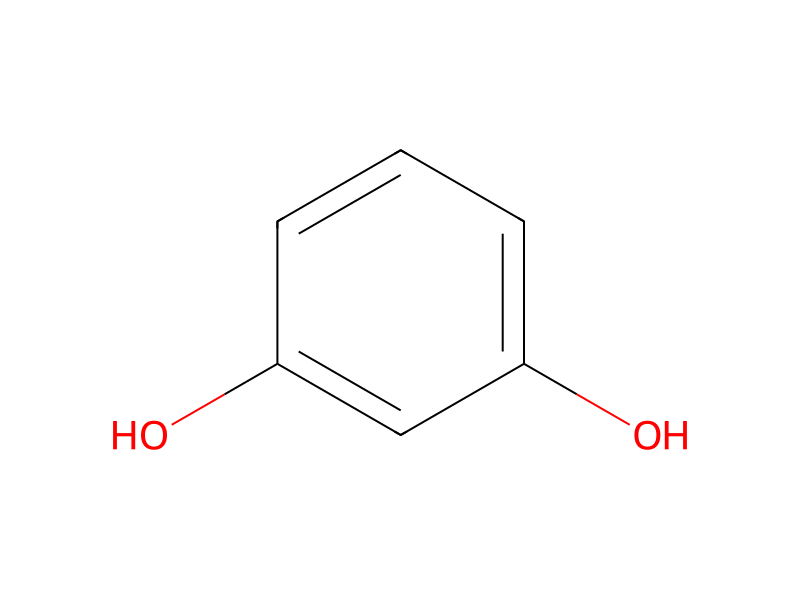
Basic information
- Standard SMILES
Oc1cccc(O)c1- InChIKey
GHMLBKRAJCXXBS-UHFFFAOYSA-N- Molecular formula
- C6H6O2
- Average molar mass
- 110.11 g/mol
- Monoisotopic mass
- 110.03677943
Names & identifiers
- Preferred name
- Resorcinol
- IUPAC
- benzene-1,3-diol
- English name
- Resorcinol
- Molecular formula
- C6H6O2
- Molecular weight
- 110.11
Names & synonyms
resorcinol108-46-3benzene-1,3-diol1,3-Benzenediol1,3-DihydroxybenzeneResorcinm-Hydroxyphenolm-Hydroquinonem-Dihydroxybenzene3-HydroxyphenolResorcinem-Benzenediol
Show more names
C6H6O2FEMA 3589
m-DioxybenzenePelagol RSDihydroxybenzolPelagol Grey RSResorzinDeveloper ODeveloper RDeveloper RS
Database identifiers
- CAS
108-46-3- PubChem CID
- 5054
- DTXSID
DTXSID2021238- ChEMBL
CHEMBL24147- ChEBI
CHEBI:27810- UNII
- YUL4LO94HK
- EC Number
- 203-585-2
- Nikkaji
- J2.863K
Properties
Computed structural properties
- XLogP
- 0.8
- Topological polar surface area
- 40.5 Ų
- Hydrogen bond donors
- 2
- Hydrogen bond acceptors
- 2
- Rotatable bonds
- 0
- Heavy atoms
- 8
- Formal charge
- 0
- Complexity
- 64
Experimental & physicochemical properties
LogP
log Kow = 0.80
0.80
0.79-0.93
OdorFaint, characteristic odor
TasteSweetish taste followed by bitter taste
Density
1.2 at 68 °F (USCG, 1999) - Denser than water; will sink
1.278 g/cu cm at 20 °C
Density of saturated air: 1.0739 (Air = 1); Percent in saturated air: 2.64% by volume (25 °C)
Density, solid (g/cu cm; 20 °C): 1.278 (alpha-phase), 1.327 (beta phase); Density aqueous solution (5.0 mol/L, 20 °C): 1.1101 g/cu cm
1.28 g/cm³
1.27 at 68 °F
Color/Form
White needle-like crystals
Needles from benzene; platelets from water
Rhombic tablets and pyramids
Platelets from ethanol. Very white crystals
For more Color/Form (Complete) data for RESORCINOL (6 total), please visit the HSDB record page.
Solubility
greater than or equal to 100 mg/mL at 65.3 °F (NTP, 1992)
In water, 7.17X10+5 mg/L at 25 °C
1 g dissolves in 0.9 mL water at room temperature, 0.2 mL water at 80 °C
1 g dissolves in 0.9 mL alcohol; freely soluble in ether, glycerol; slightly soluble in chloroform
Very soluble in carbon tetrachloride; soluble in ethanol, ethyl ether; slightly soluble in benzene, chloroform
Soluble in DMSO /dimethyl sulfoxide/, acetone at greater than or equal to 100 mg/mL at 18 °C
Flash Point
261 °F (NTP, 1992)
261 °F
261 °F (Closed cup)
127 °C (261 °F) (Closed cup)
261 °F (127 °C) (Closed cup)
127 °C c.c.
Boiling Point
531 to 536 °F at 760 mmHg (NTP, 1992)
280 °C, but volatilizes at lower temperature and is slightly volatile with steam
178.00 °C. @ 16.00 mm Hg
280 °C
277-281 °C
531 °F
DecompositionWhen heated to decomposition it emits acrid smoke and irritating fumes.
Melting Point
228 to 232 °F (NTP, 1992)
109.8 °C
Heat of fusion at mp: 21.0 kJ/mol; Heat of vaporization (kJ/mol): 78.2 at 110 °C, 75.2 at 150 °C, 72.0 at 190 °C
111 °C
110 °C
228-232 °F
Vapor Density
3.79 (NTP, 1992) - Heavier than air; will sink (Relative to Air)
3.79 (Air = 1)
3.79
Odor ThresholdOdor threshold concentration (detection): 6.0 mg/L
Physicochemical properties
- Melting point
- 109 · 109-112 °C(lit.)
- Boiling point
- 281 °C · 281 °C
- Density
- 1.27 · 1.27
- bulk density
- 600 · 600-700kg/m3
- vapor density
- 3.8 · 3.8 (vs air)
- vapor pressure
- 1 mm · 1 mm Hg ( 21.1 °C)
- refractive index
- 1.5781 · 1.5781
- FEMA
- 3589 · 3589 | RESORCINOL
- FLAVIS Number
- 4.047 · 04.047 | Benzene-1,3-diol
- Flash point
- 340 °F · 340 °F
- storage temp.
- 30 °C · Store below +30°C.
- solubility
- 2 O: · H2O: soluble1M at 20°C, clear, faintly yellow
- form
- Liquid
- Colour Index
- 76505 · 76505
- pka
- 9.81 · 9.81(at 25℃)
- color
- white
- PH
- 4 · 4-6 (100g/l, H2O, 20℃)
- Odor
- 1 % · at 1.00 % in propylene glycol. nutty creamy phenolic hawthorn musty
- Odor Type
- nutty
- biological source
- synthetic
- explosive limit
- 1.4 % · 1.4%(V)
- Water Solubility
- 140 g/100 · 140 g/100 mL
- Sensitive
- Light Sensitive
- JECFA Number
- 712 · 712
- Merck
- 14 · 14,8155
- BRN
- 906905 · 906905
- Henry's Law Constant
- 1 · 1.0×105 mol/(m3Pa) at 25℃, Duchowicz et al. (2020)
- Exposure limits
- 10 ppm · EU LTEL:10 ppm(45 mg/m3)
- Dielectric constant
- 3.2 · 3.2(0.0℃)
- Stability
- Stable. Incompatible with strong oxidizing agents. May discolour on exposure to air or light.
- Cosmetics Ingredients Functions
- HAIR DYEINGANTIOXIDANTPERFUMINGDENATURANT
- InChI
- 1S/C6H6O2/c7-5-2-1-3-6(8)4-5/h1-4,7-8H
- InChIKey
- GHMLBKRAJCXXBS-UHFFFAOYSA-N
- SMILES
- Oc1cccc(O)c1
- LogP
- 0.8 at · 0.8 at 20℃
- Toxicology and Carcinogenesis
- Toxicology and Carcinogenesis Studies of Resorcinol (CASRN 108-46-3) in F344 Rats and B6C3F1 Mice (Gavage Studies)
- Substances Added to Food (formerly EAFUS)
- RESORCINOL
- FDA 21 CFR
- 177.121 · 177.1210
- CAS DataBase Reference
- 108 · 108-46-3(CAS DataBase Reference)
- EWG's Food Scores
- 6 · 6-8
- FDA UNII
- 4 LO94HK · YUL4LO94HK
- ATC code
- 10 AX02,S01AX06 · D10AX02,S01AX06
- IARC
- 3 · 3 (Vol. 15, Sup 7, 71) 1999
- NIST Chemistry Reference
- Resorcinol(108-46-3)
- EPA Substance Registry System
- Resorcinol (108-46-3)
- UNSPSC Code
- 41116107 · 41116107
- NACRES
- 31 · NA.31
- Symbol(GHS)
- 6 · GHS06,GHS08,GHS09
- Signal word
- Danger
- Hazard statements
- 301 · H301-H313-H315-H319-H370-H317-H400
- Precautionary statements
- 501 · P501-P273-P272-P260-P270-P264-P280-P302+P352-P391-P337+P313-P305+P351+P338-P308+P311-P362+P364-P333+P313-P301+P310+P330-P405
- target organs
- Central nervous system,Blood, Respiratory system
- PPE
- 95 · dust mask type N95 (US), Eyeshields, Faceshields, Gloves
- Hazard Codes
- Xn,N
- Risk Statements
- 22 · 22-36/38-50-50/53-41-38
- Safety Statements
- 26 · 26-61-39
- RIDADR
- 2876 · UN 2876
- OEB
- A
- OEL
- 10 ppm · TWA: 10 ppm (45 mg/m3), STEL: 20 ppm (90 mg/m3)
- WGK Germany
- 2 · 2
- RTECS
- 9625000 · VG9625000
- F
- 3 · 3-8-9-23
- Autoignition Temperature
- 605 °C · 605 °C
- TSCA
- TSCA listed
- HS Code
- 2907 · 2907 21 00
- HazardClass
- 6.1 · 6.1
- PackingGroup
- III
- Storage Class
- 6.1 C · 6.1C - Combustible acute toxic Cat.3toxic compounds or compounds which causing chronic effects
- Hazard Classifications
- 4 OralAquatic · Acute Tox. 4 OralAquatic Acute 1Aquatic Chronic 3Eye Dam. 1Skin Irrit. 2Skin Sens. 1BSTOT SE 1 OralSTOT SE 2 Oral
- Hazardous Substances Data
- 108 · 108-46-3(Hazardous Substances Data)
- Toxicity
- 50 orally · LD50 orally in Rabbit: 301 mg/kg LD50 dermal Rabbit 3360 mg/kg
- REACH Registrations
- Active
- Limited Quantities
- 5 L · 5.0 L (1.3 gallons) (liquid) or 5.0 kg (11 lbs) (solid)
- Excepted Quantities
- Max Inner Pack (30g or 30ml) and Max Outer Pack (1Kg or 1L)
Safety & regulation
GHS classification
GHS Classification
Danger
H302: Harmful if swallowed [Warning Acute toxicity, oral];H315: Causes skin irritation [Warning Skin corrosion/irritation];H317: May cause an allergic skin reaction [Warning Sensitization, Skin];H319: Causes serious eye irritation [Warning Serious eye damage/eye irritation];H370: Causes damage to organs [Danger Specific target organ toxicity, single exposure];H400: Very toxic to aquatic life [Warning Hazardous to the aquatic environment, acute hazard]
P260, P261, P264, P264+P265, P270, P272, P273, P280, P301+P317, P302+P352, P305+P351+P338, P308+P316, P321, P330, P332+P317, P333+P317, P337+P317, P362+P364, P391, P405, and P501 (click each P-code to see the statement)
Danger
Hazard information
Regulatory Information
Chemical: 1,3-Benzenediol
Commission Regulation (EC) No 1565/2000 (Repealed by Com. Implementing Reg. (EU) No 872/2012)
1,3-Benzenediol is listed on the EPA's Chemical Data Reporting (CDR) system. Manufacturers and importers of 1,3-Benzenediol are required to report information about their production and use of this chemical to the EPA under the Toxic Substances Control Act (TSCA). (40 eCFR Part 711)
Status: Active Update: 11-05-2023 https://echa.europa.eu/registration-dossier/-/registered-dossier/13740;Status: Active Update: 20-05-2022 https://echa.europa.eu/registration-dossier/-/registered-dossier/24140
Resorcinol: Does not have an individual approval but may be used under an appropriate group standard
The New Jersey Worker and Community Right to Know Act requires public and private employers to provide information about hazardous substances at their workplaces. (N.J.S.A. 34:5A-1 et. seq.)
Other Safety InformationIMAP assessments - 1,3-Benzenediol: Human health tier II assessment
DOT LabelPoison
Fire Hazards
Behavior in Fire: Containers may explode. (USCG, 1999)
· Combustible material: may burn but does not ignite readily.;· When heated, vapors may form explosive mixtures with air: indoors, outdoors and sewers explosion hazards.;· Those substances designated with a (P) may polymerize explosively when heated or involved in a fire.;· Corrosives in contact with metals may evolve flammable hydrogen gas.;· Containers may explode when heated.;· Runoff may pollute waterways.;· Substance may be transported in a molten form.
Combustible.
Fire PotentialCombustible when exposed to heat or flame
Health Hazards
Inhalation of vapors or dust causes irritation of respiratory tract. Ingestion causes burns of mucous membranes, severe diarrhea, pallor, sweating, weakness, headache, dizziness, tinnitus, shock, and severe convulsions; may also cause siderosis of the spleen and tubular injury to the kidney. Contact with eyes causes irritation. Can be absorbed from wounds or through unbroken skin, producing severe dermatitis, methemoglobinemia, cyanosis, convulsions, tachycardia, dyspnea, and death. (USCG, 1999)
· TOXIC and/or CORROSIVE; inhalation, ingestion or skin contact with material may cause severe injury or death.;· Methyl bromoacetate (UN2643) is an eye irritant/lachrymator (causes flow of tears).;· Contact with molten substance may cause severe burns to skin and eyes.;· Avoid any skin contact.;· Fire may produce irritating, corrosive and/or toxic gases.;· Runoff from fire control or dilution water may be corrosive and/or toxic and cause environmental contamination.
Hazards Summary
Resorcinol may cause methemoglobinemia after ingestion of large amounts. Rats develop increased liver weights in subchronic feeding studies. [ACGIH] Allergic contact dermatitis reported in hairdressers; [Kanerva, p. 1833] Very irritating to the eyes and skin--may cause redness and pain; Can induce methemoglobinemia; [ICSC] Danger of skin sensitization; [MAK]
DOT ID and Guide
2876 153
2876 153
FDA Requirements
Drug products containing certain active ingredients offered over-the-counter (OTC) for certain uses. A number of active ingredients have been present in OTC drug products for various uses, as described below. However, based on evidence currently available, there are inadequate data to establish general recognition of the safety and effectiveness of these ingredients for the specified uses: resorcinol is included in topical acne drug products.
Drug products containing certain active ingredients offered over-the-counter (OTC) for certain uses. A number of active ingredients have been present in OTC drug products for various uses, as described below. However, based on evidence currently available, there are inadequate data to establish general recognition of the safety and effectiveness of these ingredients for the specified uses: resorcinol is included in dandruff/seborrheic dermatitis/psoriasis drug products.
Drug products containing certain active ingredients offered over-the-counter (OTC) for certain uses. A number of active ingredients have been present in OTC drug products for various uses, as described below. However, based on evidence currently available, there are inadequate data to establish general recognition of the safety and effectiveness of these ingredients for the specified uses: resorcinol is included in topical antifungal drug products.
Drug products containing certain active ingredients offered over-the-counter (OTC) for certain uses. A number of active ingredients have been present in OTC drug products for various uses, as described below. However, based on evidence currently available, there are inadequate data to establish general recognition of the safety and effectiveness of these ingredients for the specified uses: resorcinol is included in anorectal drug products.
Acne active ingredients. The active ingredient of the product consists of any of the following: ... Resorcinol, 2 percent, when combined with sulfur in accordance with section 333.320(a). ... Resorcinol monoacetate, 3 percent, when combined with sulfur in accordance with section 333.320(b).
Reactive GroupPhenols and Cresols
EC ClassificationSymbol: Xn, N; R: 22-36/38-50; S: (2)-26-61
UN ClassificationUN Hazard Class: 6.1; UN Pack Group: III
Safety & protection
Fire Fighting
Excerpt from ERG Guide 153 [Substances - Toxic and/or Corrosive (Combustible)]:;SMALL FIRE: Dry chemical, CO2 or water spray.;LARGE FIRE: Dry chemical, CO2, alcohol-resistant foam or water spray. If it can be done safely, move undamaged containers away from the area around the fire. Dike runoff from fire control for later disposal.;FIRE INVOLVING TANKS, RAIL TANK CARS OR HIGHWAY TANKS: Fight fire from maximum distance or use unmanned master stream devices or monitor nozzles. Do not get water inside containers. Cool containers with flooding quantities of water until well after fire is out. Withdraw immediately in case of rising sound from venting safety devices or discoloration of tank. ALWAYS stay away from tanks in direct contact with flames. (ERG, 2024)
Use water spray, powder.
First Aid Measures
Fresh air, rest. Artificial respiration may be needed. Refer for medical attention.
Remove contaminated clothes. Rinse and then wash skin with water and soap. Refer for medical attention .
First rinse with plenty of water for several minutes (remove contact lenses if easily possible), then refer for medical attention.
Rinse mouth. Induce vomiting (ONLY IN CONSCIOUS PERSONS!). Give a slurry of activated charcoal in water to drink. Refer for medical attention .
Accidental Release Measures
· CALL 911. Then call emergency response telephone number on shipping paper. If shipping paper not available or no answer, refer to appropriate telephone number listed on the inside back cover.;· Keep unauthorized personnel away.;· Stay upwind, uphill and/or upstream.;· Ventilate closed spaces before entering, but only if properly trained and equipped.
· ELIMINATE all ignition sources (no smoking, flares, sparks or flames) from immediate area.;· Do not touch damaged containers or spilled material unless wearing appropriate protective clothing.;· Stop leak if you can do it without risk.;· Prevent entry into waterways, sewers, basements or confined areas.;· Absorb or cover with dry earth, sand or other non-combustible material and transfer to containers.;· DO NOT GET WATER INSIDE CONTAINERS.
First Aid
EYES: First check the victim for contact lenses and remove if present. Flush victim's eyes with water or normal saline solution for 20 to 30 minutes while simultaneously calling a hospital or poison control center. Do not put any ointments, oils, or medication in the victim's eyes without specific instructions from a physician. IMMEDIATELY transport the victim after flushing eyes to a hospital even if no symptoms (such as redness or irritation) develop.;SKIN: IMMEDIATELY flood affected skin with water while removing and isolating all contaminated clothing. Gently wash all affected skin areas thoroughly with soap and water. If symptoms such as redness or irritation develop, IMMEDIATELY call a physician and be prepared to transport the victim to a hospital for treatment.;INHALATION: IMMEDIATELY leave the contaminated area; take deep breaths of fresh air. If symptoms (such as wheezing, coughing, shortness of breath, or burning in the mouth, throat, or chest) develop, call a physician and be prepared to transport the victim to a hospital. Provide proper respiratory protection to rescuers entering an unknown atmosphere. Whenever possible, Self-Contained Breathing Apparatus (SCBA) should be used; if not available, use a level of protection greater than or equal to that advised under Protective Clothing.;INGESTION: DO NOT INDUCE VOMITING. If the victim is conscious and not convulsing, give 1 or 2 glasses of water to dilute the chemical and IMMEDIATELY call a hospital or poison control center. Be prepared to transport the victim to a hospital if advised by a physician. If the victim is convulsing or unconscious, do not give anything by mouth, ensure that the victim's airway is open and lay the victim on his/her side with the head lower than the body. DO NOT INDUCE VOMITING. IMMEDIATELY transport the victim to a hospital. (NTP, 1992)
General First Aid:;· Call 911 or emergency medical service.;· Ensure that medical personnel are aware of the material(s) involved, take precautions to protect themselves and avoid contamination.;· Move victim to fresh air if it can be done safely.;· Administer oxygen if breathing is difficult.;· If victim is not breathing:;-- DO NOT perform mouth-to-mouth resuscitation; the victim may have ingested or inhaled the substance.;-- If equipped and pulse detected, wash face and mouth, then give artificial respiration using a proper respiratory medical device (bag-valve mask, pocket mask equipped with a one-way valve or other device).;-- If no pulse detected or no respiratory medical device available, provide continuous compressions. Conduct a pulse check every two minutes or monitor for any signs of spontaneous respirations.;· Remove and isolate contaminated clothing and shoes.;· For minor skin contact, avoid spreading material on unaffected skin.;· In case of contact with substance, remove immediately by flushing skin or eyes with running water for at least 20 minutes.;· For severe burns, immediate medical attention is required.;· Effects of exposure (inhalation, ingestion, or skin contact) to substance may be delayed.;· Keep victim calm and warm.;· Keep victim under observation.;· For further assistance, contact your local Poison Control Center.;· Note: Basic Life Support (BLS) and Advanced Life Support (ALS) should be done by trained professionals.;Specific First Aid:;· For corrosives, in case of contact, immediately flush skin or eyes with running water for at least 30 minutes. Additional flushing may be required.
(General first aid procedures);Eye: Irrigate immediately - If this chemical contacts the eyes, immediately wash (irrigate) the eyes with large amounts of water, occasionally lifting the lower and upper lids. Get medical attention immediately.;Skin: Water wash immediately - If this chemical contacts the skin, immediately wash the contaminated skin with water. If this chemical penetrates the clothing, immediately remove the clothing and wash the skin with water. If symptoms occur after washing, get medical attention immediately.;Breathing: Respiratory support;Swallow: Medical attention immediately - If this chemical has been swallowed, get medical attention immediately.
Safe StorageSeparated from incompatible materials and food and feedstuffs. See Chemical Dangers.
Firefighting Hazards
Water may cause frothing
Special hazards arising from the substance or mixture: Carbon oxides
Exposure Control and Personal Protection
· Wear positive pressure self-contained breathing apparatus (SCBA).;· Wear chemical protective clothing that is specifically recommended by the manufacturer when there is NO RISK OF FIRE.;· Structural firefighters' protective clothing provides thermal protection but only limited chemical protection.
Fire Fighting Procedures
If material on fire or involved in fire: Extinguish fire using agent suitable for type of surrounding fire (Material itself does not burn or burns with difficulty). Use water in flooding quantities as fog.
/Use/ water, foam, dry chemical, or carbon dioxide
Suitable extinguishing media: Use water spray, alcohol-resistant foam, dry chemical or carbon dioxide.
Advice for firefighters: Wear self contained breathing apparatus for fire fighting if necessary.
Storage Conditions
Separated from incompatible materials and food and feedstuffs.
Conditions for safe storage, including any incompatibilities: Keep container tightly closed in a dry and well-ventilated place. Air and light sensitive.
Cleanup Methods
Environmental consideration: Water spill: Use mechanical dredges or lifts to remove immobilized masses of pollutants and precipitates.
Environmental considerations: Land spill: Dig a pit, pond, lagoon, holding area to contain liquid or solid material. /SRP: If time permits, pits, ponds, lagoons, soak holes, or holding areas should be sealed with an impermeable flexible membrane liner./ Cover solids with a plastic sheet to prevent dissolving in rain or fire fighting water.
Accidental Release Measures. Personal precautions, protective equipment and emergency procedures: Use personal protective equipment. Avoid dust formation. Avoid breathing vapours, mist or gas. Ensure adequate ventilation. Evacuate personnel to safe areas. Avoid breathing dust. Environmental precautions: Prevent further leakage or spillage if safe to do so. Do not let product enter drains. Discharge into the environment must be avoided. Methods and materials for containment and cleaning up: Pick up and arrange disposal without creating dust. Sweep up and shovel. Keep in suitable, closed containers for disposal.
Nonfire Spill Response
Excerpt from ERG Guide 153 [Substances - Toxic and/or Corrosive (Combustible)]:;ELIMINATE all ignition sources (no smoking, flares, sparks or flames) from immediate area. Do not touch damaged containers or spilled material unless wearing appropriate protective clothing. Stop leak if you can do it without risk. Prevent entry into waterways, sewers, basements or confined areas. Absorb or cover with dry earth, sand or other non-combustible material and transfer to containers. DO NOT GET WATER INSIDE CONTAINERS. (ERG, 2024)
Disposal Methods
Generators of waste (equal to or greater than 100 kg/mo) containing this contaminant, EPA hazardous waste number U201, must conform with USEPA regulations in storage, transportation, treatment and disposal of waste.
A good candidate for rotary kiln incineration at a temperature range of 820 to 1,600 °C and residence times of seconds for liquids and gases, and hours for solids. A good candidate for fluidized bed incineration at a temperature range of 450 to 980 °C and residence times of seconds for liquids and gases, and longer for solids.
Chemical Treatability of Resorcinol; Concentration Process: Activated Carbon; Chemical Classification: Phenols; Scale of Study: Batch Flow/Laboratory Scale; Type of Wastewater Used: Pure Compound; Influent Concentration: 100 ppb; Results of Study: 100% reduction; 0% desorbed from carbon by elutriation with solvent (Calgon FS-300 used. Solvent included pentane-acetone, diethyl ether, methylene chloride-acetone, chloroform-acetone and acetone).
Chemical Treatability of Resorcinol; Concentration Process: Resin Adsorption; Chemical Classification: Phenols; Scale of Study: Batch Flow/Laboratory Scale Type of Wastewater Used: Pure Compound; Influent Concentration: 100 ppb; Results of Study: 100% reduction; 60% desorbed from resin by elutriation with solvent (Amberlite XAD-2 used. Solvents included pentane-acetone, diethyl ether, methylene chloride-acetone, chloroform-acetone and acetone).
For more Disposal Methods (Complete) data for RESORCINOL (9 total), please visit the HSDB record page.
Toxicology
Interactions
The micronucleus test using mouse bone marrow polychromatic erythrocytes was used to study the extent of which benzo(a)pyrene (BP) mutagenicity was inhibited by mixtures of simple phenols (resorcinol & pyrogallol) with & without the complex hindered-phenol antioxidant ... 2,6-di-tert-butyl-4-methylphenol. Mixtures of these phenolic compds inhibited benzo(a)pyrene mutagenicity more effectively than did the individual constituents. One can assume that the simple phenols regenerated in the presence of 2,6-di-tert-butyl-4-methylphenol from the tissue-oxidized forms incr the formation of detoxified or less mutagenic metabolites of benzo(a)pyrene.
Target OrgansEyes, skin, respiratory system, cardiovascular system, central nervous system, blood, spleen, liver, kidneys
Ecotoxicity Values
LC50; Species: Pimephales promelas (fathead minnow); Concentration: 88.6 mg/L for 24 hr /Conditions of bioassay not specified/
LC50; Species: Pimephales promelas (fathead minnow); Concentration: 72.6 mg/L for 48 hr /Conditions of bioassay not specified/
LC50; Species: Pimephales promelas (fathead minnow); Concentration: 53.4 mg/L for 96 hr /Conditions of bioassay not specified/
LC50; Species: Palaemonetes pugio (grass shrimp); Concentration: 170 mg/L for 24 hr /Conditions of bioassay not specified/
For more Ecotoxicity Values (Complete) data for RESORCINOL (8 total), please visit the HSDB record page.
Environmental Fate
TERRESTRIAL FATE: Based on a classification scheme(1), a Koc value of 10.36(2) indicates that resorcinol is expected to have very high mobility in soil(SRC). The pKa1 of resorcinol is 9.30(3), indicating that this compound will exist partially in the anion form in the environment and anions generally do not adsorb more strongly to soils containing organic carbon and clay than their neutral counterparts(4). Volatilization of resorcinol from moist soil surfaces is not expected to be an important fate process(SRC) given an estimated Henry's Law constant of 9.9X10⁻¹¹ atm-cu m/mole(SRC), based upon its vapor pressure, 4.89X10⁻⁴ mm Hg(5), and water solubility, 7.17X10+5 mg/L(6). Resorcinol is not expected to volatilize from dry soil surfaces(SRC) based upon its vapor pressure(5). Utilizing the Japanese MITI test, 100% of the Theoretical BOD was reached in 2 weeks(7) indicating that biodegradation is an important environmental fate process in soil(SRC).
AQUATIC FATE: Based on a classification scheme(1), a Koc value of 10.36(2) indicates that resorcinol is not expected to adsorb to suspended solids and sediment(SRC). Volatilization from water surfaces is not expected(3) based upon an estimated Henry's Law constant of 9.9X10⁻¹¹ atm-cu m/mole(SRC), derived from its vapor pressure, 4.89X10⁻⁴ mm Hg(4), and water solubility, 7.17X10+5 mg/L(5). As a class, phenols react relatively rapidly in sunlit natural water via reaction with photochemically produced hydroxyl radicals and peroxy radicals(6). According to a classification scheme(7), an estimated BCF of 3(SRC), from its log Kow of 0.80(8) and a regression-derived equation(9), suggests the potential for bioconcentration in aquatic organisms is low(SRC). Utilizing the Japanese MITI test, 100% of the Theoretical BOD was reached in 2 weeks(10) indicating that biodegradation is an important environmental fate process in water(SRC).
ATMOSPHERIC FATE: According to a model of gas/particle partitioning of semivolatile organic compounds in the atmosphere(1), resorcinol, which has a vapor pressure of 4.89X10⁻⁴ mm Hg at 25 °C(2), will exist in both the vapor and particulate phases in the ambient atmosphere. Vapor-phase resorcinol is degraded in the atmosphere by reaction with photochemically-produced hydroxyl radicals(SRC); the half-life for this reaction in air is estimated to be 1 hour(SRC), calculated from its rate constant of 2.0X10⁻¹⁰ cu cm/molecule-sec at 25 °C(SRC) that was derived using a structure estimation method(3). The vapor-phase reaction of resorcinol with nitrate radicals may be an important atmospheric removal process in urban areas at night(4). Particulate-phase resorcinol may be removed from the air by wet and dry deposition(SRC). As a class, phenols react relatively rapidly in sunlit natural water via reaction with photochemically produced hydroxyl radicals and peroxy radicals(5). Therefore, resorcinol may be susceptible to direct photolysis by sunlight(SRC).
Adverse Effects
Occupational hepatotoxin - Secondary hepatotoxins: the potential for toxic effect in the occupational setting is based on cases of poisoning by human ingestion or animal experimentation.;Methemoglobinemia - The presence of increased methemoglobin in the blood; the compound is classified as secondary toxic effect;Dermatotoxin - Skin burns.;Skin Sensitizer - An agent that can induce an allergic reaction in the skin.;ACGIH Carcinogen - Not Classifiable.
Exposure Routes
The substance can be absorbed into the body by inhalation of its aerosol, through the skin and by ingestion.
inhalation, ingestion, skin and/or eye contact
Toxicity Summary
Safe in the present practices of use and concentration. Ingredient, concentration, and use information are available in documents discoverable at https://cir-reports.cir-safety.org
IDENTIFICATION AND USE: Resorcinol is a white crystalline compound with a faint odor and bitter-sweet taste. It exists in at least two crystalline modifications. Crystalline resorcinol turns pale red in the presence of light and air and is hygroscopic. It is miscible in water. It is used in tanning, photography; manufacture of resins, resin adhesives, hexylresorcinol, p-aminosalicylic acid, explosives, dyes, tires, rubber products; in cosmetics; dyeing and printing textiles; and as a reagent for zinc. It is not registered for current pesticide use in the U.S., but approved pesticide uses may change periodically and so federal, state and local authorities must be consulted for currently approved uses. Resorcinol is also a medication, used as an antifungal, antibacterial, mildly keratolytic and local irritant agent. It is a pharmaceutical agent used topically in dermatological treatments such as acne and related skin conditions. It could also be used in combination with the other acne treatment agents such as sulphur. HUMAN EXPOSURE AND TOXICITY: An application of 3-25% solution of resorcinol to skin may cause redness, itching, dermatitis, edema or corrosion of affected area. Potential symptoms of overexposure are irritation of eyes, skin, nose, throat, upper respiratory system; dermatitis; methemoglobinemia, cyanosis, convulsions; restlessness, bluish skin, increased heart rate, dyspnea; dizziness, drowsiness, hypothermia, hemoglobinuria; spleen, kidney, liver changes. ANIMAL STUDIES: Tests of 10% soln on rabbit eyes have caused pain, conjunctival inflammation, and vascularization of cornea. Dry, powdered resorcinol applied to rabbit eyes induced necrosis sufficient to cause perforation of cornea in some and extensive vascularization in others. A subcutaneous injection of 154 mg/kg in rats produced a thyroid disturbance (myxedema and goiter); an effect that did not occur when 50 mg/kg was injected. Resorcinol intake at 1000 mg/L via contaminated drinking water cause
Ecotoxicity Excerpts
/AQUATIC SPECIES/ Sea bass (Dicentrarchus labrax) were injected intraperitoneally once (single dose) or three times (fractionated dose) with phenol or OH-phenols (hydroquinone, resorcinol, and pyrocatechol). On the basis of the lethal doses, OH-phenols were more toxic than phenol, and pyrocatechol was the most powerful compound. Hematological, metabolic and antioxidant blood parameters were measured 3 days after the end of the treatment. Metabolic variations as specific effects on erythrocytes were revealed and differences between single and fractionated doses were observed. OH-phenols-treated fish showed disorders in the metabolic toxicity indicators as hypoglycemia, low blood urea nitrogen level (BUN) and decrease of alkaline phosphatase activity (ALP).
Plant Concentrations
Resorcinol was detected, not quantified in the wood of Morus alba L. (Moraceae), white mulberry(1). It is also been found in broad bean (Vicia faba), honey mushroom (Armillaria mellea), and in exudates of seedlings of the yellow pond lilly (Nuphar lutea). Resorcinol was detected in extracts of tobacco leaves(2).
Signs and Symptoms
Abdominal pain. Blue lips, fingernails and skin. Confusion. Convulsions. Cough. Dizziness. Headache. Nausea. Sore throat. Unconsciousness.
Redness. Pain.
Redness. Pain.
See Inhalation.
irritation eyes, skin, nose, throat, upper respiratory system; methemoglobinemia; cyanosis, convulsions; restlessness, bluish skin, increased heart rate, dyspnea (breathing difficulty); dizziness, drowsiness, hypothermia, hematuria (blood in the urine); spleen, kidney, liver changes; dermatitis
Ongoing Test Status
EPA has released the first beta version (version 0.5) of the Interactive Chemical Safety for Sustainability (iCSS) Dashboard. The beta version of the iCSS Dashboard provides an interactive tool to explore rapid, automated (or in vitro high-throughput) chemical screening data generated by the Toxicity Forecaster (ToxCast) project and the federal Toxicity Testing in the 21st century (Tox21) collaboration. /The title compound was tested by ToxCast and/or Tox21 assays; See the data in Chemical Explorer/[USEPA; ICSS Dashboard Application; Available from, as of June 27, 2014: http://actor.epa.gov/dashboard/]
The following link will take the user to the National Toxicology Program (NTP) Test Agent Search Results page, which tabulates all of the "Standard Toxicology & Carcinogenesis Studies", "Developmental Studies", and "Genetic Toxicity Studies" performed with this chemical. Clicking on the "Testing Status" link will take the user to the status (i.e., in review, in progress, in preparation, on test, completed, etc.) and results of all the studies that the NTP has done on this chemical.[Available from, as of October 1, 2014: http://ntp-apps.niehs.nih.gov/ntp_tox/index.cfm?fuseaction=ntpsearch.searchresults&searchterm=108-46-3]
Effluent Concentrations
The concentration of resorcinol in the condensate water from a coal gasification facility in Grand Forks, ND ranged from not detected (no analytical detection limit reported) to 60 ppm between Jun 1980 and Apr 1982(1). A resorcinol level of 1000 ppm was detected in wastewater from a synthetic coal conversion process(2). Resorcinol has been found in effluents associated with coal gasification and conversion, coal-tar production and shale oil processing(3).
Regulatory information
Regulatory Information
Chemical: 1,3-Benzenediol
Commission Regulation (EC) No 1565/2000 (Repealed by Com. Implementing Reg. (EU) No 872/2012)
1,3-Benzenediol is listed on the EPA's Chemical Data Reporting (CDR) system. Manufacturers and importers of 1,3-Benzenediol are required to report information about their production and use of this chemical to the EPA under the Toxic Substances Control Act (TSCA). (40 eCFR Part 711)
Status: Active Update: 11-05-2023 https://echa.europa.eu/registration-dossier/-/registered-dossier/13740;Status: Active Update: 20-05-2022 https://echa.europa.eu/registration-dossier/-/registered-dossier/24140
Resorcinol: Does not have an individual approval but may be used under an appropriate group standard
The New Jersey Worker and Community Right to Know Act requires public and private employers to provide information about hazardous substances at their workplaces. (N.J.S.A. 34:5A-1 et. seq.)
FDA Requirements
Drug products containing certain active ingredients offered over-the-counter (OTC) for certain uses. A number of active ingredients have been present in OTC drug products for various uses, as described below. However, based on evidence currently available, there are inadequate data to establish general recognition of the safety and effectiveness of these ingredients for the specified uses: resorcinol is included in topical acne drug products.
Drug products containing certain active ingredients offered over-the-counter (OTC) for certain uses. A number of active ingredients have been present in OTC drug products for various uses, as described below. However, based on evidence currently available, there are inadequate data to establish general recognition of the safety and effectiveness of these ingredients for the specified uses: resorcinol is included in dandruff/seborrheic dermatitis/psoriasis drug products.
Drug products containing certain active ingredients offered over-the-counter (OTC) for certain uses. A number of active ingredients have been present in OTC drug products for various uses, as described below. However, based on evidence currently available, there are inadequate data to establish general recognition of the safety and effectiveness of these ingredients for the specified uses: resorcinol is included in topical antifungal drug products.
Drug products containing certain active ingredients offered over-the-counter (OTC) for certain uses. A number of active ingredients have been present in OTC drug products for various uses, as described below. However, based on evidence currently available, there are inadequate data to establish general recognition of the safety and effectiveness of these ingredients for the specified uses: resorcinol is included in anorectal drug products.
Acne active ingredients. The active ingredient of the product consists of any of the following: ... Resorcinol, 2 percent, when combined with sulfur in accordance with section 333.320(a). ... Resorcinol monoacetate, 3 percent, when combined with sulfur in accordance with section 333.320(b).
RCRA Requirements
U201; As stipulated in 40 CFR 261.33, when resorcinol, as a commercial chemical product or manufacturing chemical intermediate or an off-specification commercial chemical product or a manufacturing chemical intermediate, becomes a waste, it must be managed according to Federal and/or State hazardous waste regulations. Also defined as a hazardous waste is any residue, contaminated soil, water, or other debris resulting from the cleanup of a spill, into water or on dry land, of this waste. Generators of small quantities of this waste may qualify for partial exclusion from hazardous waste regulations (40 CFR 261.5).
Atmospheric Standards
This action promulgates standards of performance for equipment leaks of Volatile Organic Compounds (VOC) in the Synthetic Organic Chemical Manufacturing Industry (SOCMI). The intended effect of these standards is to require all newly constructed, modified, and reconstructed SOCMI process units to use the best demonstrated system of continuous emission reduction for equipment leaks of VOC, considering costs, non air quality health and environmental impact and energy requirements. Resorcinol is produced, as an intermediate or a final product, by process units covered under this subpart.
CERCLA Reportable Quantities
Persons in charge of vessels or facilities are required to notify the National Response Center (NRC) immediately, when there is a release of this designated hazardous substance, in an amount equal to or greater than its reportable quantity of 5000 lb or 2270 kg. The toll free number of the NRC is (800) 424-8802. The rule for determining when notification is required is stated in 40 CFR 302.4 (section IV.D.3.b).
Clean Water Act Requirements
Resorcinol is designated as a hazardous substance under section 311(b)(2)(A) of the Federal Water Pollution Control Act and further regulated by the Clean Water Act Amendments of 1977 and 1978. These regulations apply to discharges of this substance. This designation includes any isomers and hydrates, as well as any solutions and mixtures containing this substance.
State Drinking Water Guidelines(ME) MAINE 140 ug/L
Safety data
- F
- 3-8-9-23
- OEB
- A
- OEL
- TWA: 10 ppm (45 mg/m3), STEL: 20 ppm (90 mg/m3)
- PPE
- dust mask type N95 (US), Eyeshields, Faceshields, Gloves
- wgk
- 2
- tsca
- TSCA listed
- rtecs
- VG9625000
- ridadr
- UN 2876
- hs_code
- 2907 21 00
- Toxicity
- LD50 orally in Rabbit: 301 mg/kg LD50 dermal Rabbit 3360 mg/kg
- risk_code
- 22-36/38-50-50/53-41-38
- Signal word
- Danger
- Symbol(GHS)
- GHS06,GHS08,GHS09
- hazard_code
- Xn,N
- safety_code
- 26-61-39
- hazard_class
- 6.1
- Storage Class
- 6.1C - Combustible acute toxic Cat.3toxic compounds or compounds which causing chronic effects
- packing_group
- III
- target organs
- Central nervous system,Blood, Respiratory system
- Hazard statements
- H301-H313-H315-H319-H370-H317-H400
- Limited Quantities
- 5.0 L (1.3 gallons) (liquid) or 5.0 kg (11 lbs) (solid)
- Excepted Quantities
- Max Inner Pack (30g or 30ml) and Max Outer Pack (1Kg or 1L)
- REACH Registrations
- Active
- Hazard Classifications
- Acute Tox. 4 OralAquatic Acute 1Aquatic Chronic 3Eye Dam. 1Skin Irrit. 2Skin Sens. 1BSTOT SE 1 OralSTOT SE 2 Oral
- Autoignition Temperature
- 605 °C
- Precautionary statements
- P501-P273-P272-P260-P270-P264-P280-P302+P352-P391-P337+P313-P305+P351+P338-P308+P311-P362+P364-P333+P313-P301+P310+P330-P405
- Hazardous Substances Data
- 108-46-3(Hazardous Substances Data)
Chemistry & industry
Pharmacology
ATC Code
S - Sensory organs;S01 - Ophthalmologicals;S01A - Antiinfectives;S01AX - Other antiinfectives;S01AX06 - Resorcinol
D - Dermatologicals;D10 - Anti-acne preparations;D10A - Anti-acne preparations for topical use;D10AX - Other anti-acne preparations for topical use;D10AX02 - Resorcinol
QD - Dermatologicals;QD10 - Anti-acne preparations;QD10A - Anti-acne preparations for topical use;QD10AX - Other anti-acne preparations for topical use;QD10AX02 - Resorcinol
QS - Sensory organs;QS01 - Ophthalmologicals;QS01A - Antiinfectives;QS01AX - Other antiinfectives;QS01AX06 - Resorcinol
Protein BindingSpecific data regarding the protein binding of resorcinol is not readily available.
Pharmacodynamics
In vitro and in vivo studies have demonstrated that resorcinol can inhibit peroxidases in the thyroid and subsequently block the synthesis of thyroid hormones and cause goiter. Resorcinol interferes with the iodination of tyrosine and the oxidation of iodide. In an in vitro study involving lactoperoxidase (LPO) and thyroid peroxidase (TPO), it was shown that the mechanism of these two enzymes can become irreversibly inhibited by way of a suicide inactivation by resorcinol. It is believed that the Fe3+ of the porphyrin residue of the peroxidase to is oxidised to Fe4+ by hydrogen peroxide with the transfer of an oxygen radical. In LPO and TPO, the resulting π-cation radical of the porphyrin can isomerize to a radical cation with the radical in an aromatic side chain of the enzyme. The latter radical can bind, in a pH-dependent reaction, covalently and irreversibly to the resorcinol radical formed during regular oxidation of resorcinol and this reduces the activity of the enzyme greatly. While the inactivation of the enzyme and the binding of resorcinol to the enzyme may be largely increased by the presence of 0.1 nM iodide, increasing the iodide concentration to 5 mM reduced the resorcinol binding to the enzyme by one quarter but increased the enzyme activity, determined as the rate of iodination of tyrosine, more than proportionally from 6.2% to 44.7%. Nevertheless, the role played by iodide ions in the irreversible inactivation of the enzymes is not yet fully elucidated. Ultimately, such in vitro and in vivo data propose that the anti-thyroidal activity of resorcinol is caused by inhibition of thyroid peroxidase enzymes, resulting in decreased thyroid hormone production and increased proliferation due to an increase in the secretion of TSH (thyroid stimulating hormone). The iodination process is catalyzed by a haem-containing enzyme, and resorcinol is known to form covalent bonds with haem. Despite the legitimacy of this pharmacodynamic profile in resorcinol, the
Mechanism of Action
Data regarding the specific mechanisms of action of resorcinol does not appear to be readily accessible in the literature. Nevertheless, the effectiveness of the agent in treating various topical, dermatological conditions by eliciting antibacterial and keratolytic actions appears to stem from resorcinol's propensity for protein precipitation. In particular, it appears that resorcinol indicated for treating acne, dermatitis, or eczema in various skin care topical applications and peels revolves around the compound's ability to precipitate cutaneous proteins from the treated skin.
In animal studies resorcinol failed to induce thyroid gland (TG) toxicity, unless pharmacokinetic/toxicokinetic (PK/TK) conditions were manipulated (e.g., injection of resorcinol in oil or application in a slow release formulation). A recently completed two-generation reproductive toxicity study in rats did not detect any adverse effects on either reproductive or TG end points. Resorcinol intake via drinking water up to the palatability limit had resulted in average daily intakes (mg/kg) of 233 in F0 and F1 males and 304 (premating/gestation) or 660 (lactation) in females. Free resorcinol in blood plasma was barely detectable in a few parental animals, indicating rapid metabolism. This short review communication offers a perspective on compromised human skin barrier function as a likely cause of drastic increases in resorcinol absorption. In conjunction with multiple daily applications over many months to hyperemic, inflamed, and lesioned human skin much higher absorption was likely responsible for the reported human TG toxicity.
Phenols oxidizable to quinones cause cessation of protoplasmic streaming in nitella & elodea canadensis, also inhibiting adenosine triphosphatase activity. /Phenols/
Biological Half-LifeSpecific data regarding the half-life of resorcinol is not readily available, although, in one case of dermal exposure, an adult male with a 90% phenol exposure had an elimination half-life of about 14 hours.
Metabolism/Metabolites
Specific data regarding the metabolism of resorcinol is not readily available, although the major metabolite of resorcinol found in the urine was its glucuronide.
It yields 3-amino-3,4-dihydro-7-hydroxycoumarin, 2,4-di- hydroxy-l-phenylalanine, m-hydroxy-beta-d-fucoside, & m-hydroxy- phenyl-beta-d-glucoside in Escherichia /from table/
It yields m-hydroxyphenyl-alpha-d-glucoside & hydroxyquinol in Aspergillus; yields m-hydroxyphenyl sulfate & m-hydroxyphenyl-beta-d-glucuronide in rabbits. /From table/
Resorcinol yields m-methoxyphenol in streptomyces. /From table/
In the urine, the major metabolite of resorcinol was its glucuronide.
For more Metabolism/Metabolites (Complete) data for RESORCINOL (6 total), please visit the HSDB record page.
Absorption, Distribution and Excretion
The dermal absorption of resorcinol seems to be low (< 1%) when applied on healthy and intact skin. The agent absorbed very slightly under normal conditions & the absorption was lower when applied to the scalp than to clean shaven skin due to a strong fixation by the hair.
Specific data regarding the route of elimination of resorcinol is not readily available, although the major metabolite of resorcinol found in the urine was its glucuronide.
Specific data regarding the volume of distribution of resorcinol is not readily available, although it is believed that the compound's volume of distribution is considered large, owing to resorcinol's profile as a lipid-soluble compound.
Specific data regarding the clearance of resorcinol is not readily available, although it is generally believed that the relatively low topical absorption or resorcinol does not result in an extensive systemic presence and clearance.
A dose of 112 mg/kg of (14)C resorcinol was orally administered to 3 male and 3 female Fischer 344 rats. After one day, the animals were sacrificed, and major tissues and excretory products were analyzed to determine the fate of the resorcinol. Only trace amounts of the compound were found in any tissue and there was no evidence of specific organ accumulation. More than 90% of the total administered dose was recovered from the excreta in 24 hr. The primary route of excretion was in the urine. Only 1 to 2% of the dose was eliminated in the feces and less than 0.1% was eliminated as CO2. Cannulation of the common bile duct followed by iv injection of 11.2 mg/kg resorcinol indicated that excretion in bile was rapid and underwent enterohepatic circulation to be excreted in the urine. Less than 50% of the parent compound was excreted in the urine, most was in the form of four metabolites. The major metabolite of resorcinol was a glucuronide conjugate (approximately 70%). One metabolite was identified as a sulfate conjugate (10-20%), one was identified as a diconjugate with glucuronide and sulfate (5-10%), and one, present in small quantities (less than 2%), was suggested to be a diglucuronide conjugate. Repeated exposure of both sexes to daily doses of 225 mg/kg for 5 days did not alter the rate or relative metabolite ratio of resorcinol excretion.
Resorcinol absorbed very slightly under normal conditions & the absorption was lower when applied to the scalp than to clean shaven skin due to a strong fixation by the hair. The results were somewhat similar in humans, rhesus monkeys & guinea pigs.
Cellular LocationsCytoplasm;Extracellular
Uses & manufacturing
Uses
CIR ingredient: Resorcinol
Used in tanning, photography, tire building, and in the manufacturing of resorcinol-formaldehyde resins; also used in dyes, cosmetics, pharmaceuticals, skin creams, laminates, and adhesives; [ACGIH]
Working with Glues and Adhesives [Category: Other];Plastic Composites Manufacturing [Category: Industry];Leather Tanning and Processing [Category: Industry];Photographic Processing [Category: Other];Dressing Hair [Category: Other]
For resorcinol (USEPA/OPP Pesticide Code: 071401) there are 0 labels match. /SRP: Not registered for current use in the U.S., but approved pesticide uses may change periodically and so federal, state and local authorities must be consulted for currently approved uses./
In tanning, photography; manuf of resins, resin adhesives, hexylresorcinol, p-aminosalicylic acid, explosives, dyes, tires, rubber products; in cosmetics; dyeing and printing textiles; as a reagent for zinc.
Used primarily in the rubber industry for tires & reinforced rubber products (conveyer belts, driving belts) & in high-quality wood adhesives ... It is also used in the preparation of dyes & pharmaceuticals, as a cross-linking agent for neoprene & a rubber tackifier, & in cosmetics.
Impurities
Technical /USP/ grade resorcinol has 99% min resorcinol content & contains small amt of phenol & catechol as impurities. In japan, technical resorcinol has ... fp of 108.5 °C min; 0.5% max water; & 0.1% max residue on ignition. Chief impurities are other hydroquinone isomers.
Maximum limits of impurities: Residue after ignition (0.01%), Insoluble matter (0.005%), Acidity (0.02%), Diresorcinol and Phenol (0.001%).
U.S. Exports
(1972) 4.59X10+9 G
(1975) 6.30X10+8 G
(1986) No Data
U.S. Imports
(1972) 4.27X10+7 G
(1975) 4.54X10+4 G
(1984) 8.83x10+8 g
U.S. Production
2023: 10,000,000 - <50,000,000 lb;2022: 10,000,000 - <50,000,000 lb;2021: 10,000,000 - <50,000,000 lb;2020: 10,000,000 - <50,000,000 lb
(1972) 1.48X10+10 GRAMS
(1986) No Data
Worldwide production of resorcinol in 1994 was estimated to be 30,000-35,000 tons.
1,3-Benzenediol is listed as a High Production Volume (HPV) chemical (65FR81686). Chemicals listed as HPV were produced in or imported into the U.S. in >1 million pounds in 1990 and/or 1994. The HPV list is based on the 1990 Inventory Update Rule. (IUR) (40 CFR part 710 subpart B; 51FR21438).
For more U.S. Production (Complete) data for RESORCINOL (7 total), please visit the HSDB record page.
Consumption Patterns
The primary consumer (more than 50%) is the rubber industry.
42% FOR RESORCINOL-FORMALDEHYDE RESINS AND RESIN PROGENITORS; 31% EXPORTED; 15% FOR WOOD ADHESIVE RESINS; 12% FORMISC APPLICATIONS (1970)
In 1977, the United States use of resorcinol was 65% in the manufacture of rubber products, 20% in wood adhesives, and 15% for miscellaneous uses.
Consumer UsesNot Known or Reasonably Ascertainable;Adhesion/cohesion promoter;Binder
Industry UsesNot Known or Reasonably Ascertainable;Dye;Adhesion/cohesion promoter;Intermediate;Other;Binder;Polymerization promoter;Monomers
Methods of Manufacturing
Via Sulfonation of Benzene ... In the process variation used today, the sulfonation of benzene is carried out continuously with sulfur trioxide alone so that only small amounts of sulfuric acid are contained in the sulfonation mixture and the addition of lime is not required. After neutralization with sodium sulfite, soda ash, or sodium hydroxide solution, the sulfonation product disodium benzene-1,3-disulfonate is mixed with excess sodium hydroxide and fed to an alkali fusion reactor at 320 - 350 °C. The endothermic solid-state reaction yields a white powder, consisting chiefly of disodium resorcinate, sodium sulfite, and some excess sodium hydroxide. Depending on the method used, the product of the fusion reaction is treated with either a small quantity of water (in this case, solid sodiumsulfite which contains organic impurities, is obtained as byproduct) or a large quantity of water forming an almost saturated solution of the product. In both processes the dissolved disodium resorcinate is then reacted with sulfur dioxide, sulfuric acid, or hydrochloric acid to give resorcinol. The dissolved resorcinol is extracted with an organic solvent. The preferred solvent is diisopropyl ether, but benzene, 4-methyl-2-pentanone (methyl isobutyl ketone), or others can also be used. The solvent is then distilled off, and crude resorcinol is purified further by distillation in vacuum.
Via Hydroperoxidation of m- Diisopropylbenzene: Benzene, together with a benzene-cumene mixture recycled from the alkylation process, is alkylated with propene in the liquid phase by using an AlCl3-HCl complex as catalyst. After addition of recycled p-diisopropylbenzene (p-DiPB) and triisopropylbenzene (TriPB), the alkylate is subjected to isomerization/transalkylation. In this step most of p-DiPB and TriPB are converted into m-diisopropylbenzene (m-DiPB). The reaction mixture is then separated by distillation into three fractions (benzene-cumene, m-DiPB, and p-DiPB-TriPB). The subsequent autoxidation of pure m-DiPB proceeds according to a radical chain mechanism. It is accomplished in a cascade of aeration reactors by using compressed air in an aqueous alkaline medium at 90-110 °C and 0.5-0.7 MPa to yield [1,3-phenylenebis-(1-methylethylidene)]bishydroperoxide (m-diisopropylbenzene dihydroperoxide, DHP). After an overall residence time of 6 - 8 hr the oxidate contains ca. 20% DHP and ca. 35% mdiisopropylbenzene monohydroperoxide (MHP). The heterogeneous oxidate is subjected to phase separation. m-Diisopropylbenzene dihydroperoxide is then crystallized, centrifuged, dissolved in acetone, and fed to a cleavage reactor. Higher concentrations of hydroperoxides lead to the above-average formation of byproduct and increased safety hazards. The main byproducts of oxidation are meta-substituted acetophenones and dimethylphenyl carbinols. The latter are converted to recyclable m-DiPB by acid-catalyzed dehydration and hydrogenation in downstream unit operations. The cleavage of DHP to resorcinol and acetone is carried out under acid catalysis (preferably with ca. 1% H2SO4) in boiling acetone with a reaction time of 30 min. After neutralization, acetone is distilled off at normal pressure and resorcinol under vacuum. Further purification of resorcinol can be achieved by recrystallization or extraction. The overall process yield is ca. 75%, based on benzene. Alternatively, cle
Reaction of benzene with sulfuric acid to form m-benzenedisulfonic acid which is then converted to its disulfonate sodium salt by treatment with sodium sulfite. In a second step, this salt is heated to 350 °C in the presence of sodium hydroxide yielding the sodium resorcinate and sodium sulfite. After sulfuric acid work-up ... the rescorcinol is extracted and isolated in a 94% yield ...
It can be made in several other ways, by destructive distillation of brazilin or by fusion of galbanum, ammoniac, sagapenum, asafetida, or acroides with caustic potash.
Formulations/Preparations
Grades: USP, powder, resublimed, pure, reagent, technical, crude.
/Available/ as an ointment, cream, or lotion in concentrations of 1 to 10%. It is also used as compound resorcinol ointment, which contains 6% resorcinol. Resorcinol monoacetate gradually liberates resorcinol and, therefore, exerts a milder but more lasting action. It is used for the same purposes as resorcinol. Resorcinol monoacetate is compounded with sulfur in preparations for seborrhea.
Castellani Paint /topical antifungal agent/ contains resorcinol, basic fuchsin, phenol, acetone and alcohol
Night Cast Formula R /medicated acne mask/ contains 2% resorcinol, 8% sulfur and 31% alcohol
For more Formulations/Preparations (Complete) data for RESORCINOL (6 total), please visit the HSDB record page.
Household ProductsInformation on 341 consumer products that contain Resorcinol in the following categories is provided:;• Inside the Home;• Personal Care
Use Classification
Flavouring Agent -> FLAVOURING_AGENT -> JECFA Functional Classes
Flavoring Agents -> JECFA Flavorings Index
Flavouring Agent -> FLAVOURING_AGENT -> JECFA Functional Classes
Plastics -> Light stabilisers
Cosmetics -> Hair dyeing
Plastics -> Other functions -> Other stabiliser; flame retardant
Applications
Uses1. It can be used as the raw materials for the production of synthetic resins, adhesives, dyes and ultraviolet absorbing agent. It can also be used as the dipped cord of tire. Medically it can be used as the disinfection antiseptic agent. 2. Resorcinol is also known as 1, 3-hydroquinone. In the field of pesticides, it can be used as the intermediate 3-chloro-4-methyl coumarin and herbicide oxyfluorfen in the synthesis of pesticides coumaphos. It can also be used for the production of dyes, specialty coatings, pharmaceuticals, photographic material, synthetic resins, adhesives, and cosmetics. 3. Resorcinol is mainly used for the field of rubber adhesives, synthetic resins, dyes, preservative, pharmaceutical and analytical reagents. Resorcinol is similar with phenol and cresol. It can generate condensation polymer through the reaction with formaldehyde. It can be used for making glue silk and the adhesive agent of tire cord for nylon-purpose, making wood glue, and being as the adhesive for vinyl material and metal. Resorcinol is the intermediate of many kinds of azo dyes and fur dyes as well as the raw material of pharmaceutical intermediates, p-nitrogen salicylic acid. Resorcinol has bactericidal effects and can be used as preservatives for being supplied to cosmetics and dermatological drugs pastes and ointments. The resorcinol derivatives, β-methylumbelliferone can be used as the intermediate for optical bleach; tri-nitro resorcinol is detonator. There is also a considerable amount of resorcinol being used in the production of benzophenone-class ultraviolet absorbers. This product can irritate the skin and mucous membranes, can cause poisoning disease through the rapid absorption by the skin. Minimum lethal dose of rat being subject to subcutaneous injection is 450mg/kg. 4. It can be applied to the fields of photographic film, medicines, dyes and chemical fiber industry. 5. It can also be used as reagents for analysis. 6. It can be used for characterization and determination of zinc, lead, tartaric acid, nitrate and nitrite through colorimetric method; it can also applied to the colorimetric reaction for measuring sugar and Furfuryl alcohol; as the reagent for detecting ketone sugars and lignin; it can also applied to the salt reagent of diazonium compound as well as to organic synthesis.
OccurrenceReported found in roasted barley, cane molasses, beer, red wine, white wine, special wine and coffee.
UsesResorcinol is used in the manufacture of resorcinol–formaldehyde resins, resin adhesives, dyes, drugs, andexplosives; in tanning; in cosmetics; and in dyeing and printing textiles.
UsesA benzene derivative used as keratolytic and antiseborrheic. Also used in veterinary medicine as a topical antipruritic and antiseptic (has been used as intestinal antiseptic).
UsesIn very mild solutions, resorcinol is used as an anti-septic and soothing preparation for itchy skin. In slightly higher concentrations, resorcinol removes the top layer of the stratum corneum and is used particularly in cases of acne. In still higher concentrations, it can act as an aggressive surface skin exfoliant. Resorcinol can also be used as a preservative. While it is a beneficial skin care ingredient when used in low concentrations, it causes irritation in higher concentrations with a strong burning sensation and a reddening of the skin. used in high concentrations as a peel, resorcinol may cause a variety of problems, including swelling. It is is obtained from various resins.
General DescriptionResorcinol is a very white crystalline solid that becomes pink on exposure to light if not completely pure. Burns although ignition is difficult. Density approximately 1.28 g / cm3. Irritating to skin and eyes. Toxic by skin absorption. Used to make plastics and pharmaceuticals.
Upstream & downstream products
Upstream raw materials
Downstream products
Additional notes
DefinitionChEBI: Resorcinol is a benzenediol that is benzene dihydroxylated at positions 1 and 3. It has a role as an erythropoietin inhibitor and a sensitiser. It is a benzenediol, a member of resorcinols and a phenolic donor.
Related reactions
591 records




Linked notes
Loading…