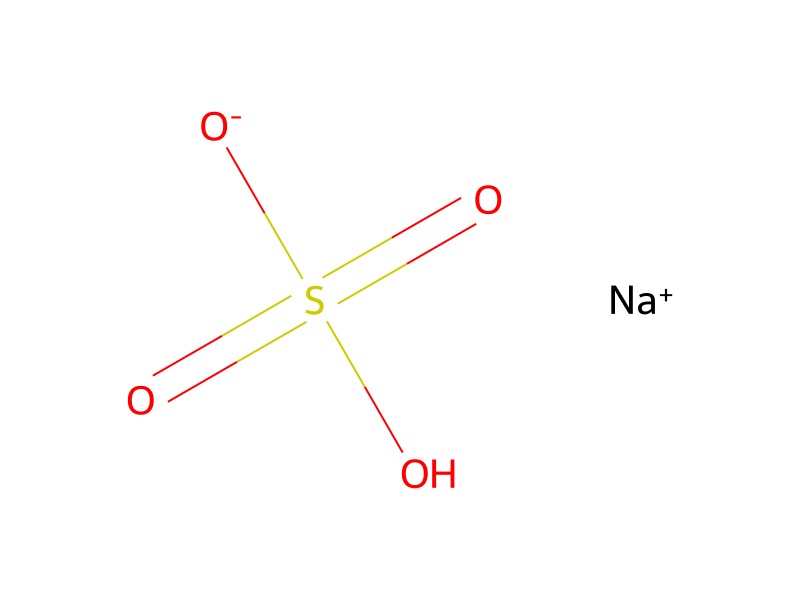
Sulfuric acid, sodium salt (1:1) is listed on the EPA's Chemical Data Reporting (CDR) system. Manufacturers and importers of Sulfuric acid, sodium salt (1:1) are required to report information about their production and use of this chemical to the EPA under the Toxic Substances Control Act (TSCA). (40 eCFR Part 711)
Status: Active Update: 24-02-2020 https://echa.europa.eu/registration-dossier/-/registered-dossier/14458
Sodium hydrogen sulphate: Does not have an individual approval but may be used under an appropriate group standard
· TOXIC and/or CORROSIVE; inhalation, ingestion or skin contact with material may cause severe injury or death.
Hazards Summary · 1 item
Corrosive to metals and tissues; Toxic by ingestion, inhalation, or skin contact; [CAMEO] Aqueous solutions are strong acids; [Merck Index] Harmful if swallowed; Do not inhale dust or aerosol; may cause acute lung edema if inhaled; [MSDSonline] Based on animal studies, not a skin irritant; [CHEMINFO]
Chemistry & industry
Pharmacology
MeSH Pharmacological ClassificationAgents that are used to stimulate evacuation of the bowels.
Uses & manufacturing
Uses · 2 items
Used as a bactericide and disinfectant; [ChemIDplus] Used to pickle metals, carbonize wool, bleach leather, and manufacture magnesia cements; [Merck Index]
Acid and Alkali Cleaning of Metals [Category: Clean]
U.S. Production2023: 250,000,000 - <400,000,000 lb
Consumer UsesProcessing aids not otherwise specified
Industry UsesBleaching agent
Household ProductsInformation on 18 consumer products that contain Sodium acid sulfate in the following categories is provided:
Use Classification · 5 items
EPA Safer Chemical Functional Use Classes -> Antimicrobial Actives;Processing Aids and Additives
Safer Chemical Classes -> Green circle - The chemical has been verified to be of low concern
DescriptionSodium bisulfate is a white crystalline solid dissolved in water. It is corrosive to metals and tissue. Sodium bisulfate is hygroscopic in that it attracts water. Sodium bisulfate dissociates completely in water into sodium (Na+), hydrogen (H+) and sulfate (SO4-2). As a mineral acid, sodium bisulfate is not expected to contaminate ground water or soil or to accumulate in the food chain (EPA 1993). Sodium bisulfate is the sodium salt of sulfuric acid. It can be used as an acidifying/buffering agent in pesticide formulations applied to growing crops, as cooling and retort water treatment agent to inhibit corrosion on exteriors of canned goods, and as a feed additive. Sodium bisulfate is used as a disinfectant in the manufacture of foods and pickling compounds. It is used in the dye industry and in the textile industry during bleaching step. Sodium bisulfate is also used as an acid bath in the jewelry for pickling, which removes the surface fire scale and oxides from the metal, leaving it a bright silver color.
2 parts · soluble in 2 parts H2O, 1 part boiling H2O; decomposes in alcohol to sodium sulfate and H2SO4 [MER06]
Sensitive
Hygroscopic
Merck
13 · 13,8658
Stability
Stable. Incompatible with strong bases, strong oxidizing agents, sodium carbonate, sodium hypochlorite. May decompose upon exposure to moist air or water.
Cosmetics Ingredients Functions
BUFFERING
InChI
InChI=1S/Na.H2O4S.H/c;1-5(2,3)4;/h;(H2,1,2,3,4);
InChIKey
TTXJTWGBBUPRBF-UHFFFAOYSA-N
SMILES
S(O)(O)(=O)=O.[NaH]
CAS DataBase Reference
7681 · 7681-38-1(CAS DataBase Reference)
Indirect Additives used in Food Contact Substances
SODIUM BISULFATE
FDA 21 CFR
175.105 · 175.105
EWG's Food Scores
1 · 1
NCI Dictionary of Cancer Terms
GBS
FDA UNII
8 V88OWIQ · BU8V88OWIQ
EPA Substance Registry System
Sodium bisulfate (7681-38-1)
UNSPSC Code
12352302 · 12352302
NACRES
23 · NA.23
Symbol(GHS)
5 · GHS05
Signal word
Danger
Hazard statements
318 · H318
Precautionary statements
280 · P280-P305+P351+P338-P310
PPE
95 · dust mask type N95 (US), Eyeshields, Gloves
Hazard Codes
Xi
Risk Statements
41 · 41
Safety Statements
24 · 24-26
RIDADR
3260 · 3260
WGK Germany
1 · 1
RTECS
1860000 · VZ1860000
F
3 · 3
TSCA
TSCA listed
HazardClass
8 · 8
PackingGroup
II
HS Code
28331900 · 28331900
Storage Class
11 · 11 - Combustible Solids
Hazard Classifications
1 · Eye Dam. 1
REACH Registrations
Active
Limited Quantities
5 L · 5.0 L (1.3 gallons) (liquid) or 5.0 kg (11 lbs) (solid)
Excepted Quantities
Max Inner Pack (30g or 30ml) and Max Outer Pack (1Kg or 1L)
DOT ID and Guide2837 154
Reactive GroupSalts, Acidic
EPA Safer ChemicalChemical: Sodium bisulfate
Reactivity Profile · 1 item
Acidic salts, such as SODIUM BISULFATE, SOLUTION, are generally soluble in water. The resulting solutions contain moderate concentrations of hydrogen ions and have pHs of less than 7.0. They react as acids to neutralize bases. These neutralizations generate heat, but less or far less than is generated by neutralization of inorganic acids, inorganic oxoacids, and carboxylic acid. They usually do not react as either oxidizing agents or reducing agents but such behavior is not impossible. Many of these compounds catalyze organic reactions. The combination of calcium hypochlorite, sodium hydrogen sulfate, starch, and sodium carbonate, when compressed, caused the materials to incandescence, followed by explosion, [Ind. Eng. Chem., 1937, 15, 282].
Air and Water ReactionsDissolves in water to give strongly acidic solutions.
Hazard Classes and Categories · 4 items
Eye Dam. 1 (99.6%)
Eye damage - category 1
Serious eye damage/eye irritation - Category 2
Eye Dam. 1
Safety & protection
Fire FightingExcerpt from ERG Guide 154 [Substances - Toxic and/or Corrosive (Non-Combustible)]:
Accidental Release Measures · 2 items
· CALL 911. Then call emergency response telephone number on shipping paper. If shipping paper not available or no answer, refer to appropriate telephone number listed on the inside back cover.
· ELIMINATE all ignition sources (no smoking, flares, sparks or flames) from immediate area.
Personal Protective Equipment (PPE)Excerpt from ERG Guide 154 [Substances - Toxic and/or Corrosive (Non-Combustible)]:
Emergency Response Planning GuidelinesSmall Fire
Toxicology
Adverse EffectsDermatotoxin - Skin burns.
Safety data
F
3
PPE
dust mask type N95 (US), Eyeshields, Gloves
wgk
1
tsca
TSCA listed
rtecs
VZ1860000
ridadr
3260
hs_code
28331900
risk_code
41
Signal word
Danger
Symbol(GHS)
GHS05
hazard_code
Xi
safety_code
24-26
hazard_class
8
Storage Class
11 - Combustible Solids
packing_group
II
Hazard statements
H318
Limited Quantities
5.0 L (1.3 gallons) (liquid) or 5.0 kg (11 lbs) (solid)
Excepted Quantities
Max Inner Pack (30g or 30ml) and Max Outer Pack (1Kg or 1L)
REACH Registrations
Active
Hazard Classifications
Eye Dam. 1
Precautionary statements
P280-P305+P351+P338-P310
UsesSodium bisulfate, or dry acid, is an acid salt known as sodium hydrogen sulfate. It can be used in a lot of ways such as food additives and cleaning, but in swimming pools, it's often used to lower pH balance and total alkalinity when they get too high. Porous aluminium can be fabricated by anodizing the metal in sodium hydrogen sulphate. Sodium bisulfate is used as a top dressing to poultry litter to control ammonia in poultry houses. It is widely used in the commercial poultry industry (Blake and Hess 2001). It is also used in the dairy industry to reduce bacterial counts in bedding and ammonia emissions, preventing environmental mastitis and calf respiratory stress (Sun, et al. 2008).
UsesSodium Hydrogen Sulfate is used in production of Nickel Hydroxide Electrode material for Alkaline battery.
UsesFlux for decomposing minerals; substitute for sulfuric acid in dyeing; disinfectant; manufacture of sodium hydrosulfide, sodium sulfate, and soda alum; liberating CO 2 in carbonic acid baths, in thermophores; carbonizing wool; manufacture of magnesia cements, paper, soap, perfumes, foods, industrial cleaners, metal pickling compounds; lab reagent.
Usessodium bisulfate is an inorganic salt used as an anti-septic and a pH adjuster in cosmetic creams. Concentrated solutions can produce strong irritation.
General DescriptionBisulfate, aqueous solution is a white crystalline solid dissolved in water. Sodium bisulfate is corrosive to metals and tissue.