
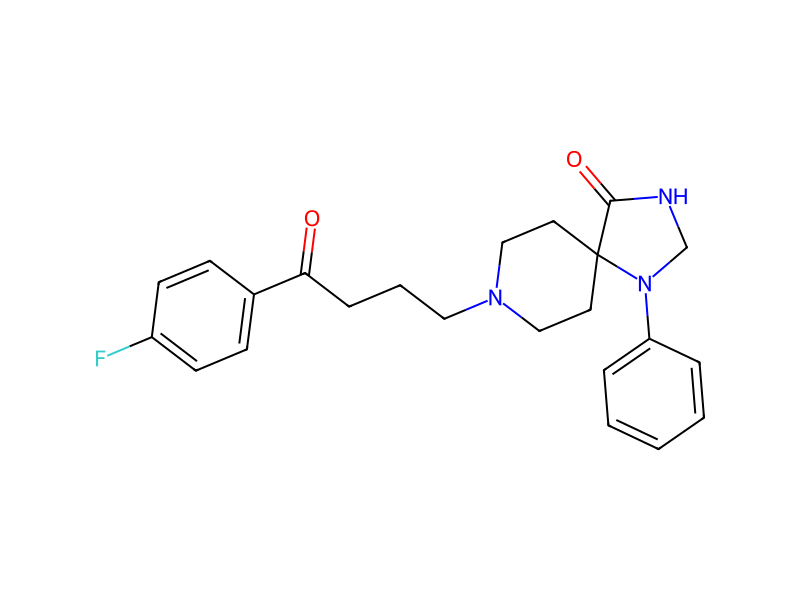
Basic information
- Standard SMILES
O=C(CCCN1CCC2(CC1)C(=O)NCN2c1ccccc1)c1ccc(F)cc1- InChIKey
DKGZKTPJOSAWFA-UHFFFAOYSA-N- Molecular formula
- C23H26FN3O2
- Average molar mass
- 395.5 g/mol
- Monoisotopic mass
- 395.20090529
Overview
Spiperone is an azaspiro compound that is 1,3,8-triazaspiro[4.5]decane which is substituted at positions 1, 4, and 8 by phenyl, oxo, and 4-(p-fluorophenyl)-4-oxobutyl groups, respectively. It has a role as a psychotropic drug, an antipsychotic agent, an alpha-adrenergic antagonist, a serotonergic antagonist and a dopaminergic antagonist. It is a member of piperidines, an azaspiro compound, an organofluorine compound, a tertiary amino compound and an aromatic ketone.
Names & identifiers
- Preferred name
- Spiperone
- IUPAC
- 8-[4-(4-fluorophenyl)-4-oxobutyl]-1-phenyl-1,3,8-triazaspiro[4.5]decan-4-one
- English name
- SPIPERONE
- Molecular formula
- C23H26FN3O2
- Molecular weight
- 395.47
Names & synonyms
spiperone749-02-0SpiropitanSpiroperidolEspiperonaSpiperonum8-[4-(4-fluorophenyl)-4-oxobutyl]-1-phenyl-1,3,8-triazaspiro[4.5]decan-4-oneR 5147DTXSID50452058-(3-(p-Fluorobenzoyl)propyl)-1-phenyl-1,3,8-triazaspiro(4.5)decan-4-one8-(3-p-Fluorobenzoyl-1-propyl)-4-oxo-1-phenyl-1,3,8-triazaspiro(4,5)decaneR-5147
Show more names
r5147SpiperonLuopenglongSpiperone-d5SpiperoneHClSpiroperidoneSpiperone, 10 mM in DMSO
NSC-1709834X6E73CJ0Q1,3,8-Triazaspiro(4.5)decan-4-one, 8-(4-(4-fluorophenyl)-4-oxobutyl)-1-phenyl-CHEBI:9233DTXCID30252058-(4-(4-Fluorophenyl)-4-oxobutyl)-1-phenyl-1,3,8-triazaspiro[4.5]decan-4-one8-[3-(p-Fluorobenzoyl)propyl]-1-phenyl-1,3,8-triazaspiro[4.5]decan-4-oneSpiroperone
Database identifiers
- CAS
749-02-0- PubChem CID
- 5265
- DTXSID
DTXSID5045205- ChEMBL
CHEMBL267930- ChEBI
CHEBI:9233- UNII
- 4X6E73CJ0Q
- EC Number
- 212-024-0
- Nikkaji
- J3.320K
Properties
Computed structural properties
- XLogP
- 3
- Topological polar surface area
- 52.7 Ų
- Hydrogen bond donors
- 1
- Hydrogen bond acceptors
- 5
- Rotatable bonds
- 6
- Heavy atoms
- 29
- Formal charge
- 0
- Complexity
- 577
Experimental & physicochemical properties
Solubility50.1 [ug/mL] (The mean of the results at pH 7.4)
Collision Cross Section
193.8 Ų [M+H]+ [CCS Type: TW; Method: calibrated with polyalanine and drug standards]
199.03 Ų [M+Na]+ [CCS Type: TW; Method: calibrated with polyalanine and drug standards]
Physicochemical properties
- Melting point
- 190 · 190-193.60C
- Boiling point
- 630.6 · 630.6±55.0 °C(Predicted)
- Density
- 1.1714 · 1.1714 (estimate)
- storage temp.
- Store at RT
- solubility
- 2 O: · H2O: slightly soluble0.2mg/mL
- pka
- 8.31 · pKa 8.31 (Uncertain);9.09 (Uncertain)
- form
- solid
- color
- light yellow
- Water Solubility
- 32 mg/L · 32mg/L(22 ºC)
- InChI
- 1S/C23H26FN3O2/c24-19-10-8-18(9-11-19)21(28)7-4-14-26-15-12-23(13-16-26)22(29)25-17-27(23)20-5-2-1-3-6-20/h1-3,5-6,8-11H,4,7,12-17H2,(H,25,29)
- InChIKey
- DKGZKTPJOSAWFA-UHFFFAOYSA-N
- SMILES
- Fc1ccc(cc1)C(=O)CCCN2CCC3(CC2)N(CNC3=O)c4ccccc4
- FDA UNII
- 4 X6E73CJ0Q · 4X6E73CJ0Q
- UNSPSC Code
- 12352200 · 12352200
- NACRES
- 77 · NA.77
- Symbol(GHS)
- 7 · GHS07,GHS08
- Signal word
- Warning
- Hazard statements
- 302 · H302-H361
- Precautionary statements
- 201 · P201-P301+P312+P330-P308+P313
- PPE
- 3 · Eyeshields, Gloves, type P3 (EN 143) respirator cartridges
- Hazard Codes
- Xn
- Risk Statements
- 22 · 22-63
- Safety Statements
- 36 · 36/37
- WGK Germany
- 3 · 3
- RTECS
- 8925000 · XX8925000
- Storage Class
- 11 · 11 - Combustible Solids
- Hazard Classifications
- 4 OralRepr · Acute Tox. 4 OralRepr. 2
Safety & regulation
GHS classification
GHS Classification
Warning
H302 (98.5%): Harmful if swallowed [Warning Acute toxicity, oral]
P203, P264, P270, P280, P301+P317, P318, P330, P405, and P501 (click each P-code to see the statement)
Aggregated GHS information provided per 68 reports by companies from 3 notifications to the ECHA C&L Inventory. Each notification may be associated with multiple companies.
Hazard information
Hazard Classes and CategoriesAcute Tox. 4 (98.5%)
Safety data
- PPE
- Eyeshields, Gloves, type P3 (EN 143) respirator cartridges
- wgk
- 3
- rtecs
- XX8925000
- risk_code
- 22-63
- Signal word
- Warning
- Symbol(GHS)
- GHS07,GHS08
- hazard_code
- Xn
- safety_code
- 36/37
- Storage Class
- 11 - Combustible Solids
- Hazard statements
- H302-H361
- Hazard Classifications
- Acute Tox. 4 OralRepr. 2
- Precautionary statements
- P201-P301+P312+P330-P308+P313
Chemistry & industry
Pharmacology
MeSH Pharmacological Classification
Agents that control agitated psychotic behavior, alleviate acute psychotic states, reduce psychotic symptoms, and exert a quieting effect. They are used in SCHIZOPHRENIA; senile dementia; transient psychosis following surgery; or MYOCARDIAL INFARCTION; etc. These drugs are often referred to as neuroleptics alluding to the tendency to produce neurological side effects, but not all antipsychotics are likely to produce such effects. Many of these drugs may also be effective against nausea, emesis, and pruritus.
Drugs that bind to but do not activate DOPAMINE RECEPTORS, thereby blocking the actions of dopamine or exogenous agonists. Many drugs used in the treatment of psychotic disorders (ANTIPSYCHOTIC AGENTS) are dopamine antagonists, although their therapeutic effects may be due to long-term adjustments of the brain rather than to the acute effects of blocking dopamine receptors. Dopamine antagonists have been used for several other clinical purposes including as ANTIEMETICS, in the treatment of Tourette syndrome, and for hiccup. Dopamine receptor blockade is associated with NEUROLEPTIC MALIGNANT SYNDROME.
Applications
UsesSpiperone is an antipsychotic.
Usesantibacterial
General DescriptionSpiperone is a butyrophenone antipsychotic agent. It induces calcium-dependent chloride secretion in the airway and functions as a potential therapeutic target for cystic fibrosis.
Upstream & downstream products
Upstream raw materials
Downstream products
Suppliers33 total
Career Henan Chemica Co+86-0371-86658258 +86-13203830695 · [email protected]
武汉英诺医药科技有限公司+86-027-59232304 15387063101 · [email protected]
成都超九八生物科技有限公司13348960310 13348960310 · [email protected]
武汉易泰科技有限公司上海分公司18930552037 · [email protected]
安耐吉化学&3A(安徽泽升科技有限公司)021-58432009 400-005-6266 · [email protected]
InvivoChem中国13549236410 · [email protected]
銳迪國際科技有限公司18024082417 · [email protected]
Zhejiang J&C Biological Technology Co.,Limited+1-2135480471 · [email protected]
上海喀露蓝科技有限公司18149758185 18149758185 · [email protected]
上海寰川实业有限公司021-61478794 · [email protected]
凯试(上海)科技有限公司021-50135380 · [email protected]
Sigma-Aldrich西格玛奥德里奇(上海)贸易有限公司021-61415566 800-8193336 · [email protected]
上海泽涵生物医药科技有限公司021-61350663 13052117465 · [email protected]
上海陶术生物科技股份有限公司+1-781-999-5354; +1-00000000000 · [email protected]
HANGZHOU LEAP CHEM CO., LTD.+86-571-87711850 +86-15355479329 · [email protected]
艾吉析科技(上海)有限公司17721401538;17717235263 17721401538 · [email protected]
陕西缔都医药化工有限公司029-029-81120477 17792793610 · [email protected]
武汉多普乐生物医药有限公司+86-02787215551 19945035818 · [email protected]
上海珞珐生化科技有限公司021-51111890 15317326293 · [email protected]
EMMX Biotechnology LLC888-539-0666 · [email protected]
上海源叶生物科技有限公司13636370518 · [email protected]
上海陶术生物科技股份有限公司13564774135 · [email protected]
上海凯裕医药科技有限公司17317130613 · [email protected]
深圳聚合生化科技有限公司+86-400-002-6226 · [email protected]
湖北玖天生物医药科技有限公司027-88013699 17354350817 · [email protected]
TargetMol中国(陶术生物)4008200310 15002144251 · [email protected]
广东翁江化学试剂有限公司0751-2815983 13927872582 · [email protected]
北京百灵威科技有限公司18210857532 18210857532 · [email protected]
上海陶术生物科技股份有限公司+1-781-999-5354 · [email protected]
Hefei TNJ Chemical Industry Co.,Ltd.+86-0551-65418671 +86-189 4982 3763 · [email protected]
南京世洲生物科技有限公司025-85560043 15850508050 · [email protected]
上海阿摩尔生物科技有限公司13370042665 18916960931 · [email protected]
上海安毕达生物科技有限公司021-61629020 18201956406 · [email protected]
Additional notes
DefinitionChEBI: An azaspiro compound that is 1,3,8-triazaspiro[4.5]decane which is substituted at positions 1, 4, and 8 by phenyl, oxo, and 4-(p-fluorophenyl)-4-oxobutyl groups, respectively.
Related reactions
13 records





Linked notes
Loading…