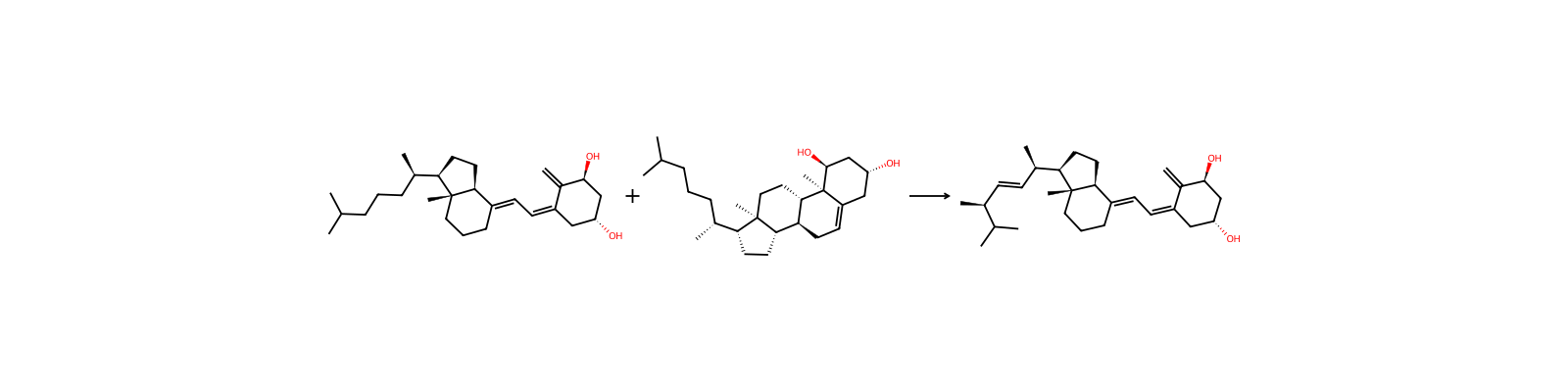
HRID 348784As reactant

54573-75-0C=C1/C(=C\C=C2/CCC[C@]3(C)[C@@H]([C@H](C)/C=C/[C@H](C)C(C)C)CC[C@@H]23)C[C@@H](O)C[C@@H]1OHKXBNHCUPKIYDM-CGMHZMFXSA-NDoxercalciferol is a hydroxy seco-steroid and synthetic vitamin D2 analogue that undergoes metabolic activation in vivo to form 1alpha,25-dihydroxyvitamin D2 (1alpha,25-(OH)2D2), a naturally occurring, biologically active form of vitamin D2. It is used to treat secondary hyperparathyroidism, a condition in which the body produces excess parathyroid hormone (PTH; a natural substance needed to control the amount of calcium in the blood) in certain people with chronic kidney disease. It has a role as a provitamin, a bone density conservation agent and a prohormone. It is a vitamin D and a hydroxy seco-steroid.
54573-75-0DTXSID1034214CHEMBL1200810CHEBI:4712FDA approved drugs -> Active ingredient
FDA approved drugs -> Active ingredient
Safety information is for reference only and does not replace the supplier’s Safety Data Sheet (SDS), applicable regulations, or professional assessment.
Danger
H300 (100%): Fatal if swallowed [Danger Acute toxicity, oral]
P264, P270, P301+P316, P321, P330, P405, and P501 (click each P-code to see the statement)
Aggregated GHS information provided per 51 reports by companies from 2 notifications to the ECHA C&L Inventory.
Drug Induced Liver Injury Rank (DILIrank 2.0)
Doxercalciferol
Ambiguous-DILI-concern
3
Adverse reactions
DOI:10.1016/j.drudis.2016.02.015
H - Systemic hormonal preparations, excl. sex hormones and insulins
QH - Systemic hormonal preparations, excl. sex hormones and insulin
Calcitriol (1α,25-(OH)2D3) and 1α,25-(OH)2D2 regulate blood calcium at levels required for essential body functions. Specifically, the biologically active vitamin D metabolites control the intestinal absorption of dietary calcium, the tubular reabsorption of calcium by the kidney and, in conjunction with parathyroid hormone (PTH), the mobilization of calcium from the skeleton. They act directly on bone cells (osteoblasts) to stimulate skeletal growth, and on the parathyroid glands to suppress PTH (parathyroid hormone) synthesis and secretion. These functions are mediated by the interaction of these biologically active metabolites with specific receptor proteins in the various target tissues. In patients with chronic kidney disease (CKD), deficient production of biologically active vitamin D metabolites (due to lack of or insufficient 25-hydroxyvitamin D-1-alpha-hydroxylase activity) leads to secondary hyperparathyroidism, which contributes to the development of metabolic bone disease.
Doxercalciferol is absorbed from the gastrointestinal tract and activated by CYP 27 in the liver to form 1α,25-(OH)2D2 (major metabolite) and 1α,24-dihydroxyvitamin D2 (minor metabolite). Activation of doxercalciferol does not require the involvement of the kidneys.
3DIZ9LF5Y9
DOXERCALCIFEROL
Chemical Structure [CS] - Ergocalciferols
Established Pharmacologic Class [EPC] - Vitamin D2 Analog
Doxercalciferol is a Vitamin D2 Analog.
DOXERCALCIFEROL
Organic substances that are required in small amounts for maintenance and growth, but which cannot be manufactured by the human body.
Agents that inhibit BONE RESORPTION and/or favor BONE MINERALIZATION and BONE REGENERATION. They are used to heal BONE FRACTURES and to treat METABOLIC BONE DISEASES such as OSTEOPOROSIS.
DescriptionDoxercalciferol is a synthetic vitamin D2 analog introduced in the US as Hectorol for the treatment of secondary hyperparathyroidism (SHPT) in patients with end-stage renal failure. It is actually 1-alpha-hydroxyvitamin D2 (one-alpha- D2) and can be synthesized by direct hydroxylation of vitamin D2 tosylate or in 5 steps from ergosterol. Doxercalciferol itself is inactive until metabolized by the liver into active 1,24-dihydroxyvitamin D2, showing a pharmacokinetic profile similar to calcitriol. During placebo-controlled clinical trials, patients with moderate to severe SHPT were treated with 1-alpha-D2 (10 μg doses) for 16 to 24 weeks; in 9 patients out of 10, blood levels of parathyroid hormone were considerably reduced, so maintaining a good control of the parathyroid hyperplasia. Moreover, only a moderate tendency to raise calcium and phosphate was observed. Doxercalciferol is orally-active and less toxic than other vitamin D analogs like alfacalcidol; it shows differentially controlled effects and has an improved safety profile compared to calcitriol.
UsesSynthetic vitamin D prohormone. A new active Vitamin D analog which inhibits growth of human neuroblastoma. Antihyperparathyroid
DefinitionChEBI: Doxercalciferol is a hydroxy seco-steroid and synthetic vitamin D2 analogue that undergoes metabolic activation in vivo to form 1alpha,25-dihydroxyvitamin D2 (1alpha,25-(OH)2D2), a naturally occurring, biologically active form of vitamin D2. It is used to treat secondary hyperparathyroidism, a condition in which the body produces excess parathyroid hormone (PTH; a natural substance needed to control the amount of calcium in the blood) in certain people with chronic kidney disease. It has a role as a provitamin, a bone density conservation agent and a prohormone. It is a vitamin D and a hydroxy seco-steroid.