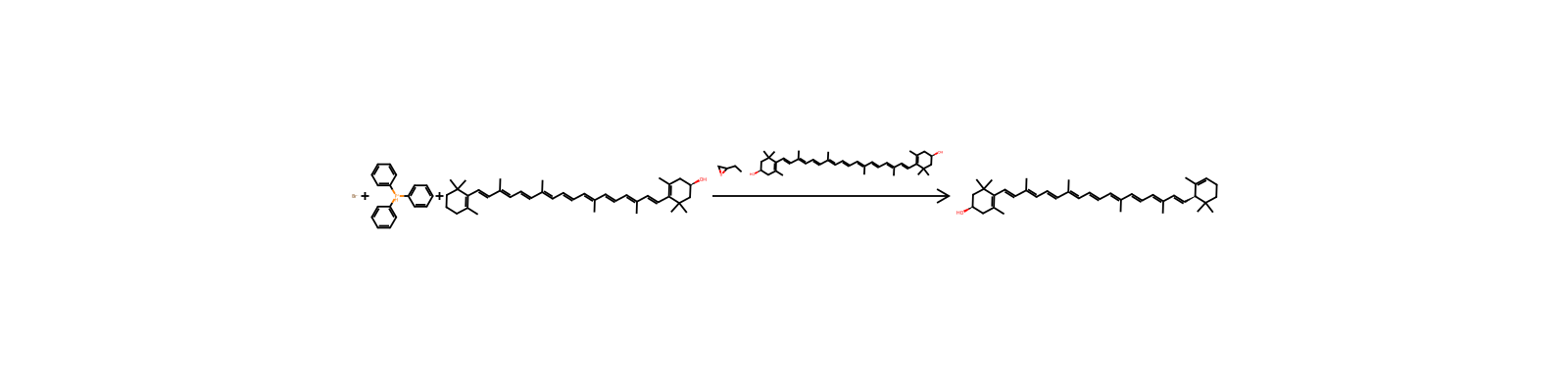
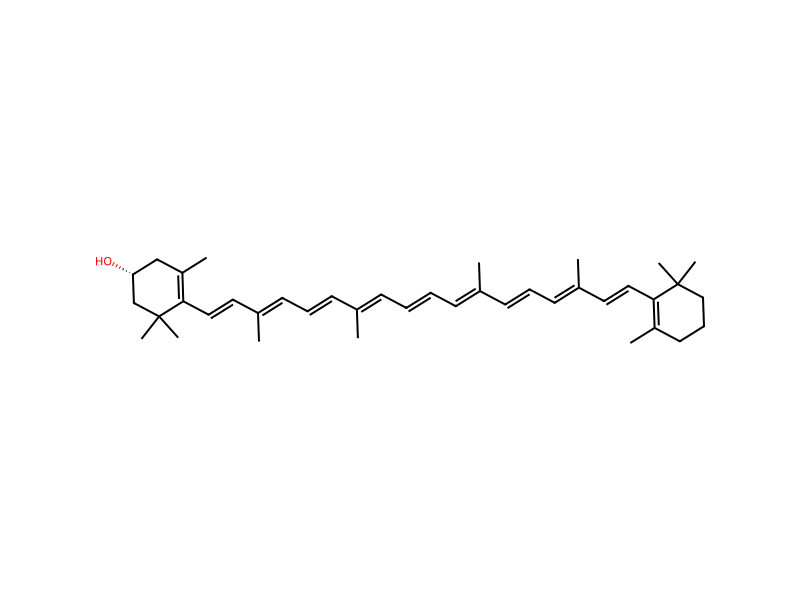
Basic information
- Standard SMILES
CC1=C(/C=C/C(C)=C/C=C/C(C)=C/C=C/C=C(C)/C=C/C=C(C)/C=C/C2=C(C)C[C@@H](O)CC2(C)C)C(C)(C)CCC1- InChIKey
DMASLKHVQRHNES-FKKUPVFPSA-N- Molecular formula
- C40H56O
- Average molar mass
- 552.9 g/mol
- Monoisotopic mass
- 552.43311641
Names & identifiers
- Preferred name
- Cryptoxanthin
- IUPAC
- (1R)-3,5,5-trimethyl-4-[(1E,3E,5E,7E,9E,11E,13E,15E,17E)-3,7,12,16-tetramethyl-18-(2,6,6-trimethylcyclohexen-1-yl)octadeca-1,3,5,7,9,11,13,15,17-nonaenyl]cyclohex-3-en-1-ol
- English name
- B-CRYPTOXANTHIN
- Molecular formula
- C40H56O
- Molecular weight
- 552.87
Names & synonyms
beta-CryptoxanthinCryptoxanthin472-70-8CryptoxanthineCryptoxantholbeta-Caroten-3-olCryptoxanthinsKryptoxanthinNeocryptoxanthinNeo-beta-cryptoxanthin3-Hydroxy-beta-carotene6ZIB13GI33
Show more names
β-CryptoxanthinE 161cCaricaxanthinβ-caroten-3-olB-CRYPTOXANTHIN
beta,beta-Caroten-3-ol, (3R)-(1R)-3,5,5-trimethyl-4-[(1E,3E,5E,7E,9E,11E,13E,15E,17E)-3,7,12,16-tetramethyl-18-(2,6,6-trimethylcyclohexen-1-yl)octadeca-1,3,5,7,9,11,13,15,17-nonaenyl]cyclohex-3-en-1-olCHEBI:10362DTXSID30912309Beta Caroten 3 olBeta Cryptoxanthin(1R)-3,5,5-trimethyl-4-((1E,3E,5E,7E,9E,11E,13E,15E,17E)-3,7,12,16-tetramethyl-18-(2,6,6-trimethylcyclohexen-1-yl)octadeca-1,3,5,7,9,11,13,15,17-nonaenyl)cyclohex-3-en-1-olRefChem:33778
Database identifiers
- CAS
472-70-8- PubChem CID
- 5281235
- DTXSID
DTXSID30912309- ChEBI
CHEBI:10362- UNII
- 6ZIB13GI33
- Nikkaji
- J5.952H
Properties
Computed structural properties
- XLogP
- 12.3
- Topological polar surface area
- 20.2 Ų
- Hydrogen bond donors
- 1
- Hydrogen bond acceptors
- 1
- Rotatable bonds
- 10
- Heavy atoms
- 41
- Formal charge
- 0
- Complexity
- 1,250
Experimental & physicochemical properties
Melting Point172 - 173 °C
Physical DescriptionSolid
Physicochemical properties
- Melting point
- 167 ℃ · 167℃
- Boiling point
- 563.32 °C · 563.32°C (rough estimate)
- Density
- 0.974 · 0.974±0.06 g/cm3 (20 ºC 760 Torr)
- refractive index
- 1.48 · 1.4800 (estimate)
- storage temp.
- -20 °C · -20°C
- solubility
- 1 mg/mL · chloroform: soluble1mg/mL
- pka
- 14.9 · 14.90±0.70(Predicted)
- form
- Solid
- color
- Red to dark red
- InChIKey
- DMASLKHVQRHNES-FKKUPVFPSA-N
- SMILES
- CC(=C\C=C\C=C(C)\C=C\C=C(C)\C=C\C1=C(C)C[C@@H](O)CC1(C)C)/C=C/C=C(C)/C=C/C2=C(C)CCCC2(C)C
- LogP
- 13.67 · 13.670 (est)
- FDA UNII
- 6 ZIB13GI33 · 6ZIB13GI33
- UNSPSC Code
- 12352205 · 12352205
- NACRES
- 79 · NA.79
- Symbol(GHS)
- 7 · GHS07
- Signal word
- Warning
- Hazard statements
- 315 · H315-H319-H335
- Precautionary statements
- 261 · P261-P305+P351+P338
- WGK Germany
- 3 · 3
- HS Code
- 29062990 · 29062990
- Storage Class
- 11 · 11 - Combustible Solids
Safety & regulation
Hazard information
Regulatory Information
Regulation (EC) No 178/2002 (amended)
.beta.,.beta.-Caroten-3-ol, (3R)-: Does not have an individual approval but may be used as a component in a product covered by a group standard. It is not approved for use as a chemical in its own right.
Regulatory information
Regulatory Information
Regulation (EC) No 178/2002 (amended)
.beta.,.beta.-Caroten-3-ol, (3R)-: Does not have an individual approval but may be used as a component in a product covered by a group standard. It is not approved for use as a chemical in its own right.
Safety data
- wgk
- 3
- hs_code
- 29062990
- Signal word
- Warning
- Symbol(GHS)
- GHS07
- Storage Class
- 11 - Combustible Solids
- Hazard statements
- H315-H319-H335
- Precautionary statements
- P261-P305+P351+P338
Chemistry & industry
Pharmacology
MeSH Pharmacological ClassificationPrecursor forms of vitamins.
Cellular LocationsExtracellular;Membrane
Applications
UsesA natural caratenoid pigment that is converted to Vitamin A in the human body. It is an antioxidant and may help prevent free radical damage to cells and DNA, as well as stimulate the repair of oxidative damage to DNA. A potential chemopreventative agent against lung cancer as well as other types of cancer.
Usesβ-Cryptoxanthin has also been used to study its effect on the production of immunoglobulins in Peyer′s patch cells ex- vivo. It has also been used as a standard in high-performance liquid chromatography (HPLC analysis).(5)
General Descriptionβ-Cryptoxanthin is an oxygen-containing carotenoid and is a member of the xanthophyll family. It is one of the major sources of vitamin A and is present in fruits such as oranges, tangerines and papayas. In addition, it is also found in corn, peas and some animal products such as egg yolk and butter.
Upstream & downstream products
Upstream raw materials
Suppliers50 total
南京世洲生物科技有限公司025-85560043 15850508050 · [email protected]
Career Henan Chemica Co+86-0371-86658258 +86-13203830695 · [email protected]
成都超九八生物科技有限公司13348960310 13348960310 · [email protected]
合肥翰刚医药科技有限公司+8618062405514 · [email protected]
武汉众志诚生物技术有限公司13628624121 13628604890 · [email protected]
上海纽雀客生物科技有限公司13916276291 · [email protected]
上海赛可锐生物科技有限公司021-58000709 13120558703 · [email protected]
湖北丹鼎医药科技有限公司17701422019 17701422019 · [email protected]
上海颖心实验室设备有限公司021-59178156 17002132182 · [email protected]
安耐吉化学&3A(安徽泽升科技有限公司)021-58432009 400-005-6266 · [email protected]
成都普思生物科技股份有限公司028-85370565-229 18080489829 · [email protected]
凯试(上海)科技有限公司021-50135380 · [email protected]
武汉丰泰威远科技有限公司+86-27-8746-5837 +86-18627785180 · [email protected]
武汉市皇臻生物化工有限公司13795480948 · [email protected]
武汉丰泰威远科技有限公司027-87465837 19945049750 · [email protected]
HONG KONG IPURE BIOLOGY CO.,LIMITED86 18062405514 18062405514 · [email protected]
TargetMol 中国(陶术生物)400-821-0310 15002144251 · [email protected]
Shijiazhuang Jianxin Biotechnology Co., LTD+undefined-86-1906231316-9 +86-19062313169 · [email protected]
天津普西唐生物医药科技有限公司010-60605840 · [email protected]
上海永叶生物科技有限公司86-021-61559134 15921386130 · [email protected]
江苏艾康生物医药研发有限公司025-66028182 17714375163 · [email protected]
北京市斯旺达康科贸有限公司010-57203829
Sigma-Aldrich西格玛奥德里奇(上海)贸易有限公司021-61415566 800-8193336 · [email protected]
上海一研生物科技有限公司021-69985186 13611928337 · [email protected]
上海昕凯医药科技有限公司21-619849051-1 18521059765 · [email protected]
上海陶术生物科技股份有限公司+1-781-999-5354; +1-00000000000 · [email protected]
Hangzhou Hyper Chemicals Limited+86-0086-57187702781 +86-13675893055 · [email protected]
上海源叶生物科技有限公司13636370518 · [email protected]
上海澄绍生物科技有限公司021-61847300 13341622919 · [email protected]
安徽酷尔生物工程有限公司0551-65171243 13856024262 · [email protected]
湖北扬信医药科技有限公司15374522761 · [email protected]
深圳市祥根生物医药有限公司0755-28967200 13631290199 · [email protected]
Shanghai Acmec Biochemical Technology Co., Ltd.+86-18621343501 · [email protected]
河南天孚化工有限公司+86-0371-55170693 +86-19937530512 · [email protected]
上海吉至生化科技有限公司021-4009004166/18616739031 18616739031 · [email protected]
北京沃凯生物科技有限公司010-62971590 18548936886 · [email protected]
上海哲研生物科技有限公司18017610038 · [email protected]
深圳聚合生化科技有限公司+86-400-002-6226 · [email protected]
河南威梯希化工科技有限公司0371-63284658 18135795563 · [email protected]
浙江联硕生物科技有限公司18616526224 · [email protected]
湖北摆渡化学有限公司027-59106051 13627137652 · [email protected]
SHANGHAI KEAN TECHNOLOGY CO., LTD.+8613817748580 · [email protected]
上海贝万塔生物科技有限公司021-67187366 19901745723 · [email protected]
湖北萃园生物科技有限公司18162795156 18162795156 · [email protected]
BOC Sciences+1-631-485-4226 · [email protected]
陕西缔都医药化工有限公司+86-29-81139210 17389186172 · [email protected]
ChemeGen 中国18818260767 · [email protected]
上海智溯科生物科技有限公司021-58056897 15399714481 · [email protected]
TargetMol中国(陶术生物)15002134094 · [email protected]
上海甄准生物科技有限公司18019219489 18901678489 · [email protected]
Additional notes
DefinitionChEBI: A carotenol that exhibits antioxidant activity. It has been isolated from fruits such as papaya and oranges.
Related reactions
1 records
Linked notes
Loading…