
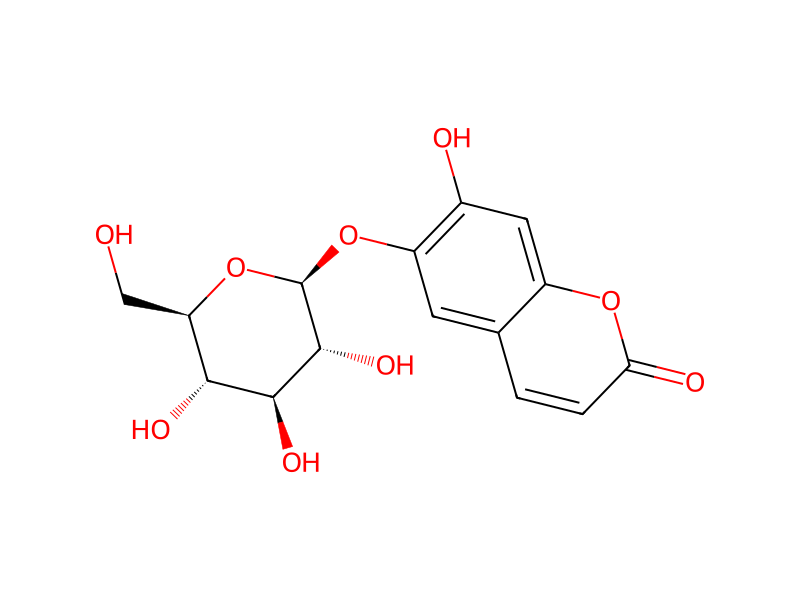
Basic information
- CAS
531-75-9- Standard SMILES
O=c1ccc2cc(O[C@@H]3O[C@H](CO)[C@@H](O)[C@H](O)[C@H]3O)c(O)cc2o1- InChIKey
XHCADAYNFIFUHF-TVKJYDDYSA-N- Molecular formula
- C15H16O9
- Average molar mass
- 340.28 g/mol
- Monoisotopic mass
- 340.07943208
Names & identifiers
- Preferred name
- Esculin
- IUPAC
- 7-hydroxy-6-[(2S,3R,4S,5S,6R)-3,4,5-trihydroxy-6-(hydroxymethyl)oxan-2-yl]oxychromen-2-one
- English name
- Esculin
- Molecular formula
- C15H16O9
- Molecular weight
- 340.28
Names & synonyms
Esculin531-75-9Esculetin 6-O-glucoside6,7-Dihydroxycoumarin 6-glucosideEsculetin 6-beta-D-glucoside6,7-Dihydroxycoumarin-6-O-glucoside7-Hydroxy-6-cumarinyl-glucosidDTXSID70453186-(beta-D-Glucopyranosyloxy)-7-hydroxy-cumarin1Y1L18LQAFCHEBI:4853NSC-26665
Show more names
EsculineEscosylBICOLOINAESCULINPOLYDROMBicolorinCrataeginPolychromvitaminc2
DTXCID50253187-hydroxy-6-[(2S,3R,4S,5S,6R)-3,4,5-trihydroxy-6-(hydroxymethyl)oxan-2-yl]oxychromen-2-one7-hydroxy-2-oxo-2H-chromen-6-yl beta-D-glucopyranoside2H-1-Benzopyran-2-one, 6-(beta-D-glucopyranosyloxy)-7-hydroxy-7-hydroxy-6-((2S,3R,4S,5S,6R)-3,4,5-trihydroxy-6-(hydroxymethyl)oxan-2-yl)oxychromen-2-oneRefChem:35731208-517-5686-183-3
Database identifiers
- CAS
531-75-9- PubChem CID
- 5281417
- DTXSID
DTXSID7045318- ChEMBL
CHEMBL482581
Properties
Computed structural properties
- XLogP
- -0.6
- Topological polar surface area
- 146 Ų
- Hydrogen bond donors
- 5
- Hydrogen bond acceptors
- 9
- Rotatable bonds
- 3
- Heavy atoms
- 24
- Formal charge
- 0
- Complexity
- 495
Experimental & physicochemical properties
Melting Point205 °C
Physical DescriptionSolid
Collision Cross Section
174 Ų [M+H]+ [CCS Type: TW; Method: calibrated with polyalanine and drug standards]
193.73 Ų [M+K]+ [CCS Type: TW; Method: calibrated with polyalanine and drug standards];182.53 Ų [M+Na]+ [CCS Type: TW; Method: calibrated with polyalanine and drug standards];164.77 Ų [M+H-H2O]+ [CCS Type: TW; Method: calibrated with polyalanine and drug standards];172.99 Ų [M+H]+ [CCS Type: TW; Method: calibrated with polyalanine and drug standards]
Physicochemical properties
- Melting point
- 203 °C · 203 °C
- alpha
- -88 · -88 º (c=2,dioxane/water1:1)
- Boiling point
- 396.1 °C · 396.1°C (rough estimate)
- Density
- 0.791 g/mL · 0.791 g/mL at 20 °C
- vapor pressure
- 0 Pa · 0Pa at 25℃
- refractive index
- -79 ° · -79 ° (C=2.4, 50% Dioxane)
Safety & regulation
Safety information is for reference only and does not replace the supplier’s Safety Data Sheet (SDS), applicable regulations, or professional assessment.
GHS classification
GHS Classification
This chemical does not meet GHS hazard criteria for 100% (137 of 137) of all reports.
Not Classified;Reported as not meeting GHS hazard criteria by 137 of 137 companies. For more detailed information, please visit ECHA C&L website.
Aggregated GHS information provided per 137 reports by companies from 1 notifications to the ECHA C&L Inventory.;Reported as not meeting GHS hazard criteria per 137 of 137 reports by companies.;There are 0 notifications provided by 0 of 137 reports by companies with hazard statement code(s).;Information may vary between notifications depending on impurities, additives, and other factors. The percentage value in parenthesis indicates the notified classification ratio from companies that provide hazard codes. Only hazard codes with percentage values above 10% are shown. For more detailed information, please visit ECHA C&L website.
Not Classified;Reported as not meeting GHS hazard criteria by 1 of 1 companies. For more detailed information, please visit ECHA C&L website.
Hazard information
Regulatory Information
Chemical: 2H-1-Benzopyran-2-one, 6-(.beta.-D-glucopyranosyloxy)-7-hydroxy-
Status: Active Update: 12-07-2018 https://echa.europa.eu/registration-dossier/-/registered-dossier/25090
2H-1-Benzopyran-2-one, 6-(.beta.-D-glucopyranosyloxy)-7-hydroxy-: Does not have an individual approval but may be used under an appropriate group standard
Hazard Classes and Categories
Not Classified
Not Classified
Regulatory information
Regulatory Information
Chemical: 2H-1-Benzopyran-2-one, 6-(.beta.-D-glucopyranosyloxy)-7-hydroxy-
Chemistry & industry
Pharmacology
PharmacodynamicsTopically applied Esculine increases the “capillary density” (the number of capillaries open to flow per surface unit) and improves the morphological aspect of the smallest blood vessels.
Mechanism of Action
The main activities of Esculine focus on capillary protection, as it improves capillary permeability and fragility. It is reported to inhibit catabolic enzymes such as hyaluronidase and collagenase, thus preserving the integrity of the perivascular connective tissue. Esculine also showed good antioxidant properties, protecting triglycerides against auto-oxidation at high temperatures . The antioxidant property might as well explain some of the anti-inflammatory activity of the product, making it a suitable product for after sun treatments, for example.
Biological Half-LifeAbsorption half life about 1 hour and elimination half life about 20 hours
Metabolism/Metabolites
After oral administration of esculin (100 mg/kg) for rats, plasma, urine, feces and bile samples were collected to screen metabolites. As a result, a total of 19 metabolites (10 phase I metabolites and 9 phase II metabolites) were found and identified. It was also found that after oral administration of esculin, the esculin could be metabolized to esculetin in vivo via deglycosylation, and esculetin was found in all biological samples.
Absorption, Distribution and ExcretionRarely, absorbed into the blood stream if used as a combination with other ingredients in suppository form. But, Applying cream or ointment form to open wound or skin may lead this drug to absorb and circulate into blood stream.
Cellular LocationsCytoplasm;Extracellular
Uses & manufacturing
Use ClassificationCosmetics -> Tonic
Related reactions
6 records





Compound notes
Loading…