
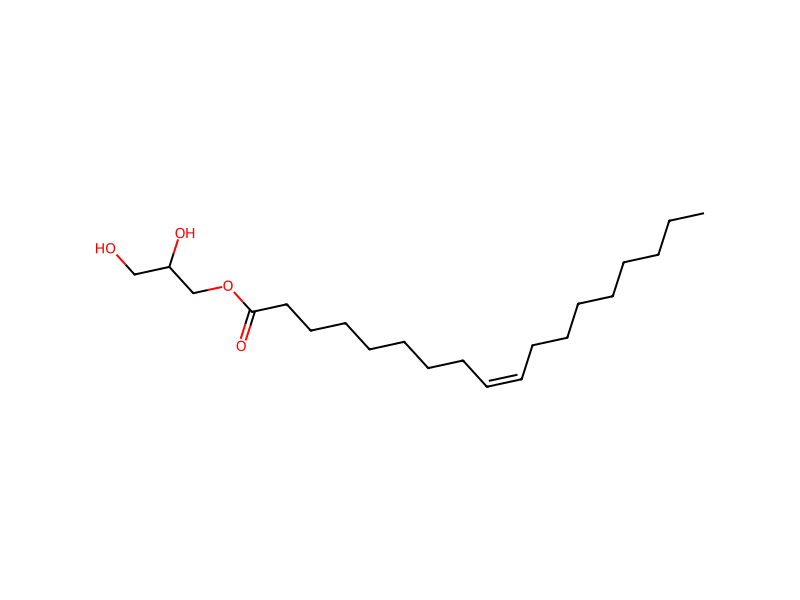
Basic information
- CAS
111-03-5- Standard SMILES
CCCCCCCC/C=C\CCCCCCCC(=O)OCC(O)CO- InChIKey
RZRNAYUHWVFMIP-KTKRTIGZSA-N- Molecular formula
- C21H40O4
- Average molar mass
- 356.5 g/mol
- Monoisotopic mass
- 356.29265976
Overview
1-oleoylglycerol is a 1-monoglyceride where the acyl group is oleoyl. It has a role as a plant metabolite. It is a 1-acylglycerol 18:1 and a monooleoylglycerol. It is functionally related to an oleic acid.
Names & identifiers
- Preferred name
- Glyceryl Monooleate
- IUPAC
- 2,3-dihydroxypropyl (Z)-octadec-9-enoate
- English name
- Glyceryl Monooleate
- Molecular formula
- C21H40O4
- Molecular weight
- 356.54
Names & synonyms
MonooleinGlyceryl monooleatealpha-MonooleinGLYCEROL MONOOLEATEGlycerol oleate25496-72-4Nikkol MGOMonoglyceryl oleateOleic monoglycerideGlycerine monooleateOleoylglycerolOlicine
Show more names
Glyceryl oleateGMO9-Octadecenoic acid (Z)-, 2,3-dihydroxypropyl ester1-Monooleoylglycerol1-OLEOYL-RAC-GLYCEROL1-OleoylglycerolAblunol GMO
Supeol1-Mono(cis-9-octacenoyl)glycerol2,3-dihydroxypropyl (Z)-octadec-9-enoateSinnoester ogcOleylmonoglycerideExcel O 95FDimodan LSQKEmalsy MO
Database identifiers
- CAS
111-03-5、25496-72-4- PubChem CID
- 5283468
- DTXSID
DTXSID3042003- ChEMBL
CHEMBL2075039、CHEMBL428593- ChEBI
CHEBI:75342- UNII
- D3AEF6S35P
- EC Number
- 203-827-7、247-038-6
- Nikkaji
- J5.104G
Properties
Computed structural properties
- XLogP
- 6.5
- Topological polar surface area
- 66.8 Ų
- Hydrogen bond donors
- 2
- Hydrogen bond acceptors
- 4
- Rotatable bonds
- 19
- Heavy atoms
- 25
- Formal charge
- 0
- Complexity
- 315
Experimental & physicochemical properties
Chemical ClassesOther Uses -> Emulsifiers/Surfactants
LipidsLipids -> Glycerolipids [GL] -> Monoradylglycerols [GL01] -> Monoacylglycerols [GL0101]
Fragrances
Fragrance Ingredient (9-Octadecenoic acid (Z)-, monoester with 1,2,3-propanetriol) -> IFRA transparency List
Fragrance Ingredient (Glyceryl monooleate) -> IFRA transparency List
SurfactantsSurfactant
OdorSWEET
TasteFATTY TASTE
Food AdditivesANTICAKING AGENT OR FREE-FLOW AGENT, DRYING AGENT, EMULSIFIER OR EMULSIFIER SALT, FLAVORING AGENT OR ADJUVANT, HUMECTANT -> FDA Substance added to food
Density
0.9420 @ 20 °C/4 °C
0.925-0.935
Color/Form
PLATES FROM ETHANOL
YELLOW OIL OR SOFT SOLID
Solubility
INSOL IN WATER; SOL IN ETHANOL, ETHER, CHLOROFORM
insoluble in water; soluble in hot organic solvents
soluble in hot alcohol (in ethanol)
Boiling Point
238-240 °C AT 3 MM HG
250 °C (8 mmHg)
Melting Point
25 °C (UNSTABLE)
MELTING POINT: 32 °C (UNSTABLE) /PRIMARY BETA FORM/; 35.5 °C (STABLE) /BETA FORM/
Physicochemical properties
- Melting point
- 35 · 35-37 °C
- Boiling point
- 409.35 °C · 409.35°C (rough estimate)
- Density
- 0.9407 g/cm3 · 0.9407 g/cm3 (35 ºC)
- refractive index
- 1.46384 · 1.46384 (589.3 nm 35℃)
- FEMA
- 2526 · 2526 | GLYCERYL MONOOLEATE
- Flash point
- 180 °C · 180 °C
- storage temp.
- 2 · 2-8°C
- solubility
- 50 mg/mL, · chloroform: 50 mg/mL, clear, colorless
- pka
- 13.16 · 13.16±0.20(Predicted)
- form
- Solid
- color
- White to Off-White
- Odor
- bland fatty waxy
- Odor Type
- bland
- biological source
- synthetic (organic)
- JECFA Number
- 919 · 919
- BRN
- 1728976 · 1728976
- Stability
- Hygroscopic
- Cosmetics Ingredients Functions
- PERFUMINGSURFACTANT - EMULSIFYINGSKIN CONDITIONING - EMOLLIENT
- Cosmetic Ingredient Review (CIR)
- Glyceryl Monooleate (111-03-5)
- InChI
- 1S/C21H40O4/c1-2-3-4-5-6-7-8-9-10-11-12-13-14-15-16-17-21(24)25-19-20(23)18-22/h9-10,20,22-23H,2-8,11-19H2,1H3/b10-9-
- InChIKey
- RZRNAYUHWVFMIP-KTKRTIGZSA-N
- SMILES
- O=C(CCCCCCC/C=C\CCCCCCCC)OCC(O)CO
- LogP
- 6.71 · 6.71
- CAS DataBase Reference
- 111 · 111-03-5(CAS DataBase Reference)
- FDA 21 CFR
- 175.3 · 175.300; 175.320; 181.27;184.1323
- EWG's Food Scores
- 1 · 1
- FDA UNII
- 3 AEF6S35P · D3AEF6S35P
- EPA Substance Registry System
- Glycerol monooleate (111-03-5)
- UNSPSC Code
- 12352211 · 12352211
- NACRES
- 25 · NA.25
- Symbol(GHS)
- 2 · GHS02,GHS07
- Signal word
- Danger
- Hazard statements
- 225 · H225-H302-H312-H332
- Precautionary statements
- 210 · P210-P280
- PPE
- 95 · Eyeshields, Gloves, type N95 (US)
- Hazard Codes
- F,Xn
- Risk Statements
- 11 · 11-20/21/22
- Safety Statements
- 36 · 36/37
- RIDADR
- 1282 · UN 1282 3/PG 2
- WGK Germany
- 1 · 1
- F
- 3 · 3
- TSCA
- TSCA listed
- HS Code
- 29161500 · 29161500
- Storage Class
- 11 · 11 - Combustible Solids
Safety & regulation
GHS classification
GHS Classification
This chemical does not meet GHS hazard criteria for 96.9% (492 of 508) of all reports.
Not Classified
Aggregated GHS information provided per 508 reports by companies from 5 notifications to the ECHA C&L Inventory.
This chemical does not meet GHS hazard criteria for 100% (260 of 260) of all reports.
Not Classified
Aggregated GHS information provided per 260 reports by companies from 1 notifications to the ECHA C&L Inventory.
Hazard information
Regulatory Information
Chemical: 9-Octadecenoic acid, monoester with 1,2,3-propanetriol, (Z)-
9-Octadecenoic acid (9Z)-, monoester with 1,2,3-propanetriol is listed on the EPA's Chemical Data Reporting (CDR) system. Manufacturers and importers of 9-Octadecenoic acid (9Z)-, monoester with 1,2,3-propanetriol are required to report information about their production and use of this chemical to the EPA under the Toxic Substances Control Act (TSCA). (40 eCFR Part 711)
1-Glyceryl monooleate: Does not have an individual approval but may be used under an appropriate group standard
Glyceryl monooleate: Does not have an individual approval but may be used under an appropriate group standard
Other Safety InformationIMAP assessments - 9-Octadecenoic acid, monoester with 1,2,3-propanetriol, (Z)-: Human health tier I assessment
Hazards SummaryMay cause mild irritation; [MSDSonline]
FDA Requirements
SYNTHETIC FLAVOR INGREDIENTS- GLYCERYL MONOOLEATE: REGULATION 172.515.
REGULATION FDA 121.1164; LIMITATIONS: SYNTHETIC FLAVOR.
EPA Safer Chemical
Chemical: Glyceryl monooleate
Chemical: Glyceryl monooleate [NF]
Hazard Classes and Categories
Not Classified
Not Classified
Toxicology
Human Toxicity Excerpts
TREATMENT OF HUMAN ERYTHROCYTE GHOST MEMBRANES WITH THE FUSOGENIC LIPID GLYCEROL MONOOLEATE INCREASED THE FLUIDITY OF THE MEMBRANE LIPIDS, BUT THE NONFUSOGENIC LIPID GLYCEROL MONOSTEARATE HAD NO EFFECT.
IF ANY OF THESE ESTERS IS SIGNIFICANTLY TOXIC, THE ACID PORTION MUST BE HELD RESPONSIBLE, NOT THE GLYCEROL. /GLYCEROL ESTERS/
Regulatory information
FDA Requirements
SYNTHETIC FLAVOR INGREDIENTS- GLYCERYL MONOOLEATE: REGULATION 172.515.
REGULATION FDA 121.1164; LIMITATIONS: SYNTHETIC FLAVOR.
Safety data
- F
- 3
- PPE
- Eyeshields, Gloves, type N95 (US)
- wgk
- 1
- tsca
- TSCA listed
- ridadr
- UN 1282 3/PG 2
- hs_code
- 29161500
- risk_code
- 11-20/21/22
- Signal word
- Danger
- Symbol(GHS)
- GHS02,GHS07
- hazard_code
- F,Xn
- safety_code
- 36/37
- Storage Class
- 11 - Combustible Solids
- Hazard statements
- H225-H302-H312-H332
- Precautionary statements
- P210-P280
Chemistry & industry
Uses & manufacturing
Uses
Used in foods, pharmaceuticals, cosmetics, rust-preventive oils, vinyl light stabilizers, odorless base paints, textile finishing, and flavoring; Used as emulsifier for liquid and paste waxes, polishes, and cleaners; [Hawley]
Painting (Pigments, Binders, and Biocides) [Category: Paint]
SURFACE-ACTIVE AGENT IN FOODS, PHARMACEUTICALS AND COSMETICS, ODORLESS BASE PAINTS, IN RUST-PREVENTIVE OILS, TEXTILE FINISHING, AND VINYL LIGHT STABILIZERS; FLAVORING INGREDIENT
U.S. Exports
(1972) No Data
(1975) No Data
U.S. Imports
(1972) No Data
(1975) No Data
U.S. Production
2023: 5,000,000 - <10,000,000 lb
(1972) 1.25X10+9 GRAMS
(1975) 1.71X10+9 GRAMS
Consumer UsesSurface modifier
Industry UsesLubricating agent
Methods of Manufacturing
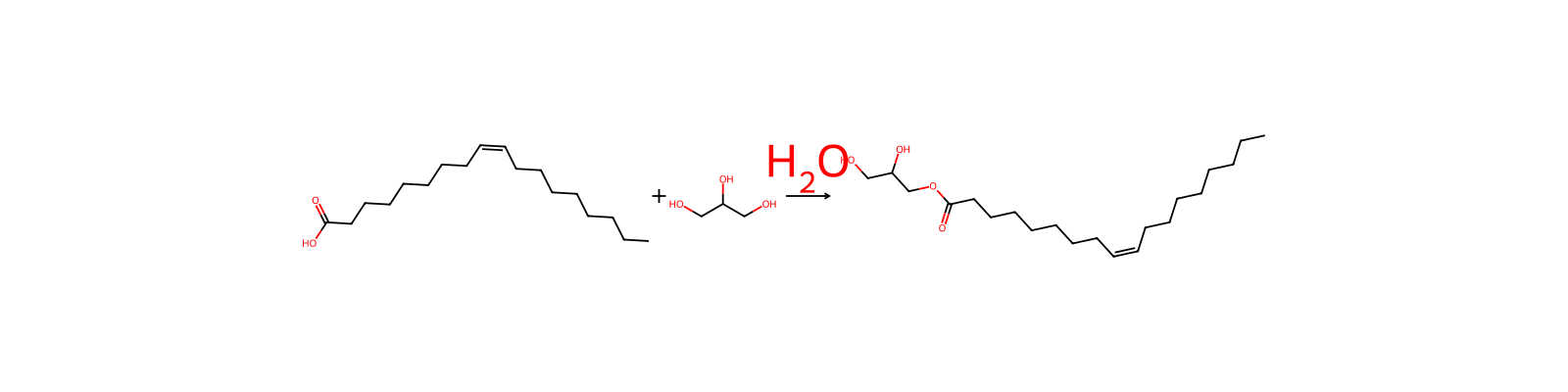
REACTION OF OLEIC ACID WITH GLYCEROL, PRODUCING A MIXTURE (PREDOMINANTLY MONOOLEATE)
SEE MONOGLYCERIDE. PRODUCED SYNTHETICALLY BY ALCOHOLYSIS OF FATS WITH GLYCEROL, YIELDING A MIXTURE OF MONO-, DI-, & TRIGLYCERIDES WHICH IS PREDOMINANTLY MONOGLYCERIDES. /MONOGLYCERIDE/
Formulations/PreparationsGRADES: EDIBLE; TECHNICAL.
Household ProductsInformation on 4 consumer products that contain Glycerol Oleate in the following categories is provided:
Use Classification
EPA Safer Chemical Functional Use Classes -> Surfactants
Safer Chemical Classes -> Green circle - The chemical has been verified to be of low concern
EPA Safer Chemical Functional Use Classes -> Surfactants
Safer Chemical Classes -> Green circle - The chemical has been verified to be of low concern
Fragrance Ingredients
Fragrance Ingredients
General Manufacturing Information
Wholesale and Retail Trade
9-Octadecenoic acid (9Z)-, 2,3-dihydroxypropyl ester: ACTIVE
9-Octadecenoic acid (9Z)-, monoester with 1,2,3-propanetriol: ACTIVE
FEMA NUMBER 2526
Applications
UsesMonoglycerides fatty acid esters 93% 1-Oleoyl, 7% 2-oleoyl.
Usesglyceryl oleate is an emollient and stabilizer derived from olive oil. It is a water-in-oil emulsifier that allows for softer emulsions than glyceryl stearate.
UsesGlyceryl Monooleate is a flavoring agent that is prepared by esterification of commercial oleic acid that is derived either from edible sources or from tall oil fatty acids. It contains and glyceryl esters of fatty acids present in commercial oleic acid. The ingredient is also used as an adjuvant and as a solvent and vehicle.
General Description1-Oleoyl-rac-glycerol is commonly known as monoolein (MO). It is an amphiphilic molecule that is made up of a glycerol backbone and a hydrocarbon chain.
Preparation methods
PreparationGlyceryl Monooleate is produced by esterification of Glycerin with Oleic acid in presence of a suitable catalyst.
Upstream & downstream products
Downstream products
Suppliers100 total
国药集团化学试剂有限公司86-21-63210123 · [email protected]
湖北永阔科技有限公司027-59223108 15972152991 · [email protected]
湖北万得化工有限公司15377098680 15377098680 · [email protected]
成都超九八生物科技有限公司13348960310 13348960310 · [email protected]
艾吉析科技(上海)有限公司17717235263 · [email protected]
武汉欣扬瑞和化学科技有限公司13720274133 · [email protected]
河南赢创生物科技有限公司16650615803 · [email protected]
杭州品高化工有限公司0571-87658025 · [email protected]
河北创海生物科技有限公司+86-86-13131129325 · [email protected]
南京林叶化学试剂有限公司13376084917 13376082704 · [email protected]
Baoji Guokang Healthchem co.,ltd+8615604608665 15604608665 · [email protected]
上海仲因实业有限公司2537653158 16621191650 · [email protected]
Dayang Chem (Hangzhou) Co.,Ltd.+86-0571-88938639 17705817739 · [email protected]
上海赛可锐生物科技有限公司021-58000709 13120558703 · [email protected]
宜昌众意泰贸易有限公司0717-6449896 13886658719 · [email protected]
武汉易泰科技有限公司上海分公司18930552037 · [email protected]
武汉市聚舜化工有限公司027-02783261126 18971318572 · [email protected]
安耐吉化学&3A(安徽泽升科技有限公司)021-58432009 400-005-6266 · [email protected]
安耐吉化学&3A(安徽泽升科技股份有限公司)400-0056266 · [email protected]
湖北兴琰新材料科技有限公司13129948835 · [email protected]
山东洛克化工有限公司17653113209 13065062079 · [email protected]
湖北广奥生物科技有限公司027-02702759223056 18162699093 · [email protected]
湖北成海化工有限公司027-59220433 18327245847 · [email protected]
武汉贝乐叶生物医药科技有限公司15871353653 18086118076 · [email protected]
玛雅试剂+86 (573) 82222445 (0)18006601000 452520369 · [email protected]
斯百全化学(上海)有限公司021-021-021-67601398-809-809-809 15221380277 · [email protected]
武汉欣扬瑞和化学科技有限公司027-83855316 18171155316
武汉普洛夫生物科技有限公司17612776928 · [email protected]
上海汇凯化学科技有限公司021-61995394 18916691159 · [email protected]
南京世洲生物科技有限公司13675144456 · [email protected]
上海爱蝶实业有限公司021-58957966 18930537195 · [email protected]
天津普西唐生物医药科技有限公司010-60605840 · [email protected]
杭州杰恒化工有限公司0571-87396432 · [email protected]
武汉贝乐叶生物医药科技有限公司18086118078 · [email protected]
湖北巨胜科技有限公司027-59599241 18871490274 · [email protected]
池州凯隆进出口贸易有限公司[email protected]
Alfa Chemistry1-516-6625404 · [email protected]
上海昕凯医药科技有限公司21-619849051-1 18521059765 · [email protected]
上海陶术生物科技股份有限公司+1-781-999-5354; +1-00000000000 · [email protected]
Henan Alfa Chemical Co., Ltd+8618339805032 · [email protected]
上海谱振生物科技有限公司4001650900 13817534909 · [email protected]
广东翁江化学试剂有限公司0751-2815987 13927875076 · [email protected]
湖北军瑞生物科技有限公司13971166412 · [email protected]
广东翁江化学试剂有限公司0751-2886766 13927870850 · [email protected]
山东智尚新材料有限公司+8617653113209 · [email protected]
荆州市尹杰化工有限公司18008658728 · [email protected]
Alfa Chemistry+1-5166625404 · [email protected]
泰安市江舟生物科技有限公司1385-13854830759 13854830759 · [email protected]
陕西缔都医药化工有限公司029-029-81120477 17792793610 · [email protected]
启源(广东)医药化工有限公司18026564465 · [email protected]
Additional notes
DefinitionChEBI: A 1-monoglyceride where the acyl group is oleoyl.
Related reactions
32 records




Compound notes
Loading…