
HRID 219488As reactant
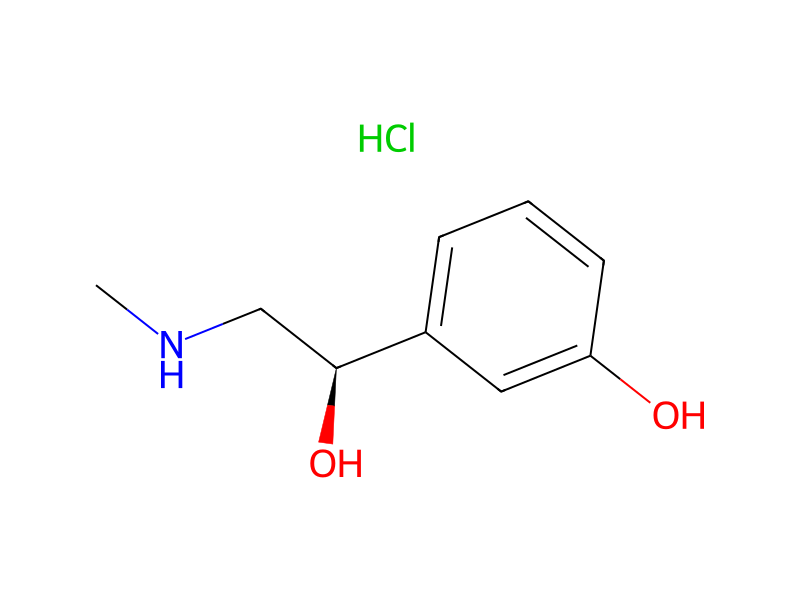
61-76-7CNC[C@H](O)c1cccc(O)c1.ClOCYSGIYOVXAGKQ-FVGYRXGTSA-NPhenylephrine hydrochloride is an odorless white microcrystalline powder. Bitter taste. pH (1% aqueous solution) about 5. (NTP, 1992)
61-76-7DTXSID3021142CHEMBL1200339Breast Feeding; Lactation; Milk, Human; Adrenergic Agents; Adrenergic Alpha-Agonists; Antiglaucoma Agents; Sympathomimetics; Vasoconstrictor Agents; Nasal Decongestants
FDA approved drugs -> Active ingredient
FDA approved drugs -> Active ingredient
Safety information is for reference only and does not replace the supplier’s Safety Data Sheet (SDS), applicable regulations, or professional assessment.
This chemical does not meet GHS hazard criteria for 0.3% (1 of 387) of reports.
Warning
H302 (90.2%): Harmful if swallowed [Warning Acute toxicity, oral]
P261, P264, P264+P265, P270, P271, P272, P280, P301+P317, P302+P352, P304+P340, P305+P351+P338, P317, P319, P321, P330, P332+P317, P333+P317, P337+P317, P362+P364, P403+P233, P405, and P501 (click each P-code to see the statement)
Aggregated GHS information provided per 387 reports by companies from 20 notifications to the ECHA C&L Inventory. Each notification may be associated with multiple companies.
REACH registered substance: Phenylephrine hydrochloride (EC: 200-517-3)
Phenylephrine hydrochloride: Does not have an individual approval but may be used under an appropriate group standard
SYMPTOMS: Symptoms of exposure to this compound may include tremor, insomnia and palpitations. Other symptoms include excessive central nervous system stimulation resulting in excitement and restlessness; tachycardia, hypertension, pallor, mydriasis, hyperglycemia and urinary retention. Severe overdosage may cause tachypnea or hyperpnea, hallucinations, convulsions and delirium. In some cases it may cause central nervous system depression with somnolence, stupor and respiratory depression. Arrhythmias (including ventricular fibrillation) may lead to hypotension and circulatory collapse. Severe hypokalemia can occur. Other symptoms include blanching and a feeling of coolness of the skin, pressor response, anxiety, nervousness, weakness, headache, dizziness and vomiting. It has an adverse effect on intraocular pressure, corneas, conjunctiva and lids. Trembling and perspiration may occur. Exposure to this compound may cause peripheral vasoconstriction, an increase in arterial pressure, reflex bradycardia and a rise in blood pressure Extravasation of the injection may cause tissue necrosis. Exposure may also cause ventricular dysrrhythmias, a sensation of fullness in the head, tingling, irritation, local discomfort at the site of application, cardiac arrhythmia or cardiac arrests, and death. It has caused acute pulmonary edema with associated hypertension in infants. Hypersensitive persons may experience mild stinging (transient).
EYES: First check the victim for contact lenses and remove if present. Flush victim's eyes with water or normal saline solution for 20 to 30 minutes while simultaneously calling a hospital or poison control center. Do not put any ointments, oils, or medication in the victim's eyes without specific instructions from a physician. IMMEDIATELY transport the victim after flushing eyes to a hospital even if no symptoms (such as redness or irritation) develop.
SMALL SPILLS AND LEAKAGE: If you spill this chemical, you should dampen the solid spill material with water, then transfer the dampened material to a suitable container. Use absorbent paper dampened with water to pick up any remaining material. Seal your contaminated clothing and the absorbent paper in a vapor-tight plastic bag for eventual disposal. Wash all contaminated surfaces with a soap and water solution. Do not reenter the contaminated area until the Safety Officer (or other responsible person) has verified that the area has been properly cleaned.
RECOMMENDED RESPIRATOR: Where the neat test chemical is weighed and diluted, wear a NIOSH-approved half face respirator equipped with an organic vapor/acid gas cartridge (specific for organic vapors, HCl, acid gas and SO2) with a dust/mist filter. (NTP, 1992)
Phenylephrine Hydrochloride
TR-322: Toxicology and Carcinogenesis Studies of Phenylephrine Hydrochloride (CASRN 61-76-7) in F344/N Rats and B6C3F1 Mice (Feed Studies) (1987 )
03/26/86
No Evidence
No Evidence
No Evidence
NASAL
Vasoconstriction [PE]; Imidazolines [CS]; Increased Sympathetic Activity [PE]; Vasoconstrictor [EPC]
NASAL PHENYLEPHRINE HYDROCHLORIDE
Adrenergic alpha1-Agonists [MoA]; alpha-1 Adrenergic Agonist [EPC]
PHENYLEPHRINE 10 MG
alpha-1 Adrenergic Agonist [EPC]; Adrenergic alpha1-Agonists [MoA]
Agents that have a strengthening effect on the heart or that can increase cardiac output. They may be CARDIAC GLYCOSIDES; SYMPATHOMIMETICS; or other drugs. They are used after MYOCARDIAL INFARCT; CARDIAC SURGICAL PROCEDURES; in SHOCK; or in congestive heart failure (HEART FAILURE).
Agents that dilate the pupil. They may be either sympathomimetics or parasympatholytics.
Drugs that mimic the effects of stimulating postganglionic adrenergic sympathetic nerves. Included here are drugs that directly stimulate adrenergic receptors and drugs that act indirectly by provoking the release of adrenergic transmitters.
Drugs used to cause constriction of the blood vessels.
Drugs designed to treat inflammation of the nasal passages, generally the result of an infection (more often than not the common cold) or an allergy related condition, e.g., hay fever. The inflammation involves swelling of the mucous membrane that lines the nasal passages and results in inordinate mucus production. The primary class of nasal decongestants are vasoconstrictor agents. (From PharmAssist, The Family Guide to Health and Medicine, 1993)
Compounds that bind to and activate ADRENERGIC ALPHA-1 RECEPTORS.
DescriptionR-(-)-Phenylephrine is an adrenergic α1A receptor agonist (Ki = 1.4 μM) that demonstrates selectivity against the α1B and α1C receptor subtypes (Kis = 23.9 and 47.8 μM, respectively). By stimulating adrenergic α1 receptors, L-phenylephrine can induce aortic smooth muscle contractions, although reported relative affinity and potency values in rabbit are 5-fold weaker compared to that of L-norepinephrine . This compound is frequently used to precontract smooth muscle in preparations designed to study the properties of various vasodilator agents.
Uses(R)-Phenylephrine Hydrochloride is an α-Adrenergic agonist. Mydriatic; decongestant.
UsesDECONGESTANTS
UsesPhenylephrine hydrochloride is used medically as a vasoconstrictor and pressor drug. It is chemically related to epinephrine and ephedrine. Actions are usually longer lasting than the latter two drugs. The action of phenylephrine hydrochloride contrasts sharply with epinephrine and ephedrine, in that its action on the heart is to slow the rate and to increase the stroke output, inducing no disturbance in the rhythm of the pulse. In therapeutic doses, it produces little if any stimulation of either the spinal cord or cerebrum. The drug is intended for the maintenance of an adequate level of blood pressure during spinal and inhalation anesthesia and for the treatment of vascular failure in shock, shock-like states, and drug-induced hypotension, or hypersensitivity. It is also used to overcome paroxysmal supraventricular tachycardia, to prolong spinal anesthesia, and as a vasoconstrictor in regional analgesia. Caution is required in the administration of phenylephrine hydrochloride to elderly persons, or to patients with hyperthyroidism, bradycardia, partial heart block, myocardial disease, or severe arteriosclerosis. The brand name Neo-Synephrine is also used to designate another product (nose drops) which does not contain phenylephrine hydrochloride. The nose drops contain xylometazoline hydrochloride.
General DescriptionOdorless white microcrystalline powder. Bitter taste. pH (1% aqueous solution) about 5.
DefinitionChEBI: A hydrochloride that is the monohydrochloride salt of phenylephrine.


