
HRID 46570As product
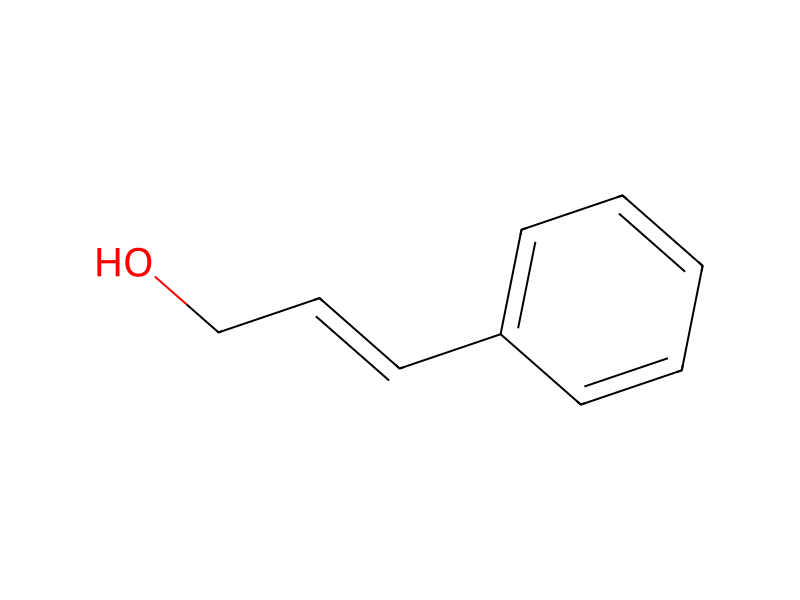
104-54-1OC/C=C/c1ccccc1OOCCDEMITAIZTP-QPJJXVBHSA-NCinnamyl alcohol is a primary alcohol comprising an allyl core with a hydroxy substituent at the 1-position and a phenyl substituent at the 3-position (geometry of the C=C bond unspecified). It has a role as a plant metabolite.
104-54-1、4407-36-7DTXSID301314144CHEMBL324794CHEBI:17177Cosmetics ingredient -> Base; Flavor; Fragrance; Other (Specify)
Cosmetic ingredients (Cinnamyl Alcohol) -> CIR (Cosmetic Ingredient Review)
Masking
Fragrance substance (Cinnamic alcohol) -> IFRA amendment 49
Fragrance Ingredient (Cinnamyl alcohol) -> IFRA transparency List
1.700
1.95
ODOR OF HYACINTH
PLEASANT, FLORAL ODOR
Safety information is for reference only and does not replace the supplier’s Safety Data Sheet (SDS), applicable regulations, or professional assessment.
This chemical does not meet GHS hazard criteria for < 0.1% (1 of 2033) of reports.
Warning
H302 (15.5%): Harmful if swallowed [Warning Acute toxicity, oral]
P261, P264, P270, P272, P280, P301+P317, P302+P352, P321, P330, P333+P317, P362+P364, and P501 (click each P-code to see the statement)
Aggregated GHS information provided per 2033 reports by companies from 21 notifications to the ECHA C&L Inventory. Each notification may be associated with multiple companies.
Warning
Chemical: 2-Propen-1-ol, 3-phenyl-
Hazard Traits - Fragrance Allergen
Regulation (EC) No 1831/2003 (amended)
2-Propen-1-ol, 3-phenyl- is listed on the EPA's Chemical Data Reporting (CDR) system. Manufacturers and importers of 2-Propen-1-ol, 3-phenyl- are required to report information about their production and use of this chemical to the EPA under the Toxic Substances Control Act (TSCA). (40 eCFR Part 711)
Status: Active Update: 25-04-2023 https://echa.europa.eu/registration-dossier/-/registered-dossier/12023
Cinnamyl alcohol: Does not have an individual approval but may be used under an appropriate group standard
Cinnamic alcohol was an allergen in 15 of 20 perfume-sensitive patients patch tested. [HSDB] An irritant; [MSDSonline] Positive patch tests reported in perfume industry and food handlers; One of the chemicals in the fragrance mix; [Kanerva, p. 1771] Included in list of established contact allergens in humans; [EC: Scientific Committee on Consumer Safety: Fragrance allergens in cosmetic products (2011)] Danger of skin sensitization; [MAK]
In general, esters containing an aromatic ring system are expected to be hydrolyzed in vivo. Cinnamyl alcohol is hydrolyzed to [DB14184].
ACIDIC & NEUTRAL URINARY METABOLITE OF CINNAMYL ALC WAS IDENTIFIED THROUGH A COMMON METABOLIC SCHEME.
Cinnamyl alcohol is a known human metabolite of beta-methylstyrene.
SS8YOP444F
CINNAMYL ALCOHOL
Established Pharmacologic Class [EPC] - Standardized Chemical Allergen
Physiologic Effects [PE] - Increased Histamine Release
Physiologic Effects [PE] - Cell-mediated Immunity
Chemical Structure [CS] - Allergens
Cinnamyl alcohol is 66% absorbed through the skin and shown to be rapidly absorbed from the gut.
Cinnamyl alcohol is metabolized and excreted primarily in the urine and, to a minor extent, in the feces. After oral or intraperitoneal administration to rats and mice, 76–77% of the dose of cinnamyl alcohol was recovered in the urine and feces within 24 h.
CINNAMYL ALC IS EXCRETED UNCHANGED IN NEUTRAL EXTRACT WHEN GIVEN TO RATS.
CIR ingredient: Cinnamyl Alcohol
Used as a fragrance, flavoring agent, deodorant, and chemical intermediate (chemical resistant coatings, photosensitive polymers, and lithographic plates); [HSDB]
AS DEODORANT IN 12.5% SOLN IN GLYCEROL
FRAGRANCE, EG, FOR COLOGNES, SOAPS, AND LOTIONS; FIXATIVE FOR PERFUME BLENDS; IN MFR OF CHEM RESISTANT COATINGS; FLAVORING AGENT FOR FOOD (EG, CANDY, GUM, BEVERAGES); CHEM INTERMEDIATE FOR CINNAMYL ESTERS USED IN PERFUMERY; IN MFG OF PHOTOSENSITIVE POLYMERS & LITHOGRAPHIC PLATES


NEEDLES OR CRYSTAL MASS
WHITE TO YELLOWISH SOLID
WHITE NEEDLES FROM PETROLEUM ETHER
Acute Tox. 4 (15.5%)
Acute Tox. 4 (100%)
Skin sensitisation - category 1
(1977) No Data
(1979) No Data
(1977) 6.74X10+5 GRAMS (PRINCPL CUSTMS DISTS)
(1979) 5.00X10+5 GRAMS (PRINCPL CUSTMS DISTS)
2023: <75,000 lb
(1974) 6.81X10+7 G-CONSUMPTION IN FRAGRANCES
(1979) PROBABLY GREATER THAN 9.08X10+5 GRAMS
Cinnamic alcohol
Cinnamyl alcohol; 3-Phenylallyl alcohol; 3-Phenyl-2-propen-1-ol; 2-Propen-1-ol, 3-phenyl-; Styrone; Styryl alcohol; Zimtalcohol; Styryl carbinol
IFRA_STD_017.pdf
49
IFRA 51st Amendment - Guidance for the use of IFRA Standards
Restriction: This material should be used only in the limited quantity as stated in the Standard
MEERWEIN-PONNDORF REDUCTION OF CINNAMALDEHYDE WITH ALUMINUM ISOPROPYLATE OR ETHYLATE; ALKALINE HYDROLYSIS OF STORAX; REDUCTION OF CINNAMAL DIACETATE WITH ACETIC ACID AND IRON FILINGS
OBTAINED ORIGINALLY BY SAPONIFICATION OF CINNAMYL CINNAMATE (STYRACIN). THIS METHOD OF EXTRACTION FROM STORAX IS STILL USABLE. SYNTHETICALLY, BY REDUCTION OF CINNAMALDEHYDE WITH SODIUM OR POTASSIUM HYDROXIDE.
Cosmetics product ingredient: Cinnamyl alcohol
Information on 67 consumer products that contain Cinnamyl Alcohol in the following categories is provided:
Fragrance Ingredients
Flavouring Agent -> FLAVOURING_AGENT -> JECFA Functional Classes
Flavoring Agents -> JECFA Flavorings Index
Flavouring Agent -> FLAVOURING_AGENT -> JECFA Functional Classes
Flavouring Agent -> FLAVOURING_AGENT -> JECFA Functional Classes
Cosmetics -> Masking
All Other Chemical Product and Preparation Manufacturing
2-Propen-1-ol, 3-phenyl-: ACTIVE
WHEN SMALL AMT OF IMPURITIES ARE PRESENT AS IN NATURAL ARTICLE (CINNAMYL ALC FROM STORAX), IT REMAINS FLUID AT LOWER TEMPERATURES THAN THE MELTING POINT.
REPORTED USES: NON-ALCOHOLIC BEVERAGES 8.8 PPM; ALCOHOLIC BEVERAGES 5.0 PPM; ICE CREAM, ICES, ETC 8.7 PPM; CANDY 17 PPM; BAKED GOODS 33 PPM; GELATINS & PUDDINGS 22 PPM; CHEWING GUM 720 PPM.
FLAVOR USEFUL IN APRICOT, PEACH, RASPBERRY, PLUM FLAVORS.
OCCURS (IN ESTERIFIED FORM) IN STORAX & IN BALSAM PERU, CINNAMON LEAVES, HYACINTH OIL. OBTAINED BY ALKALINE HYDROLYSIS OF STORAX.
0.22 [Products applied to the lips]
0.067 [Products applied to the axillae]
0.25 [Products applied to the face/body using fingertips]
1.2 [Products related to fine fragrances]
0.32 [Products applied to the body using the hands (palms), primarily leave-on (Body lotion)]
0.25 [Products applied to the face using the hands (palms), primarily leave-on (Face moisturizer)]
Uses3-Phenylprop-2-en-1-ol is a reactant in the preparation of isobenzofuranones.
DefinitionChEBI: Cinnamyl alcohol is a primary alcohol comprising an allyl core with a hydroxy substituent at the 1-position and a phenyl substituent at the 3-position (geometry of the C=C bond unspecified). It has a role as a plant metabolite.