HomeMCPSkillsWorkbenchOpenChem
HomeWorkbenchNotificationsMe
llms.txt · skill.md · MCP GuidePrivacy Policy · Terms of Service · Supportv1.8.5
  1. Home
  2. /Compound

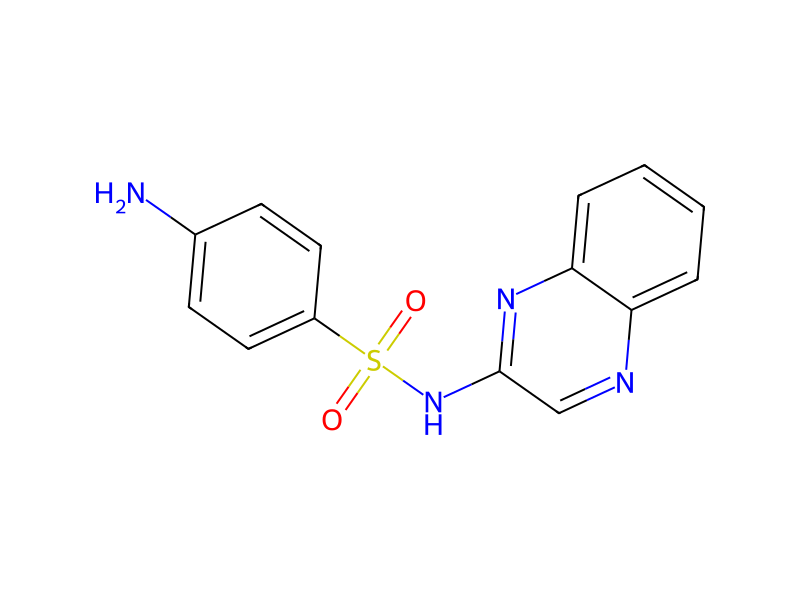
Sulfaquinoxaline

HCID 5338
New reaction
Print
Basic informationOverviewNames & identifiersPropertiesSafety & regulationChemistry & industryRelated reactionsCompound notes
Substructure searchFind similar structures

Basic information

CAS
59-40-5
Standard SMILES
Nc1ccc(S(=O)(=O)Nc2cnc3ccccc3n2)cc1
InChIKey
NHZLNPMOSADWGC-UHFFFAOYSA-N
Molecular formula
C14H12N4O2S
Average molar mass
300.34 g/mol
Monoisotopic mass
300.06809681

Overview

4-amino-N-(2-quinoxalinyl)benzenesulfonamide is a member of benzenes and a sulfonamide.

Names & identifiers

Preferred name
Sulfaquinoxaline
IUPAC
4-amino-N-quinoxalin-2-ylbenzenesulfonamide
English name
Sulfaquinoxaline
Molecular formula
C14H12N4O2S
Molecular weight
300.34

Names & synonyms

sulfaquinoxaline59-40-5SulfabenzpyrazineAvicocidSulfalineSulquinUrsokoxalineItalquinaKokozigalSulfacoxSulfachinoxalinSulfaquinoxalina
Show more names
sulphaquinoxalineSQSULFAQUINOXALINSULFACHINOXALINESulfaquinoxaline Sodium Salt Standardanti-kSUQUIN
2-SulfanilamidoquinoxalineSulfaquinoxalinumBenzenesulfonamide, 4-amino-N-2-quinoxalinyl-SQ 40Sul-q-nox4-AMINO-N-(QUINOXALIN-2-YL)BENZENE-1-SULFONAMIDE4-Amino-N-2-quinoxalinylbenzenesulfonamideNSC-41805

Database identifiers

CAS
59-40-5
PubChem CID
5338
DTXSID
DTXSID8042424
ChEMBL
CHEMBL1437847
ChEBI
CHEBI:94719
UNII
WNW8115TM9
EC Number
200-423-2
Nikkaji
J4.601I

Properties

Computed structural properties

XLogP
1.7
Topological polar surface area
106 Ų
Hydrogen bond donors
2
Hydrogen bond acceptors
6
Rotatable bonds
3
Heavy atoms
21
Formal charge
0
Complexity
442

Experimental & physicochemical properties

Chemical ClassesNitrogen Compounds -> Other Aromatics (Nitrogen)
Drugs · 2 items

Pharmaceuticals -> Antibiotics (Sulfonamide)

Pharmaceuticals -> Antibiotics

LogP · 3 items

log Kow = 1.68

1.68

1.0

Color/FormMinute crystals
Solubility · 4 items

Mol wt: 322.32. Very sol in water; pH of 1% aqueous solution is about 10. The amorphous salt is deliquescent and absorbs carbon dioxide which liberates the practically insoluble sulfaquinoxaline /Sodium salt/

Solubility = 730 mg/L in 95% alcohol and 4,300 mg/L in acetone. Soluble in aqueous sodium bicarbonate and sodium hydroxide solutions.

In water, 7.5 mg/L at pH 7 / room temp/

>45.1 [ug/mL] (The mean of the results at pH 7.4)

Animal Drugs · 2 items

FDA approved animal drugs -> Active ingredient

Pharmaceuticals -> Animal Drugs -> Approved in Taiwan

Melting Point · 2 items

Safety & regulation

Safety information is for reference only and does not replace the supplier’s Safety Data Sheet (SDS), applicable regulations, or professional assessment.

GHS classification

GHS Classification · 5 items

This chemical does not meet GHS hazard criteria for 2.1% (1 of 48) of reports.

Danger

H302 (97.9%): Harmful if swallowed [Warning Acute toxicity, oral]

P233, P260, P261, P264, P270, P271, P272, P280, P284, P301+P317, P302+P352, P304+P340, P321, P330, P333+P317, P342+P316, P362+P364, P403, and P501 (click each P-code to see the statement)

Aggregated GHS information provided per 48 reports by companies from 7 notifications to the ECHA C&L Inventory. Each notification may be associated with multiple companies.

Hazard information

Regulatory InformationSulphaquinoxaline: Does not have an individual approval but may be used under an appropriate group standard
Other Safety InformationIMAP assessments - Benzenesulfonamide, 4-amino-N-2-quinoxalinyl-: Environment tier I assessment
Hazards Summary · 1 item

A flock of chickens treated with 0.05% in feed for 2-3 days, removed 2 days, and treated again for 2-3 days had 47% mortality with hemorrhages, bone marrow pallor, and septicemia; Emergency treatment: Sulfonamides; Sulfonamides are used as antibiotics; They can cause hypersensitivity reactions including erythema multiforme and liver injury; Methemoglobinemia and renal failure may occur after toxic ingestions; [HSDB] Causes changes in renal tubules in 26-week, intermittent, oral study of rats (9100 mg/kg); Causes hemorrhage in 14 day intermittent study of dogs (1400 mg/kg); [RTECS] May cause irritation; May cause skin and respiratory sensitization; [Aldrich MSDS]

FDA Requirements · 5 items

Oral dosage form new animal drugs. Sulfamerazine, sulfamethazine, and sulfaquinoxaline powder. ... Conditions of use: (1) Chickens ...(A) As an aid in the control of coccidiosis caused by Eimeria tenella and E. necatrix susceptible to sulfamerazine, sulfamethazine, and sulfaquinoxaline ... (B) As an aid in the control of acute fowl cholera caused by Pasteurella multocida susceptible to sulfamerazine, sulfamethazine, and sulfaquinoxaline ... (2) Turkeys ... (A) As an aid in the control of coccidiosis caused by Eimeria meleagrimitis and E. adenoeides susceptible to sulfamerazine, sulfamethazine, and sulfaquinoxaline ... (B) As an aid in the control of acute fowl cholera caused by Pasteurella multocida susceptible to sulfamerazine, sulfamethazine, and sulfaquinoxaline ... .

Chemistry & industry

Pharmacology

ATC Code · 2 items

QJ - Antiinfectives for systemic use

QP - Antiparasitic products, insecticides and repellents

Mechanism of Action · 2 items

Bacteriostatic. Sulfonamides interfere with the biosynthesis of folic acid in bacterial cells; they compete with paraaminobenzoic acid (PABA) for incorporation in the folic acid molecule. By replacing the PABA molecule and preventing the folic acid formation required for DNA synthesis, the sulfonamides prevent multiplication of the bacterial cell. Susceptible organisms must synthesize their own folic acid; mammalian cells use preformed folic acid and, therefore, are not susceptible. Cells that produce excess PABA or environments with PABA, such as necrotic tissues, allow for resistance by competition with the sulfonamide. /Sulfonamides/

Sulfonamides are structural analogs and competitive antagonists of para-aminobenzoic acid (PABA) and thus prevent normal bacterial utilization of PABA for the synthesis of folic acid (pteroylglutamic acid). More specifically, sulfonamides are competitive inhibitors of dihydropteroate synthase,the bacterial enzyme responsible for the incorporation of PABA into dihydropteroic acid, the immediate precursor of folic acid. Sensitive microorganisms are those that must synthesize their own folic acid; bacteria that can utilize preformed folate are not affected. Bacteriostasis induced by sulfonamides is counteracted by PABA competitively. Sulfonamides do not affect mammalian cells by this mechanism, since they require preformed folic acid and cannot synthesize it. /Sulfonamides/

Metabolism/Metabolites · 2 items

Sulfonamides are primarily metabolized in the liver but metabolism also occurs in other tissues. Biotransformation occurs mainly by acetylation, glucuronide conjugation, and aromatic hydroxylation in many species. The types of metabolites formed and the amount of each varies depending on the specific sulfonamide administered; the species, age, diet, and environment of the animal; the presence of disease; and, with the exception of pigs and ruminants, even the sex of the animal. Dogs are considered to be unable to acetylate sulfonamides to any significant degree. /Sulfonamides/

The sulfonamides undergo metabolic alterations in vivo, especially in the liver. The major metabolic derivative is N4-acetylated sulfonamide. Acetylation, which occurs to a different extent with each agent, is disadvantageous, because the resulting products have no antibacterial activity and yet retain the toxic potentialities of the parent substance. /Sulfonamides/

Related reactions

0 records
New reaction record
No related reactions yet

Compound notes

On this pageBasic informationOverviewNames & identifiersPropertiesSafety & regulationChemistry & industryRelated reactionsCompound notes

247.5 °C

247 - 248 °C

Physical Description · 2 items

Solid; [Merck Index]

Solid

Stability/Shelf LifeStable under storage and application conditions.
Collision Cross Section · 4 items

167.8 Ų [M+H]+ [CCS Type: DT; Buffer gas: N2; Ionization: ESI+; Dataset: TOXCAST; Source Identifier: DTXSID8042424]

164.8 Ų [M+H]+ [CCS Type: TW]

155.78 Ų [M+H-H2O]+ [CCS Type: TW; Method: calibrated with polyalanine and drug standards]

166.68 Ų [M+H]+

Physicochemical properties

Melting point
247 · 247-2480C
Boiling point
551.1 · 551.1±60.0 °C(Predicted)
Density
1.3196 · 1.3196 (rough estimate)
refractive index
1.644 · 1.6440 (estimate)
storage temp.
Refrigerator
solubility
DMSO (Slightly), Methanol (Slightly), Water (Slightly)
pka
5.65 · 5.65±0.10(Predicted)
form
Solid
color
Pale Yellow to Yellow
Merck
13 · 13,9025
BRN
290026 · 290026
Major Application
agricultureenvironmental
InChI
InChI=1S/C14H12N4O2S/c15-10-5-7-11(8-6-10)21(19,20)18-14-9-16-12-3-1-2-4-13(12)17-14/h1-9H,15H2,(H,17,18)
InChIKey
NHZLNPMOSADWGC-UHFFFAOYSA-N
SMILES
C1(S(NC2C=NC3C(N=2)=CC=CC=3)(=O)=O)=CC=C(N)C=C1
LogP
1.68 · 1.680
CAS DataBase Reference
59 · 59-40-5(CAS DataBase Reference)
FDA 21 CFR
556.685 · 556.685; 558.4; 558.586
FDA UNII
8115 TM9 · WNW8115TM9
EPA Substance Registry System
Sulfaquinoxaline (59-40-5)
UNSPSC Code
41116107 · 41116107
NACRES
24 · NA.24
Symbol(GHS)
7 · GHS07,GHS08
Signal word
Danger
Hazard statements
302 · H302-H317-H334
Precautionary statements
280 · P280-P301+P312+P330-P302+P352
PPE
95 · dust mask type N95 (US), Eyeshields, Faceshields, Gloves
Hazard Codes
Xn
Risk Statements
22 · 22-42/43
Safety Statements
22 · 22-36/37-45
WGK Germany
3 · 3
RTECS
2100000 · WP2100000
TSCA
TSCA listed
HS Code
29350090 · 29350090
Storage Class
11 · 11 - Combustible Solids
Hazard Classifications
4 OralResp · Acute Tox. 4 OralResp. Sens. 1Skin Sens. 1
Hazardous Substances Data
59 · 59-40-5(Hazardous Substances Data)

Oral dosage new animal drugs. Sulfaquinoxaline drinking water. ... Conditions of use. It is used in drinking water as follows: (1) Chickens. (i) As an aid in the control of outbreaks of coccidiosis caused by Eimeria tenella, E. necatrix, E. acervulina, E. maxima, and E. brunetti. ... (2) Turkeys. (i) As an aid in the control of outbreaks of coccidiosis caused by Eimeria meleagrimitis and E. adenoeides. ... 3) Chickens and turkeys. (i) As an aid in the control of acute fowl cholera caused by Pasteurella multocida susceptible to sulfaquinoxaline and fowl typhoid caused by Salmonella gallinarum susceptible to sulfaquinoxaline. ... (4) Cattle and calves. (i) For the control and treatment of outbreaks of coccidiosis caused by Eimeria bovis or E. zurnii.

Oral dosage new animal drugs. Sulfaquinoxaline drench. ... Conditions of uses: ... For the control and treatment of outbreaks of coccidiosis in cattle and calves caused by Eimeria bovis or E. zurnii.

A tolerance of 0.1 part per million is established for negligible residues of sulfaquinoxaline in the uncooked edible tissues of chickens, turkeys, calves, and cattle.

For more FDA Requirements (Complete) data for SULFAQUINOXALINE (7 total), please visit the HSDB record page.

FIFRA Requirements · 1 item

As the federal pesticide law FIFRA directs, EPA is conducting a comprehensive review of older pesticides to consider their health and environmental effects and make decisions about their future use. Under this pesticide reregistration program, EPA examines health and safety data for pesticide active ingredients initially registered before November 1, 1984, and determines whether they are eligible for reregistration. In addition, all pesticides must meet the new safety standard of the Food Quality Protection Act of 1996. Pesticides for which EPA had not issued Registration Standards prior to the effective date of FIFRA '88 were divided into three lists based upon their potential for human exposure and other factors, with List B containing pesticides of greater concern and List D pesticides of less concern. Sulfaquinoxaline is found on List C. Case No:3135; Pesticide type:Rodenticide; Case Status:Cancelled - No products containing the pesticide are actively registered. Therefore, we are characterizing the case as cancelled. Under FIFRA, pesticide producers may voluntarily cancel their registered products. EPA also may cancel pesticide registrations if registrants fail to pay required fees or make/meet certain reregistration commitments, or if EPA reaches findings of unreasonable adverse effects.; Active ingredient (AI):N 1-(2-Quinoxaliny)sulfanilamide; AI Status: Cancelled - The active ingredient is no longer contained in any registered pesticide product. Thus, we characterize it as cancelled.

Hazard Classes and CategoriesAcute Tox. 4 (97.9%)

Safety & protection

Storage ConditionsStore below 40 °C (104 °F), preferably between 15 and 30 °C (59 and 86 °F), unless otherwise specified by manufacturer. Protect from moisture.
Disposal Methods · 1 item

SRP: At the time of review, criteria for land treatment or burial (sanitary landfill) disposal practices are subject to significant revision. Prior to implementing land disposal of waste residue (including waste sludge), consult with environmental regulatory agencies for guidance on acceptable disposal practices.

Preventive Measures · 1 item

People who handle this medication should avoid contact with eyes, skin, or clothing to prevent eye and skin burns. In case of contact, the areas affected should be flushed for at least fifteen minutes; medical attention should be sought for eye exposure. Keep out of the reach of children.

Allowable TolerancesA tolerance of 0.1 part per million is established for negligible residues of sulfaquinoxaline in the uncooked edible tissues of chickens, turkeys, calves, and cattle.

Toxicology

Interactions · 3 items

The most important interactions of the sulfonamides involve those with the oral anticoagulants, the sulfonylurea hypoglycemic agents, and the hydantoin acticonvulsants. In each case, sulfonamides can potentiate the effects of the other drug by metabolism and, possibly, displacement from albumin. Dosage adjustment may be necessary when a sulfonamide is given concurrently. /Sulfonamides/

One of the most active agents that exerts a synergistic effect when used with a sulfonamide is trimethoprim. This cmpd is a potent and selective competitive inhibitor of microbial dihydrofolate reductase, the enzyme that reduces dihydrofolate to tetrahydrofolate. It is this reduced form of folic acid that is required for one-carbon transfer reactions. The simultaneous admin of a sulfonamide and trimethoprim ... introduces sequential blocks in the pathway by which microorganisms synthesize tetrahydrofolate from precursor molecules. The ... synergistic antimicrobial effects has been realized both in vitro and in vivo. /Sulfonamides/

Para-aminobenzoic acid (PABA) is most prominent sulfonamide antagonists. Certain local anesthetics, such as procaine, that are esters of PABA antagonize these drugs in vitro and in vivo. /Sulfonamides/

Environmental Fate · 3 items

TERRESTRIAL FATE: Based on a classification scheme(1), an estimated Koc value of 200(SRC), determined from a log Kow of 1.68(2) and a regression-derived equation(3), indicates that sulfaquinoxaline is expected to have moderate mobility in soil(SRC). However, aromatic amines may bind strongly to humus and organic matter in soils due to the high reactivity of the aromatic amino group(4,5), suggesting that mobility may be much lower in some soils(SRC). An estimated pKa of 5.1 (sulfonamide nitrogen)(6), indicates that this compound will exist primarily as an anion in the environment. Volatilization of sulfaquinoxaline from moist soil surfaces is not expected to be an important fate process(SRC) because anions do not volatilize. Sulfaquinoxaline is not expected to volatilize from dry soil surfaces(SRC) based upon an estimated vapor pressure of 3.0X10⁻¹⁰ mm Hg(SRC), determined from a fragment constant method(7). Biodegradation data were not available(SRC, 2006).

AQUATIC FATE: Based on a classification scheme(1), an estimated Koc value of 200(SRC), determined from a log Kow of 1.68(2) and a regression-derived equation(3), indicates that sulfaquinoxaline is not expected to adsorb to suspended solids and sediment(SRC). However, aromatic amines may bind strongly to organic matter due to the high reactivity of the aromatic amino group(4,5). An estimated pKa of 5.1 (sulfonamide nitrogen)(SRC), calculated using a method based on linear free energy relationships and perturbed molecular orbital theory(6), indicates that this compound will exist primarily as an anion in the environment. Volatilization from water surfaces is not expected(3) based upon an estimated Henry's Law constant of 4.4X10⁻¹⁵ atm-cu m/mole(SRC), developed using a fragment constant estimation method(4). The estimated pKa of sulfaquinoxaline is 5.1(5), indicating that this compound will primarily exist in anion form in the environment and anions generally do not adsorb more strongly to soils containing organic carbon and clay than their neutral counterparts(6). According to a classification scheme(7), an estimated BCF of 11(SRC), from its log Kow(2) and a regression-derived equation(8), suggests the potential for bioconcentration in aquatic organisms is low(SRC). Biodegradation data were not available(SRC, 2006).

ATMOSPHERIC FATE: According to a model of gas/particle partitioning of semivolatile organic compounds in the atmosphere(1), sulfaquinoxaline, which has an estimated vapor pressure of 3.0X10⁻¹⁰ mm Hg at 25 °C(SRC), determined from a fragment constant method(2), is expected to exist solely in the particulate phase in the ambient atmosphere. Particulate-phase sulfaquinoxaline may be removed from the air by wet or dry deposition(SRC). Sulfaquinoxaline absorbs light at wavelengths >290 nm (lambda max = 360 nm)(3) and therefore may be susceptible to direct photolysis by sunlight(4).

Adverse EffectsOccupational hepatotoxin - Secondary hepatotoxins: the potential for toxic effect in the occupational setting is based on cases of poisoning by human ingestion or animal experimentation.
Milk Concentrations · 1 item

Sulfonamides are distributed into milk; however, the sulfonamides that are clinically relevant to food-producing animals are distributed into milk in concentrations too low to be therapeutic but high enough to produce residues. Sulfadiazine and sulfanilamide are more efficiently distributed into milk than most sulfonamides, but are not used in dairy cattle. For many sulfonamides, 0.5 to 2% of the total dose is found in the milk. Distribution into milk varies depending on the amount of non-protein -bound sulfonamide present in the blood and the amount of the nonionized and therefore liposoluble form of the medication present. Sulfonamides with higher pKa values produce a higher proportion of drug in the blood that is non-ionized, and if other factors, such as the rate of biotransformation, also support it, may be distributed more easily into milk. /Sulfonamides/

Ecotoxicity Excerpts · 1 item

/AQUATIC SPECIES/ The short-term toxicity (EC50 respectively LC50 after 2 or 4 days) of 13 feed additives was determined to 4 freshwater organisms of different trophical levels: Chlorella pyrenoidosa, Daphnia magna, Lebistes reticulatus and Salmo gairdneri. The most toxic (LC(EC)50 less than 1 mg/L) were robenidine (to all tested organisms) and stenorol (to Daphnia); moderately toxic (1 less than LC(EC)50 less than 10 mg/1) was pyrimethamine. Amprolium, ethopabate, furazolidone and zoalene proved to be little toxic (LC(EC)50 greater than 10 mg/L); whereas buquinolate, carbadox, clopidol, decoquinate, grofas and sulfaquinoxaline were under the experimental conditions not toxic for the tested organisms.

Soil Adsorption/Mobility · 1 item

The Koc of sulfaquinoxaline is estimated as 200(SRC), using a log Kow of 1.68(1) and a regression-derived equation(2). According to a classification scheme(3), this estimated Koc value suggests that sulfaquinoxaline is expected to have moderate mobility in soil. However, aromatic amines may bind strongly to humus and organic matter in soils due to the high reactivity of the aromatic amino group(4,5), suggesting that mobility may be much lower in some soils(SRC).

Human Toxicity Excerpts · 5 items

/SIGNS AND SYMPTOMS/ Complete suppression of bone-marrow activity with profound anemia, granulocytopenia, and thrombocytopenia is an extremely rare occurrence with sulfonamide therapy. It probably results from a direct myelotoxic effect and may be fatal. /Sulfonamides/

/SIGNS AND SYMPTOMS/ Focal or diffuse necrosis of the liver due to direct drug toxicity or sensitization occurs in fewer than 0.1% of patients. Headache, nausea, vomiting, fever, hepatomegaly, jaundice, and laboratory evidence of hepatocellular dysfunction usually appear 3 to 5 days after sulfonamide administration is started, and the syndrome may progress to acute yellow atrophy and death. /Hypersensitivity reactions to sulfonamides/

/SIGNS AND SYMPTOMS/ The admin of sulfonamides to newborn infants, especially if premature, may lead to the displacement of bilirubin from plasma albumin. In newborn infants, free bilirubin can become deposited in the basal ganglia and subthalamic nuclei of the brain, causing an encephalopathy called kernicterus. /Sulfonamides/

/SIGNS AND SYMPTOMS/ Short-term depression /of serum cholinesterase activity/ is caused by ... sulfanilamides ... /Sulfanilamides/

/OTHER TOXICITY INFORMATION/ Human beings, nonhuman primates, guinea pig and chicken /are resistant to/ thyroperoxidase (TPO) inhibition by sulfonamides; rat, mouse, dog and pig /are sensitive to/ TPO inhibition by sulfonamides. /From table/

Artificial Pollution SourcesSulfaquinoxaline's production and use for the treatment of coccidiosis in chickens, turkeys, and cattle(1) may result in its release to the environment through various waste streams(SRC).
Environmental Bioconcentration · 1 item

An estimated BCF of 11 was calculated for sulfaquinoxaline(SRC), using a log Kow of 1.68(1) and a regression-derived equation(2). According to a classification scheme(3), this BCF suggests the potential for bioconcentration in aquatic organisms is low(SRC).

Volatilization from Water/Soil · 1 item

An estimated pKa of 5.1 (sulfonamide nitrogen)(1), calculated using a method based on linear free energy relationships and perturbed molecular orbital theory(2), indicates that sulfaquinoxaline will exist primarily as an anion in the environment. Volatilization of sulfaquinoxaline from moist soil or water surfaces is not expected to be an important fate process(SRC) since anions do not volatilize. Sulfaquinoxaline is not expected to volatilize from dry soil surfaces(SRC) based upon an estimated vapor pressure of 3.0X10⁻¹⁰ mm Hg(SRC), determined from a fragment constant method(3).

Non-Human Toxicity Excerpts · 1 item

/LABORATORY ANIMALS: Acute Exposure/ Mortality of 47% occurred in a commercial flock of 20-week-old leghorn pullets treated with 0.05% sulfaquinoxaline in the feed. The drug was given for 2-3 days, removed for 2 days, and fed again for 2-3 days. Gross lesions consisted of disseminated hemorrhages, bone marrow pallor, a variety of changes suggesting septicemia, and overwhelming bacterial infection. Experimental feeding of sulfaquinoxaline at 0.05% in the feed at a schedule of 3 days on, 3 days off, and 2 days on successfully reproduced the essential features and gross lesions of the field toxicosis. Mortalities of 32.5% and 43.5% were observed in sulfaquinoxaline-treated groups. A high incidence of gangrenous dermatitis occurred in chickens with the experimental toxicosis, but it was not observed in the field case.

Populations at Special Risk · 3 items

... Sulfonamides ... may produce acute hemolysis in patients with glucose-6-phosphate dehydrogenase deficiency. /Sulfonamides/

The admin of sulfonamides to newborn infants, especially if premature, may lead to the displacement of bilirubin from plasma albumin. In newborn infants, free bilirubin can become deposited in the basal ganglia and subthalamic nuclei of the brain, causing an encephalopathy called kernicterus. Sulfonamides should not be given to pregnant women near term because these drugs pass through the placenta and are secreted in milk. /Sulfonamides/

... Patients with acute pyelonephritis with high fever and other severe constitutional manifestations are at risk of bacteremia and shock and should not be treated with a sulfonamide. /Sulfonamides for urinary tract infections/

Regulatory information

FDA Requirements · 5 items

Oral dosage form new animal drugs. Sulfamerazine, sulfamethazine, and sulfaquinoxaline powder. ... Conditions of use: (1) Chickens ...(A) As an aid in the control of coccidiosis caused by Eimeria tenella and E. necatrix susceptible to sulfamerazine, sulfamethazine, and sulfaquinoxaline ... (B) As an aid in the control of acute fowl cholera caused by Pasteurella multocida susceptible to sulfamerazine, sulfamethazine, and sulfaquinoxaline ... (2) Turkeys ... (A) As an aid in the control of coccidiosis caused by Eimeria meleagrimitis and E. adenoeides susceptible to sulfamerazine, sulfamethazine, and sulfaquinoxaline ... (B) As an aid in the control of acute fowl cholera caused by Pasteurella multocida susceptible to sulfamerazine, sulfamethazine, and sulfaquinoxaline ... .

Oral dosage new animal drugs. Sulfaquinoxaline drinking water. ... Conditions of use. It is used in drinking water as follows: (1) Chickens. (i) As an aid in the control of outbreaks of coccidiosis caused by Eimeria tenella, E. necatrix, E. acervulina, E. maxima, and E. brunetti. ... (2) Turkeys. (i) As an aid in the control of outbreaks of coccidiosis caused by Eimeria meleagrimitis and E. adenoeides. ... 3) Chickens and turkeys. (i) As an aid in the control of acute fowl cholera caused by Pasteurella multocida susceptible to sulfaquinoxaline and fowl typhoid caused by Salmonella gallinarum susceptible to sulfaquinoxaline. ... (4) Cattle and calves. (i) For the control and treatment of outbreaks of coccidiosis caused by Eimeria bovis or E. zurnii.

Oral dosage new animal drugs. Sulfaquinoxaline drench. ... Conditions of uses: ... For the control and treatment of outbreaks of coccidiosis in cattle and calves caused by Eimeria bovis or E. zurnii.

A tolerance of 0.1 part per million is established for negligible residues of sulfaquinoxaline in the uncooked edible tissues of chickens, turkeys, calves, and cattle.

For more FDA Requirements (Complete) data for SULFAQUINOXALINE (7 total), please visit the HSDB record page.

FIFRA Requirements · 1 item

As the federal pesticide law FIFRA directs, EPA is conducting a comprehensive review of older pesticides to consider their health and environmental effects and make decisions about their future use. Under this pesticide reregistration program, EPA examines health and safety data for pesticide active ingredients initially registered before November 1, 1984, and determines whether they are eligible for reregistration. In addition, all pesticides must meet the new safety standard of the Food Quality Protection Act of 1996. Pesticides for which EPA had not issued Registration Standards prior to the effective date of FIFRA '88 were divided into three lists based upon their potential for human exposure and other factors, with List B containing pesticides of greater concern and List D pesticides of less concern. Sulfaquinoxaline is found on List C. Case No:3135; Pesticide type:Rodenticide; Case Status:Cancelled - No products containing the pesticide are actively registered. Therefore, we are characterizing the case as cancelled. Under FIFRA, pesticide producers may voluntarily cancel their registered products. EPA also may cancel pesticide registrations if registrants fail to pay required fees or make/meet certain reregistration commitments, or if EPA reaches findings of unreasonable adverse effects.; Active ingredient (AI):N 1-(2-Quinoxaliny)sulfanilamide; AI Status: Cancelled - The active ingredient is no longer contained in any registered pesticide product. Thus, we characterize it as cancelled.

Safety data

PPE
dust mask type N95 (US), Eyeshields, Faceshields, Gloves
wgk
3
tsca
TSCA listed
rtecs
WP2100000
hs_code
29350090
risk_code
22-42/43
Signal word
Danger
Symbol(GHS)
GHS07,GHS08
hazard_code
Xn
safety_code
22-36/37-45
Storage Class
11 - Combustible Solids
Hazard statements
H302-H317-H334
Hazard Classifications
Acute Tox. 4 OralResp. Sens. 1Skin Sens. 1
Precautionary statements
P280-P301+P312+P330-P302+P352
Hazardous Substances Data
59-40-5(Hazardous Substances Data)
MeSH Pharmacological Classification · 2 items

Substances that prevent infectious agents or organisms from spreading or kill infectious agents in order to prevent the spread of infection.

Substances that are destructive to protozoans.

Absorption, Distribution and Excretion · 5 items

Sulfaquinoxaline is minimally absorbed systemically and is referred to as an enteric sulfonamide.

Sulfonamides are distributed into milk; however, the sulfonamides that are clinically relevant to food-producing animals are distributed into milk in concentrations too low to be therapeutic but high enough to produce residues. Sulfadiazine and sulfanilamide are more efficiently distributed into milk than most sulfonamides, but are not used in dairy cattle. For many sulfonamides, 0.5 to 2% of the total dose is found in the milk. Distribution into milk varies depending on the amount of non-protein -bound sulfonamide present in the blood and the amount of the nonionized and therefore liposoluble form of the medication present. Sulfonamides with higher pKa values produce a higher proportion of drug in the blood that is non-ionized, and if other factors, such as the rate of biotransformation, also support it, may be distributed more easily into milk. /Sulfonamides/

Sulfonamides are eliminated from body partly as unchanged drugs and partly as metabolic products. The largest fraction is excreted in urine, and half-life ... is thus dependent on renal function. In acid urine, the older sulfonamides are insoluble and may precipitate, causing crystalline deposits that can cause urinary obstruction. Small amt are eliminated in feces and in bile, milk, and other secretions. /Sulfonamides/

All sulfonamides are bound in varying degree to plasma proteins, particularly to albumin. The extent ... Is determined by the hydrophobicity and ... pKa; at physiological pH, drugs with a high pKa exhibit a low degree of protein binding ... /They/ are distributed throughout all tissues of the body ... /and/ readily enter pleural, peritoneal, synovial, ocular, and similar body fluids ... in the unbound active form. /Sulfonamides/

For more Absorption, Distribution and Excretion (Complete) data for SULFAQUINOXALINE (8 total), please visit the HSDB record page.

Cellular LocationsCytoplasm

Uses & manufacturing

Uses · 6 items

Used for treatment of coccidiosis and other bacterial and protozoal infections in animals; Used formerly in the US in combination with warfarin for controlling rats and mice (kills vitamin K-producing bacteria in the digestive tract); [HSDB]

Not registered for use in the US; [HSDB]

Farming (Pesticides) [Category: Industry]

For Sulfaquinoxaline (USEPA/OPP Pesticide Code: 077901) there are 0 labels match. /SRP: Not registered for current use in the U.S., but approved pesticide uses may change periodically and so federal, state and local authorities must be consulted for currently approved uses./

Mesh Heading: anti-infective agents, Antiprotozoal agents

MEDICATION (VET)

U.S. Production(1986) >10 thousand-500 thousand pounds
Methods of ManufacturingPrepared by treating 2-aminoquinoxaline with acetylsulfanilyl chloride in the presence of pyridine and hydrolyzing the resulting acetyl derivative. US patent 2404199 (1946 to Merck and Co.)
Formulations/Preparations · 2 items

Veterinary-labeled product(s): 200 mg per mL (OTC) (Sulfa -Q 20%; GENERIC). 319.2 mg per mL (OTC) (Optimed; 31.92% Sul-Q-Nox).

Sulquin 6-50; Liquid Sul-Q-Nox; Sulfa-Nox Liquid; Sulfa-Nox Concentrate

Use ClassificationPharmaceuticals -> Animal Drugs -> Approved in Taiwan
General Manufacturing InformationBenzenesulfonamide, 4-amino-N-2-quinoxalinyl-: INACTIVE
Applications · 3 items

DescriptionSulfaquinoxaline is a kind of veterinary medicine which can be used for the treatment of coccidiosis in cattle and sheep. It is usually used in combination with Amprolium and Vitamin K. It is a protective agent against upper respiratory infections of poultry and a prophylactic against coccidiosis. It takes effects via inhibiting vitamin K epoxidase (epoxide reductase, menadione epoxide reductase) and quinone reductase. Sulfaquinoxaline played an important part in the demotion of roast chicken from vaunted Sunday-dinner status to an un-respected position on the everyday menu of the Western world. Although it has long been eclipsed by other drugs in poultry management, it continues to be used in other host species.

Usesantihistaminic

UsesCoccidiostat.

Upstream & downstream products

Upstream raw materials

2-Aminoquinoxaline2-QuinoxalinoneAmmonium hydroxideFerrous chloride2-ChloroquinoxalineSulfanilamideBenzenesulfonyl chlorideThree-necked flaskMethyl o-phenylenediamineAcetanilideo-Phenylenediamine

Additional notes

DefinitionChEBI: 4-amino-N-(2-quinoxalinyl)benzenesulfonamide is a sulfonamide and a member of benzenes.