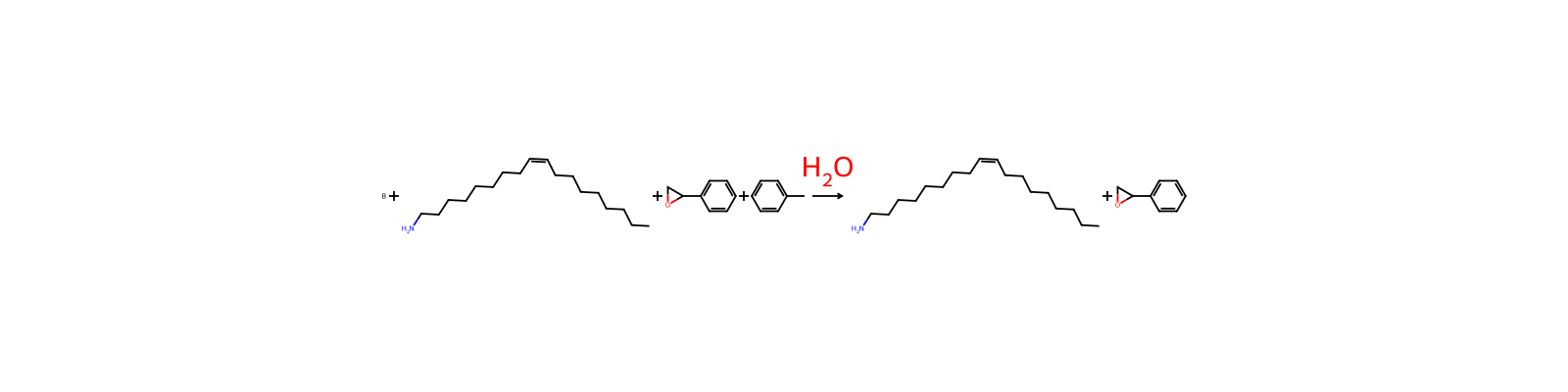
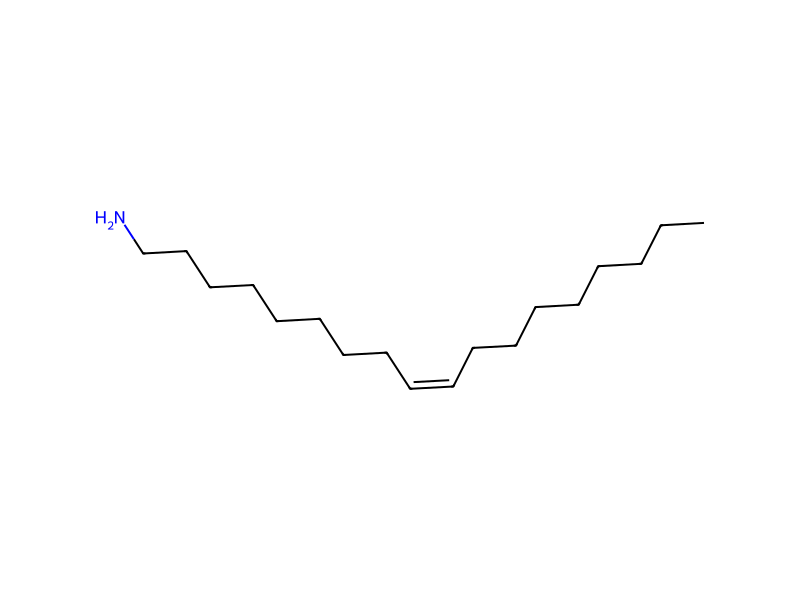
Basic information
- Standard SMILES
CCCCCCCC/C=C\CCCCCCCCN- InChIKey
QGLWBTPVKHMVHM-KTKRTIGZSA-N- Molecular formula
- C18H37N
- Average molar mass
- 267.5 g/mol
- Monoisotopic mass
- 267.29260018
Overview
promotes fusion of mouse A(9) fibroblasts; RN given refers to parent cpd with unspecified isomeric designation; structure
Names & identifiers
- Preferred name
- Oleylamine
- IUPAC
- (Z)-octadec-9-en-1-amine
- English name
- Oleylamine
- Molecular formula
- C18H37N
- Molecular weight
- 267.49
Names & synonyms
OleylamineOleamineOleyl amine112-90-3Armeen OOleinamineNoram OCIS-9-OCTADECENYLAMINEAlamine 11OleylaminKemamine P 9899-Octadecenylamine, (Z)-
Show more names
40%9-OCTADECENYLAMINEeyLAO Vnoramoarmeenoalamine11
(Z)-Octadec-9-enylamineZDQ1JWQ8DTNSC-664611-octadeceneamine hydrofluorideoleoylamineRefChem:577369oleylamine phosphate (1:1), (Z)-204-015-5
Database identifiers
- CAS
112-90-3、1838-19-3- PubChem CID
- 5356789
- DTXSID
DTXSID8026933- ChEMBL
CHEMBL1976606- UNII
- ZDQ1JWQ8DT
- EC Number
- 204-015-5
- Nikkaji
- J59.382F
Properties
Computed structural properties
- XLogP
- 7.6
- Topological polar surface area
- 26 Ų
- Hydrogen bond donors
- 1
- Hydrogen bond acceptors
- 1
- Rotatable bonds
- 15
- Heavy atoms
- 19
- Formal charge
- 0
- Complexity
- 175
Experimental & physicochemical properties
Chemical ClassesNitrogen Compounds -> Amines, Aliphatic
CosmeticsAntistatic
Vapor Pressure0.0001 [mmHg]
Food Contact SubstancesFCS -> FDA Cumulative Estimated Daily Intake (CEDI)
Physical Description
Liquid; CBI
Liquid; mp = 10-20 deg C; [IUCLID] Light yellow pasty liquid with an amine-like odor (mp = 15-30 deg C); [ECHA] Slightly beige paste; [MSDSonline]
Collision Cross Section180.2 Ų [M+H]+ [CCS Type: DT; Buffer gas: N2; Ionization: ESI+; Dataset: TOXCAST; Source Identifier: DTXSID8026933]
Physicochemical properties
- Melting point
- 18 · 18-26 °C (lit.)
- Boiling point
- 348 · 348-350 °C (lit.)
- Density
- 0.813 g/mL · 0.813 g/mL at 25 °C (lit.)
- vapor pressure
- 8 mm · 8 mm Hg ( 135 °C)
- refractive index
- 20 · n20/D 1.4596(lit.)
- Flash point
- 310 °F · 310 °F
- storage temp.
- Keep in dark place,Inert atmosphere,Room temperature
- form
- liquid
- pka
- 10.67 · 10.67±0.10(Predicted)
- color
- colorless
- Odor
- slt amine/lemon odor
- Water Solubility
- insoluble
- BRN
- 1723960 · 1723960
- Stability
- Stable. Incompatible with acids, acid chlorides, acid anhydrides, oxidizing agents.
- Cosmetics Ingredients Functions
- ANTISTATIC
- InChI
- 1S/C18H37N/c1-2-3-4-5-6-7-8-9-10-11-12-13-14-15-16-17-18-19/h9-10H,2-8,11-19H2,1H3/b10-9-
- InChIKey
- QGLWBTPVKHMVHM-MDZDMXLPSA-N
- SMILES
- [H]\C(CCCCCCCC)=C(/[H])CCCCCCCCN
- LogP
- 7.78 · 7.780 (est)
- CAS DataBase Reference
- 112 · 112-90-3(CAS DataBase Reference)
- EWG's Food Scores
- 1 · 1-3
- FDA UNII
- 1 JWQ8DT · ZDQ1JWQ8DT
- EPA Substance Registry System
- Oleylamine (112-90-3)
- UNSPSC Code
- 12352116 · 12352116
- NACRES
- 23 · NA.23
- Symbol(GHS)
- 5 · GHS05,GHS07,GHS08,GHS09
- Signal word
- Danger
- Hazard statements
- 302 · H302-H304-H314-H335-H373-H410
- Precautionary statements
- 260 · P260-P280-P301+P310-P303+P361+P353-P304+P340+P310-P305+P351+P338
- target organs
- Respiratory system
- PPE
- 3 · Eyeshields, Faceshields, Gloves, type P3 (EN 143) respirator cartridges
- Hazard Codes
- C,N
- Risk Statements
- 34 · 34-22-50/53
- Safety Statements
- 26 · 26-36/37/39-45-24/25
- RIDADR
- 2735 · UN 2735 8/PG 2
- WGK Germany
- 2 · 2
- RTECS
- 4130000 · RG4130000
- TSCA
- TSCA listed
- HazardClass
- 8 · 8
- PackingGroup
- III
- HS Code
- 29215900 · 29215900
- Storage Class
- 8 A · 8A - Combustible corrosive hazardous materials
- Hazard Classifications
- 4 OralAquatic · Acute Tox. 4 OralAquatic Acute 1Aquatic Chronic 1Asp. Tox. 1Eye Dam. 1Skin Corr. 1BSTOT RE 2STOT SE 3
- Hazardous Substances Data
- 112 · 112-90-3(Hazardous Substances Data)
- Toxicity
- 50 intraperitoneal · LD50 intraperitoneal in mouse: 888mg/kg
- Limited Quantities
- 1 L · 1.0 L (0.3 gallons) (liquid) or 1 Kg (2.2 lbs) (solid)
- Excepted Quantities
- Max Inner Pack (30g or 30ml) and Max Outer Pack (500g or 500ml)
Safety & regulation
GHS classification
GHS Classification
Danger
H302: Harmful if swallowed [Warning Acute toxicity, oral]
P260, P261, P264, P270, P271, P273, P280, P301+P316, P301+P317, P301+P330+P331, P302+P361+P354, P304+P340, P305+P354+P338, P316, P319, P321, P330, P331, P363, P391, P403+P233, P405, and P501 (click each P-code to see the statement)
This chemical does not meet GHS hazard criteria for 3.7% (60 of 1620) of reports.
Danger
H302 (90.6%): Harmful if swallowed [Warning Acute toxicity, oral]
Hazard information
Regulatory Information
Chemical: 9-Octadecen-1-amine, (Z)-
9-Octadecen-1-amine, (9Z)- is listed on the EPA's Chemical Data Reporting (CDR) system. Manufacturers and importers of 9-Octadecen-1-amine, (9Z)- are required to report information about their production and use of this chemical to the EPA under the Toxic Substances Control Act (TSCA). (40 eCFR Part 711)
Oleyl amine: Does not have an individual approval but may be used under an appropriate group standard
Other Safety InformationIMAP assessments - Primary aliphatic (C12-22) and fatty amines: Human health tier II assessment
Hazards Summary
Concentrations of 1.5% and 3% in corn oil produced moderate to severe skin irritation in rats; Post-implantation mortality observed in mice following single oral dose on ninth day of pregnancy; No evidence of teratogenicity in rats or rabbits at gavage doses maternally toxic; No evidence of mutagenicity; [IUCLID] Corrosive to rabbit skin; Effects in 28-day gavage study with rats include abnormal gait, decrease in weight gain, and minor toxicity to the liver and kidneys; No histopathological effects observed in reproductive organs; No evidence of mutagenicity, teratogenicity, or developmental toxicity; [ECHA] Causes burns; Harmful by ingestion, inhalation, and skin absorption; Inhalation can cause corrosive effects on the upper respiratory tract and lungs; [Aldrich MSDS]
DOT Hazard Classification
Oleylamine
Marine pollutant
Hazard Classes and Categories
Acute Tox. 4 (90.6%)
Acute toxicity - category 4
Acute toxicity (Oral) - Category 4
Acute Tox. 4
Toxicology
Adverse EffectsOccupational hepatotoxin - Secondary hepatotoxins: the potential for toxic effect in the occupational setting is based on cases of poisoning by human ingestion or animal experimentation.
TSCA Test Submissions
The mutagenicity of (Z)-9-octadecenylamine (ODA) was evaluated in Salmonella tester strains TA98, TA100, TA1535, TA1537 and TA1538, both in the presence and absence of added metabolic activation by Aroclor-induced rat liver S9 fraction. Based on preliminary bacterial toxicity determinations, ODA, diluted with acetone, was tested for mutagenicity at concentrations up to 20 ug/plate for nonactivated cultures and concentrations up to 200 ug/plate for activated cultures using the plate incorporation method. ODA did not cause a positive response in any of the bacterial tester strains, either with or without metabolic activation.
Safety data
- PPE
- Eyeshields, Faceshields, Gloves, type P3 (EN 143) respirator cartridges
- wgk
- 2
- tsca
- TSCA listed
- rtecs
- RG4130000
- ridadr
- UN 2735 8/PG 2
- hs_code
- 29215900
- Toxicity
- LD50 intraperitoneal in mouse: 888mg/kg
- risk_code
- 34-22-50/53
- Signal word
- Danger
- Symbol(GHS)
- GHS05,GHS07,GHS08,GHS09
- hazard_code
- C,N
- safety_code
- 26-36/37/39-45-24/25
- hazard_class
- 8
- Storage Class
- 8A - Combustible corrosive hazardous materials
- packing_group
- III
- target organs
- Respiratory system
- Hazard statements
- H302-H304-H314-H335-H373-H410
- Limited Quantities
- 1.0 L (0.3 gallons) (liquid) or 1 Kg (2.2 lbs) (solid)
- Excepted Quantities
- Max Inner Pack (30g or 30ml) and Max Outer Pack (500g or 500ml)
- Hazard Classifications
- Acute Tox. 4 OralAquatic Acute 1Aquatic Chronic 1Asp. Tox. 1Eye Dam. 1Skin Corr. 1BSTOT RE 2STOT SE 3
- Precautionary statements
- P260-P280-P301+P310-P303+P361+P353-P304+P340+P310-P305+P351+P338
- Hazardous Substances Data
- 112-90-3(Hazardous Substances Data)
Chemistry & industry
Uses & manufacturing
Uses
Used as an intermediate, surfactant in textile production, and cosmetic ingredient; Amine and organic salts: Used as petroleum product and lubricant additives, corrosion inhibitors (i.e. in oil fields), ore flotation reagents, wetting agents for asphalt, and emulsifiers; [HSDB] Used in the EU as intermediate, flotation agent for metals, lubricant in metal processing, fuel additive, corrosion inhibitor, and antistatic agent for paints; [ECHA]
Petroleum Production and Refining [Category: Industry]
...SERIES OF PRIMARY, SECONDARY, & ALIPHATIC AMINES, ORG SUBSTITUTED AMMONIA DERIV.../USED AS/ CORROSION INHIBITORS, ORE FLOTATION AGENTS, TEXTILE FINISHING AGENTS, ASPHALT ANTISTRIPPING AGENTS, RUBBER COMPOUNDING, COLOR PARTICLE DISPERSION, PETROLEUM PRODUCT ADDITIVES, CHEMICAL INTERMEDIATES /ALAMINE/
...SERIES OF STRAIGHT CHAIN AMINES...FROM C12 THROUGH C22... /WHICH/ ARE STRONGLY HYDROPHOBIC & ARE BIODEGRADABLE. .../USED AS/ CATIONIC INTERMEDIATES; REMOVAL OF MOISTURE FROM SURFACES /KEMAMINES/
CHEM INT FOR QUATERNARY AMMONIUM SALTS
CHEM INT FOR OLEYL DIAMINE & ETHOXYLATED OLEYLAMINE
U.S. Exports
(1979) No Data
(1981) No Data
U.S. Imports
(1979) No Data
(1981) No Data
U.S. Production
2023: 8,500,000 - <10,000,000 lb
(1979) 2.24X10+9 GRAMS
(1981) 2.49X10+9 GRAMS
Consumer UsesOther
Industry UsesIntermediate
Methods of ManufacturingHYDROGENATION OF (Z)-9-OCTADECENENITRILE IN THE PRESENCE OF AMMONIA & A RANEY NICKEL CATALYST
Use ClassificationCosmetics -> Antistatic
General Manufacturing Information
All Other Basic Organic Chemical Manufacturing
9-Octadecen-1-amine, (9Z)-: ACTIVE
Applications
Usesoleamine is an anti-static agent that can be synthetically manufactured or naturally derived.
UsesOleylamine is a long-chain primary alkylamine broadly used in the synthesis of metallic nanostructures. A variety of metallic nanostructures including Au, Ag, Pt, Pd, and their alloy has been synthesized in the presence of oleylamine. It has several important functions in the synthesis of metallic nanostructure. Oleylamine can simultaneously function as a solvent for the reaction mixture and stabilizing agent for metallic nanostructures. In addition, oleylamine has a boiling point of 364 °C; therefore, it can be used to synthesize metallic nanostructures at high temperatures.
UsesUsed in the chemical synthesis and capping of nanoparticles such as Fe3O4, poly (2-hydroxyethyl methacrylate)-graft-poly (ε-caprolactone), titania, mesoporous silica.
General DescriptionOleylamine (OAm) is a long chain primary alkyamine, that acts as an electron donor at elevated temperatures. OAm exhibits affinity to metals through NH2 functional groups. FTIR spectra of OAm has been reported. Oleylamine acts as strong reducing agent as well as a stabilizer in the synthesis of nanoparticle.
Upstream & downstream products
Upstream raw materials
Suppliers50 total
梯希爱(上海)化成工业发展有限公司021-67121386 · [email protected]
郑州阿尔法化工有限公司+86-18530059196 · [email protected]
上海阿拉丁生化科技股份有限公司400-6206333 13167063860 · [email protected]
Shandong chuangyingchemical Co., Ltd.18853181302 · [email protected]
湖南长沙恒昌化工有限公司0731-85070388 13217318550
合肥翰刚医药科技有限公司+8618062405514 · [email protected]
河北创海生物科技有限公司+86-86-13131129325 · [email protected]
Baoji Guokang Healthchem co.,ltd+8615604608665 15604608665 · [email protected]
韶远科技(上海)有限公司021-50795510 4000665055 · [email protected]
Syntechem Co.,Ltd[email protected]
上海迈瑞尔生化科技有限公司4006356688 18621169109 · [email protected]
安耐吉化学&3A(安徽泽升科技股份有限公司)400-0056266 · [email protected]
上海瀚鸿科技股份有限公司021-54306202 13764082696 · [email protected]
山东洛克化工有限公司17653113209 13065062079 · [email protected]
上海景颜化工科技有限公司13817811078 · [email protected]
上海隆盛化工有限公司58099637 13585536065 · [email protected]
武汉丰泰威远科技有限公司027-87465837 19945049750 · [email protected]
山东西亚化学有限公司13355009207 13355009207 · [email protected]
玛雅试剂+86 (573) 82222445 (0)18006601000 452520369 · [email protected]
四川库利南科技有限公司400-1166-196 18981987031 · [email protected]
Xiamen AmoyChem Co., Ltd+86-86-5926051114 · [email protected]
湖南汇百侍生物科技有限公司0731-85526065 13308475853 · [email protected]
Hebei Qige Biological Technology Co. Ltd+86 +8618733132031
艾科试剂4008-755-333 18080918076 · [email protected]
上海思域化工科技有限公司86-21-34053660 · [email protected]
赛默飞世尔科技(中国)有限公司800-810-5118 · [email protected]
北京伊诺凯科技有限公司400-810-7969 010-59572699 · [email protected]
江苏艾康生物医药研发有限公司025-66113011 13913916777 · [email protected]
TCI AMERICA800-4238616 · [email protected]
TOKYO CHEMICAL INDUSTRY CO., LTD.03-36680489 · [email protected]
TCI Europe320-37350700 · [email protected]
上海将来实业股份有限公司021-61552785 · [email protected]
安徽科迪达化工有限公司0554-2106669 · [email protected]
成都零六生物科技有限公司400-1166-196 13458535857 · [email protected]
上海麦克林生化科技股份有限公司15221275939 15221275939 · [email protected]
杭州杰恒化工有限公司0571-87396432 · [email protected]
上海容立化学科技有限公司021-69992220 13701886816 · [email protected]
湖北巨胜科技有限公司027-59599241 18871490274 · [email protected]
池州凯隆进出口贸易有限公司[email protected]
Sigma-Aldrich西格玛奥德里奇(上海)贸易有限公司021-61415566 800-8193336 · [email protected]
山东宸宜环保科技有限公司1856-0179988 13355310698
Hebei Runbin Biotechnology Co. LTD13180553332 · [email protected]
九鼎化学(上海)科技有限公司4009209199 · [email protected]
厦门志信化学有限公司+86-5922680277 +86-13806087780 · [email protected]
山东智尚新材料有限公司+8617653113209 · [email protected]
浙江海强化工有限公司0571-86050367 0571-86960370 0571-86050387 · [email protected]
陕西缔都医药化工有限公司+86-29-81139210 +86-17392587031 · [email protected]
北京华威锐科化工科技有限公司89508211 18501085097 · [email protected]
上海前衍生物科技有限公司02781293128 · [email protected]
上海源叶生物科技有限公司13636370518 · [email protected]
Related reactions
39 records


Linked notes
Loading…