Completing data — usually done within a minute

Basic information
- CAS
112811-59-3- Standard SMILES
COc1c(N2CCNC(C)C2)c(F)cc2c(=O)c(C(=O)O)cn(C3CC3)c12- InChIKey
XUBOMFCQGDBHNK-UHFFFAOYSA-N- Molecular formula
- C19H22FN3O4
- Average molar mass
- 375.4 g/mol
- Monoisotopic mass
- 375.1594344
Overview
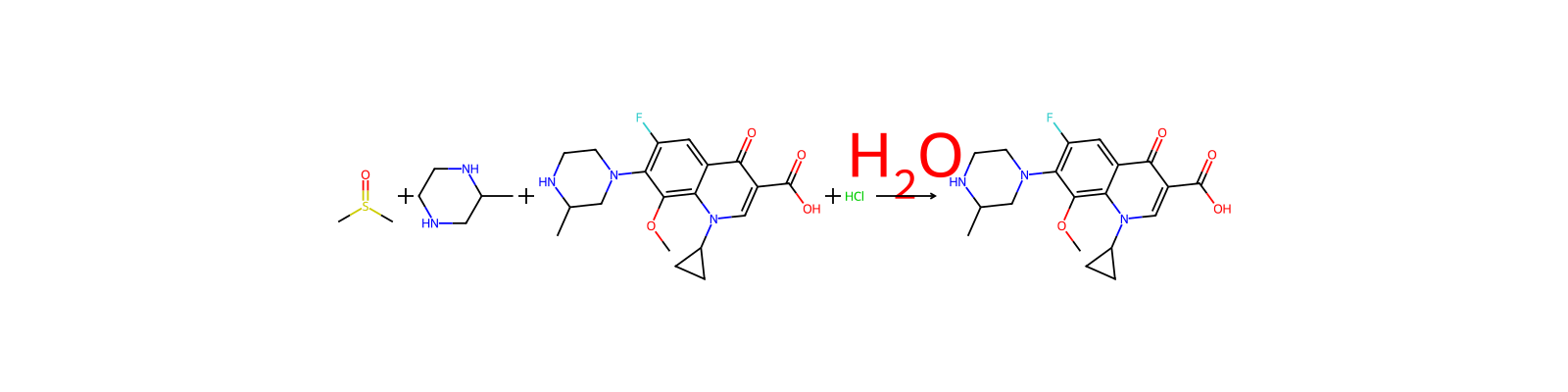
Gatifloxacin is a monocarboxylic acid that is 4-oxo-1,4-dihydroquinoline-3-carboxylic acid which is substituted on the nitrogen by a cyclopropyl group and at positions 6, 7, and 8 by fluoro, 3-methylpiperazin-1-yl, and methoxy groups, respectively. Gatifloxacin is an antibiotic of the fourth-generation fluoroquinolone family, that like other members of that family, inhibits the bacterial topoisomerase type-II enzymes. It has a role as an antimicrobial agent, an antiinfective agent and an EC 5.99.1.3 [DNA topoisomerase (ATP-hydrolysing)] inhibitor. It is a quinolone, a quinolinemonocarboxylic acid, an organofluorine compound, a N-arylpiperazine and a quinolone antibiotic.
Names & identifiers
- Preferred name
- Gatifloxacin
- IUPAC
- 1-cyclopropyl-6-fluoro-8-methoxy-7-(3-methylpiperazin-1-yl)-4-oxoquinoline-3-carboxylic acid
Names & synonyms
Gatifloxacin112811-59-3TequinGatifloZymarAM-1155GatifloxacineZymaxidZymergatifloxacin anhydrousAM 11553-Quinolinecarboxylic acid, 1-cyclopropyl-6-fluoro-1,4-dihydro-8-methoxy-7-(3-methyl-1-piperazinyl)-4-oxo-
Show more names
gatifloxacinoDTXSID50457041-Cyclopropyl-1,4-dihydro-6-fluoro-8-methoxy-7-(3-methyl-1-piperazinyl)-4-oxo-3-quinolinecarboxylic acidgatifloxacinumPD-1354321-cyclopropyl-6-fluoro-8-methoxy-7-(3-methylpiperazin-1-yl)-4-oxoquinoline-3-carboxylic acidNSC-758701CHEBI:5280
Database identifiers
- CAS
112811-59-3- PubChem CID
- 5379
- DTXSID
DTXSID5045704- ChEMBL
CHEMBL31- ChEBI
CHEBI:5280- UNII
- 81485Y3A9A
- EC Number
- 664-293-2
- Nikkaji
- J523.172H
Properties
Computed structural propertiesFilling in
- XLogP
- -0.7
- Topological polar surface area
- 82.1 Ų
- Hydrogen bond donors
- 2
- Hydrogen bond acceptors
- 8
- Rotatable bonds
- 4
- Heavy atoms
- 27
- Formal charge
- 0
- Complexity
- 653
Experimental & physicochemical properties
Drugs
Pharmaceuticals -> Antibiotics
Pharmaceuticals -> Anti infectives for systemic use -> Antibacterials for systemic use
LogP2.6
Solubility6.31e-01 g/L
Human Drugs
Breast Feeding; Lactation; Milk, Human; Anti-Infective Agents; Antibacterial Agents; Quinolones; Fluoroquinolones
FDA approved drugs -> Active ingredient
FDA approved drugs -> Active ingredient
Melting Point
182-185 °C
182 - 185 °C
Physical DescriptionSolid
Dissociation Constants
8.74
6
6
9.4
Collision Cross Section
189.5 Ų [M+H]+ [CCS Type: TW; Method: calibrated with polyalanine and drug standards]
189.03 Ų [M+H]+ [CCS Type: TW; Method: calibrated with polyalanine and drug standards]
Safety & regulation
GHS classification
GHS Classification
Warning
H302 (97.5%): Harmful if swallowed [Warning Acute toxicity, oral]
P261, P264, P270, P271, P280, P301+P317, P302+P352, P304+P340, P317, P321, P330, P362+P364, and P501 (click each P-code to see the statement)
Aggregated GHS information provided per 40 reports by companies from 3 notifications to the ECHA C&L Inventory. Each notification may be associated with multiple companies.
Hazard information
Hazard Classes and CategoriesAcute Tox. 4 (97.5%)
Toxicology
Treatment
In the event of acute oral overdose, the stomach should be emptied by inducing vomiting or by gastric lavage. The patient should be carefully observed (including ECG monitoring) and given symptomatic and supportive treatment. Adequate hydration should be maintained. (L1712)
Health EffectsAntibiotic resistance
Exposure RoutesOphthalmic. Well absorbed from the gastrointestinal tract after oral administration with absolute bioavailability of gatifloxacin is 96%
Toxicity SummaryThe bactericidal action of Gatifloxacin results from inhibition of the enzymes topoisomerase II (DNA gyrase) and topoisomerase IV, which are required for bacterial DNA replication, transcription, repair, and recombination.
Signs and SymptomsThe most common side effects from antibiotics are diarrhea, nausea, vomiting. Fungal infections of the mouth, digestive tract and vagina can also occur with antibiotics
Carcinogen ClassificationNo indication of carcinogenicity to humans (not listed by IARC).
Effects During Pregnancy and Lactation◉ Summary of Use during Lactation
Chemistry & industry
Pharmacology
ATC Code
S - Sensory organs
J - Antiinfectives for systemic use
QS - Sensory organs
QJ - Antiinfectives for systemic use
Protein Binding20%
Pharmacodynamics
Gatifloxacin is a synthetic broad-spectrum 8-methoxyfluoroquinolone antibacterial agent for oral or intravenous administration. is bactericidal and its mode of action depends on blocking of bacterial DNA replication by binding itself to an enzyme called DNA gyrase, which allows the untwisting required to replicate one DNA double helix into two. Notably the drug has 100 times higher affinity for bacterial DNA gyrase than for mammalian. Gatifloxacin is a broad-spectrum antibiotic that is active against both Gram-positive and Gram-negative bacteria. It should be used only to treat or prevent infections that are proven or strongly suspected to be caused by bacteria.
Mechanism of ActionThe bactericidal action of Gatifloxacin results from inhibition of the enzymes topoisomerase II (DNA gyrase) and topoisomerase IV, which are required for bacterial DNA replication, transcription, repair, and recombination.
Biological Half-Life7-14 hours
Metabolism/Metabolites
Gatifloxacin undergoes limited biotransformation in humans with less than 1% of the dose excreted in the urine as ethylenediamine and methylethylenediamine metabolites
Gatifloxacin undergoes limited biotransformation in humans with less than 1% of the dose excreted in the urine as ethylenediamine and methylethylenediamine metabolites Half Life: 7-14 hours
FDA Pharmacological Classification
81485Y3A9A
GATIFLOXACIN ANHYDROUS
Established Pharmacologic Class [EPC] - Quinolone Antimicrobial
Chemical Structure [CS] - Quinolones
Gatifloxacin anhydrous is a Quinolone Antimicrobial.
GATIFLOXACIN
MeSH Pharmacological Classification
Sterile solutions that are intended for instillation into the eye. It does not include solutions for cleaning eyeglasses or CONTACT LENS SOLUTIONS.
Substances that inhibit the growth or reproduction of BACTERIA.
Compounds that inhibit the activity of DNA TOPOISOMERASE II. Included in this category are a variety of ANTINEOPLASTIC AGENTS which target the eukaryotic form of topoisomerase II and ANTIBACTERIAL AGENTS which target the prokaryotic form of topoisomerase II.
Absorption, Distribution and ExcretionWell absorbed from the gastrointestinal tract after oral administration with absolute bioavailability of gatifloxacin is 96%
Cellular LocationsCytoplasm
Uses & manufacturing
Uses
Use (kg) in USA (2002): 7250
For the treatment of bronchitis, sinusitis, community-acquired pneumonia, and skin infections (abscesses, wounds) caused by S. pneumoniae, H. influenzae, S. aureus, M. pneumoniae, C. pneumoniae, L. pneumophila, S. pyogenes
Related reactions
29 records


Compound notes
Loading…