
HRID 191648As reactant
Completing data — refresh the page later to see the latest
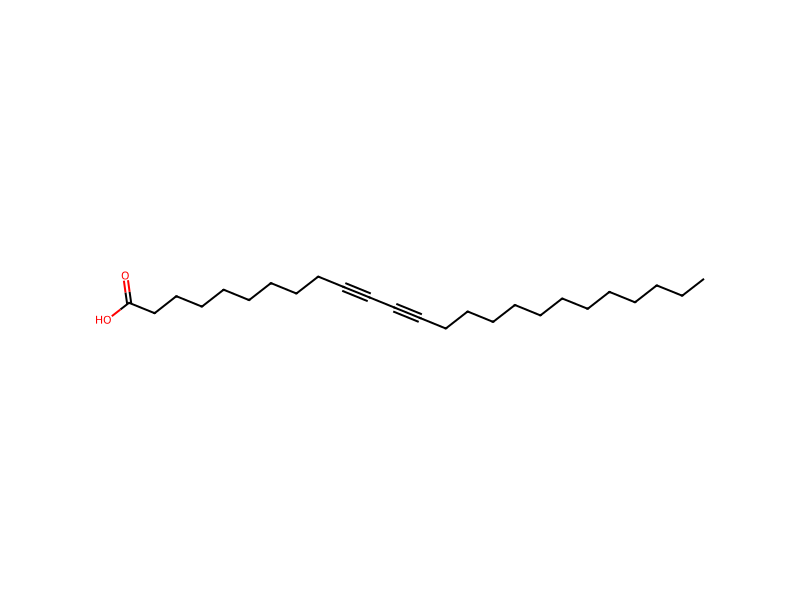
66990-32-7CCCCCCCCCCCCC#CC#CCCCCCCCCC(=O)OZPUDRBWHCWYMQS-UHFFFAOYSA-Nstructure in first source
66990-32-7DTXSID20337082Safety information is for reference only and does not replace the supplier’s Safety Data Sheet (SDS), applicable regulations, or professional assessment.
This chemical does not meet GHS hazard criteria for 1.1% (1 of 88) of reports.
Warning
H315 (98.9%): Causes skin irritation [Warning Skin corrosion/irritation]
P261, P264, P264+P265, P271, P280, P302+P352, P304+P340, P305+P351+P338, P319, P321, P332+P317, P337+P317, P362+P364, P403+P233, P405, and P501 (click each P-code to see the statement)
Aggregated GHS information provided per 88 reports by companies from 5 notifications to the ECHA C&L Inventory. Each notification may be associated with multiple companies.
Uses10,12-Pentacosadiynoic Acid is used in the preparation of colorimetric and fluorescence sensors for cationic surfactants.
Uses10,12-Pentacosadiynoic acid (PCDA) is an amphiphilic diacetylene that can be used:In combination with a semifluorinated tetracosane ((CF3(CF2)7(CH2)15CH3) to synthesize mixed monolayer by photopolymerization.For the conversion of hydrophobic upconverting nanoparticles (UCNPs) to hydrophilic.To synthesize a polymer by combining with pyridine-2-aldoxime for colorimetric detection of malathion.To synthesize a thermochromic sensor constituting polymer fibres with monomeric unit of two PCDA linked by a p-phenylene group (bis-PCDA-Ph).As an inert coating material upon self-assembly and photopolymerization to modify the surface of Fe3O4 nanoparticles.


